
SLIDE 1
Lecture 27/Chapters 22 & 23
Hypothesis Tests for Means
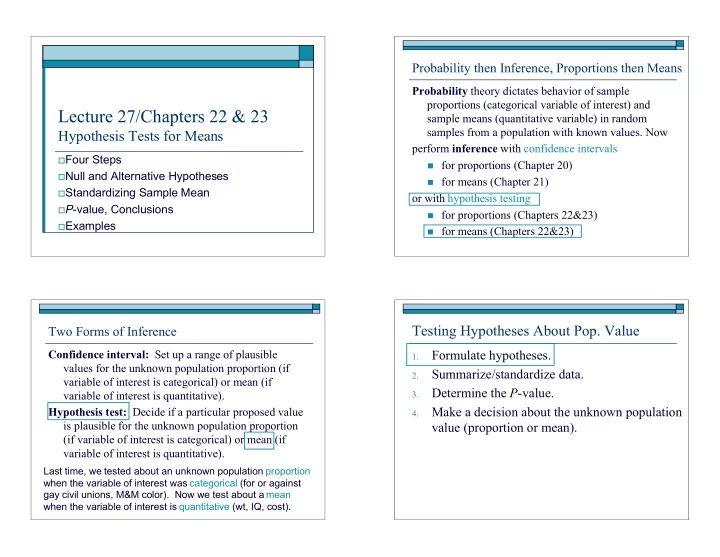
Four Steps Null and Alternative Hypotheses Standardizing Sample Mean P-value, Conclusions Examples
Probability then Inference, Proportions then Means
Probability theory dictates behavior of sample proportions (categorical variable of interest) and sample means (quantitative variable) in random samples from a population with known values. Now perform inference with confidence intervals
for proportions (Chapter 20) for means (Chapter 21)
- r with hypothesis testing
for proportions (Chapters 22&23) for means (Chapters 22&23)
Two Forms of Inference
Confidence interval: Set up a range of plausible values for the unknown population proportion (if variable of interest is categorical) or mean (if variable of interest is quantitative). Hypothesis test: Decide if a particular proposed value is plausible for the unknown population proportion (if variable of interest is categorical) or mean (if variable of interest is quantitative).
Last time, we tested about an unknown population proportion when the variable of interest was categorical (for or against gay civil unions, M&M color). Now we test about a mean when the variable of interest is quantitative (wt, IQ, cost).
Testing Hypotheses About Pop. Value
1.
Formulate hypotheses.
2.
Summarize/standardize data.
3.
Determine the P-value.
4.