Lecture 2: Introduction to Crossed Products and More 1129 July 2016 - - PowerPoint PPT Presentation

lecture 2 introduction to crossed products and more
SMART_READER_LITE
LIVE PREVIEW

Lecture 2: Introduction to Crossed Products and More 1129 July 2016 - - PowerPoint PPT Presentation

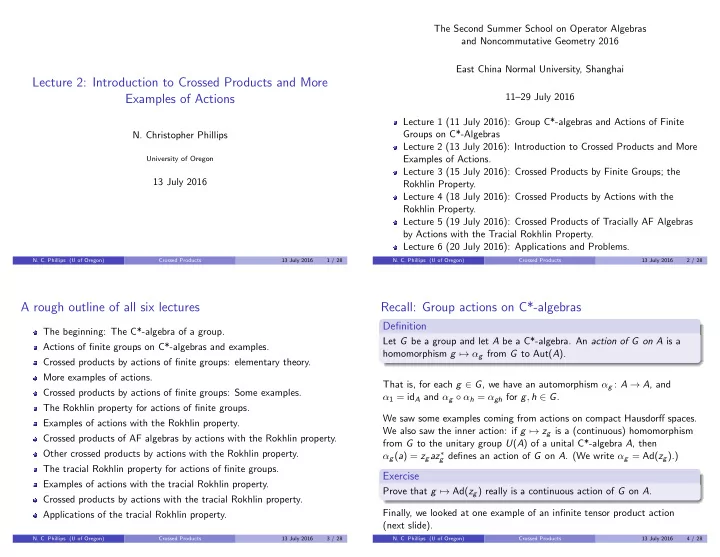
The Second Summer School on Operator Algebras and Noncommutative Geometry 2016 East China Normal University, Shanghai Lecture 2: Introduction to Crossed Products and More 1129 July 2016 Examples of Actions Lecture 1 (11 July 2016): Group


slide-1
SLIDE 1

Lecture 2: Introduction to Crossed Products and More Examples of Actions

  • N. Christopher Phillips

University of Oregon

13 July 2016

  • N. C. Phillips (U of Oregon)

Crossed Products 13 July 2016 1 / 28

The Second Summer School on Operator Algebras and Noncommutative Geometry 2016 East China Normal University, Shanghai 11–29 July 2016 Lecture 1 (11 July 2016): Group C*-algebras and Actions of Finite Groups on C*-Algebras Lecture 2 (13 July 2016): Introduction to Crossed Products and More Examples of Actions. Lecture 3 (15 July 2016): Crossed Products by Finite Groups; the Rokhlin Property. Lecture 4 (18 July 2016): Crossed Products by Actions with the Rokhlin Property. Lecture 5 (19 July 2016): Crossed Products of Tracially AF Algebras by Actions with the Tracial Rokhlin Property. Lecture 6 (20 July 2016): Applications and Problems.

  • N. C. Phillips (U of Oregon)

Crossed Products 13 July 2016 2 / 28

A rough outline of all six lectures

The beginning: The C*-algebra of a group. Actions of finite groups on C*-algebras and examples. Crossed products by actions of finite groups: elementary theory. More examples of actions. Crossed products by actions of finite groups: Some examples. The Rokhlin property for actions of finite groups. Examples of actions with the Rokhlin property. Crossed products of AF algebras by actions with the Rokhlin property. Other crossed products by actions with the Rokhlin property. The tracial Rokhlin property for actions of finite groups. Examples of actions with the tracial Rokhlin property. Crossed products by actions with the tracial Rokhlin property. Applications of the tracial Rokhlin property.

  • N. C. Phillips (U of Oregon)

Crossed Products 13 July 2016 3 / 28

Recall: Group actions on C*-algebras

Definition

Let G be a group and let A be a C*-algebra. An action of G on A is a homomorphism g → αg from G to Aut(A). That is, for each g ∈ G, we have an automorphism αg : A → A, and α1 = idA and αg ◦ αh = αgh for g, h ∈ G. We saw some examples coming from actions on compact Hausdorff spaces. We also saw the inner action: if g → zg is a (continuous) homomorphism from G to the unitary group U(A) of a unital C*-algebra A, then αg(a) = zgaz∗

g defines an action of G on A. (We write αg = Ad(zg).)

Exercise

Prove that g → Ad(zg) really is a continuous action of G on A. Finally, we looked at one example of an infinite tensor product action (next slide).

  • N. C. Phillips (U of Oregon)

Crossed Products 13 July 2016 4 / 28

slide-2
SLIDE 2

An infinite tensor product action

Let An = (M2)⊗n, the tensor product of n copies of the algebra M2 of 2 × 2 matrices. Thus An ∼ = M2n. Define ϕn : An → An+1 = An ⊗ M2 by ϕn(a) = a ⊗ 1. Let A be the (completed) direct limit lim − →n An. (This is just the 2∞ UHF algebra.) Define a unitary v ∈ M2 by v = 1 −1

  • .

Define zn ∈ An by zn = v⊗n. Define αn ∈ Aut(An) by αn = Ad(zn), that is, αn(a) = znaz∗

n for a ∈ A. Then αn is an inner automorphism of order 2.

Using zn+1 = zn ⊗ v, one can easily check that ϕn ◦ αn = αn+1 ◦ ϕn for all n (diagram on next slide). and it follows that the αn determine an

  • rder 2 automorphism α of A. Thus, we have an action of Z2 on A.

Exercise: Prove that ϕn ◦ αn = αn+1 ◦ ϕn.

  • N. C. Phillips (U of Oregon)

Crossed Products 13 July 2016 5 / 28

Infinite tensor product action example (continued)

Recall: An = (M2)⊗n ∼ = M2n. ϕn : An → An+1 = An ⊗ M2 is ϕn(a) = a ⊗ 1, and A = lim − →n An. v = 1 0

0 −1

  • ∈ U(M2), and zn = v⊗n ∈ U(An).

αn ∈ Aut(An) is αn = Ad(zn). Commutative diagram to define the order 2 automorphism α ∈ Aut(A): C

ϕ0

− − − − → M2

ϕ1

− − − − → M4

ϕ2

− − − − → M8

ϕ3

− − − − → · · · − − − − → A   α0   α1   α2   α3   α C

ϕ0

− − − − → M2

ϕ1

− − − − → M4

ϕ2

− − − − → M8

ϕ3

− − − − → · · · − − − − → A The action of Z2 is not inner (see later), although it is “approximately inner” (that is, a pointwise limit of inner actions).

  • N. C. Phillips (U of Oregon)

Crossed Products 13 July 2016 6 / 28

General infinite tensor product actions

We had A = lim − →n(M2)⊗n with the action of Z2 generated by the direct limit automorphism lim − →

n

Ad 1 −1 ⊗n We write this automorphism as

  • n=1

Ad 1 −1

  • n

A =

  • n=1

M2. In general, one can use an arbitrary group, one need not choose the same unitary representation in each tensor factor (indeed, the actions on the factors need not even be inner), and the tensor factors need not all be the same size (indeed, they can be arbitrary unital C*-algebras, provided one is careful with tensor products). If all the factors are finite dimensional matrix algebras (not necessarily of the same size) and the action in each factor is inner, the action is frequently called a “product type action”.

  • N. C. Phillips (U of Oregon)

Crossed Products 13 July 2016 7 / 28

More examples of product type actions

We will later use the following two additional examples:

  • n=1

Ad   1 1 −1  

  • n

A =

  • n=1

M3, and

  • n=1

Ad

  • diag(−1, 1, 1, . . . , 1)
  • n

A =

  • n=1

M2n+1. In the second one, there are supposed to be 2n ones on the diagonal, giving a (2n + 1) × (2n + 1) matrix.

  • N. C. Phillips (U of Oregon)

Crossed Products 13 July 2016 8 / 28

slide-3
SLIDE 3

The tensor product of copies of conjugation by the regular representation

Let G be a finite group. Set m = card(G). Let G act on the Hilbert space l2(G) ∼ = Cm via the left regular representation. That is, if g ∈ G, then g acts on l2(G) by the unitary operator (zgξ)(h) = ξ(g−1h) for ξ ∈ l2(G) and h ∈ G. Now let G act on Mm ∼ = L(l2(G)) by conjugation by the left regular representation: g → Ad(zg). Then take A = lim − →n(Mm)⊗n (which is the m∞ UHF algebra), with the action of G given by g →

  • n=1

Ad(zg). The first example we gave of a product type action is the case G = Z2. The left regular representation of Z2 is generated by 1 1

  • rather than

1 −1

  • ,

but these two matrices are unitarily equivalent. Using this, one can show (see later) that the two product type actions are “essentially the same”.

  • N. C. Phillips (U of Oregon)

Crossed Products 13 July 2016 9 / 28

Crossed products

Let G be a locally compact group, and let α: G → Aut(A) be an action of G on a C*-algebra A. There is a crossed product C*-algebra C ∗(G, A, α), which is a kind of generalization of the group C*-algebra C ∗(G). Crossed products are quite important in the theory of C*-algebras. One motivation (mentioned already): Suppose G is a semidirect product N ⋊ H. The action of H on N gives an action α: H → Aut(C ∗(N)), and

  • ne has C ∗(G) ∼

= C ∗(H, C ∗(N), α). (Exercise: Prove this when H and N are finite.) Thus, crossed products appear even if one is only interested in group C*-algebras and unitary representations of groups. Another motivation (not applicable to finite groups acting on spaces): The noncommutative version of X/G is the fixed point algebra AG. In particular, for compact G, one can check that C(X/G) ∼ = C(X)G. For noncompact groups, often X/G is very far from Hausdorff and AG is far too small. The crossed product provides a much more generally useful algebra, which is the “right” substitute for the fixed point algebra when the action is free.

  • N. C. Phillips (U of Oregon)

Crossed Products 13 July 2016 10 / 28

The universal property of the crossed product

Recall the group case. If G is a discrete group, then multiplication in C[G] is (a · ug)(b · uh) = (ab) · ugh, and adjoint is (a · ug)∗ = aug−1. If w is a unitary representation of G on H, the unital *-homomorphism πw : C[G] → L(H) is πw

  • g∈G ag · ug
  • =

g∈G ag · wg.

Theorem

The assignment w → πw is a bijection from unitary representations of G

  • n H to unital *-homomorphisms C[G] → L(H).

Unitary representations are replaced as follows:

Definition

Let α: G → Aut(A) be an action of a topological group G on a C*-algebra A. A covariant representation of (G, A, α) on a Hilbert space H is a pair (v, σ) consisting of a unitary representation v : G → U(H) and a representation σ: A → L(H) satisfying the covariance condition vgσ(a)v∗

g = σ(αg(a))

for all g ∈ G and a ∈ A.

  • N. C. Phillips (U of Oregon)

Crossed Products 13 July 2016 11 / 28

The universal property of the crossed product (continued)

α: G → Aut(A) is an action of the group G on the C*-algebra A, v : G → U(H) is a unitary representation, and σ: A → L(H) is a *-homomorphism. (v, σ) is covariant if vgσ(a)v∗

g = σ(αg(a)) for all g ∈ G and a ∈ A.

Recall: πw

  • g∈G ag · ug
  • =

g∈G ag · wg, and w → πw is a bijection

from unitary representations to unital *-homomorphisms. To keep things simple, we state the crossed product version only in the unital case. We will define a crossed product C ∗(G, A, α) such that, for (v, σ) as above and with σ unital (in particular, A is unital), there is a unital *-homomorphism πv,σ : C ∗(G, A, α) → L(H), and (v, σ) → πv,σ is a bijection from covariant representations to unital *-homomorphisms.

  • N. C. Phillips (U of Oregon)

Crossed Products 13 July 2016 12 / 28

slide-4
SLIDE 4

Defining the crossed product

Assume G is finite. Recall: C[G] is all formal linear combinations

  • g∈G ag · ug with ag ∈ C for g ∈ G. Multiplication in C[G] is

(a · ug)(b · uh) = (ab) · ugh, and adjoint is (a · ug)∗ = aug−1. Now let α: G → Aut(A) be an action of a finite group G on a unital C*-algebra A. As a vector space, C ∗(G, A, α) is the group ring A[G], consisting of all formal linear combinations of elements in G with coefficients in A: A[G] =

g∈G

cg · ug : cg ∈ A for g ∈ G

  • .

The multiplication and adjoint are given by: (a · ug)(b · uh) = (a[ugbu−1

g ]) · uguh = (aαg(b)) · ugh

(a · ug)∗ = α−1

g (a∗) · ug−1

for a, b ∈ A and g, h ∈ G, extended linearly. There is a unique norm which makes this a C*-algebra. (See below.)

  • N. C. Phillips (U of Oregon)

Crossed Products 13 July 2016 13 / 28

Defining the crossed product (continued)

Recall: Multiplication in C[G] is (a · ug)(b · uh) = (ab) · ugh, and adjoint is (a · ug)∗ = aug−1. α: G → Aut(A) is an action of a finite group G on a unital C*-algebra A. Multiplication in A[G] is (a · ug)(b · uh) = (a[ugbu−1

g ]) · uguh = (aαg(b)) · ugh

and adjoint is (a · ug)∗ = α−1

g (a∗) · ug−1.

The definition of multiplication is based on the idea that conjugating b ∈ A by ug should implement the automorphism αg, just like in the definition of a covariant representation. The definition of the adjoint is what is forced by this idea and the requirement that the group elements be unitary: u∗

g = ug−1.

Exercise: Prove that these definitions make A[G] a *-algebra over C. (You don’t need A to be unital, and, provided you use only finite linear combinations in the definition of A[G], you don’t need G to be finite.)

  • N. C. Phillips (U of Oregon)

Crossed Products 13 July 2016 14 / 28

Defining the crossed product: the general discrete case

α: G → Aut(A) is an action of a discrete group G on a C*-algebra A. (Don’t assume G is finite, and don’t assume A is unital.) The skew group ring is A[G] =

g∈G

cg · ug : cg ∈ A, cg = 0 for all but finitely many g ∈ G

  • .

Multiplication in A[G] is (a · ug)(b · uh) = (a[ugbu−1

g ]) · uguh = (aαg(b)) · ugh

and adjoint is (a · ug)∗ = α−1

g (a∗) · ug−1.

Exercise: Prove that A[G] is a *-algebra over C. If G is discrete but not finite, C ∗(G, A, α) is the completion of A[G] in a suitable norm. (In general, there are several choices, but only one gives the right universal property.) General locally compact case: See the appendix.

  • N. C. Phillips (U of Oregon)

Crossed Products 13 July 2016 15 / 28

The universal property of the crossed product

Recall: If G is finite and w : G → U(H) is a unitary representation, then πw : C[G] → L(H) is πw

  • g∈G ag · ug
  • =

g∈G ag · wg. Moreover,

w → πw is a bijection from unitary representations to unital *-homomorphisms. Also recall: A[G] =

g∈G

cg · ug : cg ∈ A, cg = 0 for all but finitely many g ∈ G

  • .

Suppose v : G → U(H) and σ: A → L(H) are a covariant representation

  • f (G, A, α) on H. Then define πv,σ : A[G] → L(H) by

πv,σ

g∈G

cg · ug

  • =
  • g∈G

σ(ag) · vg. This is just the extension of a → σ(a) and ug → vg.

Theorem

For G finite and A unital, (v, σ) → σv,σ is a bijection from unital covariant representations of (G, A, α) on H to unital *-homomorphisms A[G] → L(H).

  • N. C. Phillips (U of Oregon)

Crossed Products 13 July 2016 16 / 28

slide-5
SLIDE 5

Theorem

For G finite and A unital, (v, σ) → πv,σ is a bijection from unital covariant representations of (G, A, α) on H to unital *-homomorphisms A[G] → L(H). Exercise: Prove this theorem. All the calculations are algebra; no analysis is needed. The key to the algebra is to compare the definition of the product in A[G] (recall that ugau∗

g = αg(a)) with the condition vgσ(a)v∗ g = σ(αg(a)) in the definition

  • f a covariant representation. To recover v from πv,σ, look at πv,σ(ug).

To recover σ(a), look at πv,σ(a · u1) = πv,σ(a). You don’t need G to be finite. Exercise: Keep G finite, but no longer assume that A is unital. Assume that you know A[G] is a C*-algebra. Prove the theorem with “unital *-homomorphisms” replaced by “nondegenerate representations”. (ρ: B → L(H) is nondegenerate if ρ(B)H = H.) Now you need some analysis: since ug ∈ A[G], you will need to use an approximate identity for A.

  • N. C. Phillips (U of Oregon)

Crossed Products 13 July 2016 17 / 28

The norm on A[G]

Let α: G → Aut(A) be an action of a finite group G on a C*-algebra A. We construct a C* norm on the skew group ring A[G]. Recall: (aug)(buh) = aαg(b)ugh and (aug)∗ = α−1

g (a∗)ug−1.

Fix a faithful representation σ0 : A → L(H0) of A on a Hilbert space H0. Set H = l2(G, H0), the set of all ξ = (ξg)g∈G in

g∈G H0, with the scalar

product

  • (ξg)g∈G, (ηg)g∈G
  • =
  • g∈G

ξg, ηg. (Exercise: Prove that H is a Hilbert space.) Then define σ: A[G] → L(H) as follows. For c =

g∈G cgug and h ∈ G,

(σ(c)ξ)h =

  • g∈G

σ0(α−1

h (cg))(ξg−1h)

Exercise: If A and σ0 are unital, find a representation v : G → U(H) and a unital representation σ: A → L(H) such that (v, σ) is covariant and π = πv,σ. (This is one way one is really supposed to construct a C* norm.)

  • N. C. Phillips (U of Oregon)

Crossed Products 13 July 2016 18 / 28

The norm on A[G] (continued)

Recall: (aug)(buh) = aαg(b)ugh and (aug)∗ = α−1

g (a∗)ug−1.

Also, for c =

g∈G cgug,

(π(c)ξ)h =

  • g∈G

σ0(α−1

h (cg))(ξg−1h).

If A is unital, then for a ∈ A and g ∈ G, identify a with au1 and get (π(a)ξ)h = σ0(αh−1(a))(ξh) and (π(ug)ξ)h = ξg−1h. (Use these formulas in the exercise on the previous slide.) One can check that π is a *-homomorphism. We will just check the most important part, which is that π(ug)π(b) = π(αg(b))π(ug). We have

  • π(αg(b))π(ug)ξ
  • h = σ0
  • αh−1(αg(b))
  • (π(ug)ξ)h = σ0(αh−1g(b))(ξg−1h)

and

  • π(ug)π(b)ξ
  • h =
  • π(b)ξ
  • g−1h = σ0
  • αh−1g(b)
  • ξ
  • g−1h.

Exercise: Give a complete proof that π is a *-homomorphism.

  • N. C. Phillips (U of Oregon)

Crossed Products 13 July 2016 19 / 28

The norm on A[G] (continued)

Recall: for c =

g∈G cgug,

(π(c)ξ)h =

  • g∈G

σ0(α−1

h (cg))(ξg−1h).

If A is unital, then for a ∈ A and g ∈ G, (π(a)ξ)h = σ0(αh−1(a))(ξh) and (π(ug)ξ)h = ξg−1h. For c =

g∈G cgug, it is easy to check that

π(c) ≤

  • g∈G

cg and not much harder to check that π(c) ≥ max

g∈G cg.

Exercise: Prove these two inequalities. (The second requires looking at what π(c) does to suitable elements in H. It is related to a ≥ maxj,k |aj,k| for a matrix a = (aj,k)j,k=1,2,...,n.) The norms on the right hand sides are equivalent, so A[G] is complete in the norm c = π(c).

  • N. C. Phillips (U of Oregon)

Crossed Products 13 July 2016 20 / 28

slide-6
SLIDE 6

More examples of group actions on spaces

Recall: Every action of a group G on a compact space X gives an action

  • f G on C(X).

Let Z be a compact manifold, or a connected finite complex. (Much weaker conditions on Z suffice, but Z must be path connected.) Let X = Z be the universal cover of Z, and let G = π1(Z) be the fundamental group of Z. Then there is a standard action of G on X. Spaces with finite fundamental groups include real projective spaces (in which case this example was already on the first slide of examples) and lens spaces. The group SL2(Z) acts on R2 via the usual matrix multiplication. This action preserves Z2, and so is well defined on R2/Z2 ∼ = S1 × S1. SL2(Z) has finite cyclic subgroups of orders 2, 3, 4, and 6, generated by −1 −1

  • ,

−1 −1 1

  • ,

−1 1

  • ,

and −1 1 1

  • .

Restriction gives actions of these on S1 × S1.

  • N. C. Phillips (U of Oregon)

Crossed Products 13 July 2016 21 / 28

The rotation algebras

Let θ ∈ R. Recall the irrational rotation algebra Aθ, the universal C*-algebra generated by two unitaries u and v satisfying the commutation relation vu = e2πiθuv. If θ1 − θ2 ∈ Z, then Aθ1 = Aθ2. (The commutation relation is the same.) Some standard facts, presented without proof: If θ ∈ Q, then Aθ is simple. In particular, any two unitaries u and v in any C*-algebra satisfying vu = e2πiθuv generate a copy of Aθ. If θ ∈ Q, then Aθ is Type I. In fact, if θ = m

n in lowest terms, with

n > 0, then Aθ is isomorphic to the section algebra of a locally trivial continuous field over S1 × S1 with fiber Mn. In particular, if θ = 0, or if θ ∈ Z, then Aθ ∼ = C(S1 × S1). Aθ is the crossed product of the action of Z on S1 generated by rotation by e2πiθ. There is a “natural” continuous field over S1 whose fiber over e2πiθ is Aθ. (Obviously it isn’t locally trivial.) The algebra Aθ is often considered to be a noncommutative analog of the torus S1 × S1 (more accurately, a noncommutative analog of C(S1 × S1)).

  • N. C. Phillips (U of Oregon)

Crossed Products 13 July 2016 22 / 28

The gauge action on the rotation algebra

Recall: Aθ is the universal C*-algebra generated by two unitaries u and v satisfying the commutation relation vu = e2πiθuv. There is a unique action γ : S1 × S1 → Aut(Aθ) such that γ(λ,ζ)(u) = λu and γ(λ,ζ)(v) = ζv for λ, ζ ∈ S1. This essentially follows from the fact that λu and ζv satisfy the same commutation relation that u and v do. One must also check that (λ, ζ) → γ(λ,ζ) is a group homomorphism. (A bit of work is required to show that (λ, ζ) → γ(λ,ζ)(a) is continuous for all a ∈ Aθ. Exercise: Do

  • it. Hint: Show that it is true for a in the linear span of all umvn, and then

use an ε

3 argument.)

In particular, there are actions of Zn on Aθ generated by the automorphism u → e2πi/nu and v → v and by the automorphism u → u and v → e2πi/nv.

  • N. C. Phillips (U of Oregon)

Crossed Products 13 July 2016 23 / 28

Appendix: The C*-algebra of a locally compact group, etc.

Let G be a locally compact group. We recall that nondegenerate representations of the group C*-algebra C ∗(G) on a Hilbert space H are in

  • ne to one correspondence with the unitary representations of G on H.

To construct C ∗(G), one starts with L1(G) (using left Haar measure µ) with convolution multiplication: (a ∗ b)(g) =

  • G

a(h)b(h−1g) dµ(h). (We omit the formula for the adjoint.) If G is discrete and δg ∈ l1(G) is the standard basis vector corresponding to g ∈ G, this amounts to declaring that δg ∗ δh = δgh and δ∗

g = δg−1. A unitary representation

g → vg of G on a Hilbert space H gives a nondegenerate *-representation π of L1(G) on H via the formula π(a)ξ =

  • G

a(g)vgξ dµ(g). (One must check many things about this formula.) If G is discrete, this is just π(a) =

g∈G a(g)vg, and in particular π(δg) = vg.

  • N. C. Phillips (U of Oregon)

Crossed Products 13 July 2016 24 / 28

slide-7
SLIDE 7

The group C*-algebra

For a locally compact group G and a unitary representation v of G on H, we set π(a)ξ =

  • G

a(g)vgξ dµ(g) for a ∈ L1(G) and ξ ∈ H. If G is discrete, this is just π(a) =

g∈G a(g)vg, and in particular π(δg) = vg.

Getting v from π is easy if G is discrete, since vg = π(δg). In general, one must do some work with multiplier algebras; we omit the details. We must still get a C*-algebra. To do this, define a C* norm on L1(G) by taking a to be the supremum of π(a) over all nondegerarate *-representations π of L1(G) on Hilbert spaces. Then complete in this norm. If G is finite, this simplifies greatly. The sums π(a) =

g∈G a(g)vg are

finite sums and no completion is necessary (because L1(G) is finite dimensional). One only needs to find the C* norm. (It is equivalent to the L1 norm, but not equal to it.)

  • N. C. Phillips (U of Oregon)

Crossed Products 13 July 2016 25 / 28

The universal property of the crossed product

The crossed product C ∗(G, A, α) (for G locally compact) is defined in such a way as to have a universal property which generalizes the universal property of the group C*-algebra C ∗(G). We give the statements for the general case.

Definition

Let α: G → Aut(A) be an action of a locally compact group G on a C*-algebra A. A covariant representation of (G, A, α) on a Hilbert space H is a pair (v, σ) consisting of a unitary representation v : G → U(H) (the unitary group of H) and a representation σ: A → L(H) (the algebra of all bounded operators on H), satisfying the covariance condition vgσ(a)v∗

g = σ(αg(a))

for all g ∈ G and a ∈ A. It is called nondegenerate if σ is nondegenerate.

  • N. C. Phillips (U of Oregon)

Crossed Products 13 July 2016 26 / 28

A dense subalgebra of the crossed product

The skew group ring A[G], used when G is discrete, is replaced by Cc(G, A, α), with product (using a left Haar measure µ on G and Banach space valued integration) (ab)(g) =

  • G

a(h)b(h−1g) dµ(h) and (using the modular function ∆ of G) adjoint a∗(g) = ∆(g)−1αg(a(g−1)∗). One can define a (non C*) norm by a1 =

  • G

a(g) dµ(g). The completion is called L1(G, A, α). (One can also define L1(G, A, α) directly, using a more general version of Banach space valued integration.) Exercise: Prove that Cc(G, A, α) is a normed *-algebra. C ∗(G, A, α) is the completion of Cc(G, A, α) (or L1(G, A, α)) in a suitable C* norm. (It is the universal enveloping C*-algebra of L1(G, A, α).)

  • N. C. Phillips (U of Oregon)

Crossed Products 13 July 2016 27 / 28

The universal property of the crossed product (continued)

Definition

Let α: G → Aut(A) be an action of a locally compact group G on a C*-algebra A, and let (v, σ) be a covariant representation of (G, A, α) on a Hilbert space H. Then the integrated form of (v, σ) is the representation π: Cc(G, A, α) → L(H) given by π(a)ξ =

  • G

σ(a(g))vgξ dµ(g). C ∗(G, A, α) is then a completion of Cc(G, A, α), chosen to give:

Theorem

Let α: G → Aut(A) be an action of a locally compact group G on a C*-algebra A. Then the integrated form construction defines a bijection from the set of nondegenerate covariant representations of (G, A, α) on a Hilbert space H to the set of nondegenerate representations of C ∗(G, A, α) on the same Hilbert space.

  • N. C. Phillips (U of Oregon)

Crossed Products 13 July 2016 28 / 28