Lecture 2: Crossed Products by Finite Groups; the Rokhlin Property - - PowerPoint PPT Presentation

lecture 2 crossed products by finite groups the rokhlin
SMART_READER_LITE
LIVE PREVIEW

Lecture 2: Crossed Products by Finite Groups; the Rokhlin Property - - PowerPoint PPT Presentation

2014 Summer School for Operator Algebras East China Normal University, Shanghai Lecture 2: Crossed Products by Finite Groups; the Rokhlin Property 2631 July 2014 N. Christopher Phillips Lecture 1 (26 July 2014): Actions of Finite Groups on


slide-1
SLIDE 1

Lecture 2: Crossed Products by Finite Groups; the Rokhlin Property

  • N. Christopher Phillips

University of Oregon

27 July 2014

  • N. C. Phillips (U of Oregon)

Crossed Products; the Rokhlin Property 27 July 2014 1 / 29

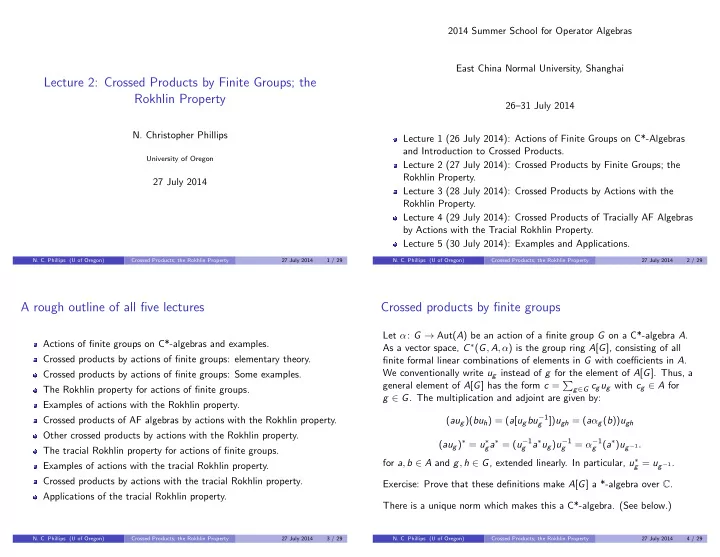
2014 Summer School for Operator Algebras East China Normal University, Shanghai 26–31 July 2014 Lecture 1 (26 July 2014): Actions of Finite Groups on C*-Algebras and Introduction to Crossed Products. Lecture 2 (27 July 2014): Crossed Products by Finite Groups; the Rokhlin Property. Lecture 3 (28 July 2014): Crossed Products by Actions with the Rokhlin Property. Lecture 4 (29 July 2014): Crossed Products of Tracially AF Algebras by Actions with the Tracial Rokhlin Property. Lecture 5 (30 July 2014): Examples and Applications.

  • N. C. Phillips (U of Oregon)

Crossed Products; the Rokhlin Property 27 July 2014 2 / 29

A rough outline of all five lectures

Actions of finite groups on C*-algebras and examples. Crossed products by actions of finite groups: elementary theory. Crossed products by actions of finite groups: Some examples. The Rokhlin property for actions of finite groups. Examples of actions with the Rokhlin property. Crossed products of AF algebras by actions with the Rokhlin property. Other crossed products by actions with the Rokhlin property. The tracial Rokhlin property for actions of finite groups. Examples of actions with the tracial Rokhlin property. Crossed products by actions with the tracial Rokhlin property. Applications of the tracial Rokhlin property.

  • N. C. Phillips (U of Oregon)

Crossed Products; the Rokhlin Property 27 July 2014 3 / 29

Crossed products by finite groups

Let α: G → Aut(A) be an action of a finite group G on a C*-algebra A. As a vector space, C ∗(G, A, α) is the group ring A[G], consisting of all finite formal linear combinations of elements in G with coefficients in A. We conventionally write ug instead of g for the element of A[G]. Thus, a general element of A[G] has the form c =

g∈G cgug with cg ∈ A for

g ∈ G. The multiplication and adjoint are given by: (aug)(buh) = (a[ugbu−1

g ])ugh = (aαg(b))ugh

(aug)∗ = u∗

ga∗ = (u−1 g a∗ug)u−1 g

= α−1

g (a∗)ug−1.

for a, b ∈ A and g, h ∈ G, extended linearly. In particular, u∗

g = ug−1.

Exercise: Prove that these definitions make A[G] a *-algebra over C. There is a unique norm which makes this a C*-algebra. (See below.)

  • N. C. Phillips (U of Oregon)

Crossed Products; the Rokhlin Property 27 July 2014 4 / 29

slide-2
SLIDE 2

Crossed products by finite groups (continued)

Let α: G → Aut(A) be an action of a finite group G on a C*-algebra A. To keep as elementary as possible, assume that A is unital. We construct a C* norm on the skew group ring A[G]. Recall: (aug)(buh) = (aαg(b))ugh and (aug)∗ = α−1

g (a∗)ug−1.

Fix a unital faithful representation π: A → L(H0) of A on a Hilbert space H0. Set H = l2(G, H0), the set of all ξ = (ξg)g∈G in

g∈G H0,

with the scalar product

  • (ξg)g∈G, (ηg)g∈G
  • =
  • g∈G

ξg, ηg. Then define σ: A[G] → L(H) as follows. For c =

g∈G cgug,

(σ(c)ξ)h =

  • g∈G

π(α−1

h (cg))(ξg−1h)

for all h ∈ G. (Some explanation is on the next slide.)

  • N. C. Phillips (U of Oregon)

Crossed Products; the Rokhlin Property 27 July 2014 5 / 29

Crossed products by finite groups (continued)

Recall: (aug)(buh) = aαg(b)ugh and (aug)∗ = α−1

g (a∗)ug−1.

Also, for c =

g∈G cgug,

(σ(c)ξ)h =

  • g∈G

π(α−1

h (cg))(ξg−1h).

For a ∈ A and g ∈ G, identify a with au1 and get (σ(a)ξ)h = π(αh−1(a))(ξh) and (σ(ug)ξ)h = ξg−1h. One can check that σ is a *-homomorphism. We will just check the most important part, which is that σ(ug)σ(b) = σ(αg(b))σ(ug). We have

  • σ(αg(b))σ(ug)ξ
  • h = π
  • αh−1(αg(b))
  • (σ(ug)ξ)h = π(αh−1g(b))(ξg−1h)

and

  • σ(ug)σ(b)ξ
  • h =
  • σ(b)ξ
  • g−1h = π
  • αh−1g(b)
  • ξ
  • g−1h.

Exercise: Prove in detail that σ, as defined above, is a *-homomorphism.

  • N. C. Phillips (U of Oregon)

Crossed Products; the Rokhlin Property 27 July 2014 6 / 29

Crossed products by finite groups (continued)

Recall: π: A → L(H0) is an isometric representation of A, H =

g∈G H0,

and σ: A[G] → L(H) is given, for c =

g∈G cgug ∈ A[G] and

ξ = (ξg)g∈G ∈ H, by (σ(c)ξ)h =

  • g∈G

π(α−1

h (cg))(ξg−1h).

It is easy to check that σ(c) ≤

  • g∈G

cg. Exercise: Prove this. Exercise: Prove that σ(c) ≥ maxg∈G cg. Hint: Look at σ(c)ξ for ξ in just one of the summands of H0 in H, that is, ξk = 0 for all but one k ∈ G. The norms on the right hand sides are equivalent, so A[G] is complete in the norm c = σ(c).

  • N. C. Phillips (U of Oregon)

Crossed Products; the Rokhlin Property 27 July 2014 7 / 29

Crossed products by finite groups (continued)

We are still considering an action α: G → Aut(A) of a finite group G on a C*-algebra A. We started with a faithful representation π: A → L(H0) of A on a Hilbert space H0. Then we constructed a representation σ: A[G] → L(l2(G, H0)), given, for c =

g∈G cgug ∈ A[G] and ξ = (ξg)g∈G ∈ H, by

(σ(c)ξ)h =

  • g∈G

π(α−1

h (cg))(ξg−1h).

We found that A[G] is complete in the norm c = σ(c). By standard theory, the norm c = σ(c) is therefore the only norm in which A[G] is a C*-algebra. In particular, it does not depend on the choice of π. We return to the notation C ∗(G, A, α) for the crossed product. Things are more complicated if G is discrete but not finite. (In particular, there may be more than one reasonable norm—since A[G] isn’t complete, this is not ruled out.) The situation is even more complicated if G is merely locally compact.

  • N. C. Phillips (U of Oregon)

Crossed Products; the Rokhlin Property 27 July 2014 8 / 29

slide-3
SLIDE 3

Universal property of crossed products by finite groups

Crossed products are supposed to have the following property:

Theorem

Let α: G → Aut(A) be an action of a locally compact group G on a C*-algebra A. Then the integrated form construction defines a bijection from the set of nondegenerate covariant representations of (G, A, α) on a Hilbert space H to the set of nondegenerate representations of C ∗(G, A, α) on the same Hilbert space. Exercise: When G is finite and A is unital, prove that C ∗(G, A, α), as constructed above, has the universal property in this theorem. Hint: All the calculations are algebra; no analysis is needed. The key to the algebra is to compare the definition of the product in A[G] (recall that ugau∗

g = αg(a)) with the condition vgπ(a)v∗ g = π(αg(a)) in the definition

  • f a covariant representation. The integrated form sends ug to vg.

Exercise: Do the same without the requirement that A be unital. Hint: Now one needs one piece of analysis: an approximate identity for A.

  • N. C. Phillips (U of Oregon)

Crossed Products; the Rokhlin Property 27 July 2014 9 / 29

Examples of crossed products by finite groups

Let G be a finite group, and let ι: G → Aut(C) be the trivial action, defined by ιg(a) = a for all g ∈ G and a ∈ C. Then C ∗(G, C, ι) = C ∗(G), the group C*-algebra of G. (So far, G could be any locally compact group.) Since we are assuming that G is finite, this is a finite dimensional C*-algebra, with dim(C ∗(G)) = card(G). If G is abelian, so is C ∗(G), so C ∗(G) ∼ = Ccard(G). If G is a general finite group, C ∗(G) turns out to be the direct sum of matrix algebras, one summand Mk for each unitary equivalence class of irreducible representations of G, with k being the dimension of the representation. Now let A be any C*-algebra, and let ιA : G → Aut(A) be the trivial

  • action. It is not hard to see that C ∗(G, A, ιA) ∼

= C ∗(G) ⊗ A. The elements

  • f A “factor out”, since A[G] is just the ordinary group ring.

Exercise: prove this. (Since C ∗(G) is finite dimensional, C ∗(G) ⊗ A is the algebraic tensor product.)

  • N. C. Phillips (U of Oregon)

Crossed Products; the Rokhlin Property 27 July 2014 10 / 29

Examples of crossed products (continued)

Let G be a finite group, acting on C(G) via the translation action on G. Set n = card(G). We describe how to prove that C ∗(G, C(G)) ∼ = Mn. Let α: G → Aut(C(G)) denote the action. For g ∈ G, we let ug be the standard unitary (as above), and we let δg ∈ C(G) be the function χ{g}. Then αg(δh) = δgh for g, h ∈ G. (Exercise: Prove this.) For g, h ∈ G, set vg,h = δgugh−1 ∈ C ∗(G, C(G), α). These elements form a system of matrix units. We check: vg1,h1vg2,h2 = δg1ug1h−1

1 δg2ug2h−1 2

= δg1αg1h−1

1 (δg2)ug1h−1 1 ug2h−1 2

= δg1δg1h−1

1

g2ug1h−1

1

g2h−1

2 .

Thus, if g2 = h1, the answer is zero, while if g2 = h1, the answer is vg1,h2. Similarly (do it as an exercise), v∗

g,h = vh,g.

Since the elements δg span C(G), the elements vg,h span C ∗(G, C(G), α). So C ∗(G, C(G), α) ∼ = Mn with n = card(G).

  • N. C. Phillips (U of Oregon)

Crossed Products; the Rokhlin Property 27 July 2014 11 / 29

Examples of crossed products (continued)

Let G be a finite group, acting on C(G) via the translation action on G. Set n = card(G). Then C ∗(G, C(G)) ∼ = Mn. Now consider G acting on G × X, by translation on G and trivially on X. Exercise: Use the same method to prove that C ∗(G, C0(G × X)) ∼ = C0(X, Mn). A harder exercise: Prove that for any action of G on X, and using the diagonal action on G × X, we still have C ∗(G, C0(G × X)) ∼ = C0(X, Mn). Hint: A trick reduces this to the previous exercise. This result generalizes greatly: for any locally compact group G, one gets C ∗(G, C0(G)) ∼ = K(L2(G)), etc.

  • N. C. Phillips (U of Oregon)

Crossed Products; the Rokhlin Property 27 July 2014 12 / 29

slide-4
SLIDE 4

Equivariant homomorphisms

We will describe several more examples, mostly without proof. To understand what to expect, the following is helpful. For α: G → Aut(A) and β : G → Aut(B), we say that a homomorphism ϕ: A → B is equivariant if ϕ(αg(a)) = βg(ϕ(a)) for all g ∈ G and a ∈ A. An equivariant homomorphism ϕ: A → B induces a homomorphism ϕ: C ∗(G, A, α) → C ∗(G, B, β), just by applying ϕ to the algebra elements. Thus, if G is discrete, the standard unitaries in C ∗(G, A, α) are called ug, and the standard unitaries in C ∗(G, B, β) are called vg, then ϕ  

g∈G

cgug   =

  • g∈G

ϕ(cg)vg. Exercises: Assume that G is finite. Prove that ϕ is a *-homomorphism, that if ϕ is injective then so is ϕ, and that if ϕ is surjective then so is ϕ. (Warning: the surjectivity result is true for general G, but the injectivity result can fail if G is not amenable.)

  • N. C. Phillips (U of Oregon)

Crossed Products; the Rokhlin Property 27 July 2014 13 / 29

Digression: Conjugacy

For α: G → Aut(A) and β : G → Aut(B), we say that a homomorphism ϕ: A → B is equivariant if ϕ(αg(a)) = βg(ϕ(a)) for all g ∈ G and a ∈ A. If ϕ is an isomorphism, we say it is a conjugacy. If there is such a map, the C* dynamical systems (G, A, α) and (G, B, β) are conjugate. This is the right version of isomorphism for C* dynamical systems. Recall that equivariant homomorphisms induce homomorphisms of crossed

  • products. It follows easily that if G is locally compact and ϕ is a conjugacy,

then ϕ induces an isomorphism from C ∗(G, A, α) to C ∗(G, B, β). Recall from the discussion of product type actions on UHF algebras that we claimed that the actions of Z2 on A = ∞

n=1 M2 generated by ∞

  • n=1

Ad 1 −1

  • and

  • n=1

Ad 1 1

  • are “essentially the same”. The correct statement is that these actions are
  • conjugate. Exercise: prove this. Hint: Find a unitary w ∈ M2 such that

w 1 0

0 −1

  • w∗ = ( 0 1

1 0 ), and take ϕ = ∞ n=1 Ad(w).

  • N. C. Phillips (U of Oregon)

Crossed Products; the Rokhlin Property 27 July 2014 14 / 29

Equivariant exact sequences

The homomorphism ϕ is equivariant if ϕ(αg(a)) = βg(ϕ(a)) for all g ∈ G and a ∈ A. Recall that equivariant homomorphisms induce homomorphisms of crossed products.

Theorem

Let G be a locally compact group. Let 0 → J → A → B → 0 be an exact sequence of C*-algebras with actions γ of G on J, α of G on A, and β of G on B, and equivariant maps. Then the sequence 0 − → C ∗(G, J, γ) − → C ∗(G, A, α) − → C ∗(G, B, β) − → 0 is exact. When G is finite, the proof is easy: 0 − → J[G] − → A[G] − → B[G] − → 0 is clearly exact.

  • N. C. Phillips (U of Oregon)

Crossed Products; the Rokhlin Property 27 July 2014 15 / 29

Examples of crossed products (continued)

Recall the example from earlier: Zn acts on the circle S1 by rotation, with the standard generator acting by multiplication by ω = e2πi/n. For any point x ∈ S1, let Lx = {ωkx : k = 0, 1, . . . , n − 1} and Ux = S1 \ Lx. Then Lx is equivariantly homeomorphic to Zn with translation, and Ux is equivariantly homeomorphic to Zn ×

  • e2πit/nx : 0 < t < 1

∼ = Zn × (0, 1). The equivariant exact sequence 0 − → C0(Ux) − → C(S1) − → C(Lx) − → 0 gives the following exact sequence of crossed products: 0 − → C0((0, 1), Mn) − → C ∗(Zn, C(S1)) − → Mn − → 0. With more work (details are in my crossed product notes), one can show that C ∗(Zn, C(S1)) ∼ = C(S1, Mn). The copy of S1 on the right arises as the orbit space S1/Zn.

  • N. C. Phillips (U of Oregon)

Crossed Products; the Rokhlin Property 27 July 2014 16 / 29

slide-5
SLIDE 5

Examples of crossed products (continued)

We use the standard abbreviation C ∗(G, X) = C ∗(G, C0(X)). For the action of Zn on the circle S1 by rotation, we got C ∗(Zn, C(S1)) ∼ = C(S1/Zn, Mn) ∼ = C(S1, Mn). Recall the example from earlier: Z2 acts on Sn via the order two homeomorphism x → −x. Based on what happened with Zn acting on the circle S1 by rotation, one might hope that C ∗(Z2, Sn) would be isomorphic to C(Sn/Z2, M2). This is almost right, but not quite. In fact, C ∗(Z2, Sn) turns out to be the section algebra of a bundle over Sn/Z2 with fiber M2, and the bundle is locally trivial—but not trivial. We still have the general principle: A closed orbit Gx ∼ = G/H in X gives rise to a quotient in the crossed product isomorphic to K(L2(G/H)) ⊗ C ∗(H). What we have done illustrates this when G is finite (so that all orbits are closed) and H is either G or {1}.

  • N. C. Phillips (U of Oregon)

Crossed Products; the Rokhlin Property 27 July 2014 17 / 29

Examples of crossed products (continued)

Recall the example from earlier: Z2 acts on S1 via the order two homeomorphism ζ → ζ. Set L = {−1, 1} ⊂ S1 and U = S1 \ L. Then the action on L is trivial, and U is equivariantly homeomorphic to Z2 × {x ∈ U : Im(x) > 0} ∼ = Z2 × (−1, 1). The equivariant exact sequence 0 − → C0(U) − → C(S1) − → C(L) − → 0 gives the following exact sequence of crossed products: 0 − → C0((−1, 1), M2) − → C ∗(Z2, C(S1)) − → C(L) ⊗ C ∗(Z2) − → 0, in which C(L) ⊗ C ∗(Z2) ∼ = C4. With more work (details are in my crossed product notes), one can show that C ∗(Zn, C(S1)) is isomorphic to {f ∈ C([−1, 1], M2): f (1) and f (−1) are diagonal matrices}.

  • N. C. Phillips (U of Oregon)

Crossed Products; the Rokhlin Property 27 July 2014 18 / 29

Crossed products by inner actions

Recall the inner action αg = Ad(zg) for a continuous homomorphism g → zg from G to the unitary group of a C*-algebra A. The crossed product is the same as for the trivial action, in a canonical way. Assume G is finite. Let ι: G → Aut(A) be the trivial action of G on A. Let ug ∈ C ∗(G, A, α) and vg ∈ C ∗(G, A, ι) be the unitaries corresponding to the group elements. The isomorphism ϕ sends a · ug to azg · vg. This is clearly a linear bijection of the skew group rings. We check the most important part of showing that ϕ is an algebra

  • homomorphism. Recall that ugb = αg(b)ug (and vgb = ιg(b)vg = bvg).

So we need ϕ(ug)ϕ(b) = ϕ(ugb). We have ϕ(ugb) = ϕ(αg(b)ug) = αg(b)zgvg and, using zgb = αg(b)zg, ϕ(ug)ϕ(b) = zgvgb = zgbvg = αg(b)zgvg. Exercise: When G is finite, give a detailed proof that ϕ is an isomorphism. (This is written out in my crossed product notes.)

  • N. C. Phillips (U of Oregon)

Crossed Products; the Rokhlin Property 27 July 2014 19 / 29

Crossed products by product type actions

Recall the action of Z2 on the 2∞ UHF algebra generated by α =

  • n=1

Ad 1 −1

  • n

A =

  • n=1

M2. Write it as α = lim − →n Ad(zn) on A = lim − →n M2n. It is not hard to show that crossed products commute with direct limits. (Exercise: Prove this for finite groups.) Since Ad(zn) is inner, we get C ∗(Z2, M2n, Ad(zn)) ∼ = C ∗(Z2) ⊗ M2n ∼ = M2n ⊕ M2n. Now we have to use the explicit form of these isomorphisms to compute the maps in the direct system of crossed products, and then find the direct

  • limit. In this particular case, the maps turn out to be unitarily equivalent to

(a, b) →

  • diag(a, b), diag(a, b)
  • ,

and a computation with Bratteli diagrams shows that the direct limit is again the 2∞ UHF algebra. (For general product type actions, the direct limit will be more complicated, and usually not a UHF algebra.)

  • N. C. Phillips (U of Oregon)

Crossed Products; the Rokhlin Property 27 July 2014 20 / 29

slide-6
SLIDE 6

Crossed products by product type actions (continued)

Recall the action of Z2 on the 2∞ UHF algebra generated by α = ∞

n=1 Ad

1 0

0 −1

  • n A = ∞

n=1 M2. Write it as α = lim

− →n Ad(zn) on A = lim − →n M2n, with maps ϕn : M2n → M2n+1. Exercise: Find isomorphisms σn : C ∗(Z2, M2n, Ad(zn)) → M2n ⊕ M2n and homomorphisms ψn : M2n ⊕ M2n → M2n+1 ⊕ M2n+1 such that, with ϕn being the map induced by ϕn on the crossed products, the following diagram commutes for all n: C ∗ Z2, M2n, Ad(zn)

  • σn

− − − − → M2n ⊕ M2n

ϕn

 

 ψn C ∗ Z2, M2n+1, Ad(zn+1)

  • σn+1

− − − − → M2n+1 ⊕ M2n+1. (You will need to use the explicit computation of the crossed product by an inner action and an explicit isomorphism C ∗(Z2) → C ⊕ C.) Then prove that, using the maps ψn, one gets lim − →n(M2n ⊕ M2n) ∼ = A. (This part doesn’t have anything to do with crossed products.) Conclude that C ∗(Z2, A, α) ∼ = A.

  • N. C. Phillips (U of Oregon)

Crossed Products; the Rokhlin Property 27 July 2014 21 / 29

Motivation for the Rokhlin property

Recall that an action (g, x) → gx of a group G on a set X is free if every g ∈ G \ {1} acts on X with no fixed points. Equivalently, whenever g ∈ G and x ∈ X satisfy gx = x, then g = 1. (Examples: G acting on G by translation, Zn acting on S1 by rotation by e2πi/n, and Z acting on S1 by an irrational rotation.) Let X be the Cantor set, let G be a finite group, and let G act freely on X. Fix x0 ∈ X. Then the points gx0, for g ∈ G, are all distinct, so by continuity and total disconnectedness of the space, there is a compact

  • pen set K ⊂ X such that x0 ∈ K and the sets gK, for g ∈ G, are all

disjoint. By repeating this process, one can find a compact open set L ⊂ X such that the sets Lg = gL, for g ∈ G, are all disjoint, and such that their union is X. Exercise: Carry out the details. (It isn’t quite trivial.)

  • N. C. Phillips (U of Oregon)

Crossed Products; the Rokhlin Property 27 July 2014 22 / 29

The Rokhlin property

Definition

Let A be a unital C*-algebra, and let α: G → Aut(A) be an action of a finite group G on A. We say that α has the Rokhlin property if for every finite set F ⊂ A and every ε > 0, there are mutually orthogonal projections eg ∈ A for g ∈ G such that:

1 αg(eh) − egh < ε for all g, h ∈ G. 2 ega − aeg < ε for all g ∈ G and all a ∈ F. 3

g∈G eg = 1.

For C*-algebras, this goes back to about 1980, and is adapted from earlier work on von Neumann algebras (Ph.D. thesis of Vaughan Jones). The Rokhlin property for actions of Z goes back further. The original use of the Rokhlin property was for understanding the structure of group actions. Application to the structure of crossed products is much more recent.

  • N. C. Phillips (U of Oregon)

Crossed Products; the Rokhlin Property 27 July 2014 23 / 29

The Rokhlin property (continued)

The conditions in the definition of the Rokhlin prperty:

1 αg(eh) − egh < ε for all g, h ∈ G. 2 ega − aeg < ε for all g ∈ G and all a ∈ F. 3

g∈G eg = 1.

The projections eg are the analogs of the characteristic functions of the compact open sets gL from the Cantor set example. Condition (1) is an approximate version of gLh = Lgh. (Recall that Lg = gL.) Condition (3) is the requirement that X be the disjoint union of the sets Lg. Condition (2) is vacuous for a commutative C*-algebra. In the noncommutative case, one needs something more than (1) and (3). Without (2) the inner action α: Z2 → Aut(M2) generated by Ad ( 0 1

1 0 )

would have the Rokhlin property. We don’t want this. For example, M2 is simple but C ∗(Z2, M2, α) isn’t. (There is more on outerness in Lecture 4.)

  • N. C. Phillips (U of Oregon)

Crossed Products; the Rokhlin Property 27 July 2014 24 / 29

slide-7
SLIDE 7

Examples

The conditions in the definition of the Rokhlin property:

1 αg(eh) − egh < ε for all g, h ∈ G. 2 ega − aeg < ε for all g ∈ G and all a ∈ F. 3

g∈G eg = 1.

Exercise: Let G be finite. Prove that the action of G on G by translation gives an action of G on C(G) which has the Rokhlin property. Exercise: Let G be finite. Let A be any unital C*-algebra. Prove that the action of G on

g∈G A by translation of the summands has the Rokhlin

property. Exercise: Let G be finite, and let G act freely on the Cantor set X. Prove that the corresponding action of G on C(X) has the Rokhlin property. (Use the earlier exercise on free actions on the Cantor set.) In the exercises above, condition (2) is trivial. Can it be satisfied in a nontrivial way? In particular, are there any actions on simple C*-algebras with the Rokhlin property?

  • N. C. Phillips (U of Oregon)

Crossed Products; the Rokhlin Property 27 July 2014 25 / 29

An example using a simple C*-algebra

The conditions in the definition of the Rokhlin property:

1 αg(eh) − egh < ε for all g, h ∈ G. 2 ega − aeg < ε for all g ∈ G and all a ∈ F. 3

g∈G eg = 1.

We want an example in which A is simple. Thus, we won’t be able to satisfy condition (2) by choosing eg to be in the center of A. From Lecture 1, recall the product type action of Z2 generated by β =

  • n=1

Ad 1 −1

  • n

A =

  • n=1

M2. We will show that this action has the Rokhlin property. In fact, we will use an action conjugate to this one: we will use w = ( 0 1

1 0 )

in place of 1 0

0 −1

  • .

Reasons for using 1 0

0 −1

  • will appear in Lecture 4.
  • N. C. Phillips (U of Oregon)

Crossed Products; the Rokhlin Property 27 July 2014 26 / 29

An example (continued)

We had w = 1 1

  • .

The action α of Z2 is generated by

  • n=1

Ad(w)

  • n

A =

  • n=1

M2. Define projections p0, p1 ∈ M2 by p0 = 1

  • and

p1 = 1

  • .

Then wp0w∗ = p1, wp1w∗ = p0, and p0 + p1 = 1.

  • N. C. Phillips (U of Oregon)

Crossed Products; the Rokhlin Property 27 July 2014 27 / 29

The action α: Z2 → Aut(A) is generated by β = ∞

n=1 Ad(w) on

A = ∞

n=1 M2. Also, wp0w∗ = p1, wp1w∗ = p0, and p0 + p1 = 1.

Recall the conditions in the definition of the Rokhlin property. F ⊂ A is finite, ε > 0, and we want projections eg such that:

1 βg(eh) − egh < ε for all g, h ∈ G. 2 ega − aeg < ε for all g ∈ G and all a ∈ F. 3

g∈G eg = 1.

Since the union of the subalgebras (M2)⊗n = An is dense in A, we can assume F ⊂ An for some n. (Exercise: Check this!) For g = 0, 1 ∈ Z2, take eg = 1An ⊗ pg ∈ An ⊗ M2 = An+1 ⊂ A. Clearly e0 + e1 = 1. Check that β(e0) = e1 and β(e1) = e0, and that e0 and e1 actually commute with everything in F. (Proofs: See the next slide.) This proves the Rokhlin property.

  • N. C. Phillips (U of Oregon)

Crossed Products; the Rokhlin Property 27 July 2014 28 / 29

slide-8
SLIDE 8

An example (continued)

The projections e0 and e1 actually commute with everything in F, essentially because the nontrival parts are in different tensor factors. Explicitly: Everything is in An+1 = M2n+1, which we identify with M2n ⊗ M2. In this tensor factorization, elements of F have the form a ⊗ 1, and eg = 1 ⊗ pg. Clearly these commute. For β(e0) = e1: we have β|An+1 = Ad

  • w⊗n ⊗ w
  • , so

β(e0) =

  • w⊗n ⊗ w
  • (1 ⊗ p0)
  • w⊗n ⊗ w

∗ = 1 ⊗ wp0w∗ = 1 ⊗ p1 = e1. The proof that β(e1) = e0 is the same.

  • N. C. Phillips (U of Oregon)

Crossed Products; the Rokhlin Property 27 July 2014 29 / 29