Classic ML Where is ML used? CS 5860 - Introduction to Formal - - PowerPoint PPT Presentation

classic ml
SMART_READER_LITE
LIVE PREVIEW

Classic ML Where is ML used? CS 5860 - Introduction to Formal - - PowerPoint PPT Presentation

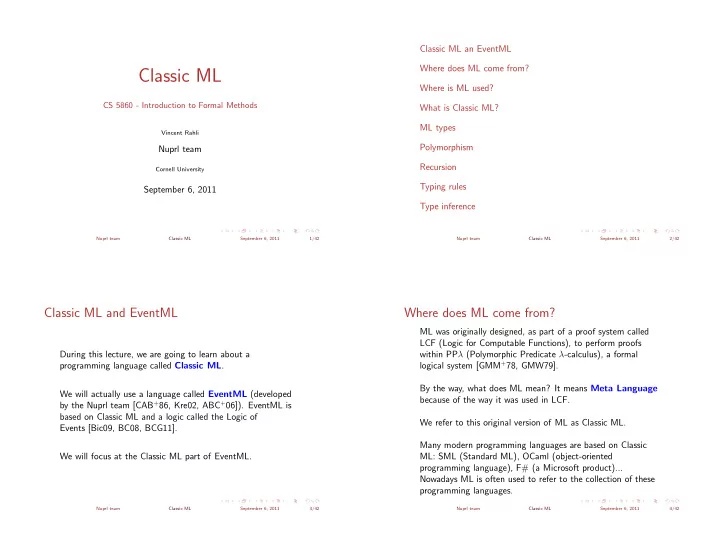
Classic ML an EventML Where does ML come from? Classic ML Where is ML used? CS 5860 - Introduction to Formal Methods What is Classic ML? ML types Vincent Rahli Nuprl team Polymorphism Recursion Cornell University Typing rules September


slide-1
SLIDE 1

Classic ML

CS 5860 - Introduction to Formal Methods

Vincent Rahli

Nuprl team

Cornell University

September 6, 2011

Nuprl team Classic ML September 6, 2011 1/42

Classic ML an EventML Where does ML come from? Where is ML used? What is Classic ML? ML types Polymorphism Recursion Typing rules Type inference

Nuprl team Classic ML September 6, 2011 2/42

Classic ML and EventML

During this lecture, we are going to learn about a programming language called Classic ML. We will actually use a language called EventML (developed by the Nuprl team [CAB+86, Kre02, ABC+06]). EventML is based on Classic ML and a logic called the Logic of Events [Bic09, BC08, BCG11]. We will focus at the Classic ML part of EventML.

Nuprl team Classic ML September 6, 2011 3/42

Where does ML come from?

ML was originally designed, as part of a proof system called LCF (Logic for Computable Functions), to perform proofs within PPλ (Polymorphic Predicate λ-calculus), a formal logical system [GMM+78, GMW79]. By the way, what does ML mean? It means Meta Language because of the way it was used in LCF. We refer to this original version of ML as Classic ML. Many modern programming languages are based on Classic ML: SML (Standard ML), OCaml (object-oriented programming language), F# (a Microsoft product)... Nowadays ML is often used to refer to the collection of these programming languages.

Nuprl team Classic ML September 6, 2011 4/42
slide-2
SLIDE 2

Where is ML used?

◮ F# is a Microsoft product used, e.g., in the .NET

framework.

◮ OCaml is developed by the INRIA. It has inspired F#.

The Coq theorem prover is written in OCaml. It has been used in the implementation of Ensemble [Hay98, BCH+00]. It is also used by companies.

◮ SML has formally defined static and dynamic semantics.

The HOL theorem prover is written in SML. It is nowadays mainly used for teaching and research.

Nuprl team Classic ML September 6, 2011 5/42

What is Classic ML (or just ML for short)?

ML is a strongly typed higher-order impure functional programming language. What does it mean?

(Nowadays, ML often refers to a family of languages such as Classic ML, SML, Caml, F#...) Nuprl team Classic ML September 6, 2011 6/42

What is ML?

Higher-order.

Functions can do nothing (we will come back to that one): \x. x Functions can take numerical arguments: \x. x + 1 let plus three x = x + 3 ;; Functions can take Boolean arguments: \a. \b. a or b

Nuprl team Classic ML September 6, 2011 7/42

What is ML?

Higher-order.

Functions can also take other functions as arguments. Function application: let app = \f. \x. (f x );; Function composition: let comp g h = \x. (g (h x)) ;; Note that, e.g, app can be seen as a function that takes a function (f) as input and outputs a function (\x. (f x)).

Nuprl team Classic ML September 6, 2011 8/42
slide-3
SLIDE 3

What is ML?

Higher-order.

BTW, a function of the form \x.e (where e is an expression) is called a λ-expression. The terms of the forms x (a variable), (e1 e2) (an application), and \x.e (a λ-expression) are the terms of the λ-calculus [Chu32, Bar84]. In 1932, Church [Chu32] introduced a system (that led to the λ-calculus we know) for “the foundation of formal logic”, which was a formal system for logic and functions.

Nuprl team Classic ML September 6, 2011 9/42

What is ML?

Impure and functional.
  • Functional. Functions are first-class objects: functions can

build functions, take functions as arguments, return functions...

  • Impure. Expressions can have side-effects: references,

exceptions. (We are only going to consider the pure part of ML.) Other functional(-like) programming language: Haskell (pure), SML (impure), F# (impure)...

Nuprl team Classic ML September 6, 2011 10/42

What is ML?

Strongly typed.

What is a type? A type bundles together “objects” (syntactic forms) sharing a same semantics. (Types started to be used in formal systems, providing foundations for Mathematics, in the early 1900s to avoid paradoxes (Russell [Rus08]).) A type system (typing rules) dictates what it means for a program to have a type (to have a static semantics). What are types good for? Types are good, e.g., for checking the well-defined behavior of programs (e.g., by restricting the applications of certain functions – see below).

Nuprl team Classic ML September 6, 2011 11/42

What is ML?

Strongly typed.

What else?

  • Flexibility. One of the best things about ML is that is has

almost full type inference (type annotations are sometimes required). Each ML implementation has a type inferencer that, given a semantically correct program, finds a type. This frees the programmer from explicitly writing down types: if a program has a type, the type inferencer will find one. Given a semantically correct program, the inferred type provides a static semantics of the program. Consider \x. x + 2. 2 is an integer. + takes two integers and returns an integer. This means that x is constrained to be an

  • integer. \x. x + 2 is then a function that takes an integer

and returns an integer.

Nuprl team Classic ML September 6, 2011 12/42
slide-4
SLIDE 4

What is ML?

Strongly typed.

Can type inferencers infer more than one type? Is each type as good as the others? In ML it is typical that a program can have several types. The more general the inferred types are the more flexibility the programmer has (we will come back to that once we have learned about polymorphism). (ML’s type system has principal type but not principal typing [Wel02] (a typing is a pair type environment/type).)

Nuprl team Classic ML September 6, 2011 13/42

What is ML?

Strongly typed.

Using types, some operations become only possible on values with specific types. For example, one cannot apply an integer to another integer: integers are not functions. The following does not type check (it does not have a type/a static semantics): let fu = (8 6) ;; Another example: using the built-in equality, one cannot check whether a Boolean is equal to an integer. The following does not type check (and will be refused at compile time): let is eq = (true = 1) ;;

Nuprl team Classic ML September 6, 2011 14/42

What is ML?

Strongly typed.

What does type check then?

  • ne can apply our plus three function to integers:

let plus three x = x + 3 ;; let fu = plus three 6 ;; One can test whether two integers are equal: let i1 = 11;; let i2 = 22;; let is eq = (i1 = i2) ;;

Nuprl team Classic ML September 6, 2011 15/42

ML types

  • Integer. For example, 12 + 3 has type Int.
  • Boolean. For example, !true has type Bool (! stands for the

Boolean negation).

  • List. For example, [1;7;5;3] has type Int List.

Function type. For example, let plus3 x = x + 3;; has type Int → Int. Product type. For example, (true , 3) has type Bool ∗ Int. Disjoint union type. For example, inl (1 + 5) has type Int + Int.

Nuprl team Classic ML September 6, 2011 16/42
slide-5
SLIDE 5

Polymorphism

We claimed that inl (1 + 5) has type Int + Int. But it can also have type Int + Bool, Int + Int List, . . . For all type T, inl (1 + 5) has type Int + T. This can be represented with a polymorphic type: Int + ’a, where ’a is called a type variable, meaning that it can be any type. Let us consider a simpler example: let id x = x;; What’s its type? The action id performs does not depend on its argument’s

  • type. It can be applied to an integer, a Boolean, a function, . . .

It always returns its argument. id’s type cannot be uniquely

  • determined. To automatically assign a (monomorphic type) to

id one would have to make a non-deterministic choice. Instead, we assign to id the polymorphic type: ’a → ’a.

Nuprl team Classic ML September 6, 2011 17/42

Polymorphism

Formally, this form of polymorphism is expressed using the ∀ quantification. This form of polymorphism is sometimes called infinitary parametric polymorphism [Str00, CW85] and ∀ types are called type schemes (see, e.g., system F [Gir71, Gir72]). Polymorphism complicates type inference but does not make it impossible.

Nuprl team Classic ML September 6, 2011 18/42

Polymorphism

Polymorphism allows one to express that a single program can have more than one meaning. Using the ∀ quantification, one can express that a single program has an infinite number of meaning, i.e., can be used in an infinite number of ways. The following function null has type ’a List → Bool: l e t n u l l l s t = case l s t

  • f

[ ] = > true

  • f x

. xs = > f a l s e ; ;

Nuprl team Classic ML September 6, 2011 19/42

Polymorphism

let declarations allow one to define polymorphic functions while lambda expression do not. For example, the following piece of code is typable: l e t x = (\ x . x ) i n ( x 1 , x true ) However, the following piece of code is not typable: (\ x . ( x 1 , x true )) (\ x . x ) In the first example, the two last x’s stand for the identity function for two different types. In the second example, the two bound x’s in \x. (x 1, x true) have to be the same function.

Nuprl team Classic ML September 6, 2011 20/42
slide-6
SLIDE 6

Recursion

Another important feature of ML (and functional languages in general) is recursion Recursion allows functions to call themselves. Recursion accomplishes what “while” loops accomplish in imperative languages but in a functional way: functions call functions. For example, to compute the length of a list, one wants to iterate through the list to count how many elements are in the

  • list. The following function computes the length of a list:

l e t r e c length l s t = case l s t

  • f

[ ] = > 0

  • f x

. xs = > 1 + length xs ; ;

Nuprl team Classic ML September 6, 2011 21/42

Recursion

Given x and y, find q (quotient) and r (remainder) such that x = (q ∗ y) + r. The “while” solution: q := 0; r := x; while r >= y do q := q + 1; r := r - y; od return (q, r); The recursive solution: l e t quot and rem x y = l e t r e c aux q r = i f r < y then (q , r ) e l s e aux ( q + 1) ( r − y ) i n aux 0 x ; ;

Nuprl team Classic ML September 6, 2011 22/42

Recursion

Another example: the factorial. The “while” solution: f := 1; i := 1; while i <= x do f := i * f;; i := i + 1;;

  • d

The recursive solution: l e t f x = i f x <= 1 then 1 e l s e x ∗ f ( x − 1 ) ; ;

Nuprl team Classic ML September 6, 2011 23/42

Typing rules

Let us consider the following expression language (sometimes referred to as core ML: v ∈ Var (a countably infinite set of variables) exp ∈ Exp ::= v | exp1 exp2 | \v.exp | let v = exp1 in exp2 Let us consider the following type language: a ∈ TyVar (a countably infinite set of type variables) τ ∈ ITy ::= a | τ1 → τ2 σ ∈ ITyScheme ::= ∀{a1, . . . , an}.τ Let environments (metavariable Γ) be partial functions from program variables to type schemes. We write environments as follows: {v1 → σ1, . . . , vn → σn}. We sometimes write a → τ for a → ∀∅.τ.

Nuprl team Classic ML September 6, 2011 24/42
slide-7
SLIDE 7

Typing rules

the function fv computes the set of free type variables in a type or in a type environment. We define the domain of an environment as follows: dom({v1 → σ1, . . . , vn → σn}) = {a1, . . . , an}. Let substitutions (metavariable sub) be partial functions from type variables to types. We write substitutions as follows: {a1 → τ1, . . . , an → τn}. We write substitution in a type as follows: τ[sub].

Nuprl team Classic ML September 6, 2011 25/42

Typing rules

Let the instantiation of a type scheme be defined as follows: τ ≺ ∀{a1, . . . , an}.τ ′ ⇐ ⇒ ∃τ1, . . . , τn. (τ = τ ′[{ai → τi | i ∈ {1, . . . , n}}]) We also define a function to “merge” environments: Γ1 + Γ2 = {a → τ | Γ2(a) = τ or (Γ1(a) = τ and a ∈ dom(Γ2))}

Nuprl team Classic ML September 6, 2011 26/42

Typing rules

(A variant of Damas and Milner’s type system, sometimes referred to as the Hindley-Milner type system and therefore

  • ften called DM or HM.)

τ ≺ Γ(vid) v : Γ, τ exp1 : Γ, τ1 → τ2 exp2 : Γ, τ1 exp1 exp2 : Γ, τ2 exp : Γ + {v → τ}, τ ′ \v.exp : Γ, τ → τ ′ exp : Γ, τ exp2 : Γ + {v → ∀(fv(τ) \ fv(Γ)).τ}, τ ′ let v = exp1 in exp2 : Γ, τ ′

Nuprl team Classic ML September 6, 2011 27/42

Typing rules

For example: Let Γ = {f → (a1 → a2), g → (a2 → a3), v → a1}. g : Γ, a2 → a3 f : Γ, a1 → a2 v : Γ, a1 f v : Γ, a2 g (f v) : Γ, a3 \v.g (f v) : {f → (a1 → a2), g → (a2 → a3)}, a1 → a3 \g.\v.g (f v) : {f → (a1 → a2)}, (a2 → a3) → a1 → a3 \f.\g.\v.g (f v) : ∅, (a1 → a2) → (a2 → a3) → a1 → a3

Nuprl team Classic ML September 6, 2011 28/42
slide-8
SLIDE 8

Typing rules

For example: Let Γ = {id → ∀{a}.a → a}. Let τ = a1 → a1 id : {id → a}, a \id.id : ∅, a → a id : Γ, τ → τ id : Γ, τ id id : Γ, τ let id = \id.id in id id : ∅, τ

Nuprl team Classic ML September 6, 2011 29/42

Type inference

Type inference vs. type checking. Let S be a type system:

◮ Type checking: given a (closed) expression exp and a type

τ, a type checker checks that exp has type τ w.r.t. S.

◮ Type inference: given a (closed) expression exp, a type

inferencer infers a type τ such that exp has type τ w.r.t. S, or fails if no such type exists. Classic ML has decidable type inference: there exists an algorithm that given an expression exp, infers a type for exp which is valid w.r.t. the static semantics of Classic ML. Classic ML seats between the simply typed λ-calculus [Bar92] (no polymorphism) and system F [Gir71, Gir72] (undecidable type inference).

Nuprl team Classic ML September 6, 2011 30/42

Type inference

Type inference for Classic ML is exponential in theory. Many algorithms are efficient in practice (quasi-linear time under some assumptions). Milner [Mil78] proposed a type inference algorithm, called the W algorithm, for an extension of core ML and proved it sound. Damas (Milner’s student) and Milner [DM82] later proved the completeness of W.

Nuprl team Classic ML September 6, 2011 31/42

Type inference

The W algorithm takes two inputs: a type environment Γ and an expression exp; and returns two outputs: a type substitution s and a type τ; such that exp has type τ in the environment Γ[s] w.r.t. the type system presented above. W is defined by induction on the structure of its expression parameter.

Nuprl team Classic ML September 6, 2011 32/42
slide-9
SLIDE 9

Type inference

Remark 1: These inference algorithms use first-order unification [MM82, BN98]. Given an application exp1 exp2, W produces, among other things, τ1 a type for exp1, and τ2 a type for exp2. A unification algorithm is then used to unify τ1 and τ2 → a where a is a “fresh” type variable (meaning that τ1 has to be a function that takes an argument of type τ2). Remark 2: Many algorithms have been designed since the W. In some algorithms constraint generation and unification interleave [Mil78, DM82, LY98, McA99, Yan00], in others the constraint generation and constraint solving phases are separated [OSW99, Pot05, PR05]. Remark 3: EventML’s inferencer is constraint based (second category).

Nuprl team Classic ML September 6, 2011 33/42

Type inference

Example: let plus1 x = x + 1 in plus1 3

◮ + is a function that takes two Ints and returns an Int. ◮ 1 and x are constrained to be Ints. ◮ plus1 is constrained to be a function that takes an Int

and returns an Int.

◮ plus1 3 is an Int. ◮ Therefore the whole expression is an Int. Nuprl team Classic ML September 6, 2011 34/42

Type inference

Example: let app f x = f x in app (\x.x + 1) 3

◮ If x has type ’a then f is constrained to have type

’a → ’b.

◮ app has polymorphic type (’a → ’b) → ’a → ’b. ◮ + is a function that takes two Ints and returns an Int. ◮ 1 and x are constrained to be Ints. ◮ The function \x.x + 1 is constrained to have type

Int → Int and 3 is an Int.

◮ An instance of app’s type is (Int → Int) → Int → Int,

where both ’a and ’b are instantiated to Int. This is the type of app’s second occurrence.

◮ Therefore the whole expression is an Int. Nuprl team Classic ML September 6, 2011 35/42

Type inference

Example: let id x = x in id id

◮ id has polymorphic type ’a → ’a. Each instance of id’s

type is a functional type.

◮ id’s first bound occurrence is a function that takes a

function as parameter.

◮ Therefore, id’s first bound occurrence’s type is an

instance of ’a → ’a such that ’a is substituted by a functional type.

◮ That functional type has to be an instance of ’a → ’a. ◮ For example, we can assign (’b → ’b) → (’b → ’b) to

id’s first bound occurrence, and ’b → ’b to id’s second bound occurrence.

◮ Therefore, the whole expression has type ’b → ’b. Nuprl team Classic ML September 6, 2011 36/42
slide-10
SLIDE 10

Type inference

Example: l e t quot and rem x y = l e t r e c aux q r = i f r < y then (q , r ) e l s e aux ( q + 1) ( r − y ) i n aux 0 x ; ;

◮ Because + and − both take Ints and return Ints, q, r,

and y are constrained to be Ints.

◮ aux’s first bound occurrence is constrained to be a

function that takes two Int’s and returns a pair of Int’s (aux has type Int → Int → (Int ∗ Int)).

◮ Because aux is applied to 0 and x in the last line, x is

constrained to be an Int.

◮ quot and rem has type Int → Int → (Int ∗ Int). Nuprl team Classic ML September 6, 2011 37/42

References I

Stuart F. Allen, Mark Bickford, Robert L. Constable, Richard Eaton, Christoph Kreitz, Lori Lorigo, and
  • E. Moran.
Innovations in computational type theory using nuprl.
  • J. Applied Logic, 4(4):428–469, 2006.
Henk P. Barendregt. The Lambda Calculus: Its Syntax and Semantics. North-Holland, revised edition, 1984. Henk P. Barendregt. Lambda calculi with types. In Handbook of Logic in Computer Science, Volumes 1 (Background: Mathematical Structures) and 2 (Background: Computational Structures), Abramsky & Gabbay & Maibaum (Eds.), Clarendon, volume 2. Oxford University Press, Inc., New York, NY, USA, 1992. Mark Bickford and Robert L. Constable. Formal foundations of computer security. In NATO Science for Peace and Security Series, D: Information and Communication Security, volume 14, pages 29–52. 2008. Mark Bickford, Robert Constable, and David Guaspari. Generating event logics with higher-order processes as realizers. Technical report, Cornell University, 2011. Ken Birman, Robert Constable, Mark Hayden, Jason Hickey, Christoph Kreitz, Robbert van Renesse, Ohad Rodeh, and Werner Vogels. The Horus and Ensemble projects: Accomplishments and limitations. In In DARPA Information Survivability Conference and Exposition (DISCEX 2000), pages 149–160. IEEE Computer Society Press, 2000. Nuprl team Classic ML September 6, 2011 38/42

References II

Mark Bickford. Component specification using event classes. In Grace A. Lewis, Iman Poernomo, and Christine Hofmeister, editors, CBSE, volume 5582 of Lecture Notes in Computer Science, pages 140–155. Springer, 2009. Franz Baader and Tobias Nipkow. Term rewriting and all that. Cambridge University Press, New York, NY, USA, 1998.
  • R. L. Constable, S. F. Allen, H. M. Bromley, W. R. Cleaveland, J. F. Cremer, R. W. Harper, D. J. Howe,
  • T. B. Knoblock, N. P. Mendler, P. Panangaden, J. T. Sasaki, and S. F. Smith.
Implementing mathematics with the Nuprl proof development system. Prentice-Hall, Inc., Upper Saddle River, NJ, USA, 1986. Alonzo Church. A set of postulates for the foundations of logic. The Annals of Mathematics, 33(2):346–366, April 1932. Luca Cardelli and Peter Wegner. On understanding types, data abstraction, and polymorphism. ACM Computing Surveys, 17(4):471–522, 1985. Luis Damas and Robin Milner. Principal type-schemes for functional programs. In POPL82, pages 207–212, New York, NY, USA, 1982. ACM. Jean-Yves Girard. Une extension de l’interpr´ etation de G¨
  • del `
a l’analyse, et son application a l’´ elimination des coupures dans l’analyse et la th´ eorie des types. In Proceedings of the Second Scandinavian Logic Symposium, pages 63–92, 1971. Nuprl team Classic ML September 6, 2011 39/42

References III

Jean-Yves Girard. Interpr´ etation Fonctionnelle et ´ Elimination des Coupures de l’Arithm´ etique d’Ordre Sup´ erieur. PhD thesis, Universite de Paris VII, 1972. Michael J. C. Gordon, Robin Milner, L. Morris, Malcolm C. Newey, and Christopher P. Wadsworth. A metalanguage for interactive proof in LCF. In POPL ’78: Proceedings of the 5th ACM SIGACT-SIGPLAN symposium on Principles of programming languages, pages 119–130, New York, NY, USA, 1978. ACM. Michael J. C. Gordon, Robin Milner, and Christopher P. Wadsworth. Edinburgh LCF: A Mechanised Logic of Computation., volume 78 of Lecture Notes in Computer Science. Springer-Verlag, 1979. Mark Hayden. The Ensemble System. PhD thesis, Cornell University, Department of Computer Science, 1998. Technical Report TR98-1662. Christoph Kreitz. The Nuprl Proof Development System, Version 5, Reference Manual and User’s Guide. Cornell University, Ithaca, NY, 2002. http://www.nuprl.org/html/02cucs-NuprlManual.pdf. Oukseh Lee and Kwangkeun Yi. Proofs about a folklore let-polymorphic type inference algorithm. ACM Transanctions on Programming Languages and Systems, 20(4):707–723, jul 1998. Nuprl team Classic ML September 6, 2011 40/42
slide-11
SLIDE 11

References IV

Bruce J. McAdam. On the unification of substitutions in type inference. In Kevin Hammond, Antony J. T. Davie, and Chris Clack, editors, 10th Int’l Workshop, IFL’98, volume 1595 of LNCS, pages 137–152. Springer, 1999. Robin Milner. A theory of type polymorphism in programming. Journal of Computer and System Sciences, 17(3):348–375, December 1978. Alberto Martelli and Ugo Montanari. An efficient unification algorithm. ACM Trans. Program. Lang. Syst., 4(2):258–282, 1982. Martin Odersky, Martin Sulzmann, and Martin Wehr. Type inference with constrained types.
  • Theor. Pract. Object Syst., 5(1):35–55, 1999.
Fran¸ cois Pottier. A modern eye on ML type inference: old techniques and recent developments. Lecture notes for the APPSEM Summer School, September 2005. Fran¸ cois Pottier and Didier R´ emy. The essence of ML type inference. In Benjamin C. Pierce, editor, Advanced Topics in Types and Programming Languages, chapter 10, pages 389–489. MIT Press, 2005. Bertrand Russell. Mathematical logic as based on the theory of types. American Journal of Mathematics, 30(3):222–262, 1908. Nuprl team Classic ML September 6, 2011 41/42

References V

Christopher Strachey. Fundamental concepts in programming languages. Higher Order Symbol. Comput., 13(1-2):11–49, 2000.
  • J. B. Wells.
The essence of principal typings. In Peter Widmayer, Francisco Triguero Ruiz, Rafael Morales Bueno, Matthew Hennessy, Stephan Eidenbenz, and Ricardo Conejo, editors, Automata, Languages and Programming, 29th Int’l Colloq., ICALP 2002, volume 2380 of LNCS, pages 913–925. Springer, 2002. Jun Yang. Explaining type errors by finding the source of a type conflict. In SFP’99: Selected papers from the 1st Scottish Functional Programming Workshop, pages 59–67, Exeter, UK, UK, 2000. Intellect Books. Nuprl team Classic ML September 6, 2011 42/42