Learning 3D object models from 2D images Cropped Input Image - - PowerPoint PPT Presentation

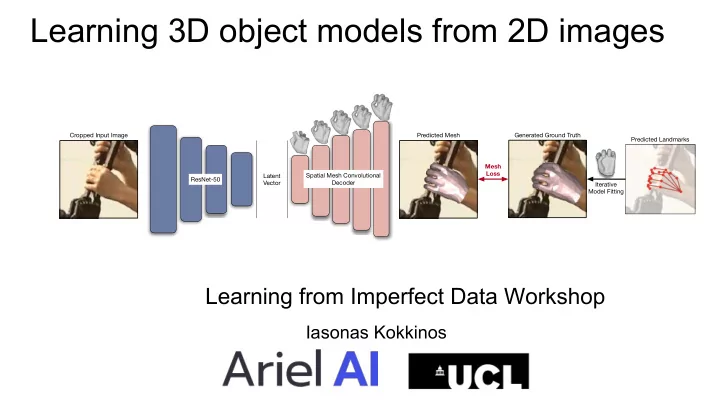
learning 3d object models from 2d images
SMART_READER_LITE
LIVE PREVIEW

Learning 3D object models from 2D images Cropped Input Image - - PowerPoint PPT Presentation

Learning 3D object models from 2D images Cropped Input Image Predicted Mesh Generated Ground Truth Predicted Landmarks Mesh Loss Latent Spatial Mesh Convolutional ResNet-50 Vector Decoder Iterative Model Fitting Learning from Imperfect


slide-1
SLIDE 1

Learning from Imperfect Data Workshop

Iasonas Kokkinos

Learning 3D object models from 2D images

Cropped Input Image Latent Vector ResNet-50 Spatial Mesh Convolutional Decoder Mesh Loss Predicted Mesh Generated Ground Truth Predicted Landmarks Iterative Model Fitting

slide-2
SLIDE 2

Ariel AI

  • R. A. Guler
  • S. Zafeiriou
  • G. Papandreou
  • H. Wang
  • D. Stoddard
  • D. Kulon
  • Z. Shu

Stony Brook

  • M. Sahasrabudhe

INRIA

  • D. Samaras

Stony Brook

Natalia Neverova FAIR

  • E. Bartrum

UCL

  • N. Paragios

INRIA

  • E. Skordos
  • H. Tam
  • A. Kakolyris
  • P. Koutras
  • E. Schmitt
  • A. Lazarou
  • S. Galanakis
  • B. Fulkerson
  • M. Bronstein

Imperial College

UCL, Imperial College, FAIR, INRIA, Stony Brook

slide-3
SLIDE 3

Image Classification Is there a person in this image? Yes? No? Object Detection Localize persons in the image. Pose Estimation Localize joints of the persons in the images. DensePose (our work) Find correspondence between all pixels and a 3D model. Part Segmentation Segment semantically meaningful body parts.

Input Image

Image Classification Is there a person in this image? Yes? No? Object Detection Localize persons in the image. Pose Estimation Localize joints of the persons in the images. DensePose (our work) Find correspondence between all pixels and a 3D model. Part Segmentation Segment semantically meaningful body parts.

Image Classification Is there a person in this image? Yes? No?

Image Classification

Human analysis: from coarse to fine

slide-4
SLIDE 4

Image Classification Is there a person in this image? Yes? No? Object Detection Localize persons in the image. Pose Estimation Localize joints of the persons in the images. DensePose (our work) Find correspondence between all pixels and a 3D model. Part Segmentation Segment semantically meaningful body parts.

Input Image

Image Classification Is there a person in this image? Yes? No? Object Detection Localize persons in the image. Pose Estimation Localize joints of the persons in the images. DensePose (our work) Find correspondence between all pixels and a 3D model. Part Segmentation Segment semantically meaningful body parts.

Person Detection Localize persons in the image.

Image Classification Person Detection

Human analysis: from coarse to fine

slide-5
SLIDE 5

Image Classification Is there a person in this image? Yes? No? Object Detection Localize persons in the image. Pose Estimation Localize joints of the persons in the images. DensePose (our work) Find correspondence between all pixels and a 3D model. Part Segmentation Segment semantically meaningful body parts.

Input Image Part Segmentation Segment semantically meaningful body parts.

Image Classification Person Detection

Image Classification Is there a person in this image? Yes? No? Object Detection Localize persons in the image. Pose Estimation Localize joints of the persons in the images. DensePose (our work) Find correspondence between all pixels and a 3D model. Part Segmentation Segment semantically meaningful body parts.

Image Classification Is there a person in this image? Yes? No? Object Detection Localize persons in the image. Pose Estimation Localize joints of the persons in the images. DensePose (our work) Find correspondence between all pixels and a 3D model. Part Segmentation Segment semantically meaningful body parts.

Part Segmentation

Human analysis: from coarse to fine

slide-6
SLIDE 6

Image Classification Is there a person in this image? Yes? No? Object Detection Localize persons in the image. Pose Estimation Localize joints of the persons in the images. DensePose (our work) Find correspondence between all pixels and a 3D model. Part Segmentation Segment semantically meaningful body parts.

Input Image Pose Estimation Localize joints of the persons in the images.

Image Classification Person Detection

Image Classification Is there a person in this image? Yes? No? Object Detection Localize persons in the image. Pose Estimation Localize joints of the persons in the images. DensePose (our work) Find correspondence between all pixels and a 3D model. Part Segmentation Segment semantically meaningful body parts.

Part Segmentation Pose Estimation

Human analysis: from coarse to fine

slide-7
SLIDE 7

Image Classification Is there a person in this image? Yes? No? Object Detection Localize persons in the image. Pose Estimation Localize joints of the persons in the images. DensePose (our work) Find correspondence between all pixels and a 3D model. Part Segmentation Segment semantically meaningful body parts.

Input Image Dense Pose Estimation Find correspondence between all pixels and a 3D model.

Image Classification Person Detection

Image Classification Is there a person in this image? Yes? No? Object Detection Localize persons in the image. Pose Estimation Localize joints of the persons in the images. DensePose (our work) Find correspondence between all pixels and a 3D model. Part Segmentation Segment semantically meaningful body parts.

Part Segmentation Pose Estimation DensePose

Human analysis: from coarse to fine

slide-8
SLIDE 8

“W “Wide Open” ” (T (The Mill, 2015)

8

Holy grail: 3D human reconstruction

slide-9
SLIDE 9

9

Ariel AI: 3D human reconstruction on mobile

slide-10
SLIDE 10

10 10 10 10

Holographic telepresence Universal motion capture Seamless augmented reality Personalised, experiential retail Kinetic learning Immersive gaming

Ariel AI: 3D human reconstruction on mobile

slide-11
SLIDE 11

11 11 11 11

Challenges

Depth/height ambiguity 3D from 2D: fundamentally ill-posed problem Scarce 3D supervision – almost impossible in-the-wild

slide-12
SLIDE 12

From imperfect vision to imperfect data

Computer Vision before deep learning:

  • Your `local evidence’ is imperfect (classifier scores, unary terms, ..)
  • Compensate for it by model-based prior during inference (AAMs, MRFs,..)

Computer Vision after deep learning:

  • Your `local evidence’ can become perfect
  • Your training data is imperfect
  • Compensate for it by some model-based prior, prior or during training
slide-13
SLIDE 13

Imperfect Data for Semantic Segmentation

“Weakly- and Semi-Supervised Learning of a Deep Convolutional Network for Semantic Image Segmentation” George Papandreou, Liang-Chieh Chen, Kevin P. Murphy, Alan L. Yuille, ICCV 2015

Bounding boxes + occupancy priors

slide-14
SLIDE 14

Imperfect Data for Instance Segmentation

Deep Extreme Cut: From Extreme Points to Object Segmentation, Kevis-Kokitsi Maninis, Sergi Caelles, Jordi Pont-Tuset, Luc Van Gool

4 points + segmentation system

slide-15
SLIDE 15

Imperfect Data for Pose Estimation

Learning Temporal Pose Estimation from Sparsely Labeled Videos, Bertasius, Gedas and Feichtenhofer, Christoph, and Tran, Du and Shi, Jianbo, and Torresani, Lorenzo(NeurIPS 2019)

Keypoints + temporal correspondence

slide-16
SLIDE 16

Part 1: Weakly- and semi- supervised learning for 3D

HoloPose: Holistic 3D Human Reconstruction In-the-Wild, A. Guler and I. Kokkinos, CVPR 2019 Weakly-Supervised Mesh-Convolutional Hand Reconstruction in the Wild, D. Kulon et al CVPR 2020

slide-17
SLIDE 17

Part 2: Fully unsupervised learning for 3D

Includes all previous tasks as special cases Unstructured face dataset deep magic happens 3D model comes out

Lifting AutoEncoders: Unsupervised Learning of 3D Morphable Models Using Deep Non-Rigid Structure from Motion,

  • M. Sahasrabudhe, Z. Shu, E. Bartrum, A. Guler, D. Samaras and I. Kokkinos, ICCV GMDL 2019
slide-18
SLIDE 18

DenseReg: From Image to Template to Task

  • R. A. Guler, G. Trigeorgis, E. Antonakos, P. Snape, S. Zafeiriou, I. Kokkinos,

DenseReg: Fully Convolutional Dense Shape Regression In-the-Wild, CVPR 2017

slide-19
SLIDE 19

DenseReg, Frame-by-Frame

slide-20
SLIDE 20

2D canonical coordinates

Supervision: from parametric model fitting to 2D keypoints

Annotation effort: a few 2D landmarks per image Density: morphable model prior

slide-21
SLIDE 21
  • R. A. Guler, N. Neverova, I. Kokkinos “DensePose: Dense Human Pose Estimation In The Wild”, CVPR’18

DensePose-RCNN: ~25 FPS

DensePose: dense image-to-body correspondence

http://densepose.org/

slide-22
SLIDE 22

Surface Correspondence TASK 2: Marking Correspondences TASK 1: Part Segmentation

... ...

sampled points input image segmented parts rendered images for the specific part Surface Correspondence TASK 2: Marking Correspondences TASK 1: Part Segmentation

... ...

sampled points input image segmented parts rendered images for the specific part

An Annot

  • tation
  • n pi

pipe peline ne-II II

slide-23
SLIDE 23

Quantization replaced by part assignment. densepose.org

U coordinates V coordinates Image

DensePose-COCO dataset

slide-24
SLIDE 24

Quantization replaced by part assignment.

De DensePose-RC RCNN Re Results

Visualization

DensePose-RCNN in action

slide-25
SLIDE 25

HoloPose: multi-person 3D reconstruction results

  • R. A. Guler, I. Kokkinos “HoloPose: Holistic 3D Human Reconstruction In The Wild”, CVPR’19
slide-26
SLIDE 26

Surface-level human understanding, CVPR 2018

De DensePose: : Dense Human an Pos

  • se Estim

imation ion In The Wild ild, , CVPR 2018

  • R. A. Güler, N. Neverova, I. Kokkinos,

En End-to to-en end Rec ecover ery of Hu Human Shape e and Pose, e, CVPR 2018

  • A. Kanazawa M. J Black D. W. Jacobs J. Malik

Lea Learning g to Estimate e 3D Hu Human Pose e and Shape e from a Singl gle e Im Image, , CVPR 2018

  • G. Pavlakos, L. Zhu, X. Zhou, K. Daniilidis

Monocu cular 3D Pose and Shape Estimation of Multiple People, , CVPR 2018, Andrei Zanfir, Elisabeta Marinoiu, Cristian Sminchisescu

SMPL parameter regression Dense UV coordinate regression

Robust & accurate, “in-the-wild” Not 3D Parametric and 3D Alignment
slide-27
SLIDE 27

Bottom-up human body reconstruction

slide-28
SLIDE 28

Bottom-up 2D Keypoint localization

slide-29
SLIDE 29

Bottom-up/Top-down Synergistic Refinement

slide-30
SLIDE 30

Synergistic Refinement

slide-31
SLIDE 31
slide-32
SLIDE 32

Ariel Holopose 2019

  • In-the-wild human 3D reconstruction
slide-33
SLIDE 33

Ariel Holopose 2020

slide-34
SLIDE 34

Weakly-Supervised Mesh-Convolutional Hand Reconstruction in the Wild

Dominik Kulon Riza Alp Güler Iasonas Kokkinos Michael Bronstein Stefanos Zafeiriou

arielai.com/mesh_hands

slide-35
SLIDE 35

youtu.be/aQ4shIsQabo

Motivation - hand pose estimation

Broad array of applications:

  • Existing approaches do not always:
slide-36
SLIDE 36

Hand Reconstruction System

Cropped Input Image Latent Vector ResNet-50

slide-37
SLIDE 37

Hand Reconstruction System

Cropped Input Image Latent Vector ResNet-50 Spatial Mesh Convolutional Decoder Predicted Mesh

slide-38
SLIDE 38

Hand Reconstruction System

Generated Ground Truth Predicted Landmarks Iterative Model Fitting

slide-39
SLIDE 39

Hand Reconstruction System

Cropped Input Image Latent Vector ResNet-50 Spatial Mesh Convolutional Decoder Mesh Loss Predicted Mesh Generated Ground Truth Predicted Landmarks Iterative Model Fitting

slide-40
SLIDE 40

Parametric Hand Model Fitting

2D Reprojection Term Bone Length Preservation Term Regularization Term K-Means Prior

Generated Ground Truth Predicted Landmarks Iterative Model Fitting

slide-41
SLIDE 41

Novel Dataset

We release a dataset of meshes aligned with in the wild images.

slide-42
SLIDE 42
slide-43
SLIDE 43

Evaluation - standard benchmarks

We also obtain state-of-the-art performance on popular laboratory datasets.

Method (synthetic, 3D) RHD (AUC) Mesh Speed (FPS)

  • Zimm. and Brox (2017)

0.675 Yang and Yao (2019) 0.849 Spurr et al. (2018) 0.849 Zhou et al. (2020) 0.856 100 (GPU) Cai et al. (2018) 0.887 Zhang et al. (2019) 0.901 Ge et al. (2019) 0.92 50 (GPU) Baek et al. (2019) 0.926 Yang et al. (2019) 0.943 Ours 0.956 70 (GPU)

slide-44
SLIDE 44

2D PCK ON MPII+NZSL

Evaluation - in the wild

We largely outperform other approaches on an in the wild benchmark.

2D PCK ON MPII+NZSL

Evaluation - in the wild

We largely outperform other approaches on an in the wild benchmark.

slide-45
SLIDE 45

Our Method Input Video

slide-46
SLIDE 46

Egocentric Perspective

Our Method Input Video

slide-47
SLIDE 47

AR Effects

Our Method Input Video

AR Effects

Our Method Input Video

slide-48
SLIDE 48

Part 2: Lifting AutoEncoders: Unsupervised 2D-to-3D

Includes all previous tasks as special cases Unstructured face dataset deep magic happens 3D model comes out

Lifting AutoEncoders: Unsupervised Learning of 3D Morphable Models Using Deep Non-Rigid Structure from Motion,

  • M. Sahasrabudhe, Z. Shu, E. Bartrum, A. Guler, D. Samaras and I. Kokkinos, Arxiv 2019
slide-49
SLIDE 49

A canonical appearance template deformed into A class of images (MNIST 3)

Learning a template and the deformation for a class of images.

?

Unsupervised learning of deformable models

slide-50
SLIDE 50

Goal: learn a template and the deformation for a class of images.

?

A canonical appearance template deformed into A class of images (Faces)

Unsupervised learning of deformable models

slide-51
SLIDE 51

Deforming AutoEncoder (DAE) model

  • Z. Zhu, M. Saha, A. Guler, D. Samaras, I. Kokkinos,

Deforming Autoencoders: Unsupervised Shape and Appearance Disentangling, ECCV 2018

slide-52
SLIDE 52

input decoded texture decoded deformation reconstruction

DAE for MNIST: single-class template

slide-53
SLIDE 53

input decoded texture decoded deformation reconstruction

DAE for Faces-in-the-Wild

slide-54
SLIDE 54

DAE-based unsupervised face alignment

Deformation

Aligned Input Landmarks

slide-55
SLIDE 55

Unsupervised alignment with DAE on MAFL dataset

slide-56
SLIDE 56

Goal: learn a 3D model from unstructured image set

Unstructured face dataset Something deep happens 3D model comes out

slide-57
SLIDE 57

3D Reconstruction: Structure-from-Motion

Assumption: Rigid Scene Methods: Factorization, Bundle Adjustment Input: Point Correspondences (e.g. through SIFT & Ransac)

Noah Snavely, Steven M. Seitz, Richard Szeliski. Modeling the World from Internet Photo Collections. IJCV, 2007.

Yasutaka Furukawa and Jean Ponce, Accurate, Dense, and Robust Multi-View Stereopsis, CVPR 2007

slide-58
SLIDE 58

3D Reconstruction: Non-Rigid Structure-from-Motion

https://www.youtube.com/watch?v=35wCPFyS3QQ

Non-Rigid Structure-From-Motion: Estimating Shape and Motion with Hierarchical Priors, Bregler et al, PAMI 2008 Dense Reconstruction of Non-Rigid Surfaces from Monocular Video, Garg et al, CVPR 2013

slide-59
SLIDE 59

DAEs: Turn Images to Corresponding Sets of Points

slide-60
SLIDE 60

Lifting AutoEncoder: NRSfM with DAEs

Deforming AutoEncoder Non-Rigid Structure-from-Motion

slide-61
SLIDE 61

Lifting AutoEncoder: NRSfM with DAEs

Deforming AutoEncoder

slide-62
SLIDE 62

Lifting Auto-Encoders: end-to-end 3D generative model

slide-63
SLIDE 63

What

Lifting AutoEncoders: Unsupervised Learning of a Fully-Disentangled 3D Morphable M§odel

Pose modification

Controllable image modification using LAEs

slide-64
SLIDE 64

What

Pose modification Expression modification

Lifting AutoEncoders: Unsupervised Learning of Fully-Disentangled 3D Morphable model Controllable image modification using LAEs

slide-65
SLIDE 65

What

Pose modification Expression modification

Lifting AutoEncoders: Unsupervised Learning of Fully-Disentangled 3D Morphable model Controllable image modification using LAEs

slide-66
SLIDE 66

What

Pose modification Illumination modification Expression modification

Lifting AutoEncoders: Unsupervised Learning of Fully-Disentangled 3D Morphable model Controllable image modification using LAEs

slide-67
SLIDE 67

Part 1: Weakly- and semi- supervised learning for 3D

HoloPose: Holistic 3D Human Reconstruction In-the-Wild, A. Guler and I. Kokkinos, CVPR 2019 Weakly-Supervised Mesh-Convolutional Hand Reconstruction in the Wild, D. Kulon et al CVPR 2020

slide-68
SLIDE 68

Part 2: Fully unsupervised learning for 3D

Includes all previous tasks as special cases Unstructured face dataset deep magic happens 3D model comes out

Lifting AutoEncoders: Unsupervised Learning of 3D Morphable Models Using Deep Non-Rigid Structure from Motion,

  • M. Sahasrabudhe, Z. Shu, E. Bartrum, A. Guler, D. Samaras and I. Kokkinos, ICCV GMDL 2019
slide-69
SLIDE 69
  • R. A. Guler
  • S. Zafeiriou
  • G. Papandreou
  • H. Wang
  • D. Stoddard
  • D. Kulon
  • Z. Shu

Stony Brook

  • M. Sahasrabudhe

INRIA

  • D. Samaras

Stony Brook

Natalia Neverova FAIR

  • E. Bartrum

UCL

  • N. Paragios

INRIA

  • E. Skordos
  • H. Tam
  • A. Kakolyris
  • P. Koutras
  • E. Schmitt
  • A. Lazarou
  • S. Galanakis
  • B. Fulkerson
  • M. Bronstein

Imperial College

Thank you!

arielai.com/mesh_hands