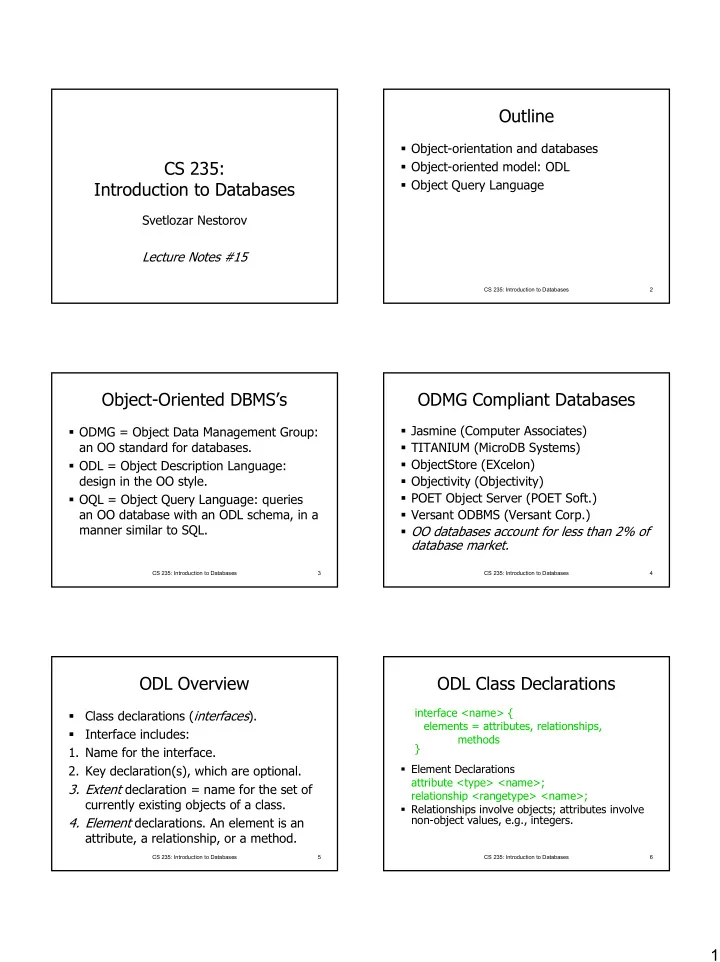
SLIDE 3 3
CS 235: Introduction to Databases 13
ODL Type System
Basic types: int, real/float, string, enumerated types, and classes. Type constructors: Struct for structures and four collection types: Set, Bag, List, and Array. Limitation on nesting:
- Relationships: class – collection
- Attributes: basic – struct – collection
CS 235: Introduction to Databases 14
Many-One Relationships
Don’t use a collection type for relationship in the “many” class. Drinkers have favorite beers:
interface Drinkers { … relationship Beers favoriteBeer inverse Beers::realFans; … }
Also add to Beers:
relationship Set<Drinkers> realFans inverse Drinkers::favoriteBeer;
CS 235: Introduction to Databases 15
Example: Multiway Relationship
- Consider a 3-way relationship bars-beers-prices. We have to create
a connecting class BBP. interface Prices { attribute real price; relationship Set<BBP> toBBP inverse BBP::thePrice; } interface BBP { relationship Bars theBar inverse ... relationship Beers theBeer inverse ... relationship Prices thePrice inverse Prices::toBBP; }
CS 235: Introduction to Databases 16
Example (contd.)
Inverses for theBar, theBeer must be added to Bars, Beers. Better in this special case: make no Prices class; make price an attribute of BBP. Notice that keys are optional.
- BBP has no key, yet is not “weak.” Object
identity suffices to distinguish different BBP
CS 235: Introduction to Databases 17
Roles in ODL
- Names of relationships handle roles. E.g. Spouses and Drinking Buddies
interface Drinkers { attribute string name; attribute Struct Bars::Addr address; relationship Set<Beers> likes inverse Beers::fans; relationship Set<Bars> frequents inverse Bars::customers; relationship Drinkers husband inverse wife; relationship Drinkers wife inverse husband; relationship Set<Drinkers> buddies inverse buddies; }
- Notice that Drinkers:: is optional when the inverse is a relationship of the
same class.
CS 235: Introduction to Databases 18
ODL Subclasses
Follow name of subclass by colon and its superclass. Example: Ales are Beers with a Color
interface Ales:Beers { attribute string color; }
Objects of the Ales class acquire all the attributes and relationships of the Beers class. While E/R entities can have manifestations in a class and subclass, in ODL we assume each
- bject is a member of exactly one class.