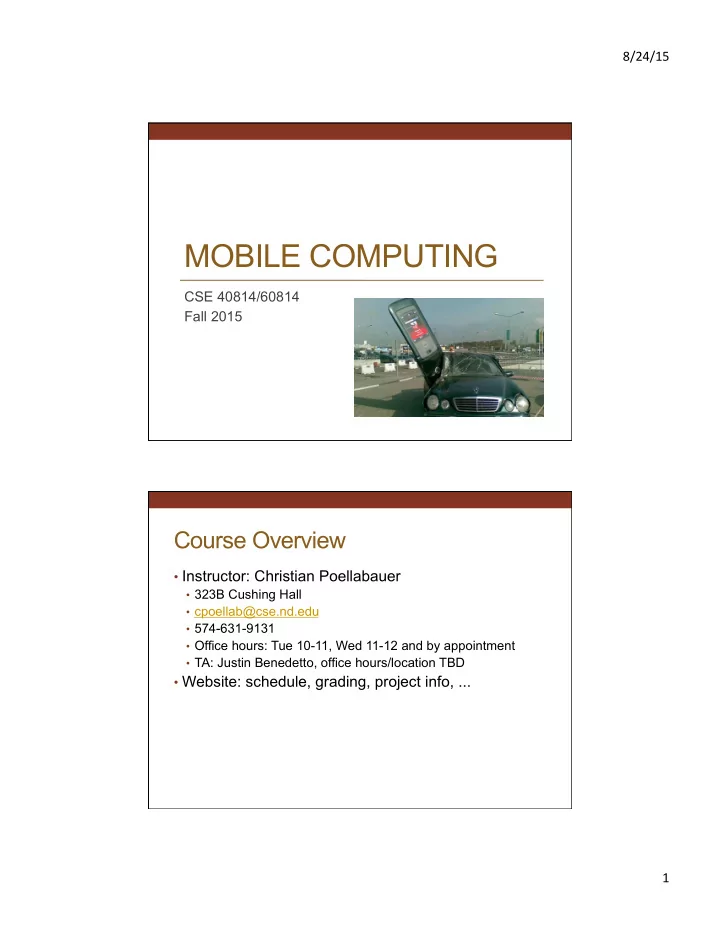
MOBILE COMPUTING CSE 40814/60814 Fall 2015 Course Overview - - PDF document

mobile computing
SMART_READER_LITE
LIVE PREVIEW

MOBILE COMPUTING CSE 40814/60814 Fall 2015 Course Overview - - PDF document

8/24/15 MOBILE COMPUTING CSE 40814/60814 Fall 2015 Course Overview Instructor: Christian Poellabauer 323B Cushing Hall cpoellab@cse.nd.edu 574-631-9131 Office hours: Tue 10-11, Wed 11-12 and by appointment TA: Justin


slide-1
SLIDE 1

8/24/15 ¡ 1 ¡

MOBILE COMPUTING

CSE 40814/60814 Fall 2015

Course Overview

  • Instructor: Christian Poellabauer
  • 323B Cushing Hall
  • cpoellab@cse.nd.edu
  • 574-631-9131
  • Office hours: Tue 10-11, Wed 11-12 and by appointment
  • TA: Justin Benedetto, office hours/location TBD
  • Website: schedule, grading, project info, ...
slide-2
SLIDE 2

8/24/15 ¡ 2 ¡

Grading

  • Midterm Exam

15%

  • Final Exam

25%

  • Mini Project

10%

  • Project Progress Reports

15%

  • Project Presentation

15%

  • Final Project Deliverables

20%

Mini Project

  • Choose a mobile platform: iOS or Android (no web, hybrid,

etc.!)S

  • Develop a simple app that can perform the following functions

(at a minimum):

  • Display a map and your location on the map (GPS, map)
  • Reads accelerometer/gyroscope and does “something” when device is

moved in certain way (e.g., shaking) (sensors)

  • Has at least two “views” where you can navigate back and forth:
  • map view
  • table/list view (with “subview”)
  • Submit code & instructions/report via AFS dropbox
  • To be done individually
  • TA may request meeting if problems arise when compiling/

running your code

  • Can be re-used for main project as you see fit
  • Deadline: 9/23 11.59pm
slide-3
SLIDE 3

8/24/15 ¡ 3 ¡

Main Project

  • Semester-long development project in broad area of

mobile computing

  • Team-based (1-3; 3+ only after approval)
  • If help needed identifying team members, let me know!
  • Project proposal due: 9/9 11.59pm
  • Platforms/devices of your choice:
  • SW: Android, iOS, Windows, Blackberry, TinyOS, …
  • HW:
  • Smartphones, tablets
  • Embedded devices & development boards
  • Sensor devices
  • Wearables
  • Robots, UAVs

Project Characteristics

  • Portable solution/app
  • Context/location awareness
  • Mobile – cloud integration
  • Sensors on mobile devices
  • Device embedded into mobile system
  • Wireless network technology
  • Communication-oriented (should talk to something/body

else)

slide-4
SLIDE 4

8/24/15 ¡ 4 ¡

Project Structure

  • 2 written progress reports
  • Final report, delivered with code
  • In-class demo/presentation of project
  • Resources:
  • B30 Lab & other Engineering labs
  • Plenty of mobile/sensing/embedded devices (can purchase if

needed)

  • Collaboration is encouraged!!

Course Goal

  • To understand what are the fundamental concepts &

challenges in Mobile Computing and what are some of the solutions towards solving these fundamental challenges

  • But also:
  • To get you a high-paying job
  • To enrich you with new ideas
  • To train you in (mobile) systems oriented thinking
  • To provide you with skills in mobile development
slide-5
SLIDE 5

8/24/15 ¡ 5 ¡

Mobile Developer Jobs

  • http://www.networkworld.com/news/2012/110712-it-

salaries-2013-264063.html:

  • 1. Mobile applications developer

2012 salary range: $85,000-$122,500 2013 salary range: $92,750-$133,500 Net: 9% increase

  • “Best Computer Jobs For the Future”:

http://www.itcareerfinder.com/brain-food/blog/entry/best- computer-jobs-for-the-future.html

  • #1: Mobile App Developer Employment Projections | 2010 -

2020

  • 10-Year Growth Pct: 32% (much faster than avg.)
  • 10-Year Growth Volume: 292,000 new jobs
  • Average Salary: $95,000

Mobile Computing

  • Computing enabled by presence of wireless enabled portable

devices (PDAs, cell phones etc.):

  • Many other names/overlapping computing paradigms:
  • Pervasive Computing
  • Ubiquitous Computing
  • Wireless Computing
  • Embedded Computing
  • Nomadic Computing
  • Wireless Sensor Networks
  • Ad-Hoc Networks
  • Mesh Networks
  • Vehicular Networks
slide-6
SLIDE 6

8/24/15 ¡ 6 ¡

Mobile Computing

11

  • Applications
  • Location-awareness
  • Mobility Support
  • Security
  • Resource Management
  • Network Protocols
  • Broadcast
  • Technologies
  • Standards
  • Wireless Medium

Wireless Communication Mobile Computing

Trends in Mobile

slide-7
SLIDE 7

8/24/15 ¡ 7 ¡

Trends in Mobile Trends in Mobile

  • Forrester: “US consumers will make $52 billion in mobile

payments in 2014 and ramp up their mobile spending to $142 billion by the end of 2019.”

  • Gartner: “By year-end 2016, more than $2 billion in online

shopping will be performed exclusively by mobile digital assistants.”

  • IDC: “Difficulties linking mobile platforms to existing databases

will cause 45% of mobile enterprise app initiatives to be delayed or go over budget in 2015.”

  • Gartner: “Through 2015, more than 75% of mobile applications

will fail basic security tests.”

  • IBM: “81% of companies have employee owned devices

accessing their networks, but only 48% claim to have a well- defined mobile security strategy.”

slide-8
SLIDE 8

8/24/15 ¡ 8 ¡

Trends in Mobile Trends in Mobile

slide-9
SLIDE 9

8/24/15 ¡ 9 ¡

Trends in Mobile Trends in Mobile

slide-10
SLIDE 10

8/24/15 ¡ 10 ¡

Trends in Mobile Trends in Mobile

slide-11
SLIDE 11

8/24/15 ¡ 11 ¡

Trends in Mobile Trends in Mobile

  • Cellphone vs. Smartphone
  • More than 10T SMS in 2013
  • https://en.wikipedia.org/wiki/

List_of_most_downloaded_Android_applications

  • https://en.wikipedia.org/wiki/App_Store_%28iOS

%29#Most_downloaded_apps

slide-12
SLIDE 12

8/24/15 ¡ 12 ¡

Trends in Mobile

Universities and the Mobile Revolution

slide-13
SLIDE 13

8/24/15 ¡ 13 ¡

Universities and the Mobile Revolution

Enablers

  • Wireless communication networks
  • multiple networks “covering” the globe
  • world-wide deregulation and spectrum auctions
  • standard communication systems and air link interfaces
  • Portable information appliances
  • laptops, notebooks, sub-notebooks
  • hand-held computers, tablets
  • smartphones
  • Internet:
  • TCP/IP & de-facto application protocols
  • ubiquitous web content
slide-14
SLIDE 14

8/24/15 ¡ 14 ¡

Wireless Networks

  • The edge of the Internet becoming wireless
  • Single hop networks
  • Multi-hop networks

Wireless versus Fixed Networks

  • Higher loss-rates due to interference
  • emissions of, e.g., engines, lightning
  • Restrictive regulations of frequencies
  • frequencies have to be coordinated, useful frequencies are almost all occupied
  • Low transmission rates
  • local some Mbit/s, regional currently, e.g., 53kbit/s with GSM/GPRS or about

150 kbit/s using EDGE

  • Higher delays, higher jitter
  • connection setup time with GSM in the second range, several hundred

milliseconds for other wireless systems

  • Lower security, simpler active attacking
  • radio interface accessible for everyone, base station can be simulated, thus

attracting calls from mobile phones

  • Always shared medium
  • secure access mechanisms important
slide-15
SLIDE 15

8/24/15 ¡ 15 ¡

Advantages of Wireless

  • Significantly lower cost
  • No cable, low labor cost, low maintenance
  • Ease
  • Minimum infrastructure - scatter and play
  • Unrestricted mobility
  • Unplugged from power outlet
  • Ubiquity
  • Available like water/electricity - holy grail

The Future

Internet

slide-16
SLIDE 16

8/24/15 ¡ 16 ¡

The Future

RFID and Sensor Networks Citywatchers, Walmart Intel, Philips, Bosch … Personal Area Networks Motorola, Intel, Samsung … Mesh Networks and Wireless Backbones Microsoft, Intel, Cisco … Internet

Mobile + Wireless

PHY MAC / Link Network Transport Security Application Incentives Channel fluctuations Spatial Reuse Mobility Energy Savings Eavesdropping Loss Discrimination Privacy Ubiquitous Services Interference Mgmt. Enabling wireless ubiquity. Showing what is feasible, and what is not …

Applications that exploit ubiquity and mobility. Challenges underlying such applications

slide-17
SLIDE 17

8/24/15 ¡ 17 ¡

Mobile + Wireless

PHY MAC / Link Network Transport Security Application Incentives Channel fluctuations Spatial Reuse Mobility Energy Savings Eavesdropping Loss Discrimination Privacy Ubiquitous Services Interference Mgmt.

Wireless Networking Mobile Computing