Leadi Leading ng Questi uestions ns Why did you come to - - PDF document

leadi leading ng questi uestions ns
SMART_READER_LITE
LIVE PREVIEW

Leadi Leading ng Questi uestions ns Why did you come to - - PDF document

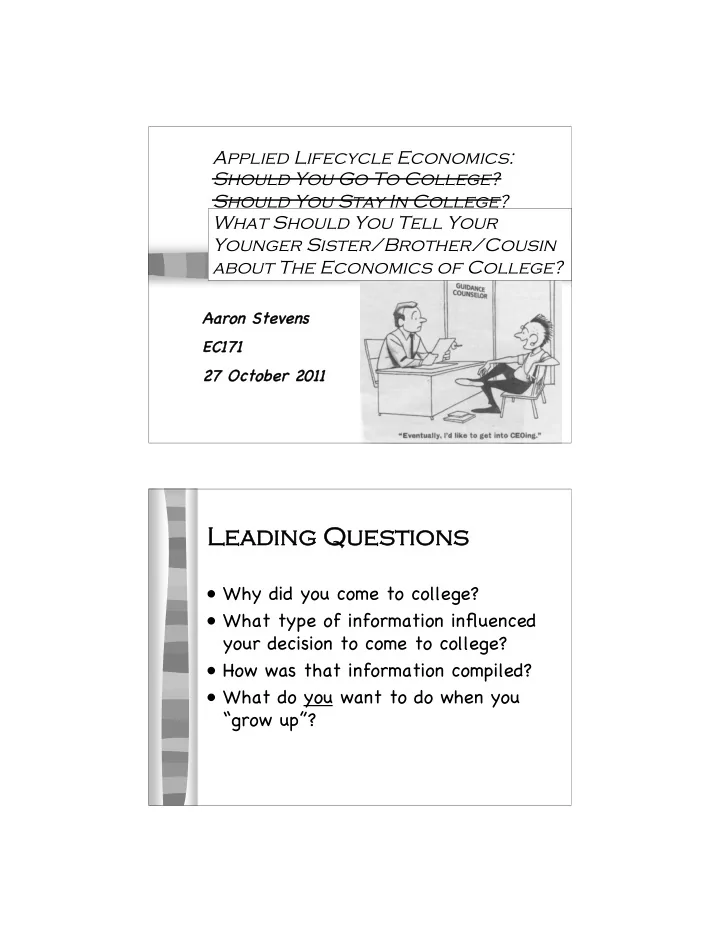
Applied Lifecycle Economics: Should You Go To College? Should You Stay In College? What Should You Tell Your Younger Sister/Brother/Cousin about The Economics of College? Aaron Stevens Aa EC1 EC171 71 27 27 October tober 201 2011 1


slide-1
SLIDE 1

1

Aa Aaron Stevens EC1 EC171 71 27 27 October tober 201 2011

Applied Lifecycle Economics: Should You Go To College? Should You Stay In College? What Should You Tell Your Younger Sister/Brother/Cousin about The Economics of College?

Leadi Leading ng Questi uestions ns

  • Why did you come to college?
  • What type of information influenced

your decision to come to college?

  • How was that information compiled?
  • What do you want to do when you

“grow up”?

slide-2
SLIDE 2

Wh What They Said About Go Going to Co College

Lifetime Earnings Soar with Education.

http://usgovinfo.about.com/library/weekly/aa072602a.htm

Wh What Are The Costs of a Col College De Degre ree?

  • Direct costs: tuition, room and board, books

and materials, entertainment

  • Financing costs: loan payments or forgone

use of capital

  • Opportunity cost?

Add it up: how much does this cost?

slide-3
SLIDE 3

Fai Failu lure re to to Get t a a De Degre gree

6-year graduation rates, 2008 data:

Source: http://www.higheredinfo.org/dbrowser/index.php

slide-4
SLIDE 4

Col College Grad Grads Hol Holding No Non-Co College Jobs

Source: “Outcomes for College Graduates” http://www2.ed.gov/pubs/CollegeForAll/graduates.html

Col College Grad Grads Hol Holding No Non-Co College Jobs

According to BLS 17,000,000 Americans with college degrees are doing jobs that don’t require a degree.

slide-5
SLIDE 5

Stu Stude dent nt Loan Loan Hell ll

  • Average student loan debt among graduates
  • f private non-profit institutions: $34,212
  • 71% of students borrowed
  • Many borrowers pay more in loan payments

than rent!

  • Student loan debt now exceeds credit card

debt http://www.federalreserve.gov/RELEASES/g19/Current/

  • Up to 25% of borrowers default on student

loans

  • “Government Vastly Undercounts Defaults”

http://chronicle.com/article/Many-More-Students-Are/66223/

See: ee: http://www.fi .finaid.o .org/loans/

Apples Apples to to Apples Apples

How can we do an apples-to-apples analysis?

  • What is the total cost of a BU degree?
  • What if Mom and Dad are paying?
  • What is your next best alternative?
  • What about taxes and benefits?
  • Back to the future analysis using ESPlanner.
slide-6
SLIDE 6

Non-College Jobs

"there are something like 50 million jobs

  • ut there that don't require a bachelor's

degree and pay upwards of $40,000 a year."

  • - Harlow Unger, author of "But What If I Don't Want to Go to

College? A Guide to Success Through Alternative Education.”

Top 25 highest paying jobs that don’t require a college degree:

http://jobs.aol.com/articles/2009/06/26/25-highest-paying-jobs-no-bachelors-degree-required/

Cal Calcu culat ating Cos Costs

TOTAL: $59,714

slide-7
SLIDE 7

Thi This s is s Your Your Li Life fe

What will you be when you grow up?

  • You the electrician
  • You the engineer

(and who would you want to marry?)

Thi This s is s Your Your Li Life fe

Electrical you:

  • Begin work after high school, starting salary of

$43,178.

  • After 5 years, you earn the mean salary of

$48,100.

Software Engineering you:

  • Graduate from BU, starting salary is $49,928.
  • After 10 years, you earn the mean salary of

$72,010.

US Department of Labor, “May 2007 Occupational Employment and Wage Estimates -- National Cross-Industry Estimates”. http://www.bls.gov/oes/2007/may/oes_nat.htm

slide-8
SLIDE 8

Con Consump mption

  • n Smoot

Smoothing

What will you be when you grow up?

Common Common Assump mption

  • ns
  • Everyone retires at age 65
  • College is paid for by borrowing
  • student loans paid back over 30 years
  • interest rate of 7.65% (average of Stafford

Loans and Federal PLUS loans)

  • Ceteris Paribus:
  • No spouses, children, houses, etc.
  • “Living standard” is consumption-smoothed

after-tax income less savings.

slide-9
SLIDE 9

You You the the

Methodology note: account for opportunity cost (time) by adjusting the age when subject enters workforce.

You You the the

slide-10
SLIDE 10

An An Elec lectri trician? an?

Phrases heard at the dinner table:

  • “What kind of job is that for a ….. ?”
  • “We didn’t work this hard for you to

become a … !

Di Dire rect ct Cos Cost t Colle College ge:

Use student loan to account for direct cost and finance cost of college:

slide-11
SLIDE 11

You You the the

Assume: working retail for $9/hour = $18,000/year. Methodology note: account for opportunity cost (time) by adjusting the age when subject enters workforce.

You You the the

I’m not dead yet! How am I going to eat?

slide-12
SLIDE 12

You You the the @

Notice: the costs of a college education are the same irrespective of course of study.

You You the the @

slide-13
SLIDE 13

You You the the You You the the

slide-14
SLIDE 14

You You the the

St Standa ndard d of

  • f Li

Living ng

slide-15
SLIDE 15

Wh What You Learned Today

Just Just “go going to college” d doesn’t ne necessa ssari rily ly bui uild ld Hum uman n Capi pita tal! l! Inc Inclu lude actu tual co costs and opportunity co cost, years years of lost wages ages, bo borro rrowing Ma Make an apples-to-apples comparison an and d ev eval aluat uate e stan andard dard of living! g!

Announc Announceme ment nts and nd To

  • Do

Do

Readings for Today and Thursday:

  • Deb

ebt-Free ee U

  • STTE: ch 9, 10
  • Government Vastly Undercounts Defaults

http://chronicle.com/article/Many-More-Students-Are/66223/

  • http://www.studentloanjustice.org/

Ho Homework 6: 6: do on n your own n to see what you you lear earn Ho Homework 7: 7: assigne ned TUE TUE 11/1, due 11/3

slide-16
SLIDE 16

Follow Follow up Readi ading ng

  • Freeman, Richard B. "The Facts about the Declining

Economic Value of College." Journal of Human Resources 15.1 (1980): 124-42. EconLit. ESBSOhost. Boston University Library. 25 Sep. 2008.