LCCMR ID: 207-G Project Title: RELC "Gardenology" Project - - PDF document

lccmr id 207 g
SMART_READER_LITE
LIVE PREVIEW

LCCMR ID: 207-G Project Title: RELC "Gardenology" Project - - PDF document

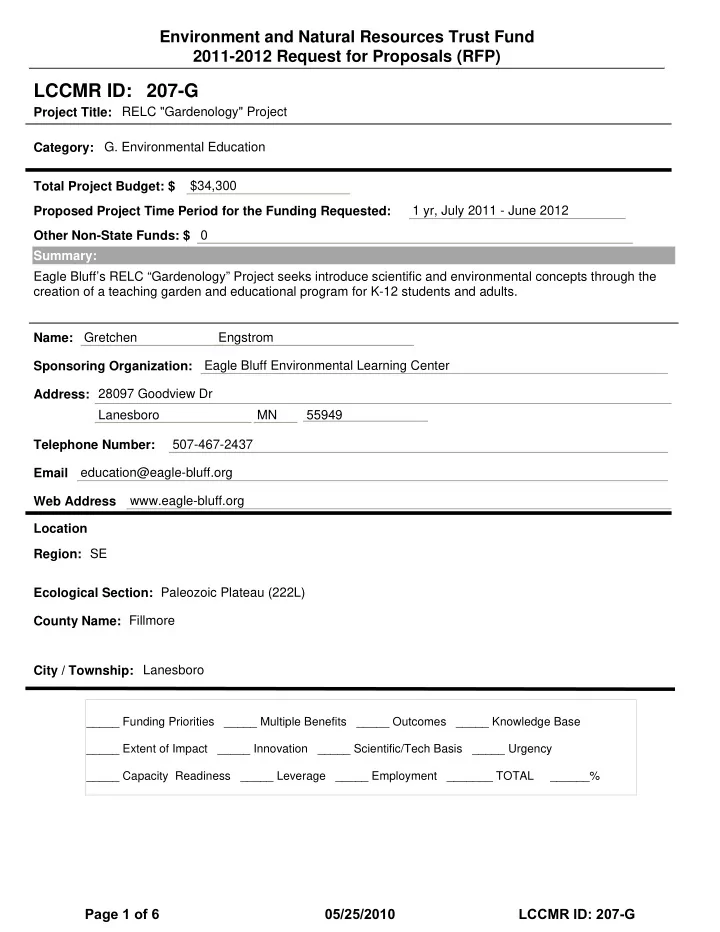
Environment and Natural Resources Trust Fund 2011-2012 Request for Proposals (RFP) LCCMR ID: 207-G Project Title: RELC "Gardenology" Project Category: G. Environmental Education Total Project Budget: $ $34,300 Proposed Project


slide-1
SLIDE 1

Environment and Natural Resources Trust Fund 2011-2012 Request for Proposals (RFP)

RELC "Gardenology" Project $34,300 1 yr, July 2011 - June 2012 Gretchen Engstrom Eagle Bluff Environmental Learning Center 28097 Goodview Dr Lanesboro MN 55949 507-467-2437 education@eagle-bluff.org www.eagle-bluff.org Fillmore Lanesboro Eagle Bluff’s RELC “Gardenology” Project seeks introduce scientific and environmental concepts through the creation of a teaching garden and educational program for K-12 students and adults. Project Title: Total Project Budget: $ Proposed Project Time Period for the Funding Requested: Other Non-State Funds: $ Name: Sponsoring Organization: Address: Telephone Number: Email Web Address County Name: City / Township: Region: Summary: SE Location Ecological Section: Paleozoic Plateau (222L)

_____ Funding Priorities _____ Multiple Benefits _____ Outcomes _____ Knowledge Base _____ Extent of Impact _____ Innovation _____ Scientific/Tech Basis _____ Urgency _____ Capacity Readiness _____ Leverage _____ Employment _______ TOTAL ______%

Category:

  • G. Environmental Education

LCCMR ID: 207-G

Page 1 of 6 05/25/2010 LCCMR ID: 207-G

slide-2
SLIDE 2

2011-2012 MAIN PROPOSAL

PROJECT TITLE: RELC “Garden-ology” Project: Introducing scientific and environmental concepts through garden-based education. PROJECT STATEMENT: Gardens can address biological and ecological issues such as species/habitat loss, resource degradation, and CO2 production; when used as an educational tool to introduce students to those concepts, a garden can have an even greater impact. Minnesota’s Residential Environmental Learning Centers (RELC’s) have established themselves as leader in environmental education with over 60,000 students participating in their programming with over 15,000 from 130 schools visiting Eagle Bluff alone. With the addition of a teaching garden and learning lab, Eagle Bluff is seeking to utilize techniques which effectively teach scientific and environmental concepts and subsequently serve as a model to be replicated at all Minnesota RELC’s or similar educational facilities. The project goals are 1.Establish a garden as a teaching tool and student learning lab in order to create habitat for pollinators and other beneficial species, conserve soil and water resources, and demonstrate CO2 reducing activities; 2.Establish a hands-on garden-based educational program in order to introduce K-12 students to wildlife habitat needs and techniques for preventing habitat loss, sustainable gardening techniques in order to conserve soil and water resources and composting/planting native species as a way to combat CO2 production and reinforce the concept of energy cycling; and 3.Provide resources for the classroom which reinforce garden-based experiences and would result in the use of garden-based activities in the

  • school. We will achieve our goals by constructing habitat for wildlife, employing sustainable

gardening techniques, planting ecosystem specific and native plants, composting, integrating the garden into current educational programming, establishing and promoting a new class on sustainable gardening, creating and promoting pre/post Eagle Bluff-visit activities for classroom use, designing and fabricating interpretive signs which engage visitors/students during non-formal educational opportunities, creating and distributing handouts for garden visitors, and partnering with Earth Partnership for Schools which offers teacher training on developing gardens/native plantings and integrating them into school curriculum.

  • II. DESCRIPTION OF PROJECT ACTIVITIES

Activity 1: Establish teaching garden. Budget: $10,100 Phase one will establish the infrastructure that we will need to begin growing and to subsequently demonstrate the ecological and biological concepts we will teach about. The tasks associated will provide habitat for beneficial animals, employ sustainable gardening techniques, and set-up a functional composting system. Outcomes will be measured by: tracking the completion of each project and tracking the populations of beneficial animals which utilize the garden. Outcome Completion Date Construction of raised beds. Aug 2011 Installation of fencing and benches. Aug 2011 Walkway construction. Aug 2011 Installation of rain barrel watering and outdoor sink system. Aug 2011 Installation of wildlife habitat structures. Aug 2011 Seeds and plants purchased. Aug 2011 Re-installation of composters. Aug 2011 Activity 2: Establish educational programming. Budget: $13,300 The garden will be integrated into current educational programming in order to teach biological and ecological concepts. Classes to utilize garden classroom include: Wildlife Ecology (habitat, predator/prey, limiting factors), Insects (habitat, pollinators), Birds (habitat, pollinators), Fungus AmongUs (energy cycle, decomposition), FoodWISE (CO2, energy cycle), and Pioneer Life (heirloom species). We will design and offer a new Eagle Bluff class on sustainable gardening/native

Page 2 of 6 05/25/2010 LCCMR ID: 207-G

slide-3
SLIDE 3
  • plants. Lastly, interpretive signs will be installed which invite visitors to engage with the garden

during non-formal educational opportunities. Outcomes will be measured by tracking the number of students participating in current classes that utilize the garden and tracking the number of students that participate in the new garden-based class. Outcome Completion Date 1.Garden Activities designed which integrate into current programming March 2012

  • 2. A new garden-based class designed and added to curriculum catalogue. March 2012
  • 3. Students participating in new garden class.

April 2012

  • 4. Interpretive garden signage installed.

May 2012 Activity 3: Design educational resources. Budget: $10,900 Educational resources designed for the school and home will be distributed which reinforce student experiences as part of the garden programming at Eagle Bluff. The resources include: handouts for garden visitors, pre/post Eagle Bluff-visit activities, and family pages. The Earth Partnership for Schools program will be offered to educators interested in establishing native plantings as a teaching tool and student learning lab. Outcomes will be measured by tracking the number of handouts distributed, surveying teachers’ utilization of and satisfaction with the pre/post activities, tracking surveying EPS workshop participants. Outcome Completion Date

  • 1. Garden handouts designed and utilized.

April 2012

  • 2. Pre/post activities and created and promoted.

April 2012

  • 3. Educator attendance at the 2011 EPS summer institute.

June 2012

  • III. PROJECT STRATEGY A. Project Team/Partners Grant Recipients: Gretchen Engstrom, Eagle

Bluff ELC, Gretchen will coordinate the project and design the curriculum. Sara Sturgis, Eagle Bluff ELC, Sara will assist with curriculum development and graphic design of the interpretive panels and print materials. Darin Johnson, Eagle Bluff ELC, Darin will assist with the labor and construction of the garden infrastructure. Contributing Partners: Rick Hall, Earth Partnership for Schools, Rick will consult on the curriculum development and teacher training workshop. Shannon Carmody, Seed Savers Exchange, Shannon will consult on the garden layout/development and use of native

  • plantings. Seed Savers has also committed to providing Eagle Bluff with heirloom seeds as part of

their Herman’s Garden Program. B. Timeline Requirements: With respect to the seasonality of gardens, we would begin establishing the garden infrastructure and select wildlife habitat structures in July 2011 and completed by August; if weather does not cooperate we would postpone construction until March. September to March, work would begin on the on-site educational program, planning the EPS teacher workshop, promoting the garden curriculum opportunities with schools, and designing the interpretive signs and handouts. Beginning April, we would the begin the planting process, complete the installation of the remaining wildlife structures and begin utilizing the garden curriculum with schools. Interpretive signs would be installed by the end of May. The EPS teacher workshop would be held in late June 2012 once the garden has been established and the curriculum piloted by schools. C. Long-Term Strategy and Future Funding Needs: For the past two years, Eagle Bluff has been working to establish a garden-based program and have committed staff time as such. A plot has been laid out and research and design work has begun including preliminary acquisition of some gardening items. Support and supplies have been garnered from Seed Saver’s Exchange (heirloom seeds), POET Biorefining (rain barrels), MPCA grant (composting barrels), the Sustainable Dream Greenhouse (soaker hoses and financial support), and we have established a relationship with the Jeffer’s Foundation of Prior Lake to provide financial support of teacher workshops like the Earth Partnership for Schools. After its initial start up, Eagle Bluff is prepared to support this project’s long term needs in its entirety. Replacement items, repairs, annual supplies (i.e. seeds), and staff time will be supported through Eagle Bluff’s operating budget. We will also devote time and resources to assist other RELC’s to establish their own garden and garden- based educational program.

Page 3 of 6 05/25/2010 LCCMR ID: 207-G

slide-4
SLIDE 4

BUDGET ITEM Eagle Bluff Personnel: Project leader/ Curriculum coord: Gretchen Engstrom (0.5 FTE) = 15,000 Curriculum and graphic design: Sara Sturgis - 120 hrs x 25.00/hr = 3,000 Labor and construction: Darin Johnson - 40 hrs x 20.00/hr = 800 Contracts: N/A Equipment/Tools/Supplies: Lumber -3,000 Permanent Fencing and Gates - 2000 Gravel - 500 Planting containers - 300 Compost sifters (2) - 100 Plantings (perrenials, fruit trees, etc.) - 700 Storage shed - 1,000 Garden cart (2) - 500 Outdoor sink - 200 Wildlife structures: observation bee hive, nesting and watering areas - 500 Acquisition (Fee Title or Permanent Easements):N/A Travel: N/A Additional Budget Items: Interpretive signs - 3,000 Printing costs - 200 Workshop support - 3,000 TOTAL ENVIRONMENT & NATURAL RESOURCES TRUST FUND $ REQUEST SOURCE OF FUNDS AMOUNT Status Other Non-State $ Being Applied to Project During Project Period: N/A N/A Other State $ Being Applied to Project During Project Period: N/A In-kind Services During Project Period: Curriculum and graphic design - Eagle Bluff ELC - 3,000 Heirloom seeds and planning consulation - Seed Savers Exchange - 500 Workshop planning consultation - Earth Partnership for Schools - 500 Garden design consultation - Susainable Dream Greenhouse - 500 Bed Fill - Scheevel Farms - 250 4,750 $ Secured Remaining $ from Current ENRTF Appropriation (if applicable): N/A Funding History: Composters - MPCA (Acquired as a result of a different funding project, will be integrated into this project) - 1,500 Plant supports and rainbarrel structure- MN Ag inthe Classroom - 200 Soaker hoses - Sustainable Dream Greenhouse - 25 Rain barrels - Poet Biorefining - 150 Heirloom seed stock - Seed Saver's Exchange - 250 2,175 $ AMOUNT

2011-2012 Detailed Project Budget

  • IV. TOTAL TRUST FUND REQUEST BUDGET - 1 year
  • V. OTHER FUNDS

18,800 $ 34,300 $ 9,300 $ N/A N/A 6,200 $ N/A

Page 4 of 6 05/25/2010 LCCMR ID: 207-G

slide-5
SLIDE 5

Project Manager Qualifications Gretchen Engstrom has 12 years of experience in Environmental Education with the last six as Science Education Coordinator at Eagle Bluff ELC. Gretchen has overseen the revision of over 20 existing classes, the addition of new classes, the creation of pre/post activities, and MN state graduation standards alignment. For the last two years, Gretchen has directed Eagle Bluff’s garden education efforts. Gretchen has a BA in Biology from St. Olaf College and a Certificate in Environmental Education from the University of Minnesota-Duluth. Organization Description Eagle Bluff Environmental Learning Center is located in rural southeastern Minnesota, where it was established as a (501) (c) (3) private, non-profit, member supported educational institution in 1978. It is one of several members of the residential environmental learning center (RELC) network and now welcomes over 15,000 participants on an annual basis. As a fully accredited school with qualified educators on staff who work closely with classroom teachers, we offer three-hour intensive classes that incorporate indoor and outdoor activities focused on hands on

  • learning. Schools stay three to five days giving time to build an interrelated view of the

curriculum concepts. Eagle Bluff programs serve varied special populations, but 90% of our programs target fifth through eighth grade students. Schools come from the suburbs, inner city, and rural communities of Minnesota, Iowa, and Wisconsin. Program offerings are diverse and

  • extensive. Teachers can choose from the following classes:
  • Challenge Skills Classes: Group Challenges, Tree Tops High Ropes, Rock Climbing
  • Adventure Classes: Winter Survival, Orienteering, Archery, Root River Snowshoe,

Canoeing, Cross Country Skiing, Minimum Impact Camping

  • Earth and Physical Science Classes: Earth Exploration, Karst Geology, Stream Lab
  • Culture Classes: Oneota Native American Life, Pioneer Life, Root River Hike
  • Ecology Classes: Wildlife Ecology, The Big Freeze, Forest Ecology, River Ecology
  • Natural History: Insects, Birds, Amphibians, Animal Signs, Trees and Keys, Fungus

AmongUs and Pond Life. Eagle Bluff is surrounded by 1,000 acres of mixed hardwood forest, upland prairies, trout streams, and the Root River. Our campus is open to the public and includes the Schroeder Renewal Resources Building, Dining Hall, Dormitory (accommodating 250), and our Discovery Center Classroom Center. The complex also includes a flexible auditorium, an enclosed, two story climbing wall with eight climbing routes, a spacious activity room large enough to host indoor official archery competitions, four raptor mews, and a greenhouse. In addition to the facilities themselves, Eagle Bluff maintains three distinct outdoor high ropes courses, group challenge courses, two group campfire rings, a demonstration prairie garden, interpretive nature trails, cross country ski trails, and several remote program sites.

Page 5 of 6 05/25/2010 LCCMR ID: 207-G

slide-6
SLIDE 6

Page 6 of 6 05/25/2010 LCCMR ID: 207-G