Pre-Calc Trigonometry 2015-03-24 www.njctl.org Slide 3 / 207 - - PDF document

pre calc
SMART_READER_LITE
LIVE PREVIEW

Pre-Calc Trigonometry 2015-03-24 www.njctl.org Slide 3 / 207 - - PDF document

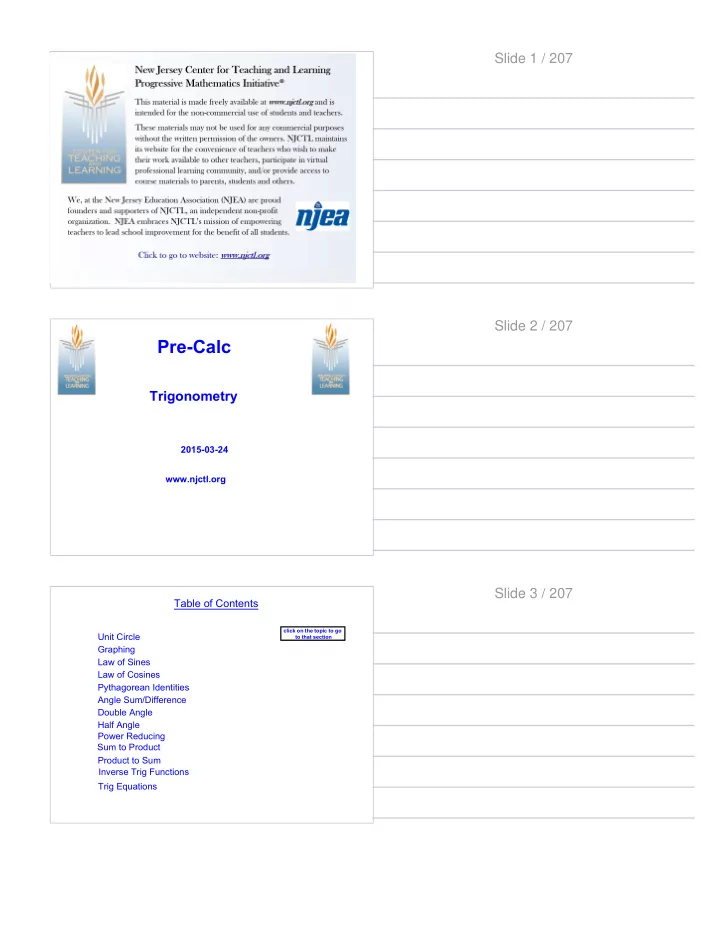
Slide 1 / 207 Slide 2 / 207 Pre-Calc Trigonometry 2015-03-24 www.njctl.org Slide 3 / 207 Table of Contents click on the topic to go Unit Circle to that section Graphing Law of Sines Law of Cosines Pythagorean Identities Angle


slide-1
SLIDE 1

Slide 1 / 207

Pre-Calc

Trigonometry

www.njctl.org 2015-03-24

Slide 2 / 207

Table of Contents

Unit Circle Graphing Law of Sines Law of Cosines Pythagorean Identities Angle Sum/Difference Double Angle Half Angle Sum to Product Inverse Trig Functions Trig Equations Product to Sum Power Reducing

click on the topic to go to that section

Slide 3 / 207

slide-2
SLIDE 2

Unit Circle

Return to Table of Contents

Slide 4 / 207

Unit Circle

Goals and Objectives

Students will understand how to use the Unit Circle to find angles and determine their trigonometric value.

Slide 5 / 207

Why do we need this?

The Unit Circle is a tool that allows us to determine the location of any angle. Unit Circle

Slide 6 / 207

slide-3
SLIDE 3

Special Right Triangles

Unit Circle

Slide 7 / 207

Example 1: Find a Example 2: Find b & c 6 a 4 b c

Unit Circle

Teacher Teacher

Slide 8 / 207

Example 3: Find d Example 4: Find e 8 d e 9

Unit Circle

Teacher Teacher

Slide 9 / 207

slide-4
SLIDE 4

Example 5: Find f Example 6: Find g & h 1 f 1 h g

Unit Circle

Teacher Teacher

Slide 10 / 207

30o 45o 60o 30o 45o 60o 30o 45o 60o 30o 45o 60o

Unit Circle

Slide 11 / 207

Unit Circle

Slide 12 / 207

slide-5
SLIDE 5

Unit Circle

Slide 13 / 207

Unit Circle

Slide 14 / 207

Unit Circle

Slide 15 / 207

slide-6
SLIDE 6

Slide 16 / 207 Slide 17 / 207 Slide 18 / 207

slide-7
SLIDE 7

Slide 19 / 207 Slide 20 / 207 Slide 21 / 207

slide-8
SLIDE 8

4 Which function is positive in the second quadrant? Choose all that apply.

A

cos x

B

sin x

C

tan x

D

sec x

E

csc x

F

cot x

Unit Circle

Teacher Teacher

Slide 22 / 207

5 Which function is positive in the fourth quadrant? Choose all that apply.

A

cos x

B

sin x

C

tan x

D

sec x

E

csc x

F

cot x

Unit Circle

Teacher Teacher

Slide 23 / 207

6 Which function is positive in the third quadrant? Choose all that apply.

A

cos x

B

sin x

C

tan x

D

sec x

E

csc x

F

cot x

Unit Circle

Teacher Teacher

Slide 24 / 207

slide-9
SLIDE 9

Teacher Teacher

Example: Given the terminal point of (

  • 5/13,-12/13)

find sin x, cos x, and tan x.

Unit Circle

Slide 25 / 207

7 Given the terminal point find tan x.

Unit Circle

Teacher Teacher

Slide 26 / 207

8 Given the terminal point find sin x.

Unit Circle

Teacher Teacher

Slide 27 / 207

slide-10
SLIDE 10

9 Given the terminal point find tan x.

Unit Circle

Teacher Teacher

Slide 28 / 207

10 Knowing sin x = Find cos x if the terminal point is in the first quadrant

Unit Circle

Teacher Teacher

Slide 29 / 207

11 Knowing sin x = Find cos x if the terminal point is in the 2

nd quadrant

Unit Circle

Teacher Teacher

Slide 30 / 207

slide-11
SLIDE 11

Slide 31 / 207

Graphing

Return to Table of Contents

Slide 32 / 207

Graphing cos, sin, & tan Graph by using values from the table. Since the values are based on a circle, values will repeat.

Graphing

Slide 33 / 207

slide-12
SLIDE 12

Graphing cos, sin, & tan Graph by using values from the table. Since the values are based on a circle, values will repeat.

Graphing

Slide 34 / 207

Graphing cos, sin, & tan Graph by using values from the table. Since the values are based on a circle, values will repeat.

Graphing

Slide 35 / 207

Graphing cos, sin, & tan Graph by using values from the table. Since the values are based on a circle, values will repeat.

Graphing

Slide 36 / 207

slide-13
SLIDE 13

Parts of a trig graph

x cos x

Amplitude Period

Graphing

Slide 37 / 207 Slide 38 / 207

y= a sin(x) or y= a cos(x) In the study of transforming parent functions, we learned "a" was a vertical stretch or shrink. For trig functions it is called the amplitude.

Graphing

Slide 39 / 207

slide-14
SLIDE 14

In y= cos(x), a=1 This means at any time, y= cos (x) is at most 1 away from the axis it is oscillating about. Find the amplitude: y= 3 sin(x) y= 2 cos(x) y= -4 sin(x)

Graphing

Teacher Teacher

Slide 40 / 207

13 What is the amplitude of y = 3cosx ?

Graphing

Teacher Teacher

Slide 41 / 207

14 What is the amplitude of y = 0.25cosx ?

Graphing

Teacher Teacher

Slide 42 / 207

slide-15
SLIDE 15

15 What is the amplitude of y = -sinx ?

Graphing

Teacher Teacher

Slide 43 / 207 Slide 44 / 207

y= sin b(x) or y= cos b(x) In the study of transforming parent functions, we learned "b" was a horizontal stretch or shrink. y= cos x has b=1. Therefore cos x can make one complete cycle is 2#. For trig functions it is called the period.

Graphing

Slide 45 / 207

slide-16
SLIDE 16

y = cos x completes 1 "cycle" in 2#. So the period is 2π. y = cos 2x completes 2 "cycles" in 2 # or 1 "cycle" in #. The period is # y = cos 0.5x completes

1/2 a cycle in 2#. The period is 4#.

Graphing

Slide 46 / 207

The period for y= cos bx or y= sin bx is

Graphing

Slide 47 / 207

16 What is the period of

A B C D

Graphing

Teacher Teacher

Slide 48 / 207

slide-17
SLIDE 17

17 What is the period of

A B C D

Graphing

Teacher Teacher

Slide 49 / 207

18 What is the period of

A B C D

Graphing

Teacher Teacher

Slide 50 / 207 Slide 51 / 207

slide-18
SLIDE 18

y= sin (x+c) or y= cos (x+c) In the study of transforming parent functions, we learned "c" was a horizontal shift y= cos (x+# ) has c = π. The graph of y= cos (x+π) is the graph of y=cos(x) shifted to the left # . For trig functions it is called the phase shift.

Graphing

Slide 52 / 207 Slide 53 / 207 Slide 54 / 207

slide-19
SLIDE 19

Slide 55 / 207 Slide 56 / 207 Slide 57 / 207

slide-20
SLIDE 20

Slide 58 / 207

y= sin (x) + d or y= cos (x) + d In the study of transforming parent functions, we learned "d" was a vertical shift

Graphing

Slide 59 / 207

23 What is the vertical shift in

Graphing

Teacher Teacher

Slide 60 / 207

slide-21
SLIDE 21

24 What is the vertical shift in

Graphing

Teacher Teacher

Slide 61 / 207

25 What is the vertical shift in

Graphing

Teacher Teacher

Slide 62 / 207 Slide 63 / 207

slide-22
SLIDE 22

Slide 64 / 207 Slide 65 / 207 Slide 66 / 207

slide-23
SLIDE 23

Slide 67 / 207 Slide 68 / 207

30 What is the amplitude of this cosine graph?

Graphing

Teacher Teacher

Slide 69 / 207

slide-24
SLIDE 24

31 What is the period of this cosine graph? (use 3.14 for pi)

Graphing

Teacher Teacher

Slide 70 / 207

32 What is the phase shift of this cosine graph?

Graphing

Teacher Teacher

Slide 71 / 207

33 What is the vertical shift of this cosine graph?

Graphing

Teacher Teacher

Slide 72 / 207

slide-25
SLIDE 25

34 Which of the following of the following are equations for the graph?

A B C D

Graphing

Teacher Teacher

Slide 73 / 207

Law of Sines

Return to Table of Contents

Slide 74 / 207 Slide 75 / 207

slide-26
SLIDE 26

When to use Law of Sines

(Recall triangle congruence statements) · ASA · AAS · SAS (use Law of Cosines) · SSS (use Law of Cosines) · SSA (use Law of Sines- but be cautious!)

Law of Sines

Slide 76 / 207 Slide 77 / 207 Slide 78 / 207

slide-27
SLIDE 27

Teacher Teacher

Example: Teddy is driving toward the Old Man of the Mountain, the angle of elevation is 10 degrees, he drives another mile and the angle of elevation is 30 degrees. How tall is the mountain? 30 10 5280 x y

Law of Sines

Slide 79 / 207 Slide 80 / 207 Slide 81 / 207

slide-28
SLIDE 28

Law of Sines with SSA. SSA information will lead to 0, 1,or 2 possible solutions. The one solution answer comes from when the bigger given side is

  • pposite the given angle.

The 2 solution and no solution come from when sin

  • 1 is used in the

problem and the answer and its supplement are evaluated, sometimes both will work, sometimes one will work,and sometimes neither will work.

Slide 82 / 207

Teacher Teacher

Example solve triangle ABC A B C 40 5 7

Law of Sines

Slide 83 / 207

Teacher Teacher

Example solve triangle ABC A B C 40 7 5

Law of Sines

Slide 84 / 207

slide-29
SLIDE 29

Teacher Teacher

A B C 40 7 5 64.1 Solution 1 115.9 A B C 40 7 5 Solution 2

Law of Sines

Slide 85 / 207

Teacher Teacher

Example solve triangle ABC A B C 50 14 7

Law of Sines

Slide 86 / 207 Slide 87 / 207

slide-30
SLIDE 30

38 How many triangles meet the following conditions?

Law of Sines

Teacher Teacher

Slide 88 / 207

39 How many triangles meet the following conditions?

Law of Sines

Teacher Teacher

Slide 89 / 207

Law of Cosines

Return to Table of Contents

Slide 90 / 207

slide-31
SLIDE 31

Slide 91 / 207

When to use Law of Sines

(Recall triangle congruence statements) · ASA · AAS · SAS (use Law of Cosines) · SSS (use Law of Cosines) · SSA (use Law of Sines- but be cautious!) When we began to study Law of Sines, we looked at this table: Its now time to look at SAS and SSS triangles.

Law of Cosines

Slide 92 / 207 Slide 93 / 207

slide-32
SLIDE 32

Slide 94 / 207 Slide 95 / 207 Slide 96 / 207

slide-33
SLIDE 33

Example: Joe went camping. Sitting at his camp site he noticed it was 3 miles to one end of the lake and 4 miles to the other end. He determined that the angle between these two line of sites is 105

  • degrees. How far is it across the lake?

3 4 105 x

Law of Cosines

Teacher Teacher

Slide 97 / 207 Slide 98 / 207 Slide 99 / 207

slide-34
SLIDE 34

Slide 100 / 207

Identities

Return to Table of Contents

Slide 101 / 207

Trigonometry Identities are useful for simplifying expressions and proving

  • ther identities.

Slide 102 / 207

slide-35
SLIDE 35

Pythagorean Identities

Return to Table of Contents

Slide 103 / 207

Trigonometric Ratios

Pythagorean Identities

Slide 104 / 207

Pythagorean Identities

Pythagorean Identities

Slide 105 / 207

slide-36
SLIDE 36

Simplify:

Pythagorean Identities

Teacher Teacher

Slide 106 / 207

Simplify:

Pythagorean Identities

Teacher Teacher

Slide 107 / 207

Simplify:

Pythagorean Identities

Teacher Teacher

Slide 108 / 207

slide-37
SLIDE 37

Prove:

Pythagorean Identities

Teacher Teacher

Slide 109 / 207 Slide 110 / 207

Prove:

Pythagorean Identities

Teacher Teacher

Slide 111 / 207

slide-38
SLIDE 38

Slide 112 / 207

43 The following expression can be simplified to which choice?

A B C D

Pythagorean Identities

Teacher Teacher

Slide 113 / 207

44 The following expression can be simplified to which choice?

A B C D

Pythagorean Identities

Teacher Teacher

Slide 114 / 207

slide-39
SLIDE 39

45 The following expression can be simplified to which choice?

A B C D

Pythagorean Identities

Teacher Teacher

Slide 115 / 207

Angle Sum/Difference

Return to Table of Contents

Slide 116 / 207

Angle Sum/Difference Identities are used to convert angles we aren't familiar with to ones we are (ie. multiples of 30, 45, 60, & 90).

Angle Sum/Difference

Slide 117 / 207

slide-40
SLIDE 40

Sum/ Difference Identities

Angle Sum/Difference

Slide 118 / 207

Find the exact value of

Angle Sum/Difference

Teacher Teacher

Slide 119 / 207 Slide 120 / 207

slide-41
SLIDE 41

Find the exact value of

Angle Sum/Difference

Teacher Teacher

Slide 121 / 207

Find the exact value of

Angle Sum/Difference

Teacher Teacher

Slide 122 / 207

Prove:

Angle Sum/Difference

Teacher Teacher

Slide 123 / 207

slide-42
SLIDE 42

Prove:

Angle Sum/Difference

Teacher Teacher

Slide 124 / 207

46 Which choice is another way to write the given expression?

A B C D

Angle Sum/Difference

Teacher Teacher

Slide 125 / 207

47 Which choice is the exact value of the given expression?

A B C D

Angle Sum/Difference

Teacher Teacher

Slide 126 / 207

slide-43
SLIDE 43

Double Angle

Return to Table of Contents

Slide 127 / 207

Double-Angle Identities

Double Angle

Slide 128 / 207 Slide 129 / 207

slide-44
SLIDE 44

Write cos3x in terms of cosx

Double Angle

Teacher Teacher

Slide 130 / 207

48 Which of the following choices is equivalent to the given expression?

A B C D

Double Angle

Teacher Teacher

Slide 131 / 207 Slide 132 / 207

slide-45
SLIDE 45

50 Which of the following choices is equivalent to the given expression?

A B C D

Double Angle

Teacher Teacher

Slide 133 / 207

Half Angle

Return to Table of Contents

Slide 134 / 207 Slide 135 / 207

slide-46
SLIDE 46

Find the exact value of cos15 using Half-Angle Identity

Half Angle

Teacher Teacher

Slide 136 / 207

Find the exact value of tan 22.5

Half Angle

Teacher Teacher

Slide 137 / 207

51 Find the exact value of

A B C D

Half Angle

Teacher Teacher

Slide 138 / 207

slide-47
SLIDE 47

52 Find the exact value of

A B C D

Half Angle

Teacher Teacher

Slide 139 / 207

Find cos(u/2) if sin u= - 3/7 and u is in the third quadrant

Pythagorean Identity but Why Negative?

Half Angle

Teacher Teacher

Slide 140 / 207 Slide 141 / 207

slide-48
SLIDE 48

54 Find if and u is in the 4th quadrant?

A B C D

Half Angle

Teacher Teacher

Slide 142 / 207

Power Reducing Identities

Return to Table of Contents

Slide 143 / 207

Power Reducing Identities

Power Reducing Identities

Slide 144 / 207

slide-49
SLIDE 49

Reduce sin4x to an expression in terms of first power cosines.

Power Reducing Identities

Teacher Teacher

Slide 145 / 207

Reduce cos4x to an expression in terms of first power cosines.

Power Reducing Identities

Teacher Teacher

Slide 146 / 207

55 Which of the following choices is equivalent to the given expression?

A B C D

Power Reducing Identities

Teacher Teacher

Slide 147 / 207

slide-50
SLIDE 50

56 Which of the following choices is equivalent to the given expression?

A B C D

Power Reducing Identities

Teacher Teacher

Slide 148 / 207

57 Which of the following choices is equivalent to the given expression?

A B C D

Power Reducing Identities

Teacher Teacher

Slide 149 / 207

Sum to Product

Return to Table of Contents

Slide 150 / 207

slide-51
SLIDE 51

Sum to Product

Sum to Product

Slide 151 / 207

Write cos 11x + cos 9x as a product

Sum to Product

Teacher Teacher

Slide 152 / 207

Write sin 8x - sin 4x as a product

Sum to Product

Teacher Teacher

Slide 153 / 207

slide-52
SLIDE 52

Find the exact value of cos

5π/ 12 + cos π/12

Sum to Product

Teacher Teacher

Slide 154 / 207

Prove

Sum to Product

Teacher Teacher

Slide 155 / 207

Prove:

Sum to Product

Teacher Teacher

Slide 156 / 207

slide-53
SLIDE 53

58 Which of the following is equivalent to the given expression?

A B C D

Sum to Product

Teacher Teacher

Slide 157 / 207

59 Which of the following is equivalent to the given expression?

A B C D

Sum to Product

Teacher Teacher

Slide 158 / 207

60 Which of the following is not equivalent to the given expression?

A B C D

Sum to Product

Teacher Teacher

Slide 159 / 207

slide-54
SLIDE 54

Product to Sum

Return to Table of Contents

Slide 160 / 207 Slide 161 / 207

Rewrite as a sum of trig functions.

Product to Sum

Teacher Teacher

Slide 162 / 207

slide-55
SLIDE 55

Rewrite as a sum of trig functions.

Product to Sum

Teacher Teacher

Slide 163 / 207

61 Which choice is equivalent to the expression given?

A B C D

Product to Sum

Teacher Teacher

Slide 164 / 207 Slide 165 / 207

slide-56
SLIDE 56

Inverse Trig Functions

Return to Table of Contents

Slide 166 / 207 Slide 167 / 207 Slide 168 / 207

slide-57
SLIDE 57

Inverse Trig Functions

Since the cosine function does not pass the horizontal line test, we need to restrict its domain so that cos-1 is a function. cos x: Domain[0 , # ] Range[-1 , 1] cos-1 x: Domain[-1 , 1] Range[0 , π] Remember to find an inverse, switch x and y.

Inverse Trig Functions

Slide 169 / 207

1

  • 1

# # /2

y=cos-1x

Inverse Trig Functions

Slide 170 / 207

Inverse Trig Functions

Since the sine function does not pass the horizontal line test, we need to restrict its domain so that sin-1 is a function. sin x: Domain Range[-1 , 1] sin-1 x: Domain[-1 , 1] Range

Inverse Trig Functions

Slide 171 / 207

slide-58
SLIDE 58

y=sin-1x

1

  • 1

Inverse Trig Functions

Slide 172 / 207

Inverse Trig Functions

Since the tangent function does not pass the horizontal line test, we need to restrict its domain so that tan-1 is a function. tan x: Domain Range tan-1 x: Domain Range

Inverse Trig Functions

Slide 173 / 207

y=tan

  • 1x

Inverse Trig Functions

Slide 174 / 207

slide-59
SLIDE 59

Secant

Inverse Trig Functions

Slide 175 / 207

y=sec -1 x 1

  • 1

sec-1x : Domain: (-# ,-1] ∪ [1 , # ) Range: [0, # /2) ∪ [# , 3# /2)

Inverse Trig Functions

Slide 176 / 207

Cosecant

Inverse Trig Functions

Slide 177 / 207

slide-60
SLIDE 60

1

  • 1

Cosecant sec-1x : Domain: (-# ,-1] ∪ [1 , # ) Range: (0, # /2] ∪ (# , 3# /2]

Inverse Trig Functions

Slide 178 / 207

Cotangent

Inverse Trig Functions

Slide 179 / 207

Cotangent 1

  • 1

cot-1 x: Domain: Reals Range: (0 , # )

Inverse Trig Functions

Slide 180 / 207

slide-61
SLIDE 61

Restrictions

Inverse Trig Functions

Slide 181 / 207

Example: Evaluate the following expression.

Inverse Trig Functions

Teacher Teacher

Slide 182 / 207

Example: Evaluate the following expression.

Inverse Trig Functions

Teacher Teacher

Slide 183 / 207

slide-62
SLIDE 62

Example: Evaluate the following expressions.

Inverse Trig Functions

Teacher Teacher

Slide 184 / 207

63 Evaluate the following expression:

A B C D

Inverse Trig Functions

Teacher Teacher

Slide 185 / 207

64 Evaluate the following expression:

A B C D

Inverse Trig Functions

Teacher Teacher

Slide 186 / 207

slide-63
SLIDE 63

65 Evaluate the following expression:

A B C D

Inverse Trig Functions

Teacher Teacher

Slide 187 / 207

Example: Evaluate the following expressions.

Inverse Trig Functions

Teacher Teacher

Slide 188 / 207

Example: Evaluate the following expressions.

Inverse Trig Functions

Teacher Teacher

Slide 189 / 207

slide-64
SLIDE 64

Slide 190 / 207 Slide 191 / 207 Slide 192 / 207

slide-65
SLIDE 65

Trig Equations

Return to Table of Contents

Slide 193 / 207

To solve a trigonometry equation, apply the rules of algebra to isolate the trig function(s).

Examples: Solve.

Trig Equations

Teacher Teacher

Slide 194 / 207

To solve a trigonometry equation, apply the rules of algebra to isolate the trig function(s).

Examples: Solve.

Trig Equations

Teacher Teacher

Slide 195 / 207

slide-66
SLIDE 66

Examples: Solve.

Trig Equations

Teacher Teacher

Slide 196 / 207

Examples: Solve.

Trig Equations

Teacher Teacher

Slide 197 / 207

69 Find an apporoximate value of x on [0, ) that satisfies the following equation:

Trig Equations

Teacher Teacher

Slide 198 / 207

slide-67
SLIDE 67

Slide 199 / 207

Examples: Solve.

Trig Equations

Teacher Teacher

Slide 200 / 207

Examples: Solve.

Trig Equations

Teacher Teacher

Slide 201 / 207

slide-68
SLIDE 68

Examples: Solve.

Trig Equations

Teacher Teacher

Slide 202 / 207

Examples: Solve.

Trig Equations

Teacher Teacher

Slide 203 / 207

Examples: Solve.

Trig Equations

Teacher Teacher

Slide 204 / 207

slide-69
SLIDE 69

Examples: Solve.

Trig Equations

Teacher Teacher

Slide 205 / 207

71 Find an apporoximate value of x on [0, ) that satisfies the following equation:

Trig Equations

Teacher Teacher

Slide 206 / 207 Slide 207 / 207