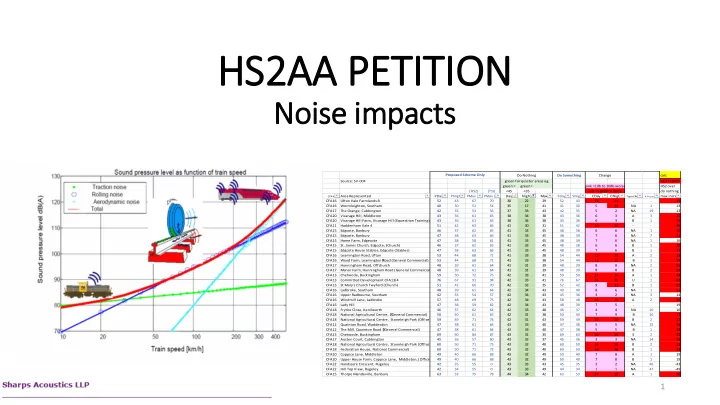
HS2AA PETITION Noise impacts Proposed Scheme Only Do Nothing Do - - PowerPoint PPT Presentation

hs2aa petition
SMART_READER_LITE
LIVE PREVIEW

HS2AA PETITION Noise impacts Proposed Scheme Only Do Nothing Do - - PowerPoint PPT Presentation

HS2AA PETITION Noise impacts Proposed Scheme Only Do Nothing Do Something Change calc Source: SV-004 green for quieter areas eg red =+20db green = green= pink =1db to 10db worse HS2 over (HS2) (TSI) <45 <35 red ='+10dB or


slide-1
SLIDE 1

HS2AA PETITION

Noise impacts

1

calc Source: SV-004 red =+20db green = green= HS2 over (HS2) (TSI) <45 <35 do nothing CFA # Area Represented PDay PNight PMax (a) PMax (b) Day Night Max SDay SNight CDay CNight Type Effect # Impacts max increase CFA16 Ufton Vale Farmlands B 52 43 67 70 30 22 29 52 43 22 21
  • 41
CFA16 Wormleighton, Southam 40 30 51 54 35 17 41 41 30 5 14 NA 1 13 CFA17 The Grange, Cubbington 42 35 53 56 37 33 43 42 35 5 2 NA 19 13 CFA20 Vicarage Hill, Middleton 43 36 61 63 38 34 38 43 36 6 3 A 3 25 CFA20 Vicarage Hill Farm, Vicarage Hill (Equestrian Training) 43 36 61 63 38 34 38 43 36 6 3 B 1 25 CFA11 Haddenham Vale 4 51 42 63 66 41 30 31 51 42 10 12
  • 35
CFA15 Edgcote, Banbury 46 37 62 65 41 33 45 48 38 6 6 NA 1 20 CFA15 Edgcote, Banbury 47 38 63 66 41 33 45 48 39 7 6 NA 7 21 CFA15 Home Farm, Edgecote 47 38 58 61 41 33 45 48 39 7 6 NA 1 16 CFA15
  • St. James Church, Edgcote, (Church)
46 37 62 65 41 33 45 48 38 6 6 B 1 20 CFA15 Edgcote House Stables, Edgcote (Stables) 47 38 63 66 41 33 45 48 39 7 6 B 1 21 CFA16 Leamington Road, Ufton 53 44 68 71 41 33 38 54 44 12 12 A 2 33 CFA16 Wood Farm, Leamington Road (General Commercial) 53 44 68 71 41 33 38 54 44 12 12 B 1 33 CFA17 Hunningham Road, Offchurch 48 39 61 64 41 31 39 48 39 8 8 NA 2 25 CFA17 Manor Farm, Hunningham Road (General Commercial) 48 39 61 64 41 31 39 48 39 8 8 B 2 25 CFA13 Chetwode, Buckingham 59 50 72 75 42 33 41 59 50 17 17 A 1 34 CFA13 Committed Development CFA13/4 76 67 91 94 42 33 41 76 67 34 33 U 1 53 CFA13 St Mary's Church Twyford (Church) 51 42 66 70 42 32 35 52 42 9 11 B 1 35 CFA16 Ladbroke, Southam 48 39 61 64 42 34 43 49 40 8 6 NA 1 21 CFA16 Upper Radbourne, Southam 42 33 54 57 42 34 43 45 36 3 2 NA 3 14 CFA16 Windmill Lane, Ladbroke 57 48 69 73 42 34 43 58 48 16 14 A 2 30 CFA16 Lady Hill 47 38 59 62 42 34 43 48 39 7 5
  • 19
CFA18 Frythe Close, Kenilworth 46 37 62 64 42 33 48 46 37 4 4 NA 10 16 CFA18 National Agricultural Centre, (General Commercial) 50 40 61 65 42 31 38 50 40 7 9 B 10 27 CFA18 National Agricultural Centre, Stoneleigh Park (Office) 59 49 71 74 42 31 43 59 49 16 18 B 2 31 CFA12 Quainton Road, Waddesdon 47 38 61 64 43 33 40 47 38 5 5 NA 15 24 CFA12 The Mill, Quainton Road (General Commercial) 47 38 61 64 43 33 40 47 38 5 5 B 1 24 CFA13 Chetwode, Buckingham 69 60 84 87 43 31 35 69 60 26 29 S 2 52 CFA17 Austen Court, Cubbington 45 36 57 60 43 33 37 45 36 3 3 NA 14 23 CFA18 National Agricultural Centre, Stoneleigh Park (Office) 60 50 71 73 43 32 40 60 50 16 18 B 2 33 CFA18 Federation House, National Commercial) 60 50 71 73 43 32 40 60 50 16 18 B 1 33 CFA20 Coppice Lane, Middleton 49 40 66 68 43 32 49 50 40 7 8 A 1 19 CFA20 Upper House Farm, Coppice Lane, Middleton, (Office) 49 40 66 68 43 32 49 50 40 7 8 B 1 19 CFA22 Handsacre Crescent, Rugeley 42 35 55 43 33 43 45 35 2 2 NA 46
  • 43
CFA22 Hill Top View, Rugeley 42 34 55 43 33 49 44 34 1 1 NA 47
  • 49
CFA15 Thorpe Mandeville, Banbury 63 53 75 78 44 34 42 63 53 18 19 A 1 36 red ='+10dB or more green for quieter areas eg Proposed Scheme Only Do Nothing Do Something Change pink =1db to 10db worse
slide-2
SLIDE 2

Doug Sharps

  • Member of Institute of Acoustics since its inception; Fellow for 30

years.

  • Chartered engineer and Fellow of Institution of Mechanical Engineers.
  • Expert witness at over 300 planning inquiries and court cases.
  • Advised on many major projects from Concorde, airports, ports,

Thames Tunnel, Channel tunnel.

2

slide-3
SLIDE 3

HS2AA – Scope of f Presentation

  • Not taking every point in Petition to avoid duplication.
  • Numerous points regarding defects in EIA process could be taken not least:
  • The inability of an individual to be able to identify the residual noise impact on their

property (a fundamental requirement of EIA Regs).

  • The absence of LAMAX noise contours and any LAMAX LOAEL.
  • Central theme:

HS2 proposed noise controls do not protect health and quality of life or the amenity of residents sufficiently during construction or operation of the

  • railway. They require amendment.

3

slide-4
SLIDE 4

Differences between HS2 and HS1

  • HS1 route follows transport corridors – HS2 does not.
  • Train frequency – HS2 much greater.
  • Train times of day – HS2 more trains earlier and later.
  • Speed – HS2 faster.
  • Noise implications – HS2 more invasive.

HS1 is a poor template or model for HS2.

4

28 Eurostars a day

slide-5
SLIDE 5

LOAEL and SOAEL

  • Effect threshold levels based on noise “dose-response”.
  • How people will behave if exposed to certain “total” noise levels.
  • Levels above SOAEL to be avoided.
  • Levels above LOAEL and below SOAEL to be mitigated and minimised.
  • LOAELs serve as HS2 design target (LAeqT and LAMAX).
  • If LOAEL or SOAEL too high, unacceptable impacts will result and

insufficient mitigation will be adopted to protect health, quality of life and amenity.

5

slide-6
SLIDE 6

Total Noise

  • WHO guidelines and Night Noise Guidelines provide “guideline

values” for total noise.

  • Total noise is noise from all sources – all-encompassing.
  • But HS2 adopts LOAEL and SOAEL thresholds for rail operations in

isolation (and only uses total noise for assessing increases).

  • If HS2 is designed to LOAEL thresholds then total noise at receptors

could exceed WHO guideline values.

  • Need appropriate criteria to take this into account.

6

slide-7
SLIDE 7

Character of f Noise

  • The noise controls proposed for rail noise do not take account of the

character of the noise of a high speed train:

  • Different characteristics of noise result in marked differences of impact.
  • Noise will arrive very quickly (rise-time) due to train speed (100 metres/second),

resulting in abrupt increase in sound (particularly exiting tunnels).

  • The acoustic frequency of high speed train is relatively high.
  • The LOAEL values used by HS2 not derived from dose-response studies of high

speed rail noise.

  • A correction to LOAEL/SOAEL must be made to allow for the characteristics of HS2

noise – particularly in quiet areas.

7

slide-8
SLIDE 8

Character of f Noise

8

High speed trains external noise: a review of measurements and source models for the TGV case up to 360 kph Gautier et al. Slide shows TGV at 320 kph at 25 metres from track. Undated.

slide-9
SLIDE 9

Character of f Noise

9

From a response by HS2 under Freedom of Information legislation. May 2010

slide-10
SLIDE 10

Character of f Noise

10

HS2 ES Appendix SV-oo1-000Annex D2 Fig 5. Level at 25 metres from track.

slide-11
SLIDE 11

Dayt ytime and Evening

  • There is greater sensitivity to noise in the evening period than during

the day as many more people are at home and relaxing (young sleeping).

  • The distinction between day and evening is recognised by UK

Government and WHO.

  • Evening thresholds should be 5 to 10 dB below daytime.
  • HS2 itself has separate, lower, evening LOAEL values in the

construction impact assessment but none for rail noise.

  • It is necessary to have separate, lower, LOAEL and SOAEL for the

evening period.

11

slide-12
SLIDE 12

Noise controls at Night

  • Noise needs to be controlled at night to protect sleep.
  • HS2 proposed noise controls at night adopt an 8 hour averaging period

which is inappropriate.

  • Trains will only operate during part of the 8 hour period.
  • It is wrong to average over the full period in such case.
  • Trains will operate in the particularly sensitive “shoulder” night periods - not deep

sleep.

  • WHO NNG says choose the assessment index that best reflects impact -

LAMAX better indicator of sleep impact from HS trains than LAeqT.

  • LAMAX levels vs background matter as do number of events.
  • HS2 propose a 60 LAMAX as LOAEL - NNG intimates this is too high – but

used here.

12

slide-13
SLIDE 13

Im Impact of f HS2 LAMAX at Night

  • HS2 contend: the highest LAMAX baseline level recorded overnight should

be compared to HS2 LAMAX.

  • However, it is wrong to compare one highest overnight baseline LAMAX

against lots of HS2 LAMAXs.

  • Comparison between the average LAMAX baseline level and HS2 LAMAX

(HS2/TSI) level is reasonable.

  • 10 dB or more difference (twice as loud) @ 7,223/10,970 properties
  • 20 dB or more difference (4 times as loud) @ 1,120/1,908 properties
  • 30 dB or more difference (8 times as loud) @ 82/165 properties
  • The ES and HS2AA analysis simply show that, at night, the LAMAX

generated by HS2 will be well above the prevailing (i.e. average) LAMAX experienced at many properties.

13

slide-14
SLIDE 14

Quiet Areas

  • Proposed noise controls do not make a distinction between quiet rural areas and noisier urban

areas – they should.

  • 87% of HS2 between M25 & M42 is in rural areas and not a transport corridor (54.5 miles).
  • Policy seeks to minimise impact upon health and quality of life.
  • UK Government recognises that effect levels will be different for different kinds of acoustic

environments.

  • Nature of the rural noise climate is markedly different from urban.
  • The same level of noise will have markedly different impact in rural areas than urban areas
  • lack of masking sound.
  • It is necessary to have noise controls that recognise the difference between quiet areas and
  • ther areas.
  • Quiet areas are LAeq16hr = 45 dB or lower during day and LAeq8hr = 35 dB or lower at night.

But also need a common-sense approach to defining quiet areas.

14

slide-15
SLIDE 15

Uncontrolled noise

  • How people use outdoor space is an important consideration. If

noise results in a change in behaviour, the noise should be managed.

  • Currently omitted places
  • Gardens – only patio/BBQ area.
  • Footpaths.

15

slide-16
SLIDE 16

SOAEL

  • SOAEL should be defined at a level of 10 dB above LOAEL, not +15 dB

(for LAeqT) or +20/25 dB (for LAMAX) as HS2 propose.

  • National Physical Laboratory advise that significant impacts (SOAEL)
  • ccur at much higher levels than low impact (LOAEL).
  • 10 dB is double the loudness = much higher level.
  • HS2 adopts this +10 dB approach for construction noise in IP E23.

16

slide-17
SLIDE 17

Proposed Noise levels

HS2AA propose different noise levels to replace those in E20 Appendix B Table 1. LOAEL and SOAEL must reflect the impact of HS2 noise character in quiet areas. Two sets of LOAEL and SOAEL are required – to reflect the difference in impacts in areas with different noise climates.

17

slide-18
SLIDE 18

HS2 proposed Noise levels

Table 1

Period Noise index LOAEL SOAEL Provenance Day LAeq16hr 50 dB The WHO Guidelines for Community Noise Day LAeq16hr 65 dB The Noise insulation Regulation (railways) Night LAeq8hr 40 dB The WHO Night Noise Guidelines’ guideline value Night LAeq8hr 55 dB The WHO Night Noise Guidelines “Interim Target” Night LAMAX 60 dB The WHO Guidelines for Community Noise Night LAMAX 80/85 dB The findings of 3 research papers

18

HS2 apply LOAEL and SOAEL to HS2 noise alone

slide-19
SLIDE 19

HS2AA proposed Noise levels

Table 2 For areas not designated as “quiet”.

Period Noise index LOAEL SOAEL Provenance Day LAeq12hr 50 dB WHO guideline value Day LAeq12hr 60 dB As above + 10 dB Evening LAeq4hr 45 dB Daytime level minus 5 dB for addition impact during the evening Evening LAeq4hr 55 dB As above + 10 dB Night LAMAX 60 dB WHO guideline value Night LAMAX 70 dB As above + 10 dB

19

LOAEL and SOAEL apply to total noise

slide-20
SLIDE 20

HS2AA proposed Noise levels

Table 3 For areas designated as “quiet”.

Period Noise index LOAEL SOAEL Provenance Day LAeq12hr 40 dB Table above minus 10 dB. Day LAeq12hr 50 dB Table above minus 10 dB. Evening LAeq4hr 35 dB Table above minus 10 dB. Evening LAeq4hr 45 dB Table above minus 10 dB. Night LAMAX 50 dB Table above minus 10 dB. Night LAMAX 60 dB Table above minus 10 dB.

20

LOAEL and SOAEL apply to total noise

slide-21
SLIDE 21

Crossrail change criteria

Table 4

Predicted noise change (LAeq16hr day or 8hr night) Decrease more than 3 dB Significant decrease Significant positive impact Decrease/increase less than 3 dB No significant change (But still minimise and mitigate if above LOAEL) Increase 3 to 5 dB Slight increase Significant negative impact. Increase 6 to 10 dB Moderate increase Significant negative impact. Increase more than 10 dB Substantial increase Significant negative impact.

21

slide-22
SLIDE 22

Assessment method

Table 5

22

Threshold (re “do something”)* Noise change (“do something” versus “do nothing” Scale rating Action Total noise < LOAEL NA NA Do nothing Total noise > LOAEL but < SOAEL Increase in noise > 0 < 3 dB Take reasonable measures Increase in noise 3 dB or more “Significant” negative impact Avoid the increase Total noise > SOAEL Avoid any increase *Note: HS2 apply thresholds to HS2 noise only.

slide-23
SLIDE 23

IP IP E20 – “Reasonably practicable”

  • Noise controls in IPE20 are limited to that which is reasonably practicable.
  • Reduction in the speed of trains in a given location should be considered.
  • Currently the nominated undertaker alone to make a judgment that includes

balancing cost against environmental benefit.

  • Crossrail gave undertaking involving local authorities in the design process,

including provision of how the obligation to meet a design standard using steps which were reasonably practicable was met.

  • In present case, the design steps should at minimum be ratified by a local

authority working group to ensure democratic accountability.

  • For HS2, where many LAs, judgment must also be ratified by independent third

party.

23

slide-24
SLIDE 24

Construction Noise

  • BS5228 method 2 – “5dB change” should be used
  • This method allows identification of potential “significant” effects.
  • Crossrail adopted a similar approach.
  • Mineral planning limits appropriate for long term earth works.
  • HS2 approach inappropriate in a number of ways not least:
  • Its method identifies noise insulation thresholds – not significant impact.
  • LOAEL is also wrongly identified as a result
  • It would permit very significant changes in noise levels in quieter areas.

24

slide-25
SLIDE 25

Tie nominated undertaker to assessment

  • An undertaking is required to ensure that the project is tied to the assumptions on which the noise

assessment has been undertaken in the ES and they are adhered to. These include

  • A limit on maximum speed to 360 kph;
  • A maximum of 10% of trains will operate at speeds above 330 kph;
  • No greater numbers of trains per hour than is shown in Figure 6 of SV-001-000 noise, sound and

vibration technical appendix shall operate on the parts of the route shown;

  • No trains in passenger service shall operate on the line between 0000 hours and 0500;
  • No freight or cargo trains shall operate on the line;
  • Only trains of 400m or less shall operate on the line;
  • The aerodynamic noise from the pantograph together with the track specification and maintenance

regime shall ensure that at all times noise emissions from an HS2 train will be at least 3dB less than if a current European high speed train were operating on the HS2 track;

  • No train operating on the line shall have cast iron tread brakes;
  • Only articulated bogies shall be used on the line.
  • An undertaking is also required to ensure that
  • rails are ground regularly to the specification assumed in the ES impact assessment
  • wheels are maintained to the roughness specification assumed in the ES impact assessment.
  • These two undertakings sought were required of Crossrail and the Northern Line extension.

25