Last Time You have a test on Tuesday Testing embedded software - - PDF document

last time
SMART_READER_LITE
LIVE PREVIEW

Last Time You have a test on Tuesday Testing embedded software - - PDF document

Last Time You have a test on Tuesday Testing embedded software Kinds of tests Open book, open note When to test No electronics: Phones, computers, calculators, etc. How to test Test coverage metrics Take home


slide-1
SLIDE 1

1

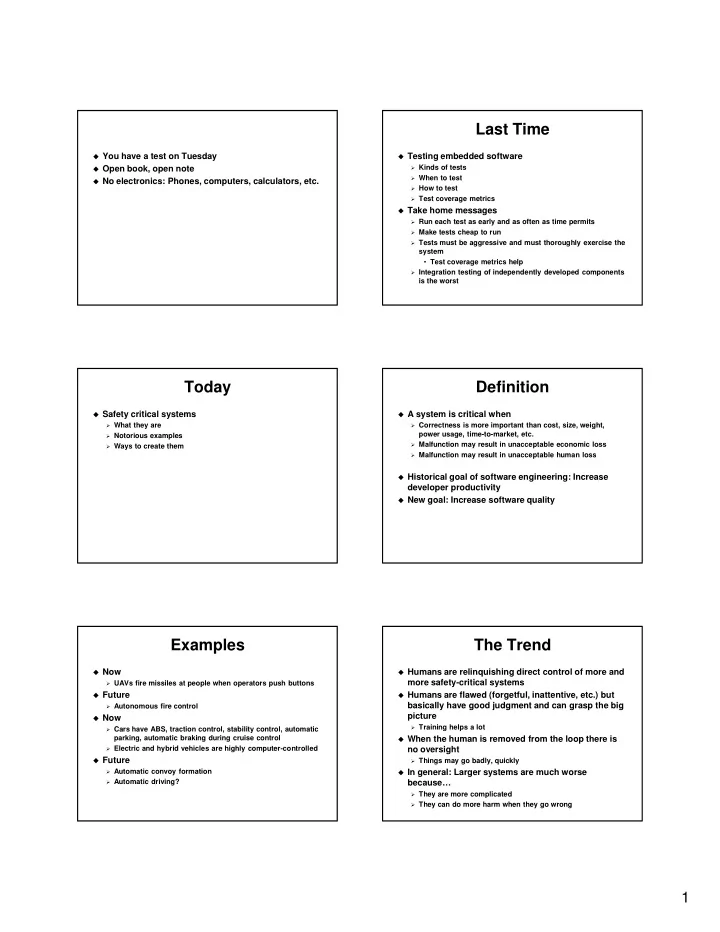
You have a test on Tuesday Open book, open note No electronics: Phones, computers, calculators, etc.

Last Time

Testing embedded software

Kinds of tests When to test How to test Test coverage metrics

Take home messages

Run each test as early and as often as time permits Make tests cheap to run Tests must be aggressive and must thoroughly exercise the

system

  • Test coverage metrics help

Integration testing of independently developed components

is the worst

Today

Safety critical systems

What they are Notorious examples Ways to create them

Definition

A system is critical when

Correctness is more important than cost, size, weight,

power usage, time-to-market, etc.

Malfunction may result in unacceptable economic loss Malfunction may result in unacceptable human loss

Historical goal of software engineering: Increase

developer productivity

New goal: Increase software quality

Examples

Now

UAVs fire missiles at people when operators push buttons

Future

Autonomous fire control

Now

Cars have ABS, traction control, stability control, automatic

parking, automatic braking during cruise control

Electric and hybrid vehicles are highly computer-controlled

Future

Automatic convoy formation Automatic driving?

The Trend

Humans are relinquishing direct control of more and

more safety-critical systems

Humans are flawed (forgetful, inattentive, etc.) but

basically have good judgment and can grasp the big picture

Training helps a lot

When the human is removed from the loop there is

no oversight

Things may go badly, quickly

In general: Larger systems are much worse

because…

They are more complicated They can do more harm when they go wrong

slide-2
SLIDE 2

2

Critical Systems

Obviously not just a software problem! Other angles that need to be considered

Faulty specification Faulty hardware Human error Malicious users Malicious non-users

Today we focus on software issues

Risk

Minimizing overall risk is the general strategy However:

Risk is fundamental and unavoidable Risk management is about managing tradeoffs Risk is a matter of perspective

  • Standpoint of individual exposed to hazard
  • Standpoint of society – total risk to general public
  • Standpoint of institution responsible for the activity

Quantifying risk does not ensure safety

Design for Safety

Order of Precedence:

1.

Design for minimum risk

2.

Incorporate safety devices

3.

Provide warning devices

4.

Develop procedures and training

Case Study 1: Missile Timing

Military aircraft modified from hardware-controlled to

software-controlled missile launch

After design, implementation, and testing, plane was

loaded with a live missile and flown

The missile engine fired, but the missile never

released from the aircraft

A “wild ride” for the test pilot

Problem: Design did not specify for how long the

“holdback” should be unlocked

Programmer made an incorrect assumption Missile was not unlocked for long enough to leave the rack Oops!

Case Study 2: Missile Choice

Weapon system supporting both live and practice

missiles used in field practice

Operator “fires” a practice missile at a real aircraft

during an exercise

Software is programmed to choose the best

available weapon for a given target

Deselects the practice missile Selects a live missile Fires

From the report: “Fortunately the target pilot was

experienced … but the missile tracked and still detonated in close proximity.”

Case Study 3: Therac-25

Computer-controlled radiation therapy Goal: Destroy tumors with minimal impact on

surrounding tissue

11 systems deployed during the 1980s Many new features over previous versions Lots of software control Increased power From a report: “The software control was

implemented in a DEC model PDP 11 processor using a custom executive and assembly language. A single programmer implemented virtually all of the

  • software. He had an uncertain level of formal

education and produced very little, if any, documentation on the software.”

slide-3
SLIDE 3

3

More Therac-25

Outcome: Six massive radiation overdoses, five

deaths

Compounding the problem: Company didn’t believe

software could be at fault

“Records show that software was deliberately left

  • ut of an otherwise thorough safety analysis

performed in 1983 which used fault-tree methods. Software was excluded because ‘software errors’ have been eliminated because of extensive simulation and field testing. Also, software does not degrade due to wear, fatigue or reproduction

  • process. Other types of software failures were

assigned very low failure rates with no apparent justification.”

Therac-25 Facts

Hardware interlocks were replaced by software

without any supporting safety analysis

There was no effective reporting mechanism for field

problems involving software

Software design practices (contributing to the

accidents) did not include basic, shared-data and contention management mechanisms normal in multi-tasking software

The design was unnecessarily complex for the

  • problem. For instance, there were more parallel

tasks than necessary. This was a direct cause of some of the accidents

Specific Therac-25 Bugs

“Equipment control task did not properly

synchronize with the operator interface task, so that race conditions occurred if the operator changed the setup too quickly. This was evidently missed during testing, since it took some practice before operators were able to work quickly enough for the problem to

  • ccur.”

“The software set a flag variable by incrementing it.

Occasionally an arithmetic overflow occurred, causing the software to bypass safety checks.”

Two More Examples

Ariane 5 (1996)

Reused Ariane 4 software Higher horizontal velocity of Ariane 5 caused a 16-bit

variable to overflow

Resulting chain of failures necessitated destroying the

rocket

Mars Pathfinder (1997)

“…very infrequently it was possible for an interrupt to occur

that caused the (medium priority) communications task to be scheduled during the short interval while the (high priority) information bus thread was blocked waiting for the (low priority) meteorological data thread.”

Classic priority inversion We’ll cover these (and how to avoid them) later

Software V&V

Verification and validation – making sure that

software does the right thing

Obvious problem – figuring out what “the right thing” is

V&V typically uses 40-60% of total effort Parts of the solution:

Development process Specification Testing Inspection Fault-tree analysis Language choice Software techniques Static analysis / formal verification

Fault Tree Analysis

Fault: Abnormal or undesirable system state Failure: Loss of functionality Primary failure: Failing element operating within its

specifications

Secondary failure: Failing element operating outside

  • f its specifications

What was the primary failure for the Challenger?

Fault tree idea:

Connect faults and failures using logical operations in order

to understand the consequences of faults individually and in combination

slide-4
SLIDE 4

4

Fault Tree Example Language Choice

We looked at MISRA C A better example is SPARK Ada

Pervasive support for static analysis

  • All rule violations statically detectable

No implementation-defined behavior Tons of tool support “SPARK code was found to have only 10% of the residual

errors of full Ada and Ada was found to have only 10% of the residual errors of C”

Software Safety Techniques

Interlocks

Important actions require signals from two or more

independent sources

Firewalls

Hardware / software protection boundary between critical

and non-critical functionality

Example software firewalls:

  • Address spaces
  • CPU reservations
  • Module tainting

Redundancy

Correct result is computed by having multiple processes /

processors vote

Static Analysis / Verification

Goal: Rule out classes of errors across all possible

executions

Potentially much faster than testing Potentially more thorough than testing Stack depth analysis is one example – can “prove” that a

system is invulnerable to stack overflow

Other examples – absence of:

Array / pointer misuse Integer and FP overflow Use of uninitialized data Numerical errors Exceptions Deviation from specification

Static Analysis Properties

In general static analysis:

Finds many trivial problems Does not find the most important problems Has a hard time finding the deepest problems Has high computational complexity

Even so:

My opinion (and lots of other people’s) is that static analysis

is the only way forward for creating large safety-critical systems

Example: PolySpace Verifier

Pure static analysis

No testcases, no execution

Analyzes Ada, C, C++

Anecdotal evidence suggests that Ada version is by far the

best

Deep analysis of large C, C++ programs is still barely

feasible

Found the Ariane bug

(After the fact)

Lots of big customers

slide-5
SLIDE 5

5

Summary

Safety-critical software is extremely hard to create

Can’t be done by organizations that do not take this very

seriously

No shortage of horror stories

Risk mitigation requires many different techniques

Software-based Hardware-based Process-based Etc.