SLIDE 1
Last time: integrating vector fields
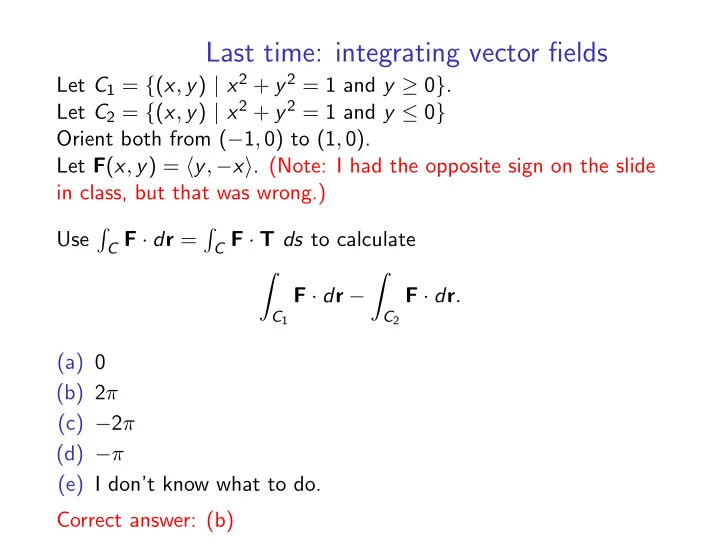
Let C1 = {(x, y) | x2 + y2 = 1 and y ≥ 0}. Let C2 = {(x, y) | x2 + y2 = 1 and y ≤ 0} Orient both from (−1, 0) to (1, 0). Let F(x, y) = ⟨y, −x⟩. (Note: I had the opposite sign on the slide in class, but that was wrong.) Use ∫︁
C F · dr =
∫︁
C F · T ds to calculate
∫︂
C1
F · dr − ∫︂
C2
F · dr. (a) 0 (b) 2π (c) −2π (d) −π (e) I don’t know what to do. Correct answer: (b)
SLIDE 2
Solution
C1 C2 F For C1: F = T, so ∫︂
C1
F · Tds = ∫︂
C1
|T|2ds = ∫︂
C1
1ds = π. For C2: F = −T, so ∫︂
C2
F · Tds = ∫︂
C2
(−1)ds = −π. So ∫︁
C1 F · dr −
∫︁
C2 F · dr = π − (−π) = 2π.
SLIDE 3
Example 1
Let F = ∇f be a conservative vector field on R2 or R3, and let C be a curve with initial point P and terminal point Q. Assume that ∇f is continuous. The Fundamental Theorem of Line Integrals tells us that ∫︂
C
∇f · dr = f (Q) − f (P). This implies that F is independent of path.
SLIDE 4
Example 2
Let F(x, y) = ⟨−y, x⟩. At the beginning of class, we found two curves C1 and C2 with the same initial point (−1, 0) and the same terminal point (1, 0), but we showed that the integrals of F over C1 and C2 were not equal. So F is not path independent. Remark: Combining this observation with the previous slide, we can conclude that F is not conservative.
SLIDE 5
Is the vector field conservative?
We’re going to look at the vector field describing wind velocity. Discuss with your neighbour: is this vector field conservative? https://earth.nullschool.net/ (Remember the options below:) (a) Yes, we think it is. (b) No, we think it’s not. (c) We don’t agree/we don’t know. Answer: the vector field is not conservative. You can find circles around which the integral is not zero.
SLIDE 6
Comments on the proof
Theorem: For D open and connected, the integral of F is path independent ⇔ F is conservative. We have to prove two things.
∙ The integral of F is path independent ⇒ F is conservative. ∙ The vector field F is conservative ⇒ the integral is path
independent. We already showed the second line, using the Fundamental Theorem of Line Integrals.
SLIDE 7
The integral of F is path independent ⇒ F is conservative.
We’re mostly going to skip the proof, but here is the main idea. Choose any point P in D. Define f : D → R as follows. Given any point Q in D, choose a path C from P to Q. We can do this because D is connected! Now let f (Q) = ∫︁
C F · dr ∈ R.
It doesn’t matter what path C we chose, because the integral is path independent! We claim that ∇f = F, which shows that F is conservative.