Last time: critical points Let f : R 2 R . A point ( a , b ) R 2 is - - PowerPoint PPT Presentation

last time critical points
SMART_READER_LITE
LIVE PREVIEW

Last time: critical points Let f : R 2 R . A point ( a , b ) R 2 is - - PowerPoint PPT Presentation

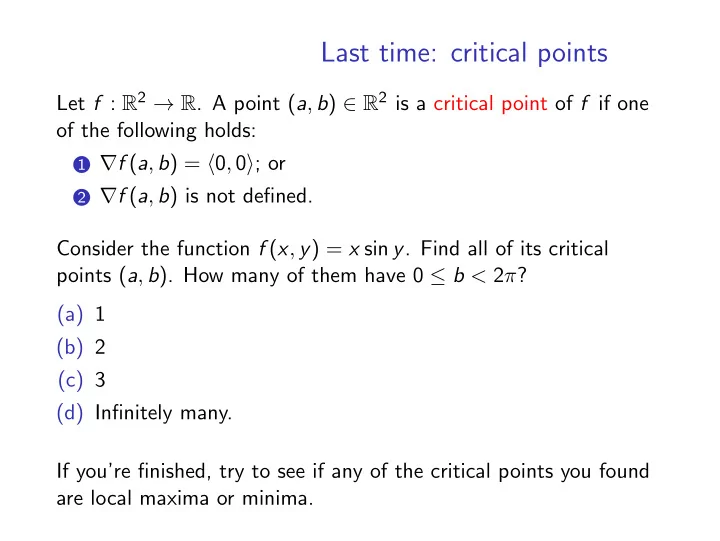
Last time: critical points Let f : R 2 R . A point ( a , b ) R 2 is a critical point of f if one of the following holds: 1 f ( a , b ) = 0 , 0 ; or 2 f ( a , b ) is not defined. Consider the function f ( x , y ) = x sin y .


slide-1
SLIDE 1

Last time: critical points

Let f : R2 → R. A point (a, b) ∈ R2 is a critical point of f if one

  • f the following holds:

1 ∇f (a, b) = ⟨0, 0⟩; or 2 ∇f (a, b) is not defined.

Consider the function f (x, y) = x sin y. Find all of its critical points (a, b). How many of them have 0 ≤ b < 2𝜌? (a) 1 (b) 2 (c) 3 (d) Infinitely many. If you’re finished, try to see if any of the critical points you found are local maxima or minima.

slide-2
SLIDE 2

Announcements

∙ Midterm 1 graded and returned. Requests for regrade should

be submitted in writing to your section TA, who will refer your question to the TA who graded that specific question.

∙ Homework deadline is at 8am. It will be strict starting next

Monday!

∙ Please register your i-clicker. If you don’t see your scores on

Moodle, send me an email with your name, your UIN, and your i-clicker registration number.

slide-3
SLIDE 3

Local maximum/minimum

Fix f : R2 → R, not necessarily differentiable; fix (a, b) ∈ R2.

∙ We say f has a local maximum at (a, b) if

f (a, b) ≥ f (x, y) for all (y, x) near (a, b).

∙ We say f has a local minimum at (a, b) if

f (a, b) ≤ f (x, y) for all (y, x) near (a, b). Here “near (a, b)” means “for all (x, y) contained in a small disk

  • f radius 𝜗 around the point (a, b)”. (𝜗 can be very small!)
slide-4
SLIDE 4

Practice with the second derivative test

Recall the function f (x, y) = x sin y. The point (0, 𝜌) is a critical

  • point. Find D.

(a) D = 0 (b) D = 1 (c) D = -1 (d) I don’t know what to do.

slide-5
SLIDE 5

Second derivative test

1 D > 0, fxx(a, b) > 0 ⇒ local minimum at (a, b). 2 D > 0, fxx(a, b) < 0 ⇒ local maximum at (a, b). 3 D < 0 ⇒ saddle point at (a, b).