Large-Scale Numerical Simulation of Fluid Structure Interactions in - - PowerPoint PPT Presentation

large scale numerical simulation of fluid structure
SMART_READER_LITE
LIVE PREVIEW

Large-Scale Numerical Simulation of Fluid Structure Interactions in - - PowerPoint PPT Presentation

Large-Scale Numerical Simulation of Fluid Structure Interactions in Low Reynolds Number Flows APS 64 rd Annual Meeting Division of Fluid Dynamics Ali EKEN & Mehmet SAHIN 20 November 2011 Baltimore, Maryland, USA Astronautical Engineering


slide-1
SLIDE 1

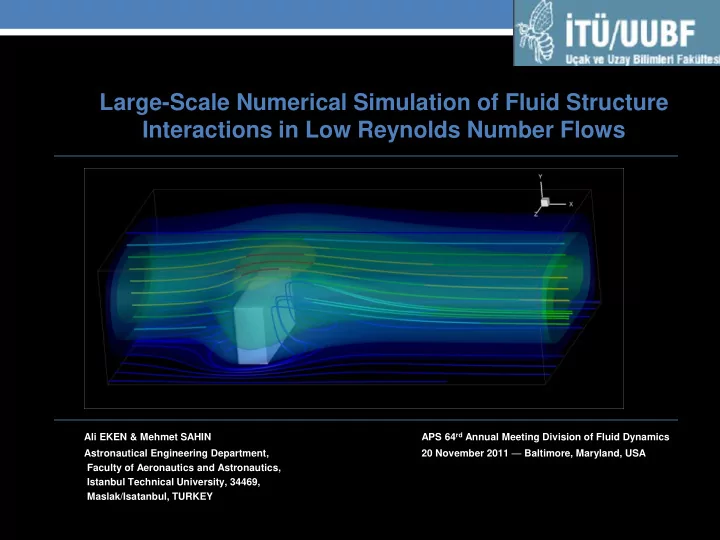
Large-Scale Numerical Simulation of Fluid Structure Interactions in Low Reynolds Number Flows

Ali EKEN & Mehmet SAHIN APS 64rd Annual Meeting Division of Fluid Dynamics Astronautical Engineering Department, 20 November 2011 — Baltimore, Maryland, USA Faculty of Aeronautics and Astronautics, Istanbul Technical University, 34469, Maslak/Isatanbul, TURKEY

slide-2
SLIDE 2
  • Motivations
  • Numerical Modelling
  • Structure Solver
  • Structure Solver Validation
  • Test Case I: Plate with a Hole
  • ALE Fluid Solver
  • ALE Fluid Solver Validation
  • Test Case II: The Flow Past an Oscillating Circular

Cylinder in a Channel

  • Fluid Structure Coupling
  • Fluid Syructure Solver Validation
  • Test Case III: Vortex-induced vibration of an elastic

cantilever beam

  • Test Case IV: 3-D Elastic Solid in a Steady Channel

Flow

  • Conslutions and Future Works

CONTENTS

slide-3
SLIDE 3

Fluid structure interactions for a 3d parachute Trimarchi at al., (2011). Membrane wing fluid structure interaction Stanford at al., (2008). Vascular fluid structure interaction Bazilevs at al., (2010).

Motivations

Fighter tail buffeting and aircraft flutter (from NASA).

slide-4
SLIDE 4

Structure Solver

slide-5
SLIDE 5

The governing equations of motion within the solid domain: Galerkin Finite Element Formulation: Displacement Boundary Conditions: Traction Boundary Conditions:

Structure Solver

Equations of Solid Motion

slide-6
SLIDE 6

Structure Solver

Finite Element Discretization with Incompatible Modes

slide-7
SLIDE 7

The stiffness Matrix: Mass Matrix: Surface Tractions: Static Condensation:

Structure Solver

Finite Element Discretization with Incompatible Modes

slide-8
SLIDE 8

The system of equations: Newmark Method:

Structure Solver

Solution of Resulting System of Equations

slide-9
SLIDE 9

5N of concentrated loads at the free end Dimensions 100x100x1 mm Hole diameter 60 mm

Structure Solver

Test Case I: Plate with a Hole

slide-10
SLIDE 10

Structure Solver

Test Case I: Plate with a Hole: Displacement Results

slide-11
SLIDE 11

ALE Fluid Solver

slide-12
SLIDE 12

The integral form

  • f

the incompressible Navier-Stokes equations

  • n

deforming meshes: The momentum equation: The continuity equation: No-slip wall boundary condition: Inflow boundary condition: Outflow boundary condition:

ALE Solver

Equations of Fluid Motion

slide-13
SLIDE 13

Numerical Discretization

(a) Two-dimensional dual volume (b) Three-dimensional dual volume The side centered finite volume was initially used by Hwang (1995) and Rida et al. (1997) on unstructured meshes. The present arrangement of the primitive variables leads to a stable numerical scheme and it does not require any ad-hoc modifications in order to enhance pressure-velocity

  • coupling. The most appealing feature of this primitive variable arrangement

is the availability of very efficient multigrid solvers.

slide-14
SLIDE 14

The computed contributions for the x-momentum equation are given below for the right element The time derivation: The convective term due to fluid motion:

ALE Solver

Numerical Discretization (Continued...)

slide-15
SLIDE 15

The convective term due to grid motion: The pressure term:

ALE Solver

Numerical Discretization (Continued...)

The Geometric Conservaion Law (GCL) is satisfied

slide-16
SLIDE 16

The viscous term: The gradient terms are calculated from the Gauss-Green theorem:

ALE Solver

Numerical Discretization (Continued...)

slide-17
SLIDE 17

The kinematic viscosity Density The cylinder center is oscillating sinusoidally such that the location of the cylinder center is given by and , . The computational mesh consists of 70667 quadrilateral elements and the time step is set to .

ALE Solver

TEST CASE II: An Oscillating Circular Cylinder in a Channel

slide-18
SLIDE 18

ALE Solver

TEST CASE II: An Oscillating Circular Cylinder in a Channel

t=20.0s t=21.0s t=22.0s t=23.0s

u-velocity vector component contours with streamtraces for an oscillating circular cylinder in a channel at several different time levels. .

slide-19
SLIDE 19

The comparison of the cd and cl with the numerical results of Wan and Turek (JCP , 2007).

ALE Solver

TEST CASE II: An Oscillating Circular Cylinder in a Channel

slide-20
SLIDE 20

Fluid Structure Interaction

slide-21
SLIDE 21

Fluid domain: Solid domain: Fluid-structure interface: Fluid on rigid boundary:

FSI Solver

Fluid Structure Interaction Coupling

slide-22
SLIDE 22

The resulting algebraic linear system: The modified system: Three banded matrix Additive Schwartz preconditioned GMRES(m) algorithm is used to solve the algebraic equations. An ILU(4) preconditioner with rcm ordering is employed within each partioned subdomains. The implementation

  • f

the Krylov subspace methods, preconditioning and matrix-matrix multiplication have been caried out using PETSc library. In order to encounter non-linearity due to uknown vertex locations at (n+1) several sub iterations are performed.

FSI Solver

The Fully Coupled System

slide-23
SLIDE 23

Mesh Generation (GAMBIT, CUBIT, ...) Mesh Partition (METIS library) Linear Solver Post Processing (Tecplot) Parallel Fully-Coupled FSI Code Kroylov subspace methods (PETSc library) Preconditioners (PETSc library)

FSI Solver

Parallelization and Efficiency

slide-24
SLIDE 24

FSI Solver

Fluid: Solid:

TEST CASE III: Vortex-induced vibration of an elastic plate

slide-25
SLIDE 25

FSI Solver

Coarse mesh with 40935 quadrilateral elements and 41395 nodes (273 185 DOF). Generated using CUBIT library.

TEST CASE III: Vortex-induced vibration of an elastic plate

slide-26
SLIDE 26

FSI Solver

Fine mesh with 125443 quadrilateral elements and 126920 nodes (837 609 DOF). Generated using CUBIT library.

TEST CASE III: Vortex-induced vibration of an elastic plate

slide-27
SLIDE 27

The time variation of the computed tip displacement for the coarse and fine

  • meshes. The time step is set to 0.001 and Re=332.60.

FSI Solver

TEST CASE III: Vortex-induced vibration of an elastic plate

Due to large startup vortex Periodic state

slide-28
SLIDE 28

FSI Solver

TEST CASE III: Vortex-induced vibration of an elastic plate

The instantaneous u-velocity contours with streamlines at t=3.0.

slide-29
SLIDE 29

FSI Solver

TEST CASE III: Vortex-induced vibration of an elastic plate

The instantaneous vorticity contours with streamlines at t=3.0.

slide-30
SLIDE 30

FSI Solver Richter, (2011)

Fluid: Solid:

TEST CASE IV: 3D elastic solid in a steady channel flow

slide-31
SLIDE 31

FSI Solver

TEST CASE IV: 3D elastic solid in a steady channel flow The computational mesh with local mesh refinement using CUBIT

  • library. The half of the doamin is shown. The mesh consists of

374523 nodes and 362224 hexahedral elements (4 096 651 DOF).

slide-32
SLIDE 32

FSI Solver

TEST CASE IV: 3D elastic solid in a steady channel flow The computed streamtraces at Re=40. The color shows the magnitude of the u-velocity component.

slide-33
SLIDE 33

FSI Solver

TEST CASE IV: 3D elastic solid in a steady channel flow The computed isobaric surfaces at Re=40. The color shows the magnitude of the pressure value.

slide-34
SLIDE 34

FSI Solver

TEST CASE IV: 3D elastic solid in a steady channel flow The computed displacement vectors at Re=40. The color shows the magnitude of the x-displacement.

  • St. Venant Kirchhoff

material with large displacement

slide-35
SLIDE 35

FSI Solver

Conclusions and Future Works

  • A parallel unstructured fluid structure interaction (FSI) code

has been developed.

  • The fluid solver is based on the solution of the incompressible

Navier-Stokes equations using an ALE formulation.

  • The solid solver is based on the linear elastic material model

with small deformations. The large deformations with non- linear models will be added to the present code.

  • Currently we use one level preconditioned iterative solver for

the whole coupled solver. In the future, the fully coupled sytem will be solved using monolitic preconditioners.

  • The present code will be applied to solve the fluid structure

interactions for memrane wing Micro Aerial Vehicles (MAV).

slide-36
SLIDE 36

Acknowledgement The authors gratefully acknowledge the use of the Chimera machine at the Faculty

  • f

Aeronautics and Astronautics at ITU, the computing resources provided by the National Center for High Performance Computing of Turkey (UYBHM) under grant number 10752009 and the computing facilities at TUBITAK ULAKBIM, High Performance and Grid Computing Center. The authors also would like to thank Thomas Richter at the University of Heidelberg for performing the validation cases.