Langat HELP River Basin Initiative in Malaysia Prof. Dr. Mazlin Bin - - PDF document

langat help river basin initiative in malaysia
SMART_READER_LITE
LIVE PREVIEW

Langat HELP River Basin Initiative in Malaysia Prof. Dr. Mazlin Bin - - PDF document

3/29/2010 Langat HELP River Basin Initiative in Malaysia Prof. Dr. Mazlin Bin Mokhtar Dr. Rahmah Elfithri and d Md. Abdullah Abraham Hossain Institute for Environment and Development (LESTARI) Universiti Kebangsaan Malaysia 43600, UKM


slide-1
SLIDE 1

3/29/2010 1 Langat HELP River Basin Initiative in Malaysia

  • Prof. Dr. Mazlin Bin Mokhtar
  • Dr. Rahmah Elfithri

d and

  • Md. Abdullah Abraham Hossain

Institute for Environment and Development (LESTARI) Universiti Kebangsaan Malaysia 43600, UKM BANGI, Selangor, Malaysia

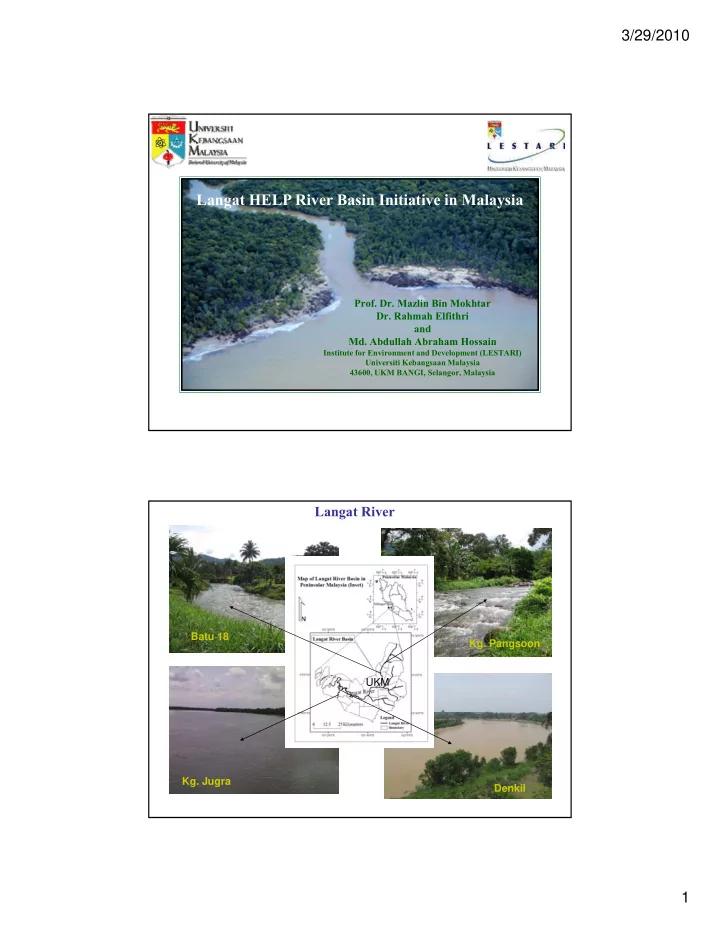
Langat River

Batu 18

  • Kg. Pangsoon

UKM

  • Kg. Jugra

Denkil

slide-2
SLIDE 2

3/29/2010 2

What Makes Langat Unique?

  • Langat River Basin, Malaysia is recognized as one of the

HELP Basins since 2004, initiated by the LESTARI, UKM.

  • Langat was classified as Evolving HELP Basin, out of 90

Langat was classified as Evolving HELP Basin, out of 90 catchments from 56 countries in the world.

  • The selection has been made based on the international

programme that is a catchment based activity which is interfacing scientific research with stakeholders needs.

  • Includes scientists, stakeholders, policy-makers, lawyers.
  • Provides options as against imposing solutions.
  • Providing/testing/implementing and improving solutions.
  • Sharing experiences across a global network of basins.
  • Geographical location.

Integrated Water Resources Management

To promote a process towards the vision of The Three Es by coordinated

development and management of water, land and related resources, in order to maximize the resultant Economic and social welfare in an Equitable manner maximize the resultant Economic and social welfare in an Equitable manner without compromising the sustainability of vital Ecosystems.

The Four Dublin principles (1992)

  • 1. Fresh water is finite and vulnerable resource
  • 2. Participatory approach
  • 3. Women play a central role
  • 4. Water has economic value

The Tools: The Three Pillars of management components: The Tools: The Three Pillars of management components:

  • 1. Enabling Environment: Policy, Law, Finance
  • 2. Institutional framework
  • 3. Appropriate management instruments
slide-3
SLIDE 3

3/29/2010 3

The Outcome

A cross-sectoral coordination of water agencies:

– Water for people: water supply and sanitation – Water for food: farms and fisheries – Water for nature: conservation and recreation – Water for other uses: hydropower, industry, safety, transportation

What is HELP?

  • The Hydrology for the Environment, Life and Policy (HELP) is an integral cross cutting

activity and transdisciplinary initiative of the United Nations Educational Scientific Organization (UNESCO) led by the International Hydrological Programme (IHP) to solve g ( ) y y g g ( ) real problems in real catchments.

  • HELP is creating a new approach to integrated catchment management through the creation
  • f a framework for water law and policy experts, water resource managers and water

scientists to work together on water-related problems.

  • The HELP network is composed by 90 basins classified under the 4 categories:

· Group D: Demonstration HELP Basin - This is seen as demonstrating best practice in HELP and IWRM, with something to offer other basins. · Group O: Operational HELP Basin This is an established basin which may Group O: Operational HELP Basin - This is an established basin which may become a World Demonstration Basin in due course. · Group E: Evolving HELP basin - This is a basin which is not yet fully operational. · Group P: Proposed HELP Basin - Additional information is needed to re-classify this basin.

slide-4
SLIDE 4

3/29/2010 4

Malaysian Context on IWRM

Malaysia has accepted IWRM as an innovative approach in managing its water resources since 1990s by the water technical agencies (e.g. DID)

  • Formation of Malaysian Water Partnership (MyWP) in 1997 and

y p ( y )

  • Malaysian Capacity Building Network for IWRM (MyCapNet) in 2001

to promote IWRM Implementation and Capacity Building in IWRM. IWRM is also in line with Malaysian Government aspirations as stated in different policy documents: – The Third Outline Perspective Plan, Malaysia (OPP3) 2001-2010 – The 8th Malaysia Plan documents (MP8) 2001-2005 – The 9th Malaysia Plan (MP9) 2006-2010

National Policy Agenda on IWRM

The issues of sustainability of water use and conservation are well d t d th h diff t li d t f M l i ti l documented through different policy documents of Malaysia as national agenda (GoM 2006c; UNEP 2006). Third Outline Perspective Plan (OPP3), Chapter 1, Paragraph 1.81: Effort to manage forests sustainabily will be intensified and at the same time expanding the multiple use of forests, steps will be taken to formulate integrated river basin management plans to improve water quality and supply as well as managing water resources. To ensure sustainability of coastal resources integrated coastal management plans will be introduced in all states (GoM 2000b).

slide-5
SLIDE 5

3/29/2010 5

National Policy Agenda on IWRM

Eighth Malaysia Plan

  • IWRM approach has been endorsed under sustainable environmental

management. management. Ninth Malaysia Plan, Chapter 22, Paragraph 22.22: The utilization of the integrated river basin management (IRBM) approach will be intensified to improve river and ground water quality (GoM 2006c). Besides, this plan also emphasized on following issues:

  • To make efforts to protect and conserve land, water, biodiversity;
  • To promote sustainable natural resource management practices in relation
  • To promote sustainable natural resource management practices in relation

to land, water, forest, energy and marine resources;

  • To make closer cooperation with stakeholders and non-governmental
  • rganizations (NGOs) in addressing environment and natural resource

concerns; and

  • To enhance protection of the environment and conservation of natural

resources and contribute towards improving the quality of life. (GoM 2009).

National Water Vision 2020

National Water Vision 2020 endorsed that in support of Vision 2020 (towards achieving developed nation status), Malaysia will conserve and manage its water resources to ensure adequate and safe water for all (including the environment). The key objectives of the vision are:

  • Water for people
  • Water for food and rural development
  • Water for economic development
  • Water for environment

Gotoroyong-event at Batu 18

slide-6
SLIDE 6

3/29/2010 6

Existing Institutional Arrangements for IRBM in LRB

  • National Policies

National Policies

  • Laws and rules
  • Organizations (formed inter-organizational network)

Relevant National Policies

  • National Forestry Policy 1992;

N i l P li Bi l i l Di i (1998)

  • National Policy on Biological Diversity (1998);
  • National Policy on the Environment (2002);
  • National Wetlands Policy (2004);
  • National Physical Plan (2005);
  • National Urbanisation Policy (2006);

y ( );

  • National Agriculture Policy (2006); and
  • National Biotechnology Policy (2006)
slide-7
SLIDE 7

3/29/2010 7

Laws and Rules

Important Federal level laws

  • Environmental Quality Act 1974;
  • Environmental Quality Act, 1974;
  • Land Conservation Act, 1960;
  • Irrigation Areas Act, 1953;
  • Fisheries Act, 1985;
  • Town and Country Planning Act, 1976;
  • National Forestry Act, 1984;
  • Mineral Development Act, 1994;
  • Water Services Industry Act, 2006;and
  • National Park Act, 1980;

Mangroves in LRB

Laws and Rules

Important State level laws/rules

  • The Drainage Works Act, 1954;

The Drainage Works Act, 1954;

  • Irrigation Areas Act, 1953 (Revised in 1989);
  • The National Land Code, 1965;
  • Land Conservation Act, 1960;
  • Waters Act 1920 (Revised in 1989);
  • The Forest Act, 1984;
  • Water Supply Enactments, 1955;
  • Perbadanan Urus Air Selangor;Selangor Waters Management Authority

Enactment 1999; Enactment, 1999;

  • Protection of Wildlife Act, 1972;
  • National Parks Act, 1980;
  • Town and Country Planning Act, 1976;
  • The Fisheries Act, 1985;
  • Fisheries Maritime Regulations, 1967 (Amended in1987);
slide-8
SLIDE 8

3/29/2010 8

Laws and Rules

Important State level laws/rules

  • Merchant Shipping (Exemption) Order, 1961;
  • Poisons Act 1952;
  • Prevention and Control of Infectious Diseases Act,1988;
  • Environmental Quality Act, 1974;
  • Local Government Act, 1976;
  • Street, Drainage and Building Act, 1974;
  • Mining Enactment, 1929;
  • Geological Survey Act 1974;
  • Geological Survey Act, 1974;
  • Pesticides Act, 1974;
  • Pesticides (resgistration) Rules, 2005;
  • Pesticides (Exemption) Order, 2004;
  • Pig Framing Enactment;
  • Sewerage Services Act, 1993;

Religious occasion

Cabinet National Council National Water Resources Council (NWRC) National Physical Planning Council (NPPC) National Coastal Protection Council (NCPC) National Physical Plan Council (NPPC) Federal Government Prime Minister Department

Inter-organizational Network for IRBM in LRB

Cabinet River Basin Organization Lembaga Urus Air Selangor (LUAS) Private Agency Federal Government Agency Selangor State Government National Water Services Commission (SPAN) National Physical Plan Council (NPPC) Ministry EXCO SUK Negeri Sembilan State Government and

  • F. T. of Putrajaya

State Government Agency Local Authority Universities by locations Langat River Basin National Research Institute Non-Government Organization and Association

slide-9
SLIDE 9

3/29/2010 9

Organizational Setup that is Legitimately Responsible for Water Related Policy Matters in LRB.

Organization Responsibility Description Federal Government Policy matters Development of a holistic Federal Government (Ministry

  • f

Energy, Green Technology and Water) Policy matters Development of a holistic water policy for the country by setting policy directions. National Water Resource Council (NWRC) Water resource matters –Cross boundaries/ inter-State/ issue

  • f

national interest Ensures coordination with the various State Government in the management

  • f

the water basins basins. State Government Raw water matters Regulate raw water abstraction and catchment management National Water Services Commission (SPAN) Regulatory matters Regulate the water services industry (water and sewerage services)

Important Interventions in Langat River Basin

Preparation of Integrated River Basin Management Plan

  • Sl. #

Management perspectives Issues under consideration 1. Catchment management and monitoring Land use; Forests and biodiversity; Soil erosion; and sedimentation; 2. River corridor development and management Reclamation; Rehabilitation; Restoration; Remediation; Preservation; and Conservation; 3. Water resources development and management Surface water and ground water management; Water treatment plants; Pollution threats for surface water and ground water; Development of new water supply source; River water quality improvement; Reduction of non- revenue water loss; Rainwater harvesting; and Industrial waste water recycling; recycling; 4. Flood mitigation Structural measures for flood mitigation (for Sg. Langat; Sg. Semenyih;

  • Sg. Beranang; and Sg. Labu); Non-structural measures; and Flood

forecasting; 5. Environmental management Pollution control (from point source, non-point source); Solid waste management including schedule waste; and Water quality monitoring;

Source: DID. 2003. Integrated river basin management plan for Langat River Basin, Volume 3. Department of Irrigation and Drainage, Kuala Lumpur: Department

  • f Irrigation and Drainage (DID)
slide-10
SLIDE 10

3/29/2010 10

Important Interventions Applicable in Langat River Basin

  • Formation of Lembaga Urus Air Selangor or its

acronym, LUAS (or SWMA in English) under the Selangor Waters Management Authority Selangor Waters Management Authority Enactment 1999 pursuant to the approval of the Selangor State Legislative Assembly on 9 April 1999.

  • Formation of National Water Services

Commission (SPAN) to provide central regulatory service

  • Increased in coordination among implementing

agencies through LUAS

  • Water quality has been improved through water

quality monitoring

  • Different research studies carried out on Langat

River Basin

  • Kg. Batu 18

Research Initiatives By UKM

Mission Promote integrated and sustainable water resources management and development towards good water governance in Malaysia development towards good water governance in Malaysia. Objectives a. Conduct various innovative research on water resources management and governance b. Explore various concepts and guidelines to establish the good water governance. c Facilitate networking between various c. Facilitate networking between various

slide-11
SLIDE 11

3/29/2010 11

Research Initiatives on the Basis of Scalar Components of River System Within LRB

Natural system Social system Scalar components Example Scalar components Example

Micro habitat Water quality Individual Capacity building Micro habitat Water quality, Chemical governance Individual Capacity building, awareness Hydraulic unit Flow-sediment interaction Household Motivation, campaign Geomorphic unit River structure- process Neighbourhood &village Social learning Reach Pattern of channel landform, flood plain River basin IRBM Landscape Topographic feature State Love our river Landscape Topographic feature State Love our river Catchment Drainage, geology Country Sustainable development/ IWRM Ecoregion Lithologic and climatic control Region & global HELP initiative

Research Opportunities Through Different Types of Projects

  • Collaborative research project
  • Fundamental research project
  • Contract research project
  • Research University Operational Funds’ project
  • Research University Grants project
  • Science Fund project

Paya Indah Wetland

slide-12
SLIDE 12

3/29/2010 12

Type of Funding Research Project Partner Impact on Scalar Component 2008

How are we utilizing research fund?

Collaborative research project Climate change policy Ministry of Natural Resources and Environment Country Collaborative research project Planning for developing environmentally sensitive areas for hills and highlands in Selangor Department of Town and Rural Planning, Selangor (JPBD) State F d t l Sit ti d l i f Mi i t f Hi h St t Fundamental Situation and gap analysis for chemicals management Ministry of Higher Learning State Fundamental Chemicals governance in Malaysia: development of chemical management systems Ministry of Higher Learning Country Type of Funding Research Project Partner Impact on Scalar Component Contract Strategic plan for forest t i P i l Forestry Department of P i l M l i Country

How are we utilizing research fund?

management in Peninsular Malaysia Peninsular Malaysia (JPSM) Contract Baseline information on Malaysian environmental health Ministry of Health, Malaysia Country Contract 1st Malaysian national environmental health action plan (NEHAP) Ministry of Health, Malaysia Country p ( ) Research University Operational Funds’ project Ecosystem services and public policy: the case of wildlife conservation in Malaysia Research University Operational Fund Country

slide-13
SLIDE 13

3/29/2010 13

Type of Funding Research Project Partner Impact on Scalar Component Research University Sustainable campus Research University Operational Fund Reach

How are we utilizing research fund?

University Operational Funds’ project Operational Fund Research University Grant Managing contaminated land for Langat Basin ecosystem health sustainability Research University Grant River basin Research University Grant Landscape fragmentation and heterogeneity of mangrove forest in Peninsular Malaysia Research University Grant Country/ regional y Research University Grant Connecting ecosystem science with policy processes for a national scale ecosystem approach in Malaysia Research University Grant Country Type of Funding Research Project Partner Impact on Scalar Component Research Developing management Research University Reach

How are we utilizing research fund?

University Grant system and sustainable resource planning towards sustainable ecosystem in UKM campus Grant 2007 Collaborative Research Hydrology of the Langat Basin: surface water and ground water interaction Ministry of Science, Technology and Innovation through Basin ground water interaction Innovation through IRPA research funding Collaborative Research Ecological footprint in landuse planning Town and Country Planning Department, Peninsular Malaysia Country

slide-14
SLIDE 14

3/29/2010 14

Type of Funding Research Project Partner Impact on Scalar Component Collaborative R h Ground water ecosystem: the i t f d t Ministry of Science, T h l d River Basin

How are we utilizing research fund?

Research impact of ground water abstraction to land stability in Langat Basin Technology and Innovation Collaborative Research Landscape ecological assessment of protected areas in Peninsular Malaysia for sustainable management planning Ministry of Science, Technology and Innovation Country Fundamental Sustainability science and Ministry of Higher Country Research y governance: development of an integrated framework y g Education y Fundamental Research Developing capacity of academia for the practical implementation of IWRM in Malaysia Ministry of Higher Education Country/State Type of Funding Research Project Partner Impact on Scalar Component Collaborative Research Bandar lestari: environment award Department of Environment Ministry Country

How are we utilizing research fund?

Research award Environment, Ministry

  • f Natural Resources

and Environment Collaborative Research Sekhola lestari: environment award Department of Environment, Ministry

  • f Natural Resources

and Environment Country Collaborative Research Feasibility study on toxic and hazardous waste recovery GEF-KANSI Country potential in Malaysia Collaborative Research Implementing integrated water resources management (IWRM) in Malaysia: multistakeholder and multidisciplinary approach Ministry of Science, Technology and Innovation Regional (Pahang River Basin and Langat River Basin)

slide-15
SLIDE 15

3/29/2010 15

Type of Funding Research Project Partner Impact on Scalar Component Fundamental Science and governance for Ministry of Higher Country

How are we utilizing research fund?

Fundamental Research Science and governance for sustainable development Ministry of Higher Education Country Fundamental Research MyIWRM, What can I do? Developing capacity for the practical implementation of IWRM in Malaysia International Capacity Building Network for IWRM (CapNet) Country

Focus on Ecosystem Health of the Langat River Basin.

The objectives of the study were: i. To understand inter and multi-disciplinary approaches to monitoring and assessing the health of the Langat Basin ecosystem and suggest framework for integration framework for integration ii. To identify strategies and tools that allow integration of conservation and development iii. To gather scientists and technical experts to monitor, analyze, evaluate and make recommendations on the sustainable management

  • f ecosystem health at the national level based on the Langat Basin a

case study iv To suggest a list of environmental health indicators which will assist iv. To suggest a list of environmental health indicators which will assist planners, policy and decision makers in planning and environmental management v. To develop information directory related to Langat Basin Ecosystems to facilitate sharing of information and references vi. To develop a decision support system inclusive of data bases, good management systems, modeling and friendly user interface.

slide-16
SLIDE 16

3/29/2010 16

  • Ecosystem Approach in IWRM should be taken into consideration:

– The integration of the roles played by various agencies (both government and private sectors, and NGOs and the citizens), – Land use development activities and Protection of vital ecosystems

Ecosystem Approach

– Protection of vital ecosystems.

  • Strong coordinated national actions are required to integrate

legislation and all relevant stakeholders that are related to water resources management, including NGOs.

  • The integration will take into account the coordination in decision

making among different levels of government and among various sectoral departments and agencies within government, private sectors, NGOs, communities and also universities or research institutes. NGOs, communities and also universities or research institutes.

  • Needs commitment from all stakeholders, especially NGOs, where

currently no involvement from any NGOs in Malaysia in WRM of Langat Basin. At least to add numbers of NGOs to be involved and participated fully in IWRM processes in Langat river Basin.

F

  • c us on Pa rtic ipa tory Ma na g e me nt for IWRM

T hroug h Colla bora tive De c ision Ma king

  • CDM is a n a ppro a c h whe re individua ls a nd o rg a niza tio ns re c o g nize the ir

inte rde pe nde nc e c o mmunic a te a nd a g re e to do c ume nt re q uire me nts prio r inte rde pe nde nc e , c o mmunic a te a nd a g re e to do c ume nt re q uire me nts prio r to sub mitting re po rts, a nd pre se nt a nd re so lve re g ula to ry re q uire me nts e a rly in the a dministra tive pro c e ss.

  • I

ndividua ls a nd o rg a niza tio ns me e t re g ula rly to c la rify pro b le ms, o rg a nize the ir disc ussio ns, c o nduc t jo int pro b le m-so lving , a nd wo rk to ma ke c o mple x ta sks e a sie r thro ug h impro ve d c o mmunic a tio n a nd c o o rdina tio n.

  • Co lla b o ra tive de c isio n-ma king pro vide s individua ls a nd o rg a niza tio ns:

– T

  • b e tte r liste n

– T

  • de ve lo p a mo re ho ne st a ppro a c h

– T

  • de mo nstra te fo llo w-thro ug h o r mo dify c o mmitme nts
  • Wo rking to g e the r a s a te a m with a n a ppro a c h o f CDM will a tta in a c o mmo n

g o a l: time ly, c o st-e ffic ie nt, e nviro nme nta l c le a nup a nd c o mplia nc e .
slide-17
SLIDE 17

3/29/2010 17

Wo rk T

  • g e the r

As a T e a m Re c o g nize F a c e -to -F a c e Inte ra c tio n F a c ilita te E duc a tio n De c ide Go a ls Co lle c tive ly De ve lo p So lutio ns Co o pe ra tive ly

CDM

Co mmunic a te Initia te T

  • g e the r

Org a nize d Disc ussio n Inte rde pe nde nc e Me e t re g ula rly Vo lunta ry Inc re a se d Info rma tio n E xc ha ng e Ag re e Cla rify Pro ble ms Co nduc t Jo int Pro b le m So lving Se ssio ns

How CDM?

Ope n Pa rtic ipa tio n Invo lve me nt fro m the Be g inning / E a rly in the Pro c e ss Co lla b o ra tio n in Me e ting s Ide ntify Ne w Sta ke ho lde rs a lo ng the Wa y Invo lve me nt o f Re la te d Sta ke ho lde rs

Ca se Study on Promoting CDM in the L a ng a t Ba sin

  • T

he L a ng a t Rive r Ba sin a dministra tive ly invo lve s two sta te s viz. Se la ng o r Sta te a nd Ne g e ri Se mb ila n Sta te a nd a lso the Putra ja ya F e de ra l T e rrito ry. g j y y

  • T

his b a sin ha s b e c o me the fo c us o f ma jo r de ve lo pme nt: – T he Ne w F e de ra l Go ve rnme nt Administra tive Ce ntre o f Putra ja ya – T he Multime dia Supe r Co rrido r (MSC) – Cyb e rja ya – T he Ma la ysia n Bio Va lle y pro je c t – T he K ua la L umpur I nte rna tio na l Airpo rt (K L I A) – T he F

  • rmula One Gra nd Prix Circ uit a t Se pa ng

Se e ra l instit tio ns o f hig he r le a rning inc l ding ni e rsitie s – Se ve ra l institutio ns o f hig he r le a rning inc luding unive rsitie s

  • T

he rive rs pla y a sig nific a nt ro le in the e c o lo g y o f the b a sin, pro vide po ta b le wa te r to re side nts within the b a sin a s we ll a s in the a dja c e nt K la ng Va lle y, industrie s a nd a g ric ultura l a re a s.

slide-18
SLIDE 18

3/29/2010 18

Focus on NGOs and Academia

  • NGOs, universities, private sector and governments have different roles

to play but should compliment each other.

  • Necessary for NGOs and Academia to develop capacity for participation

and implementation of IWRM in Malaysia.

  • NGOs play an important facilitating and catalysing role in stimulating

and implementing IWRM processes, especially in involving local communities and the general public.

  • Until now however, limited attention has been given to NGOs to develop

the capacity of NGOs to act as facilitators or catalysts in the IWRM the capacity of NGOs to act as facilitators or catalysts in the IWRM processes.

  • Academia plays an important role in educating the future leaders achieving

better water resources management in the country.

  • This

programme, as a first step, focus

  • n

the development of the capacity of NGOs and Academia in their role as facilitators and catalysts for IWRM involving communities

Focus on NGOs and Academia

involving communities.

  • The

training courses

  • n

IWRM for NGOs and Academia to specifically strengthen their role in the IWRM processes in Malaysia. These trainings include subjects such as:

– Basic principles of IWRM Stakeholder participation – Stakeholder participation – Empowering society – Awareness raising among private sector and schools – Tools that could be used

slide-19
SLIDE 19

3/29/2010 19

Training Module and Manual for NGOs Training Module and Manual for Academia

slide-20
SLIDE 20

3/29/2010 20

Focus on Regional River Basin Issues

Project: Implementing Integrated Water Resources Management (IWRM) in Malaysia: Multistakeholder and Multidisciplinary Approach. Research Areas: Langat River Basin & Pahang River Basin Output: 1 (one) PhD research & 1 (one) Masters degree research. Deliverables: (a) Indicator system for Pahang River Basin. (b) IWRM strategy for Pahang River Basin. (c) Identification of institutional challenges and scope of social learning in LRB (d) Several dialogues with government agencies to build consensus on strategy (e) Highlighted issues on Cameron Highlands, Chini Lake d K l P h ( ) g g g and Kuala Pahang (f) Adopted IWRM in the neighbouring river basin which is future sources of raw water for LRB

Focus on Social Learning

Social learning is a process of learning by doing together and balancing top-down and bottom-up approaches of decision making b grad all impro ing stakeholder decision making by gradually improving stakeholder participation beyond informative

  • r

consultative participation which might end up with them co-designing and co-deciding mechanism. It is a iterative learning process and evolving in nature. Social learning will promote stability of expectations (ex- ante) and consistency in actions (ex-post) by developing institution at all levels

slide-21
SLIDE 21

3/29/2010 21

Social Learning & Capacity Building

Social learning Capacity building Continuous and iterative process Discrete and ad hoc programme Indigenous knowledge and procreations Exotic knowledge and utilization E l f I d i Evolve from governance process Imposed in governance process Shared problem perception Individual problem perception Motivation and action Motivation but action opportunistic Learner changes the environment and changed environment affects learner Environmental change not guaranteed Proceed with uncertainty and complexity Proceed with certain goal and simplicity Ability to cope with dynamic nature of ecosystem Unable to cope with dynamic nature of ecosystem y y Balance between top-down and bottom up approaches for decision making Top down approach for decision making Resilient and adaptive Dependent and fixed Subjective in origin and operation and objective in manifestation and impact Subjective in origin without operation and

  • bjective in manifestation but without impact

Deals with policy formulation and implementation Deals with programme formulation and implementation

Opinion Survey Result on Social Learning

TABLE: Binary logit model summary

Variables Coefficient(β) Z-Stat P- value Odd- Ratio (e ^ β) α 0.44 0.28 0.78 1.56 X1

  • 0.06
  • 0.08

0.94 0.94 X2

  • 0.61
  • 0.89

0.37 0.54 X3

  • 0.09
  • 0.13

0.90 0.92 X4

  • 0.92
  • 1.18

0.24 0.40 X5

  • 1.23
  • 1.53

0.13 0.29 X6

  • 0.29
  • 0.32

0.75 0.75 X7 0.20 0.26 0.80 1.23 X8 1.36^ 2.22 0.03 3.89^ X9 1.43^ 2.11 0.04 4.17^ X9 1.43 2.11 0.04 4.17 X10 (Social learning) 2.84* 3.69 0.00 17.11* X11 0.36 0.49 0.62 1.43 X12

  • 1.55
  • 1.37

0.17 0.21 X13 0.09 0.13 0.89 1.10 X14

  • 0.87
  • 1.16

0.25 0.42 X15 0.68 1.10 0.27 1.98 *, ^, ~ indicates significant level at 1%, 5% and 10% significance level.

slide-22
SLIDE 22

3/29/2010 22

Secondary stakeholders at Federal level Secondary stakeholders at State level and river basin level

Proposed Framework for social learning at Langat River Basin

Lembaga Urus Air Selangor (LUAS) Primary stakeholders at river basin level Suruhanjaya Perkhidmatan Air Negara (SPAN) i i h i i i d i l i New investment in the water supply, sewerage services, demand management, NRW and quality of services Joint Monitoring and enforcement for IRBM Social Learning for agenda setting at local level

Note: (a) Primary stakeholder (who enjoy products and services from the river basin but not formally engaged/employed with agency (ies) responsible for managing product and services of river and associated resources) and (b) Secondary stakeholder (who may or may not getting product and services but formally engaged/employed with agency (ies) responsible for managing product and services of rive basin and associated resources).

What We Have Achieved on LRB

  • LRB is recognized as HELP Evolving RB under UNESCO HELP Programme.
  • IRBM process has been introduced in LRB since 1999
  • Research network has been developed
  • Inter-organizational network has been functional through LUAS

Inter organizational network has been functional through LUAS

  • River Basin Enactment has been enacted since 1999
  • HELP principles have been followed for river basin management
  • LRB has its own IRBM plan
  • IRBM Plan is under implementation by concerned agencies
  • Water supply service and sanitation services have been improved
  • Self financing ability is improving within LUAS
  • Certain level of stakeholders are involved in decision making

Diff i i h i i i i i h i l

  • Different agencies are reporting their activities in the respective annual reports
  • Higher level research like Masters and PhD level research work have been

carried out on Langat River Basin.

  • Stakeholder participation issues are brought under formal higher level research.
  • Already experiencing IRBM implementation by following IRBM plan.
slide-23
SLIDE 23

3/29/2010 23

Way Forward

We need collaboration and cooperation from UNESCO HELP Programme to upgrade the UNESCO HELP Programme to upgrade the present status of Evolving HELP Basin to Operational HELP Basin for Langat River Basin.

  • May cooperate to organize short training course for higher level officials

d f LRB f i hi M l i d b f HELP

Possible Cooperation and Collaboration between LESTARI and UNESCO HELP Programme

and water mangers of LRB from within Malaysia and members of HELP programme of other neighbouring countries.

  • May arrange some scholarship funds for students who are interested to

carry out PhD research on IWRM and water through LESTARI, UKM

  • May provide support to organize seminar and workshop for policy makers

in Malaysia to disseminate HELP policy matters.

  • May provide support to organize field visit for the LRB stakeholders to
  • ther HELP river basins in the region.

g

  • May join LESTARI, UKM for collaborative research on LRB to ensure
  • perational river basin soon.
  • May collaborate to carry out study on how to strategize institutional

change and stakeholder participation for IRBM implementation in LRB.

  • All

these contributions from UNESCO would be useful to the improvement of R & D work on Langat River Basin.

slide-24
SLIDE 24

3/29/2010 24

LESTARI Research Network

Integrated Integrated approach; approach; way way forward………….

  • rward………….

Terima Kasih Terima Kasih Thank You Thank You