Lac Courte Oreilles (LCO) Mino Maajisewin (A Good Beginning) Home - - PowerPoint PPT Presentation

lac courte oreilles lco mino maajisewin a good beginning
SMART_READER_LITE
LIVE PREVIEW

Lac Courte Oreilles (LCO) Mino Maajisewin (A Good Beginning) Home - - PowerPoint PPT Presentation

Lac Courte Oreilles (LCO) Mino Maajisewin (A Good Beginning) Home Visitation Program 1998 Tribe received POCAN funding 2011 to present Awarded Family Foundations Comprehensive Home Visitation Grant Jenny Bisonette Mary F. Tribble


slide-1
SLIDE 1

Lac Courte Oreilles (LCO) Mino Maajisewin (A Good Beginning) Home Visitation Program

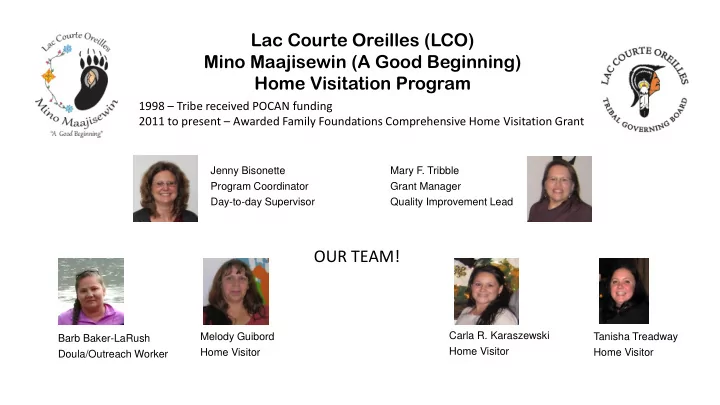
Carla R. Karaszewski Home Visitor Melody Guibord Home Visitor Tanisha Treadway Home Visitor Jenny Bisonette Program Coordinator Day-to-day Supervisor Barb Baker-LaRush Doula/Outreach Worker

OUR TEAM!

Mary F. Tribble Grant Manager Quality Improvement Lead

1998 – Tribe received POCAN funding 2011 to present – Awarded Family Foundations Comprehensive Home Visitation Grant

slide-2
SLIDE 2

Lac Courte Oreilles (LCO) Mino Maajisewin (A Good Beginning) Home Visitation Program

  • Part of Family Foundations Comprehensive Home Visiting (FFHV) network in

the State of Wisconsin 14 contracted agencies -some with multiple sites 27 programs serving 26 counties and 5 Tribes LCO is one of five Tribal Programs in the state

  • What is Mino Maajisewin?

Voluntary, intensive, and long-term home visitation services Focus on supporting parent-child interaction

2

slide-3
SLIDE 3

3

WHAT Healthy Families America is theoretically rooted in the belief that early, nurturing relationships are the foundation for life-long, healthy development. Interactions between direct service providers and families are relationship- based, designed to promote positive parent-child relationships and healthy attachment, strength-based, family centered, culturally sensitive and reflective.

  • Requirement of FFHV funding is being accredited by one of four nationally recognized models
  • To ensure local programs are implementing best practice standards with fidelity to research and the model

Our mission is to promote child well-being and prevent the abuse and neglect of our nation’s children through intensive home visiting.  Initiate Services Prenatally or at Birth  Screening Checklist/Parent Survey to Determine Eligibility  Voluntary Services/Creative Outreach/Family Retention  Service Intensity  Promotion of Parent-Child Relationships  Medical Home and Additional Services  Caseload Management  Service Provider Selection  Stop Gap Training  Staff Training  Supervision  Governance and Administration

slide-4
SLIDE 4

The families we serve...

  • Currently serving 40 families
  • Member of a Federally Recognized Tribe residing in

Sawyer County

  • First-time parent
  • Family is enrolled during pregnancy or within 3 months
  • f birth
  • Reoccurring themes:
  • History of childhood trauma
  • History of substance use
  • Lack of positive peer relationships/social support
  • Poverty
  • Approximately 50% of moms screen positive for

depression

  • 32% of participants have 5 plus ACES

4

slide-5
SLIDE 5

5 Growing up in a safe home, where I feel loved and my needs are met. Mom and dad are able to read my cues. They know how to respond to my needs in a loving and nurturing way.

Promoting parent child interaction

How we serve….

Voluntary services Home Visitor Training Relationship with the family, focusing on strengths and needs Connecting families to appropriate resources and follow-up Weekly supervisory session and reflective practice Weekly home visits Screening/assessments tools Family Goal Planning Meeting the family where they are at (family decides) Information on developmental milestones Support during labor and delivery Financial support Information for a healthy pregnancy

slide-6
SLIDE 6

How do we know we are making a difference?

Continuous Quality Improvement (CQI) A systematic approach to improving processes and outcomes through

regular data collection, examination of performance relative to pre-determined targets, review of practices that promote or impede improvement, and application of changes in practices that may lead to improvements in

performance.

slide-7
SLIDE 7

Mino Maajisewin’s Explanation of CQI

  • Looking at our data, discussing what is not happening (or needs to happen)

and then coming up with ideas to test to make improvement.

  • How do we make the services we provide better?

State CQI Initiatives Maternal Depression Reproductive Life Plan Home Visit Completion Rate Abuse Assessment /Safety Planning Breastfeeding Home Visiting Collaborative Improvement & Innovation Network (HV CoIIN) Maternal Depression Breastfeeding Internal CQI Initiatives Referral to Enrollment, Data Collection Processes and File Management Systems

slide-8
SLIDE 8

8

Is mom present at time of referral? Continue outreach efforts for 30 – 45 days. Is it a POSITIVE SCREEN?

If the screen is negative, offer family information and referrals for a good “family fit”. Early Head Start FACE NWCFRC/FFHV

Is OW able to start complete Engagement paperwork? Engagement record is created in DAISEY/SPHERE. NOTE: Date initial paperwork is completed is date of engagement. OW begins outreach efforts; set-up first visit to complete initial Engagement paperwork. Is OW able to complete Engagement paperwork? OW schedules time to complete a Parent Survey (PS). Types up PS; reviews and scores PS with Program Coordinator. Is the PS score 25 or more?

Referral received by OW. NOTE: Sometimes, OW is able to meet with mom right away; sometimes she is not.

Parent Survey scores of 25+

 PC assigns Home Visitor (HV)  PC completes “Bubble Sheet”  Engagement folder to GM for family file creation – Red file (Enrollment File) Includes the following: Enrollment Form – GM prefills information collected to-date onto this form Partnership Agreement, Transportation Waiver, Grievance Procedures, Supportive Services, Prenatal Assessment and Blank Blue Folder  Engagement folder becomes “Traveling” folder  Enrollment file and Traveling folder to PC  PC and OW reviews Enrollment File with assigned HV  Schedule first home visit with mom to enroll into the program OW ENROLLS MOM IN SPHERE/DAISEY

  • Takes out of engagement and enrolls in enrollment.

Discharge from Engagement. Does family want services? (Committing to the program)

Referral to Enrollment Process October 20, 2015 – Mapping started: Jenny and Mary December 15, 2016 – Mapping completed: Jenny, Mary and Barb START: Mom is referred to Mino Maajisewin

All referrals start with Outreach Worker (OW). Any referrals received in the program offices are forwarded to the OW to begin the referral process. OW has pre-made Engagement folders that include the following information: Communication Record; Contact Information; Screening Checklist; Family Rights Statement; Protection of Family’s Confidential Information Statement; Information Use Notice and Section I: Initial Enrollment (Face Sheet).

NO

YES

NO YES

NO YES YES YES NO NO YES NO END: Mom is enrolled in Mino Maajisewin

Initial Engagement paperwork is completed with mom.

PS scores <25

 OW offers family information and referral  OW gives Engagement folder to Grant Manager (GM) for data entry  GM files folder in program file  OW offers family information and referral  OW completes “Declines Services” form with family  OW gives Engagement folder to GM for data entry  GM files folder in program file

Family Sold?
slide-9
SLIDE 9

The Blue Folder

Blank, pre-made folders are created that includes:

  • Initial Edinburgh Postnatal Depression Scale

(EPDS) screen

  • Confidential Release of Information

Authorization

  • Local and Tribal Community Resources and

Services

  • More Than Just the Blues pamphlet
  • Plan of Action and Outcome Results for

Potential Depression Risk

These pre-made folders contain information the Home Visitors need to complete a screen. It also includes information and documentation for positive screens and if a referral is to be made.

slide-10
SLIDE 10

Develop goal plans with moms who are experiencing depressive symptoms. Moms will have a self-identified goal plan specifically related to decreasing depressive symptoms. If we ask the question, “What do you think will help you to feel better?”, will the home visitor be able to work with mom to develop a specific goal to decreasing depressive symptoms.

slide-11
SLIDE 11

Additional efforts to build capacity around serving families who experience depression and other mental health issues

  • Mother-Infant Therapy Group

 Oshki Maamaa Eni Mino Ayaang = To work towards being in a Good State of Mind

  • Reflective Practice
  • Infant Mental Health Consultation

12

Oshki-Maamaa amaa Eni Eni-mino mino-ayaa aang ng

A Mother-Infant therapy group that

  • ffers the opportunity to connect

with other moms who have similar feelings and experiences in mothering. Support in coping with feelings of mothering and your relationship with your baby.

slide-12
SLIDE 12

Family Story

I was introduced to this program after I found out that I was pregnant for the first time in 2013. At the time, I was homeless and pregnant, without family support or parents to guide me on the right path….I was very skeptical [at first] and I had a hard time keeping my appointments because I was homeless for the first 6-9 months after my daughter was born….[After attending the group meeting for moms], my life started to turn around before my very eyes because I was creating structure and setting goals during these sessions. Suddenly, everything didn’t seem as bad as I thought it was going to be….I made it a point to stick with this program because I really do enjoy my home visitor….I have gained emotional support for parenting as well as learning new parenting skills during my home visits. I have gained educational support for myself….I have overcome many obstacles, trials and tribulations since I first started the program….I got my first place [to live] almost two years ago. I started attending the Lac Courte Oreilles Community College last summer, and I work 20 hours a week to support the both of us….I honestly believe if I didn’t have the support from the Mino Maajisewin Program, I wouldn’t be where I am today.

slide-13
SLIDE 13

Family Story

When I enrolled with the Mino Maajisewin program I was about 7 months pregnant. At the time I was living with my mother and with no job, but clean and sober for the first time in most of my life; all because of a little girl I was soon to meet. 3 months after my daughter was born I finally got a job and a few months after that I’d gotten my very

  • wn place to live for the first time ever!! Mino Maajisewin has been a tremendous

help to me and my daughter the past year and a half. The education my home visitor gives me on my daughter’s growth and development helps me realize where my daughter is at and where she should be with the coming of her age. It helps me to be at ease with her growth and development because I now have an idea what’s going on with her and I don’t have to guess at it, and feeling lost and frustrated because I wouldn’t know what to do for her at certain stages of her growth and development. With the help of Mino Maajisewin I am the mother I’ve always hoped and wanted to be, I know what to avoid from my past experiences and the environment I was raised

  • in. In times of struggle the Mino Maajisewin Program has been there to help me, for

example; I couldn’t afford a bigger car seat for my daughter, I told this to my home visitor and she arranged for a car seat specialist to come to my home and teach me to use and install it in my car, and gave me the car seat for $10.00. I was so relieved and most grateful for their help. I honestly don’t know how I would be without their support and teachings.