Improving Member Health and Quality of Life Rural Health Symposium - - PowerPoint PPT Presentation

improving member health and quality of life
SMART_READER_LITE
LIVE PREVIEW

Improving Member Health and Quality of Life Rural Health Symposium - - PowerPoint PPT Presentation

Improving Member Health and Quality of Life Rural Health Symposium June 19, 2018 Presented by Rafielle Freeman and Cheri Moreland BlueCare Tennessee is an Independent Licensee of BlueCross BlueShield 1 Association. This document has been


slide-1
SLIDE 1

1

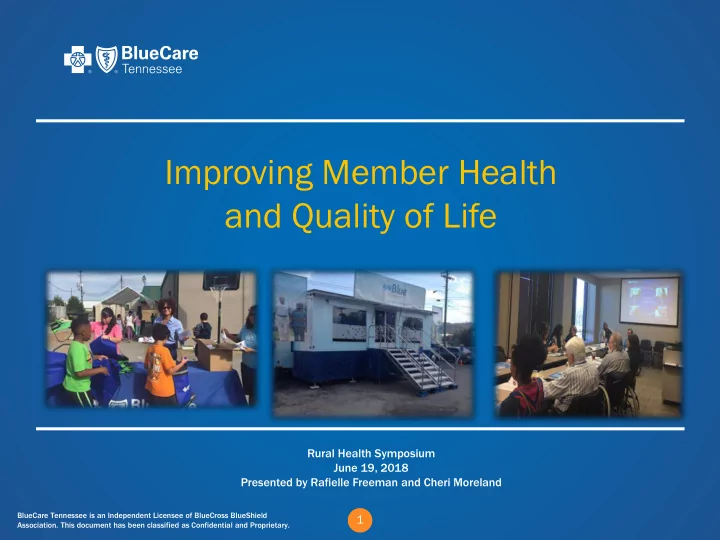
Improving Member Health and Quality of Life

Rural Health Symposium June 19, 2018 Presented by Rafielle Freeman and Cheri Moreland

BlueCare Tennessee is an Independent Licensee of BlueCross BlueShield

  • Association. This document has been classified as Confidential and Proprietary.
slide-2
SLIDE 2

2

BlueCare Facts

Founded in 1993 as one of TennCare’s first Managed Care Organizations (MCOs) Created as a stand-alone, for-profit subsidiary; with a separate HMO license Employs over 900 employees, head-quartered in Chattanooga, TN, with 5 regional offices Provide healthcare services to ~ 600,000 members NCQA Accredited Hold multiple contracts with the State of Tennessee

slide-3
SLIDE 3

Traditional Medicaid program providing physical and behavioral health services to low-income children, pregnant women and disabled individuals. Risk-based contracts for East, Middle, and West Tennessee regions.

496,295

Medicaid long-term services and supports program providing nursing facility and home-based care. Effective July 1, 2016, ECF promotes and supports integrated, competitive employment and independent living skills for individuals with intellectual and developmental disabilities (IDD)

11,462

Statewide program for some of our most vulnerable populations such as SSI and children in state custody. Administrative Services Only (ASO) – based contract.

35,710

Program for individuals who are dually eligible for Medicare and

  • Medicaid. Risk-based

contract effective January 1, 2014. Supplemental benefits include dental and vision.

15,562

Children’s Health Insurance Program (CHIP) providing full health coverage for eligible children age 18 and under, as well as pregnant women, whose household income exceeds traditional Medicaid limits.

71,039

3

BlueCare Tennessee Products and Populations

CHOICES/ Employment & Community First (ECF) CHOICES TennCare Select BlueCare Plus Dual Special Needs Plan (DSNP) CoverKids BlueCare Core Risk
slide-4
SLIDE 4

4

BlueCare Tennessee Membership

as of 5/11/18

slide-5
SLIDE 5

5

BlueCare Tennessee Mission

slide-6
SLIDE 6

Member Outreach

6

Member Outreach is an activity of providing services to our populations who might not otherwise have access to those services.

slide-7
SLIDE 7

7

Wh What is is di differ eren ent t about t Med edic icaid id manage ged d care?

To improve population health “it’s the housing, it’s the lack

  • f access to food, it’s the broken families, it’s all that messy
  • stuff. It’s a complex story so it can’t have a medical fix to

make it work rk.”

  • Dr. David B. Nash

Dean of the Jefferson School of Population Health

slide-8
SLIDE 8

8

Educate & Encourage our Members

To Improve Outcomes

slide-9
SLIDE 9

TennCare Kids EPSDT

9

TennCare Kids is a full program of checkups and health care services for children from birth through age 20 who have TennCare. These services make sure that babies, children, teens, and young adults receive the health care they need.

slide-10
SLIDE 10

TennCare Kid ids – EPS PSDT

Membership and Goal

10

BlueCare Tennessee provides health plans to more than 353,000 members under the age of 21.

Our goal is to assure that children get the health care they need when they need it

  • The right care, to the right child, at

the right time, in the right setting Address health problems before they become advanced and treatment is more difficult and costly

This can be accomplished with your help through their EPSDT Screenings

slide-11
SLIDE 11

TennCare Kid ids – EPS PSDT

EPSDT Defined

11

EP EPSDT Defini initi tion:

  • n:

The Early and Periodic Screening, Diagnostic and Treatment (EPSDT) benefit provides comprehensive and preventive health care services for children under age 21 who are enrolled in Medicaid. Early – Assessing and identifying problems early Peri riodic dic - Checking children's health at periodic, age-appropriate intervals Screen enin ing - Providing physical, mental, developmental, dental, hearing, vision, and other screening tests to detect potential problems Diagn gnosis

  • sis - Performing diagnostic tests to follow up when a risk is identified

Treatme tment nt - Control, correct or reduce health problems found

slide-12
SLIDE 12

TennCare Kid ids – EPS PSDT

2015-2017 CMS-416 MCO Averages

12

slide-13
SLIDE 13

TennCare Kid ids – EPS PSDT

CMS-416 Yearly Rate Comparisons –Middle

13

Middle

County 2016 2017 Bedford 66% 78% Cannon 58% 62% Cheatham 72% 78% Clay 61% 63% Coffee 67% 76% Cumberland 79% 83% Davidson 77% 82% DeKalb 57% 63% Dickson 62% 66% Fentress 60% 68% Giles 68% 70% Hickman 61% 72% Houston 62% 65% Humphreys 64% 72% Jackson 72% 75% Lawrence 69% 81% Lewis 64% 69% Lincoln 56% 62% Macon 64% 73%

Middle

County 2016 2017 Marshall 71% 83% Maury 70% 77% Montgomery 69% 78% Moore 69% 77% Overton 59% 70% Perry 53% 56% Pickett 70% 78% Putnam 80% 86% Robertson 74% 82% Rutherford 67% 77% Smith 63% 66% Stewart 57% 64% Sumner 63% 71% Trousdale 64% 71% Van Buren 68% 65% Warren 60% 65% Wayne 67% 75% White 77% 82% Williamson 66% 71% Wilson 67% 75%

Increased = 38 Decreased = 1 No Change = 0

slide-14
SLIDE 14

TennCare Kid ids – EPS PSDT

CMS-416 Yearly Rate Comparisons –West

14

West

County 2016 2017 Benton 76% 84% Carroll 72% 85% Chester 57% 61% Crockett 69% 73% Decatur 55% 63% Dyer 83% 86% Fayette 66% 73% Gibson 66% 68% Hardeman 56% 63% Hardin 53% 56% Haywood 52% 62% Henderson 59% 65% Henry 68% 71% Lake 64% 73% Lauderdale 59% 70% Madison 60% 61% McNairy 52% 57% Obion 64% 76% Shelby 68% 71% Tipton 64% 64% Weakley 68% 74%

Increased = 20 Decreased = 0 No Change = 1

slide-15
SLIDE 15

TennCare Kid ids – EPS PSDT

CMS-416 Yearly Rate Comparisons –East

15

East

County 2016 2017 Anderson 62% 65% Bledsoe 64% 65% Blount 66% 70% Bradley 61% 63% Campbell 74% 76% Carter 70% 77% Claiborne 59% 64% Cocke 78% 85% Franklin 65% 70% Grainger 65% 70% Greene 64% 76% Grundy 58% 63% Hamblen 76% 80% Hamilton 62% 66% Hancock 75% 84% Hawkins 64% 75% Jefferson 72% 76%

East

County 2016 2017 Johnson 65% 69% Knox 64% 68% Loudon 70% 77% Marion 58% 58% McMinn 74% 76% Meigs 77% 75% Monroe 69% 76% Morgan 64% 65% Polk 58% 57% Rhea 64% 69% Roane 74% 68% Scott 62% 62% Sequatchie 57% 65% Sevier 69% 78% Sullivan 65% 70% Unicoi 81% 84% Union 68% 72% Washington 74% 81%

Increased = 30 Decreased = 3 No Change = 2

slide-16
SLIDE 16

16

Community Care Partners

Alisa Johnson

Community Care Partner (CCP) Office: 423-854-6048 Cell: 423-413-5557 Email: Alisa_Johnson@BCBST.com

Sylvia Stamper

Community Care Partner (CCP) Office: 423-535-8172 Cell: 423-255-6875 Email: Sylvia_Stamper@BCBST.com

Jasmine Dary

Community Care Partner (CCP) Office: 423-535-8108 Cell: 615-393-1386 Email: Jasmine_Daryl@BCBST.com

Shanae Carrawell

Community Care Partner (CCP) Office: 901-544-2302 Cell: 901-302-0820 Email: Kiawanna_Carrawell@BCBST.com

Shenece Craddock

Community Care Partner (CCP) Office: 423-535-7427 Cell: 423-463-2984 Email: Shenece_Craddock@BCBST.com

slide-17
SLIDE 17

17

Strategies to Promote Event Attendance

Telephone Calls Postcards Website Postings Facebook/Instagram Flyers Incentives

slide-18
SLIDE 18

Fitness Events

18

slide-19
SLIDE 19

Advisory Panels & Workshops

19

slide-20
SLIDE 20

20

Meet Members Where They Live

Community & Health Equity Advisory Panels

Regional Priority: Opioid Use Disorder Regional Priority: EPSDT Regional Priority: TBD Regional Priority: Social Service Exchange

Purpose:

The role of the BlueCare Tennessee’s Community and Health Equity Panel is to drive movement toward health equity in and between communities across the state. + BlueCare team has assembled a set of Community and Health Equity Advisory Panels in four regions of Tennessee: Upper East, Lower East, Middle and West. + These groups include BlueCross and BlueCare leaders, along with physicians and representatives from community agencies in those regions + BlueCare and its partners are tackling different health needs in different ways, because the populations in each part of Tennessee face unique challenges + BlueCare is taking a collaborative approach to better understand how those challenges are playing out in real life for the residents of those regions

slide-21
SLIDE 21

21

Meet Members Where They Live

CHOICES Advisory Panels

East Region: CHOICES Advisory Board Middle Region: CHOICES Advisory Board West Region: CHOICES Advisory Board

Purpose:

The role of the BlueCare Tennessee’s CHOICES Advisory Panel is to create a forum where members, member representatives, advocates and providers

  • ffer input and

recommendations regarding BlueCare Tennessee’s program, policies and procedures.

+ The CHOICES Advisory Group provides input into BC/TCS’ planning and delivery

  • f long-term support services, CHOICES Quality Management/Quality

Improvement activities, program monitoring and evaluation, as well as member, family and provider education + BC/TCS provides orientation and ongoing training for Advisory Group members in order for them to have sufficient information and understanding of the CHOICES program to fulfill their responsibilities + Additional Panels include ECF CHOICES Advisory Panel and Behavioral Health Advisory Committee

slide-22
SLIDE 22

Resource Parent Education

22

Insurance should be the least

  • f our parent’s worries. They

should never wonder about which path to go in terms of the child’s healthcare. We want to provide support. Strengthen Resource Parent awareness of our programs and services Offer curriculum for inclusion in the Resource Parent Training Program Improve the Resource Parent Experience regarding Access to Care Promote Healthy Lifestyles and Explore Opportunities to Address Gaps in Care

slide-23
SLIDE 23

Community Partnerships

23

slide-24
SLIDE 24

Community Partnership Engagement

Goals and Rational

24

Goal

Our Community Engagement Strategy focuses on building relationships with community agencies, stakeholders, civic organizations and interest groups to work side-by-side as long- term partners—building a coalition of support for BC/TCS programs, initiatives, policies, and services—with the end goal of improving the quality and efficiency of care for BlueCare members statewide and making the community a better place to live.

Rational

  • Allows us to enhance the shared BlueCare Community Care Model by tapping into

diverse resources, programs, services and activities to improve the quality of members lives.

  • Promotes a wide variety of community interactions that range from information sharing,

accessing and sharing resources, population assessments, to community consultation, community outreach events, referral services and in most instances, active participation in decision-making processes.

  • Empowers those from the community to learn about our initiatives and programs that

support our operational goals including NCQA, EPSDT, and HEDIS /CAHPS, allowing them to see multiple sides and increasing the likelihood that initiatives and/or solutions will be widely accepted.

  • Increases the level of trust between communities and our organization.
slide-25
SLIDE 25

Provider Education & Engagement

25

slide-26
SLIDE 26

Provider Tools

26

Provider Administration Manual Monthly BlueAlert Newsletter Articles Quality Newsletters Clinical Practice Guidelines Website Resources including Billing Guidelines and Toolkits Collaboration with the Tennessee Chapter of the American Academy of Pediatrics, Tennessee Primary Care Association and Tennessee Hospital Association Annual All Blues Workshops Annual Tennessee Medical Association Workshops Annual Vaccines for Children Workshop Various Provider Conferences

slide-27
SLIDE 27

Provider Tools

27

Community Mental Health Center Initiatives Medical Record Audits Behavioral Health Resources

  • Referral Assistance Line
  • Primary Care Provider Consultation line
  • State of Tennessee Crisis Hotline
  • PCP Behavioral Health Tool Kit

Other techniques and tools

  • Appointment Faxes
  • Pediatric Initial Health Assessment Forms
  • PCP Membership Listing
  • Referral to Specialist / Care Coordination /IEP / EBLL
slide-28
SLIDE 28

Enhanced Training BEHIP

28

BEHIP Behaviorally Effective Healthcare In Pediatrics Collaborative training program between BlueCare and TNAAP to educate pediatric PCPs to

  • Use tools and strategies to screen for, assess, and manage patients with

emotional, behavioral, and substance abuse challenges

  • Use helpful, natural language with patients regarding screening results
  • Know and access behavioral resources
slide-29
SLIDE 29

Enhanced Training BEHIP

29

Available online Free and will earn up to 5.25 AMA PRA Category 1 credit(s) To access the online training modules, visit http://www.tnapp.org/behip and look for the online training modules link Provide pediatric healthcare provider with tools and strategies to screen for, access and manage patients with common behavioral health concerns Modules range from 30 minutes to 1 hour, covering the following topics:

  • Module 1: Introduction to Behavioral Health Pediatrics
  • Module 2: Postpartum Depression
  • Module 3: Disruptive Behavior
  • Module 4: Inattention
  • Module 5: Anxiety
  • Module 6: Depression
  • Module 7: Substance Abuse
  • Module 8: Workflow and Coding
slide-30
SLIDE 30

Provider Quality Engagement Strategy

30

Achieving successful patient outcomes is directly impacted by Provider Engagement. To accomplish this evolving focus on quality, Health Plans across the nation have evolved their quality improvement portfolio by partnering with primary care providers through Pay for Quality programs. Quality-based purchasing strategies aim to better coordinate a variety of quality improvement efforts toward a shared set of priorities that focus on core

  • populations. This is especially relevant for Medicaid MCOs.

Successful quality-based program implementation and thus effective provider engagement includes identification of performance indicators which are:

Resources: HealthChoice and Acute Care Administration Division of HealthChoice Management and Quality Assurance (2012). Medicaid Managed Care Organization Value-Based Purchasing Activities Report. Retrieved from https://mmcp.dhmh.maryland.gov. Optum (2015). Provider engagement has a major impact on quality, costs and outcomes. Retrieved from http://www.optum.com.

slide-31
SLIDE 31

Provider Quality Engagement Strategy

31

The essential elements to provider engagement with the goal to improve quality and member health outcomes include the following: Increased adoption of gap closure activities

  • Provided the right resource tools and application, providers can use decision support to

close applicable member gaps in care. Said systems offer providers near-time access into patient profiles and most importantly into integral gaps in care reports. Such essential patient information helps providers to ascertain a much more holistic view of their patients’ health status and provide a greater impact on overall patient health outcomes.

Use of data-driven best practices

  • Knowing the right questions to ask and being able to tap into data-driven insights leads to

more targeted interventions for patients and more efficient use of a provider’s time. It also decreases unnecessary tests and treatments, increasing provider and health plan financial performance.

Improved use of decision-support tools and thus increased interoperability

  • A complete view of the patient’s prior care is essential to improving care and reducing

unnecessary treatment. Providers must be able to quickly view medical records, regardless

  • f where they are located and what electronic health record (EHR) they were created in.
slide-32
SLIDE 32

Tennessee Health Care Initiative Innovation

32

3 Strategies: Primary Care Transformation

  • Patient Centered Medical Home
  • Tennessee Health Link
  • Care Coordination Tool

Episodes of Care Long Term Services and Supports

slide-33
SLIDE 33

Tennessee Health Care Initiative Innovation

33

PCMH model includes the following:

Patient-Centered Access: Providing same-day appointments for routine and urgent care Team-Based Care: Conducting scheduled patient care team meetings or a structured communications process Population Health Management: Using risk stratification to address chronic and acute care services and perform outreach activities Care Management Support: Identifying high-need, high-risk patients for care management and developing care plans with self-care support recommendations Care Coordination and Care Transitions: Tracking referrals; completing follow up and coordination of care transitions Performance Measurement and Improvement: Measuring and tracking quality and efficiency metrics

slide-34
SLIDE 34

Improvement Design

  • Transformational

Activities with:

  • Large, low

performing practices

  • Large, almost ready

practices

  • Clinical Data Exchange

Oversight

  • Value Based Program

Design

  • Quality Metrics
  • Financial
  • Qualitative review of

provider performance reports Tools & Resources

  • Quality Care Rewards

Tool improvement and metrics

  • Quality Materials
  • Quality Improvement

meeting collaboration with Navigant

  • BCBST PCMH

Consultant Collaboration TennCare Coordination

  • Strategic Decision

Making

  • Quality Measure

Selection

  • Quality Measure

Accuracy

  • Collaborate with non-

PCMH providers to promote treatment

  • pportunities to

improve gap closure

  • Cross functional

education and training for PCMH/THL

34

BlueCare’s Role in Primary Care Transformation

slide-35
SLIDE 35

35

Provider Engagement & Incentive Team Provider Scorecard Provider Performance Reports Provider Reports Provider Engagement Provider Resources

slide-36
SLIDE 36

Substance Use Disorder Initiatives

36

+ Opioid Stewardship and Safety + Best Care for Substance Use Disorder (SUD) + Medication-Assisted Treatment (MAT) Expansion

  • Challenge embraced by BlueCross
  • Very high priority set by Governor Haslam
  • https://www.tn.gov/governor/news/2018/1/22/haslam-announces-

aggressive--comprehensive-plan-to-end-tennessee-s-opioid- epidemicemic.html

  • Priority strongly re-affirmed by TennCare
  • https://www.tn.gov/tenncare/tenncare-s-opioid-strategy.html
  • Partner with TN Together
  • https://www.tn.gov/opioids

+ Tele-Education: Project ECHO

slide-37
SLIDE 37

Questions

37

Local SOLUTIONS, Meaningful RESULTS