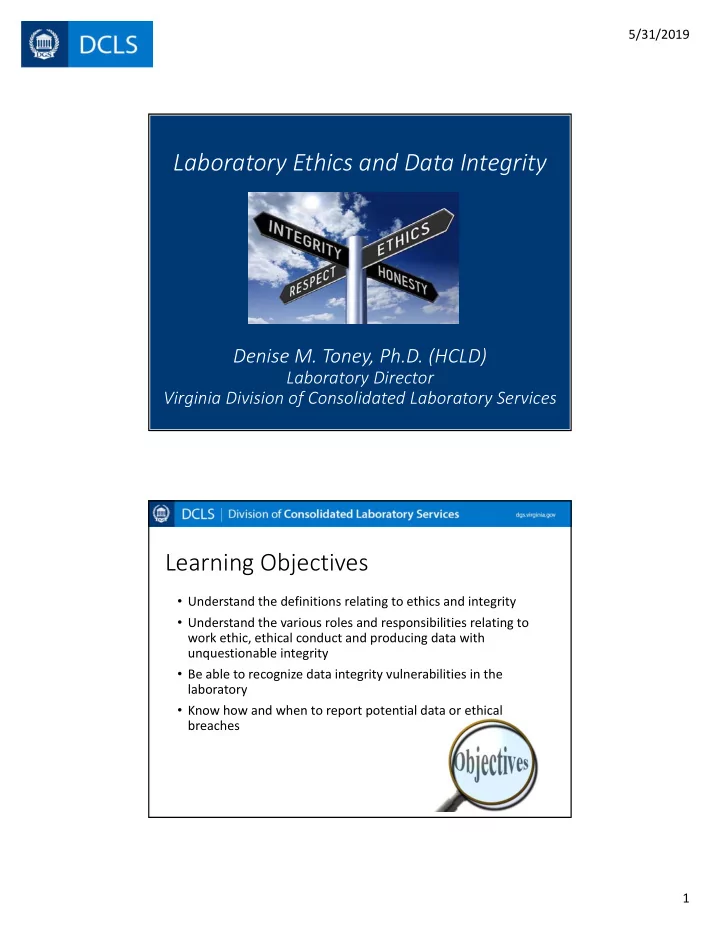
Laboratory Ethics and Data Integrity Denise M. Toney, Ph.D. (HCLD) - - PDF document

laboratory ethics and data integrity
SMART_READER_LITE
LIVE PREVIEW

Laboratory Ethics and Data Integrity Denise M. Toney, Ph.D. (HCLD) - - PDF document

5/31/2019 Laboratory Ethics and Data Integrity Denise M. Toney, Ph.D. (HCLD) Laboratory Director Virginia Division of Consolidated Laboratory Services Learning Objectives Understand the definitions relating to ethics and integrity


slide-1
SLIDE 1

5/31/2019 1

Laboratory Ethics and Data Integrity

Denise M. Toney, Ph.D. (HCLD)

Laboratory Director Virginia Division of Consolidated Laboratory Services

Learning Objectives

  • Understand the definitions relating to ethics and integrity
  • Understand the various roles and responsibilities relating to

work ethic, ethical conduct and producing data with unquestionable integrity

  • Be able to recognize data integrity vulnerabilities in the

laboratory

  • Know how and when to report potential data or ethical

breaches

2

slide-2
SLIDE 2

5/31/2019 2

Introduction

Definitions

Ethics: Principles of conduct governing an individual

  • r profession*

Ethical Behavior: Acting in a way that displays integrity, honesty and morally good behavior

Work Ethic: Demonstrating ethical behavior at work; a set

  • f values centered on the importance of doing work and

working hard*

Integrity: Firm adherence to a moral code* or set of values; the quality of being honest and consistent

Data Integrity: Maintaining the accuracy and consistency of data over its entire life‐cycle

*Merriam Webster

Laboratory Ethics and Data Integrity

Takes Commitment “At all levels”

slide-3
SLIDE 3

5/31/2019 3

Administrative Priority

  • Most laboratories have policies, procedures, and

trainings to highlight the importance of ethics, integrity and expectations of honesty

  • Examples can include:
  • Employee Code of Ethics
  • Mission or Vision Statements
  • Quality Policy Statements
  • Standards of Conduct
  • Conflicts of Interest Disclosures

Employee Code of Ethics (Virginia)

  • I am committed to the highest ideals of professionalism and the

stewardship of public resources.

  • I will not hold financial interests that conflict with the conscientious

performance of duty.

  • I will act impartially and not give preferential treatment to any private
  • rganization or individual.
  • I will disclose waste, fraud, abuse, and corruption to appropriate

authorities.

  • I will uphold these principles, demonstrating professional integrity and

conscious that public office is a public trust.

  • I will conduct myself at work in a manner that is consistent with the

Commonwealth's Standards of Conduct for Employees, applicable agency regulations and policies, and the policies of the Department of Human Resource Management.

slide-4
SLIDE 4

5/31/2019 4

2009 The NELAC Institute (TNI) Standard:

  • Section 5.2.7 (2009 TNI V1M2 & 2016 TNI V1M2 Rev.2.1)
  • “Data integrity training shall be provided as a formal part of new employee orientation and

shall also be provided on an annual basis for all current employees”.

  • “Employees are required to understand that any infractions of the laboratory data integrity

procedures shall result in detailed investigation that could lead to very serious consequences including immediate termination, debarment, or civil/criminal prosecution”.

Clinical Laboratory Improvement Amendments (CLIA) :

  • 42 CFR 493 Subpart M Personnel for Non‐waived Testing

ISO/IEC 17025:

  • “…policies and procedures to avoid involvement in any activities that would diminish

confidence in its competence, impartiality, judgment, or operational integrity.”

7

Data Integrity and Ethics Training

Regulatory Requirement

7

What is “GOOD” Work Ethic?

slide-5
SLIDE 5

5/31/2019 5

“GOOD” Work Ethic

Reliable Truthful Honest Dependable Responsible Hard-working Committed Mature Helpful Focused Dedicated Accountable

Characteristics of Good Work Ethic

Reliable

  • Showing up to work on time and when scheduled
  • Completing assigned tasks, independently and on time
  • Managing one’s time and emotions effectively
  • Attending meetings fully prepared and following up on action items in a

timely manner

Responsible

  • Doing more than the bare minimum
  • Caring about your job performance (giving your best effort)
  • Helping co‐workers with tasks when asked or when help is needed
slide-6
SLIDE 6

5/31/2019 6

Dependable

  • Working together to meet laboratory/group goals
  • Striving to always deliver quality work
  • Respecting EVERYONE at every level; including working with difficult people

Integrity and Honesty

  • Always being truthful
  • Striving for high moral standards
  • Aiming for accuracy in every thing you do
  • Asking questions or speaking up when things are questionable

Characteristics of Good Work Ethic

Why Behave Ethically at Work?

“It is just the RIGHT thing to do!!”

  • Our laboratory data and laboratory decisions impact

lives, impact our communities, the environment, the safety of our food supply, etc.

  • Your personal reputation and the reputation of your

laboratory depends upon it (“Customer trust”)

  • Demonstrating good work ethic and a positive

attitude impacts morale and provides a positive example for all employees

  • The penalties for misconduct for you, your

laboratory, and your leadership can be substantial

12

slide-7
SLIDE 7

5/31/2019 7

So what’s the big deal?

13

Some Decisions Can be Challenging

  • Scientifically sound decisions are not always clear
  • Scientific troubleshooting and interpretation of data can be

tricky

  • Producing reliable/defensible data

What is an improper practice?

  • Scientifically unsound or technically unjustified practice that

makes results appear acceptable

  • Decisions can often seem like no big deal
slide-8
SLIDE 8

5/31/2019 8

Reasons why improper practices

  • ccur?
  • Production or deadline pressures
  • To avoid having to re‐run samples
  • To avoid having to perform instrument

maintenance

  • Poor communication and/or training
  • Misinterpretation of method requirements
  • Personality and attitude, not really necessary
  • Fear of authority; intimidating work environment
  • Lack of attention to detail
  • Misguided trust

Unethical Work Behavior

Examples

  • Entering data or results for work you did not perform
  • “Dry‐labbing”
  • Entering freezer temperatures or QC data when not performed
  • Initialing results for co‐worker
  • Failure to run proper controls or cherry‐picking control

data

  • Not following laboratory protocols
  • Sending out results without proper review
  • Omitting steps in a SOP
  • Improper calibration or NO calibration
slide-9
SLIDE 9

5/31/2019 9

  • Changing run dates or accessioning dates/times to make

samples appear to meet holding times (“Time Travel”)

  • Deleting data that doesn’t meet customers needs or at the

request of a customer

  • Sharing information about laboratory testing or testing

results with family or friends (breaches in confidentiality) If you are EVER UNSURE if your actions are unethical ask yourself….would you do it if someone was watching you?

Unethical Work Behavior

Examples

  • EPA definition of FRAUD*

“The deliberate falsification during reporting of analytical and quality assurance results that failed method and contractual requirements to make them appear to have passed requirements”

  • Fraud is purposeful
  • Fraud is not a mistake or an accident
  • Fraud is an intentional misrepresentation of lab

data in order to hide known or potential problems

  • Fraud makes data look better than it really is, with

the intent to deceive

* EPA 2006 Evaluation Report

When it “Crosses the Line” = FRAUD

slide-10
SLIDE 10

5/31/2019 10

  • Civil Prosecution
  • Criminal Prosecution
  • Penalties can be up to 5 years in prison

and/or a $500,000 fine

  • Suspension or loss of accreditation
  • Loss of customers and work
  • Violation of standards of conduct and

grounds for immediate termination

Penalties for Fraud

Impacts not only YOU but your co‐workers, the Lab, and the Director

  • Was it done intentionally to misrepresent data?
  • Did you know that the action specifically violated a

policy or procedure?

  • Were you told NOT to do it and you did it anyway?
  • When asked about what happened, did you tell a

lie?

  • Gut check – Do you feel as if your actions were

wrong?

Ways to tell if an improper practice or unethical work behavior is FRAUD?

slide-11
SLIDE 11

5/31/2019 11

Ethics and Data Integrity

Laboratory Program Key Elements

Documentation Training Policies and Procedures Data Monitoring and Review Confidentiality Employee Assessment

So who is responsible for what?

22

slide-12
SLIDE 12

5/31/2019 12

Employee Responsibilities

  • Uphold ethical practices and data integrity each and every day
  • Ask for help when you are unsure of the proper action to take
  • Be sensitive and alert to situations that could result in actions

by ANYONE that are improper, illegal, or unethical

  • Talk to co‐workers when they appear to be in danger of violating

ethics and data integrity policies or procedures; help them get help

  • Report ethical or data integrity violations (or suspicions) to your

manager (or above)

  • Remember your actions speak louder than words

23

  • Develop and maintain a robust quality management

system focused on ethics and data integrity

  • Perform continuous data review, always looking for

red flags or warning signs

  • Conduct internal audits, monitoring and blind

sample challenges as required or necessary

  • Ensure an open door policy for all employees
  • Promote a culture where employees feel safe

reporting concerns or issues in confidence

QA Staff Responsibilities

slide-13
SLIDE 13

5/31/2019 13

  • Promote the importance of ethics and data integrity at all levels
  • Minimize “undue” pressure throughout the lab especially on

staff

  • Promptly notify customers when data integrity is compromised;

re‐issue reports as necessary

  • Ensure all employees know that there are SEVERE consequences

not only for themselves but for the entire laboratory for actions involving scientific misconduct and fraud

  • Provide an environment where employees can report concerns

without retribution; make available multiple reporting channels including anonymous reporting

Management Responsibilities How to Report Issues?

  • Report to your manager/supervisor, QA Department
  • r Laboratory Director
  • In circumstances requiring reporting of fraudulent

activities at the State level or higher

Contact:

  • State Fraud, Waste, and Abuse Hotline (if available)
  • US EPA Fraud Waste and Abuse Hotline: 1‐888‐546‐

8740; e‐mail: OIG_Hotline@epa.gov

slide-14
SLIDE 14

5/31/2019 14

REMEMBER: Mistakes happen!

Reporting mistakes is an important and vital component of a strong quality management system

“The aim of leadership should be to improve the performance of man and machine, to improve quality, to increase output, and simultaneously to bring pride of workmanship to people, […], the aim of leadership is not merely to find and record failures of men, but to remove the causes of failure; to help people to do a better job with less effort” ‐ W. Edwards Deming

Summary

  • Always be honest and ethical
  • Ask questions if you don’t understand
  • Its OK to make a mistake, it is NOT OK to hide the mistake
  • Good COMMUNICATION is key to preventing ethical and data

integrity issues

  • See something – Say something
  • Question something ‐ ASK
  • Remember: Fraud and ethical breaches can result in serious

consequences – it’s NOT worth your job or going to jail over

slide-15
SLIDE 15

5/31/2019 15

Contact Information

Denise M. Toney, Ph.D., HCLD

Laboratory Director Division of Consolidated Laboratory Services 600 North 5th Street Richmond, VA 23219 denise.toney@dgs.virginia.gov Phone: 804‐648‐4480

References

1. UEPA Office of the Inspector General ‐ Evaluation Report: Promising Techniques Identified to Improve Drinking Water Laboratory Integrity and Reduce Public Health Risks. Report No. 2006‐P‐00036. September 21, 2006. 2. www.usda‐ethics.net, USDA Office of Ethics 3. Environmental Protection Agency website, http://www.epa.gov/oig/ 4. EPA Document: QA/G‐8 November 2002 5. 2009 TNI Standard 6. Houston Chronicle online http://smallbusiness.chron.com/5‐factors‐demonstrate‐strong‐work‐ethic‐ 15976.html 7. Commonwealth of Virginia, Division of Consolidated Laboratory Services, Laboratory Ethics and Data Integrity Annual Training 2018. 8. The Department of Health and Human Services, Office of Research Integrity, http://ori.dhhs.gov/ 9. Houston Health Department, Laboratory Ethics and Data Integrity Training Document (APHL online). 10. State Hygienic Laboratory at the University of Iowa, Training‐Source online course, Ethics and Data Integrity for Technical and Non‐Technical Staff.