L04: Eukaryotes BIOL 153/L Black Hills State Univ. Ramseys See - - PDF document

l04 eukaryotes
SMART_READER_LITE
LIVE PREVIEW

L04: Eukaryotes BIOL 153/L Black Hills State Univ. Ramseys See - - PDF document

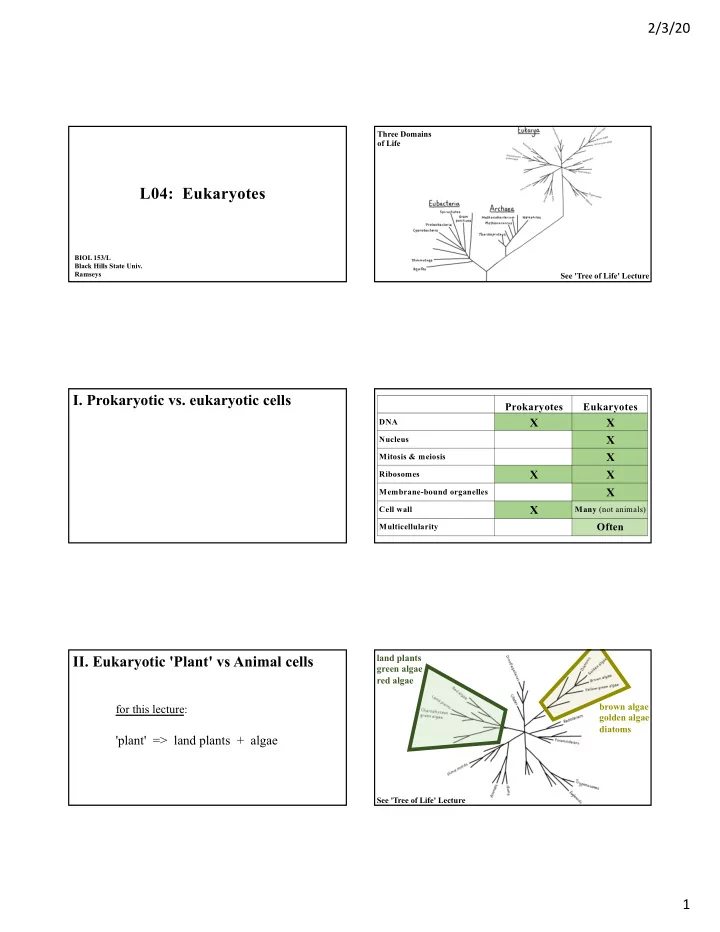
2/3/20 Three Domains of Life L04: Eukaryotes BIOL 153/L Black Hills State Univ. Ramseys See 'Tree of Life' Lecture I. Prokaryotic vs. eukaryotic cells Prokaryotes Eukaryotes X X DNA X Nucleus X Mitosis & meiosis X X


slide-1
SLIDE 1

2/3/20 1

L04: Eukaryotes

BIOL 153/L Black Hills State Univ. Ramseys

See 'Tree of Life' Lecture Three Domains

  • f Life
  • I. Prokaryotic vs. eukaryotic cells

Prokaryotes Eukaryotes

DNA

X X

Nucleus

X

Mitosis & meiosis

X

Ribosomes

X X

Membrane-bound organelles

X

Cell wall

X

Many (not animals) Multicellularity

Often

  • II. Eukaryotic 'Plant' vs Animal cells

for this lecture:

'plant' => land plants + algae

land plants green algae red algae brown algae golden algae diatoms

See 'Tree of Life' Lecture

slide-2
SLIDE 2

2/3/20 2

'Plant' cells Animal cells

Cell wall

X

Cell type diversity Less More Mitochondria

X X

Chloroplasts

X

Vacuoles Always

(large vacuoles)

Often

(small vacuoles)

  • III. Eukaryotic cell components
  • A. Nucleus

membrane-bound compartment containing linear DNA (chromosomes) nucleus disassociates during mitosis and meiosis

  • B. Cytoplasm

living matter of cell, outside nucleus cytosol is term for the cytoplasm 'goo'

nucleus cytosol cell membrane

  • C. Organelles
slide-3
SLIDE 3

2/3/20 3

  • 1. Definition of organelle
  • Narrow: membrane-bound structure in cytoplasm
  • Broad: any cell structure outside nucleus
  • 2. Membrane-bound organelles (examples)
  • a. Mitochondria

2x membrane-bound organelle; performs aerobic respiration

  • b. Chloroplast

2x membrane-bound organelle; performs photosynthesis

  • c. Vacuole

membrane-bound space with water,

  • rganic + inorganic molecules, enzymes

functions in storage, materials isolation, turgor pressure

  • d. Eyespot apparatus

membrane-bound organelle; senses light direction + intensity

found in many unicellular photosynthetic organisms

slide-4
SLIDE 4

2/3/20 4

nucleus cytosol mitochondria chloroplast cell membrane vacuole

  • 3. Non-bound organelles (examples)
  • a. Ribosome

small structure composed of protein + RNA

site of protein synthesis in cell cytoplasm

  • b. Flagella

threadlike structure protruding from cell; function in movement

found in many unicellular photosynthetic organisms, sperm of many multicellular photosynthetic organisms

  • D. Cytoskeleton

network of microtubules + actin filaments in cytosol

in-cell movement (cell division, cytoplasmic streaming, etc.)

  • E. Cell wall

structural layer outside cell membrane; provides support + protection

complex composition usually including carbohydrate polymers and microfibril structures

slide-5
SLIDE 5

2/3/20 5

eukaryotes very traditionally called 'plants' (prokaryote cell walls different)

  • 1. Taxonomic distribution

land plants, algae, fungi, many protists

  • 2. Land Plant cell walls
  • a. Multiple layers
  • 1º cell wall: flexible, exterior
  • 2º cell wall: rigid, interior (not always present)
  • middle lamella: interface between cells
  • b. Composition
  • 1º cell wall: cellulose, hemicellulose, pectin
  • 2º cell wall: lignin, cutin, suberin
  • c. Plasmodesmata

small channels traversing cells walls

allow regulated communication + transport among cells

intercellular space plasmodesmata nucleus cytosol mitochondria chloroplast cell wall cell membrane middle lamella vacuole

slide-6
SLIDE 6

2/3/20 6

  • 3. Other cell walls
  • Fungi: chitin

carbohydrate that provides rigidity to fungal cell walls

  • Fungi: chitin
  • Diatoms: silica (glass)

SiO2 provides strength and ridigity to cell wall

  • Diatoms: silica (glass)
  • Brown algae: alginate

reacts with calcium in ocean water, creates flexible gel

slide-7
SLIDE 7

2/3/20 7

  • Brown algae: alginate

reacts with calcium in ocean water, creates flexible gel

  • Red algae: carageenan, agar, calcium carbonate

provide flexibility (carageenan, agar), rigidity (calcium c.)