Gene Expression: Details Pre-mRNA Secondary (Eukaryotes) Structure - - PowerPoint PPT Presentation

gene expression details pre mrna secondary
SMART_READER_LITE
LIVE PREVIEW

Gene Expression: Details Pre-mRNA Secondary (Eukaryotes) Structure - - PowerPoint PPT Presentation

Gene Expression: Details Pre-mRNA Secondary (Eukaryotes) Structure Prediction Aids DNA pre-mRNA mRNA Protein Splice Site Recognition nucleus Protein gene Donald J. Patterson, Ken Yasuhara, Walter L. Ruzzo DNA January 3-7, 2002


slide-1
SLIDE 1

1

1

Pre-mRNA Secondary Structure Prediction Aids Splice Site Recognition

Donald J. Patterson, Ken Yasuhara, Walter L. Ruzzo University of Washington Computational Molecular Biology Group

January 3-7, 2002 Pacific Symposium on Biocomputing

3

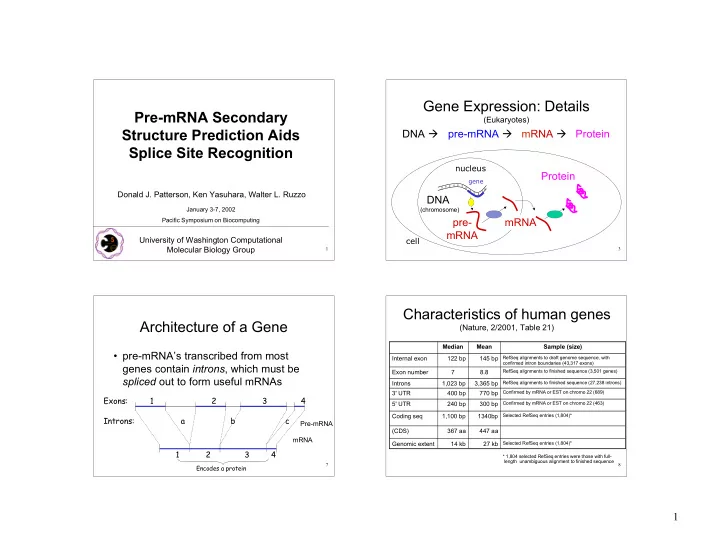
Gene Expression: Details

(Eukaryotes)

DNA  pre-mRNA  mRNA  Protein DNA

(chromosome)

Protein

gene

cell

pre- mRNA

nucleus

mRNA

7

Architecture of a Gene

  • pre-mRNA’s transcribed from most

genes contain introns, which must be spliced out to form useful mRNAs

Exons: 1 2 3 4 Introns: a b c 1 2 3 4

Pre-mRNA mRNA

Encodes a protein

8

Characteristics of human genes

(Nature, 2/2001, Table 21)

* 1,804 selected RefSeq entries were those with full- length unambiguous alignment to finished sequence Selected RefSeq entries (1,804)*

27 kb 14 kb Genomic extent 447 aa 367 aa (CDS)

Selected RefSeq entries (1,804)*

1340bp 1,100 bp Coding seq

Confirmed by mRNA or EST on chromo 22 (463)

300 bp 240 bp 5' UTR

Confirmed by mRNA or EST on chromo 22 (689)

770 bp 400 bp 3' UTR

RefSeq alignments to finished sequence (27,238 introns)

3,365 bp 1,023 bp Introns

RefSeq alignments to finished sequence (3,501 genes)

8.8 7 Exon number

RefSeq alignments to draft genome sequence, with confirmed intron boundaries (43,317 exons)

145 bp 122 bp Internal exon Sample (size) Mean Median

slide-2
SLIDE 2

2

9

Cell, Vol. 92, 315–326, February 6, 1998 Mechanical Devices of the Spliceosome: Motors, Clocks, Springs, and Things Jonathan P. Staley and Christine Guthrie

10

Relevance of Splice Prediction

  • Splice site prediction is critical to

eukaryotic gene prediction.

– Average human gene has 8.8 exons – Genes with over 175 exons known – Current primary sequence models do not display the same discriminatory power that cells exhibit in vivo – Small per-site error rate compounds

11

Hypothesis

  • Secondary structure contains

information useful for predicting splice site location.

  • This information is in addition to

primary sequence information.

– Specific instances of secondary structure variation affecting the splicing process.

12 Summary Statistics Secondary Structure Prediction (MFOLD) Possible acceptor splice sites Pre-mRNA sequences Primary Sequence Model (WAM) Summary Statistics Machine Learner Threshold Classifier

Secondary Structure Predictions

slide-3
SLIDE 3

3

13 Possible acceptor splice sites Pre-mRNA sequences Primary Sequence Model (WAM) Machine Learner Secondary Structure Prediction (MFOLD)

Secondary Structure Predictions Summary Statistics Threshold Classifier Summary Statistics 14

Data Set

  • Drawn from 462 unrelated, annotated, multi-

exon human genes with standard splicing. (Reese 97)

  • 1,980 acceptor splice sites (3’ end of intron)
  • 1,980 non-sites selected randomly

– Aligned to an “AG” consensus – Located within 100 bases of an annotated acceptor splice site.

15 Secondary Structure Prediction (MFOLD) Possible acceptor splice sites Pre-mRNA sequences Primary Sequence Model (WAM) Machine Learner

Secondary Structure Predictions Summary Statistics Threshold Classifier Summary Statistics 16

intron

exon 5’ exon

What's in the Primary Sequence?

slide-4
SLIDE 4

4

17

What's in the Primary Sequence?

Weight Matrix Model (0th order Markov Model)

  • 4
  • 3
  • 2
  • 1

+1 +2 +3 A

22 4 100 25 25 27

C

33 74 13 21 27

G

22 100 52 22 24

T

22 21 9 32 23

acceptor splice site intron exon

18

Sequence-based Metric

  • 1st order Weight Array Matrix (WAM) / Markov

Model

– Pi(Ni={A,C,G,U} | Ni-1={A,C,G,U} )

  • Training

– Generate two conditional probability tables for positions (–21,+3), one from positive examples and

  • ne from negative examples.
  • Testing

– For each sequence, x, calculate its likelihood ratio:

( ) ( )

  • +

x P x P

WAM WAM 10

log

19

Secondary Structure Predictions Possible acceptor splice sites Pre-mRNA sequences Primary Sequence Model (WAM) Machine Learner Secondary Sequence Model (MFOLD) Secondary Structure Prediction (MFOLD) Summary Statistics Threshold Classifier Summary Statistics 20

Secondary Structure

Acceptor Splice Site

100

slide-5
SLIDE 5

5

21

Secondary Structure Predictions Secondary Structure Prediction (MFOLD) Possible acceptor splice sites Pre-mRNA sequences Primary Sequence Model (WAM) Machine Learner Summary Statistics Threshold Classifier Summary Statistics 22

Secondary Structure Statistics

  • Optimal Folding Energy
  • Max Helix score
  • Neighbor Pairing Correlation Model

23

  • 1. Optimal Folding Energy

Secondary Sequence Prediction (MFOLD)

Free Energy

  • 35.2 kcal/mole

Free Energy

  • 34.0 kcal/mole

Free Energy

  • 2.0 kcal/mole

… ...CUGCUUUCUCCCCUCUCAGGGACUUACAGUUUGAGAUGC...

24

  • 2. Max Helix
  • Calculate
  • Calculate

x HStart

P

, x HEnd

P

,

) , ( max

, , ) 5 , 5 ( x HEnd x HStart i i x i

P P MaxHelix

+

  • =

What is the highest probability that a helix will form nearby?

Helix

slide-6
SLIDE 6

6

25

O

Unpaired base

P

Paired base

S

Paired and stacked base

  • 3. Neighbor Pairing Correlation

Model

Change the pre- mRNA alphabet from nucleotides to structural symbols

O

Unpaired base

P

Paired base

S

Paired and stacked base

26

  • 3. Neighbor Pairing Correlation

Model

P S O O O O O P S O O P S P S O

Unpaired base

P

Paired base

S

Paired and stacked base

O

Unpaired base

P

Paired base

S

Paired and stacked base Change the pre- mRNA alphabet from nucleotides to structural symbols

27

  • 3. Neighbor Pairing Correlation

Model

  • 2nd order Markov Model

– Pi(Ni={O,P,S} | Ni-1={O,P,S} ^ Ni-2={O,P,S} )

  • Training

– Generate two conditional probability tables for positions (–50,+3), one from positive examples and one from negative examples.

  • Testing

– For each sequence, x, calculate its log likelihood ratio:

( ) ( )

  • +

x P x P

NPCM NPCM 10

log

28 Possible acceptor splice sites Pre-mRNA sequences Primary Sequence Model (WAM) Machine Learner Secondary Structure Prediction (MFOLD)

Secondary Structure Predictions Summary Statistics Threshold Classifier Summary Statistics

slide-7
SLIDE 7

7

29

Machine Learners

  • Decision Trees

– Quinlan’s C4.5

  • Support Vector Machines

– Noble’s svm 1.1 – Radial Basis Kernel degree 2

  • Both take a vector of statistics and

produce a yes/no binary classifier.

31 Secondary Structure Prediction (MFOLD) Possible acceptor splice sites Pre-mRNA sequences Primary Sequence Model (WAM) Machine Learner

Secondary Structure Predictions Summary Statistics Threshold Classifier Summary Statistics 32

Results

(Decision Trees)

0.016 5.5 93.13 WAM,OFE,NPCM,MH 0.009 6.6 93.21 WAM,OFE,MH 0.022 5.9 93.16 WAM,OFE,NPCM 0.066 5.5 93.13 WAM,OFE 92.73 WAM (baseline) p

% Error Reduction Mean Accuracy (%)

Features

WAM = Weight Array Matrix (Primary Sequence Method) OFE = Optimal Free Energy MH = Max Helix NPCM = Neighbor Pairing Correlation Matrix Wilcoxon p-value under 10-fold cross-validation

33

LLR of Base Pairing

25% more likely for acceptor splice sites to pair at position -2

slide-8
SLIDE 8

8

34

35% more likely for acceptor splice sites to initiate a helix at position –2 and -1

LLR of Helix Initiation

35

Results

45% more likely for acceptor splice sites to continue a helix through the splice site.

LLR of Helix Continuation

36 37

slide-9
SLIDE 9

9

38

Helix Formed at Splice Site

Acceptor Non-Acceptor Pr(No Helix) 0.37 0.48 Pr(Helix) 0.63 0.52 Pr(Folds Left) 0.35 0.26 Pr(Folds Right) 0.28 0.26

39

Conclusions

  • Secondary structure statistics correlate

with splice site location.

  • Our models (Max Helix, NPCM) can

represent some of the relevant secondary structure.

  • These models capture correlations that

current primary sequence models don’t capture.

40

Future Work

  • Other organisms

– Oryza sativa (rice) in progress

  • Donor splice sites
  • Other features?
  • More structure models

– Stochastic Context Free Grammars?

41

Acknowledgements

  • Don Paterson
  • Ken Yasuhara
  • Jeff Stoner
  • Kevin Chu

More Info

http://www.cs.washington.edu/homes/ruzzo

UW CSE Computational Biology Group