L. Li (LMD/CNRS): Energy page 1 The energy density per unit volume - - PowerPoint PPT Presentation

l li lmd cnrs energy page 1 the energy density per unit
SMART_READER_LITE
LIVE PREVIEW

L. Li (LMD/CNRS): Energy page 1 The energy density per unit volume - - PowerPoint PPT Presentation

L. Li (LMD/CNRS): Energy page 1 The energy density per unit volume of the atmosphere is the sum of internal , potential , and kinetic energies: ( C v T + gz + v 2 / 2). Internal and potential energies are closely coupled. When air in a


slide-1
SLIDE 1
  • L. Li (LMD/CNRS):

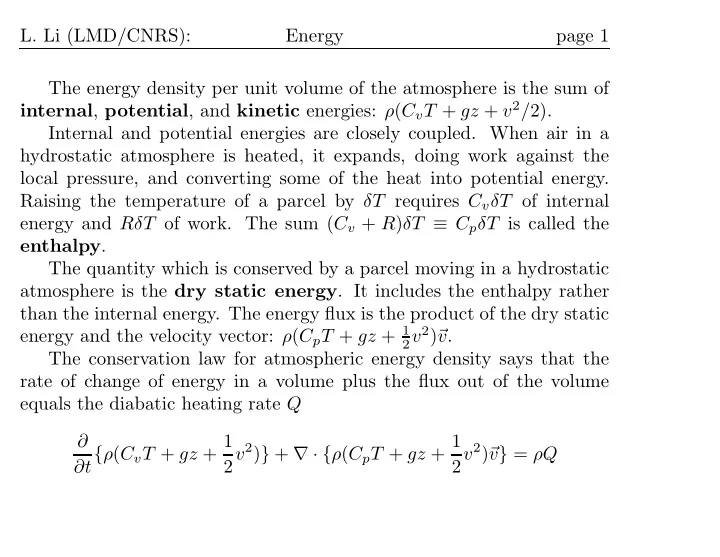
Energy page 1 The energy density per unit volume of the atmosphere is the sum of internal, potential, and kinetic energies: ρ(CvT + gz + v2/2). Internal and potential energies are closely coupled. When air in a hydrostatic atmosphere is heated, it expands, doing work against the local pressure, and converting some of the heat into potential energy. Raising the temperature of a parcel by δT requires CvδT of internal energy and RδT of work. The sum (Cv + R)δT ≡ CpδT is called the enthalpy. The quantity which is conserved by a parcel moving in a hydrostatic atmosphere is the dry static energy. It includes the enthalpy rather than the internal energy. The energy flux is the product of the dry static energy and the velocity vector: ρ(CpT + gz + 1

2v2)

v. The conservation law for atmospheric energy density says that the rate of change of energy in a volume plus the flux out of the volume equals the diabatic heating rate Q ∂ ∂t{ρ(CvT + gz + 1 2v2)} + ∇ · {ρ(CpT + gz + 1 2v2) v} = ρQ

slide-2
SLIDE 2
  • L. Li (LMD/CNRS):

Energy page 2 Energy budget of the Earth and conversion of heat in different forms. The greenhouse effect of the atmosphere is due to its particular radiative properties: almost transparent for solar radiation, but almost

  • paque for the infrared terrestre radiation.
slide-3
SLIDE 3
  • L. Li (LMD/CNRS):

Energy page 3 Radiative budget at the top of the atmosphere

slide-4
SLIDE 4
  • L. Li (LMD/CNRS):

Energy page 4 Zonally and annually averaged of vT

slide-5
SLIDE 5
  • L. Li (LMD/CNRS):

Energy page 5 Vertical integration of vT, annual average total mean transient stationary

slide-6
SLIDE 6
  • L. Li (LMD/CNRS):

Energy page 6 Zonally and annually averaged of vZ

slide-7
SLIDE 7
  • L. Li (LMD/CNRS):

Energy page 7 Vertical integration of vZ, annual average total mean transient stationary

slide-8
SLIDE 8
  • L. Li (LMD/CNRS):

Energy page 8 Zonally and annually averaged of vq

slide-9
SLIDE 9
  • L. Li (LMD/CNRS):

Energy page 9 Vertical integration of vq, annual average total mean transient stationary

slide-10
SLIDE 10
  • L. Li (LMD/CNRS):

Energy page 10 Zonally and annually averaged of vE

slide-11
SLIDE 11
  • L. Li (LMD/CNRS):

Energy page 11 Vertical integration of vE, annual average total mean transient stationary

slide-12
SLIDE 12
  • L. Li (LMD/CNRS):

Energy page 12 Vertical integration of E transport, annual average

slide-13
SLIDE 13
  • L. Li (LMD/CNRS):

Energy page 13 Vertical integration of q transport, annual average

slide-14
SLIDE 14
  • L. Li (LMD/CNRS):

Energy page 14 Divergence of E transport and q transport, annual average