SLIDE 1 B « 7 4 3
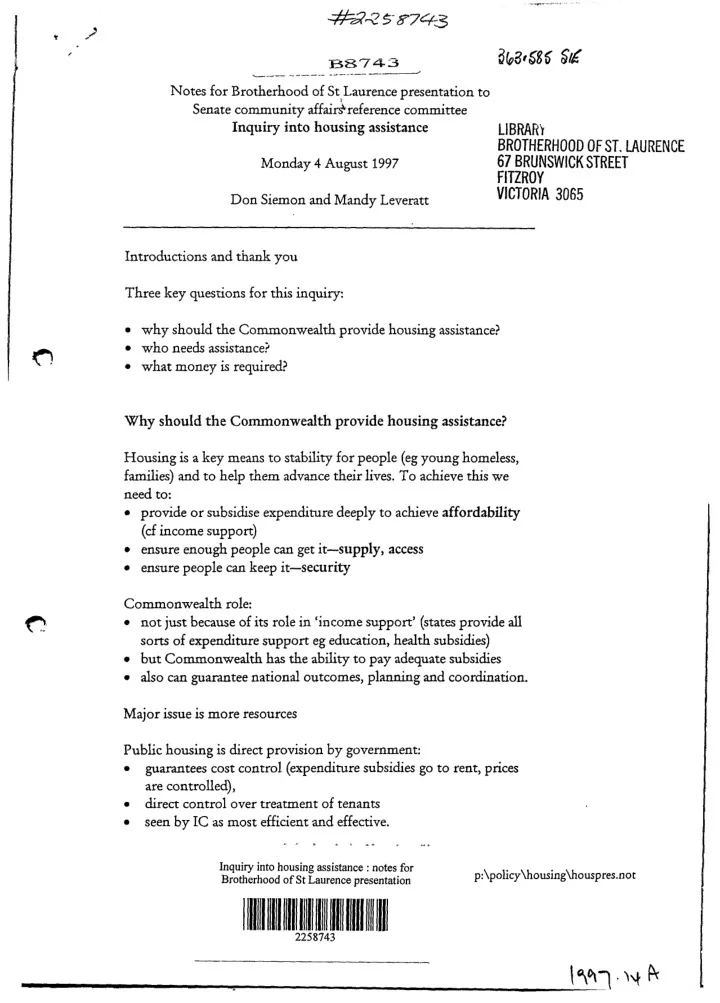
N o te s fo r B ro th e rh o o d of St L aurence p resen ta tio n to Senate c o m m u n ity affair^reference com m ittee In q u iry in to h o u s in g assistan ce M o n d ay 4 A u g u st 1997 D o n S iem on and M an d y L everatt
L IBR A R Y BR O THE R HO O D O F
AURE NCE 67 BR U N S WIC K STR E E T F ITZ R O Y VIC TO R IA 3065
In tro d u c tio n s an d th a n k y o u T h re e k e y q u estio n s fo r th is in q u iry :
- w h y sh o u ld th e C o m m o n w ea lth p ro v id e h o u sin g assistance?
- w h o needs assistance?
- w h a t m o n e y is required?
W h y s h o u ld th e C o m m o n w e a lth p ro v id e h o u s in g assistance? H o u sin g is a k e y m eans to stab ility fo r p eo p le (eg y o u n g hom eless, fam ilies) an d to h elp th em advance th e ir lives. T o achieve th is w e n eed to:
- p ro v id e o r subsidise ex p en d itu re d eep ly to achieve a ffo rd a b ility
(cf in co m e su p p o rt)
- ensure en o u g h peo p le can get it—su p p ly , access
- ensure p eo p le can keep it—se c u rity
C o m m o n w e a lth role:
- n o t ju st because o f its ro le in ‘in co m e su p p o rt’ (states p ro v id e all
so rts o f e x p en d itu re su p p o rt eg education, h ealth subsidies)
- b u t C o m m o n w e a lth has th e ab ility to p a y adequate subsidies
- also can guarantee n atio n al ou tco m es, p lan n in g an d co o rd in atio n .
M a jo r issue is m o re resources P u b lic h o u sin g is direct p ro v isio n b y g o vernm ent:
- guarantees co st c o n tro l (expenditu re subsidies go to ren t, prices
are co n tro lled ),
- d irect c o n tro l o v er tre a tm e n t o f ten an ts
- seen b y IC as m o st efficient an d effective.
I n q u ir y in to h o u s in g a s s i s t a n c e : n o t e s fo r . . . . B r o th e r h o o d o f S t L a u r e n c e p r e s e n ta tio n p : \ p o h c y \ h o u s m g \ h o u s p r e s . n o t 2 2 5 8 7 4 3
f t
SLIDE 2
Presentation to Senate community affairs reference committee on Housing Assistance
W h o n e e d s a s s is ta n c e ?
C u rre n t policies assum e th a t p riv ate m ark e t su ited to jo b seekers and p u b lic h o u sin g needed o n ly fo r special needs, o ld er p eople, em ergencies. T h is d iv isio n m ain ly reflects ratio n in g o f th e v e ry few p u b lic h o u sin g places. T argets fo r p u b lic h o u sin g sh o u ld be b o th th o se in an d o utside la b o u r m ark et: u n stab le h o u sin g is a b a rrie r to e m p lo y m en t an d w ill lead to lo n g er p erio d s outside w o rk (eg y o u n g people) p u b lic h o u sin g location is n o t a w o rk force b a rrie r fo r m o st (p articu lar locations) in co m e testin g m ay b e m o re of a p ro b le m reflects stag n atio n in p u b lic h o u sin g (no relo catio n o f sto ck , h a rd fo r ten an ts to m ove). P u b lic ten a n ts n o t ‘over-subsidised’. H o riz o n ta l eq u ity —subsidies to h o m e o w n ersh ip are th e co rrect co m p ariso n . C o m p ariso n s b etw een te n a n t ten u res m isleading— ignores th e p u rp o se an d lo n g -term efficiency o f p u b lic h o u sing. R e n t A ssistance to p riv ate ten an ts valuable in s h o rt te rm b u t n o t m o st efficient o r effective w ay o f assisting (IC). B ro ad er assistance needed if value o f th is is to be m axim ised: to assure affo rd ab ility (ren t co ntrols) o r ex p an d low -cost su p p ly (tax incentives).
O
2
SLIDE 3 Presentation to Senate community affairs reference committee on Housing Assistance
W h a t m o n e y is r e q u ir e d ?
N o te th e ex ten t o f decline in C o m m o n w ealth fu n d in g —halv in g of capital grants. D esp ite c la im s th a t G o v ern m en t w an ts to direct assistance to th o se m o st in need, have seen red uctio ns in R A (eg to ro o m in g h ouse residents) as w ell as increase in p u b lic secto r rents. G o v e rn m e n t roles and resp o n sib ility n o t so m u ch an issue—k ey th in g is to get long-term C o m m o n w ealth co m m itm en t to su p p o rt subsidies at reasonable level of access in o rd e r to fu n d ad d itio n al su p p ly . C an be d o n e w ith off-budget d eb t fin an cin g (N ew m an). B o tto m lines fo r B ro th erh o o d in reform :
- low -in co m e p u b lic ten an ts sh o u ld n o t see rents rise,
- far m o re p eo p le sh o u ld get access to th is level of affo rd ab ility
(th ro u g h p u b lic housing),
- R A valuable as co m p lem en tary m easure fo r th o se left in th e
p riv ate ren tal m ark et.
3
SLIDE 4
S E N A T E I N Q U I R Y I N T O H O U S I N G A S S I S T A N C E
O
1 . I N T R O D U C T I O N
T he B rotherhood o f St L aurence w elcom es this opportunity to contribute to the Senate Inquiry into H ousing A ssistance. A lthough n o t a large provider o f housing - the B rotherhood’s contribution here is restricted to accom m odation for low incom e older persons such as room ing houses, hostels, nursing hom es and som e independent living units - the B rotherhood has a long-standing com m itm ent to the achievem ent o f secure, affordable housing for disadvantaged people in our society. T he B rotherhood was form ed during the D epression years. Its early years w ere therefore spent assisting fam ilies affected by unem ploym ent. In the im m ediate post w ar years its attention turned to the plight o f low -incom e people living in rented slum dw ellings in the inner urban region o f M elbourne. T he founder o f the B rotherhood, Father G erard T ucker, in concert w ith other religious leaders such as O sw ald B arnett, w as instrum ental in the form ation o f the V ictorian H ousing C om m ission and the consequent developm ent o f public housing. In addition to this direct interest in housing, the B rotherhood has, through its long standing policy and research unit, produced a num ber o f publications concerned w ith the issue o f housing and housing affordability for low incom e and disadvantaged people. B efore addressing som e specific T erm s o f R eference, the B rotherhood believes that an understanding and definition o f housing assistance is required as there is little conceptual clarity in the debate as it has been conducted over the last three years since the “housing reform agenda” reared its head.
2 . T H E M E A N I N G O F H O U S I N G A S S I S T A N C E
C urrently, “housing assistance” in A ustralia is pursued through tw o separate system s: R ent A ssistance (RA ) payable to eligible social security recipients in the private rental sector, and ren t rebates, w hich are sum s o f m oney deducted from the notional rents charged to tenants in public housing. T hese rebates are designed to ensure that low incom e households (again, com m only, pension and benefit recipients) do not pay m ore th an a designated proportion o f their incom e in rent. T he form er system is paid through the Federal D epartm ent o f Social Security, w hilst the latter is adm inistered by State H ousing A uthorities. R ent rebates are a form o f direct housing assistance because they not only incorporate a specific affordability benchm ark - usually set som ew here betw een 19% and 25% o f household incom e - but they are also tied to housing w hich is exogenous to the housing m arket proper. B y contrast, because it is capped, R A does not relate significantly to the actual level o f rents paid by low -incom e private tenants. R A
1
SLIDE 5 evolved as an extension o f income support in recognition o f the higher costs private tenants face com pared w ith other social security recipients. It is not designed to produce an affordability outcom e. T he B rotherhood believes that the Senate Inquiry needs to be particularly m indful o f this im portant distinction betw een incom e support and direct housing assistance because the form er system im plicitly assum es m inim al governm ental responsibility fo r housing affordability and, indeed, devolves the responsibility for the risks associated w ith housing upon the individual through the operation o f a largely un regulated private rental m arket. D irect housing assistance, how ever, only occurs in the public rental sector and has been predicated on the b elief th at the m arket w ill alw ays fail som e people (even if only tem porarily) and that therefore governm ents have som e responsibility to intervene through a com bination o f supply-side m easures and affordability benchm arks. H ousing subsidies m ore generally, are not, how ever, confined to either public housing
- r incom e support. W ith regard to investm ent in private rental housing, a sector w hich
is com posed prim arily o f very sm all investors w ith only one or tw o investm ent properties, governm ents intervene in m arket processes in tw o w ays: through negative gearing and through depreciation schedules, o f the w hich the form er is arguably the m ost pertinent. A com m on argum ent used to explain the continuation o f negative gearing for housing investm ent is by w ay o f reference to the period 1985-87 w hen the tax w as quarantined and there w as an apparent drop in investm ent in this sector. A ccording to this approach, negative gearing represents an essential plank in the policy' o f encouraging and fostering the supply o f private rental properties. H ow ever, L eigh has argued that the re-introduction o f negative gearing w as follow ed by the stock m arket crash ju st
- ne m onth later and that, therefore, it is not possible to disentangle the im pact o f the
tw o events on housing investm ent activity. (L eigh 1989: 5) A ustralia is som ew hat unusual am ong O E CD countries in that investor housing assistance through tax expenditures has not been accom panied by tenant housing assistance through rent controls. Thus tax expenditure m easures in the investm ent m arket have acted to m axim ise the incom e o f investors w ithout a corresponding attention to either the issues o f quality and affordability for tenants. M axim isation o f incom e - or incom e support - is also evident in the tax treatm ent o f hom e ow ners and purchasers. T he non-im putation o f rent m ay be regarded as a form
- f tax expenditure. M uch o f the assistance to hom e ow ners, how ever, occurs through
the absence o f capital gains tax on the fam ily hom e even w hen a num ber o f transactions m ay take place w hich result in significant financial gain to households w hen they trade their housing investm ent and to the transm ission o f inter-generational w ealth. A gain, A ustralia m ay be regarded as som ew hat unusual here in th at it does not m ake any allow ance for low -incom e or first-tim e housing purchasers to claim p art or all o f th eir m ortgage interest against their incom e tax.
SLIDE 6 I , .|f < "E T his b rief overview o f the m eaning o f housing assistance suggests that residents in
- nly one form o f housing tenure - public housing - can be said to be explicitly in
receipt o f housing assistance. T he other tenures and sectors - private rental and investm ent, and home ow nership and purchasing - m ay m ore properly be said to be in receipt o f incom e support or taxation incentives.
3 . T E R M S O F R E F E R E N C E 3 .1 T h e e ffe c tiv e n e ss o f e x is tin g fo r m s o f h o u s in g a s s is ta n c e in a lle v ia tin g h o u s in g -r e la te d p o v e r ty a n d e n s u r in g A u s tr a lia n s h a v e a c c e s s to a ffo r d a b le , a d e q u a t e a n d a p p r o p r ia te ly lo c a te d s e c u r e h o u s in g .
A s the above discussion into the m eaning o f housing assistance suggests, only one form has the express intention o f alleviating housing-related poverty through a com bination o f housing supply and affordability benchm arks - and that is public housing and rent rebates. In addition, it seem s unlikely that any other option w ill deliver a sufficient subsidy to achieve these outcom es, particularly in the light o f public sector cutbacks.
»
W ith regard to specific assistance to low -incom e households, the Industry' C om m ission Inquiry into Public H ousing (1993) produced the follow ing analysis o f the relative social and econom ic costs and benefits o f various possible governm ent interventions.
Rnf>n% and ranking o f housing assistance approaches Criteria Cash payment Housing voucher, allowance1 1 Heailleasing Public housing Social justice Targeting6 Poor Average Good Good Accessibility Not addressed Poorly addressed0 Partly addressed5 * Partly addressed Appropriateness Nor* addressed Partly addressed Addressed Addressed Affordability Poorly addressed Addressed Addressed Addressed Security of tenure Other concerns^ Not addressed Not addressed Partly addressed* Addressed Poorly addressed Partly addressed Addressed Addressed Client problems induced Poverty trap Possible Less likely* Less likely Less likely Moral Hazard Possible Possible * Less likely Less likely Fraud Possible Possible Less likely Less likely Efficiency1 ' Long-term 3rd 4th 2nd 1st Cost effectiveness1 Long-term 4th 3rd 2nd 1st Other financial characteristics Capital outlay required Very little Little Modest Large Risk performance i Poor Poor Good Very good Administrative costs'5 Small Large Medium Small' Fle.tibilitym Short-term Good Good Medium Small
3
SLIDE 7 T he criteria established by the Industry C om m ission m ake it apparent th at public housing represents the m ost effective and efficient m eans o f alleviating housing- related poverty for low incom e households. Such a conclusion should com e as little surprise given th at public housing represents both a supply and dem and-side subsidy. O ther approaches, such as cash paym ents, vouchers and headleasing each have their various draw backs although it is noticeable that the m ajor draw backs are m ost likely to occur w ith either cash paym ents or through housing vouchers/allow ances. T he current m odel o f Rent A ssistance does not address a num ber o f the key criteria for solving housing-related poverty.
3 .2 T h e e q u ita b le d is tr ib u tio n o f h o u s in g a s s is ta n c e w it h r e g a r d to : (i) le v e ls o f a s s is ta n c e p r o v id e d
In recent discussions over the “housing reform agenda” m ust has been m ade o f the apparent disparity betw een the levels o f subsidies received by public and private low incom e tenants. T hus, the argum ent runs, there are approxim ately 337,000 public renters w ho receive rent rebates at an average o f $4,000 per annum ; on the other hand, about 985,000 private renters receive R ent A ssistance at an average subsidy o f about $1,600 p er annum . T here are a num ber o f problem s w ith this argum ent. T he first, is the m anner in w hich the subsidy to public renters has been calculated. T he $4,000 annual subsidy to public tenants has been constructed on the basis o f the rental incom e the properties w ould fetch in an open m arket. W hat has not been clarified, how ever, is precisely how such “m arket” rents have been determ ined. Thus, it is not know n w hether this relates to location, quality, size, com parability or any com bination o f these factors. Such im precision has not helped in recent debates. Second, and perhaps o f greater concern, is the m anner in w hich the debate over subsidy levels has been constructed. T he choice o f a m arket rent to determ ine levels o f subsidy to public tenants has raised the suggestion that public tenants enjoy an unfair advantage over low -incom e private tenants, w hich carries w ith it the further connotation that such advantage m ust be dim inished. T he effect o f this argum ent is already being felt w ithin the public housing system in V ictoria. T he form er D epartm ent o f Planning and D evelopm ent has been dism antled w ith the O ffice o f H ousing now jo in ing forces w ith the large H um an Services D epartm ent. T he H um an Services D epartm ent w as itself the result
am algam ation betw een the two form er departm ents o f H ealth and C om m unity
- Services. W ith the addition o f the O ffice responsible for the delivery o f housing
services, a quite clear link has been m ade betw een public housing and those w ho are also clients in the health and com m unity services sector - nam ely, the aged and those w ith disabilities. Thus, the provision o f public housing in V ictoria is no longer ju st restricted to those on low incom es but has, instead, becom e even m ore targeted tow ards those w ho experience additional disadvantage. In other w ords, the perceived unfairness o f the high subsidy accruing to public tenants w ill be nullified by restricting access to this tenure to only the m ost disadvantaged in V ictoria. L ow -
4
SLIDE 8 incom e households w ithout additional disadvantage w ill be forced to take their chances in the open m arket place. T he th ird problem w ith the ‘inequitable subsidy’ argum ent is that the debate over the respective levels o f assistance granted to public and private tenants has served to
- bscure the least transparent form o f assistance, w hich is th at granted to both investors
and hom e ow ners. M oreover, such assistance is not m erely a function o f current taxation policies. In the past, hom e ow nership has been actively facilitated by the C om m onw ealth G overnm ent through the C om m onw ealth State H ousing A greem ent. T he renegotiatio n o f the C S H A in 1956 under the auspices o f the M enzies G overnm ent actively prom oted hom e ow nership through the .channelling o f C SH A funds in to a H om e B uilders A ccount. T he consequence o f this w as th at alm ost 30 percent o f the funds for hom e ow nership w ere provided by the C om m onw ealth G overnm ent. O verall, it has been estim ated that “36 percent o f all new hom es and flats com pleted in A ustralia betw een 1945 and 1970 w ere funded on term s and conditions w hich m ade them m uch cheaper than if they had been produced by the private secto r alone” . (B eer 1993: 154) M ore recently, direct assistance has been replaced by indirect assistance through the tax system . T he available evidence tends to support the conclusion th at this indirect system further advantages the already advantaged, particularly through the absence o f capital gain s tax on the fam ily hom e, (ibid: 163) Subsidies occur across all housing tenures, thereby achieving som e form of-horizontal
- equity. T he subsidies to public housing tenants provide som e equivalence to those
given to hom e ow ners and produce tw o housing outcom es - housing w hich is secure and affordable for people w ho w ould not otherw ise be able to achieve them . W ith regard to targeting and different levels o f assistance, how ever, there is no evidence o f any concerted governm ent effort across all tenures to achieve vertical equity. T he B rotherhood believes that this is an issue w hich requires urgent consideration. F rom th e perspective o f the B rotherhood, it is clear that an artificial notion o f unfairness has been introduced into the debate over the subsidies in order to ju stify an
- verall lack o f political com m itm ent to the notion o f housing affordability and the
alleviation o f housing-related poverty. T he B rotherhood further believes that this ju stificatio n for the contraction o f the public sector (as this is w hat tig hter targeting w ill resu lt in) represents a cruel abandonm ent o f those in our society w ho have borne the burden o f industry restructuring and consequent high and prolonged levels o f unem ploym ent.
(ii) r e la tiv e h o u s in g o u tc o m e s fr o m s u c h a s s is ta n c e
Supply-side m easures in com bination w ith rent rebates have proved to be the m ost effective and efficient m eans o f alleviating housing-related poverty. To the extent that dem and fo r public housing far outstrips supply, the housing outcom es relative to other sectors h av e proved to be restricted to those w ho have been fortunate to gain entry to this form o f tenure. T his restriction is entirely a legacy o f political com m itm ent and
5
SLIDE 9 1
governm ental m anipulation o f the housing m arket and housing desires am ong the population. H om e ow nership, as w e have seen, increased dram atically in the post-w ar period to becom e the largest tenure as a consequence o f favourable governm ent policies. H ow ever, current policies through the taxation system benefit those already w ithin the system rather than those seeking entry into the system . U nfortunately, recent experim ents by governm ents - notably in Q ueensland and N ew South W ales - to assist low -incom e people into hom e ow nership have resulted in extrem ely poor outcom es for m any. It is notable th at in a num ber o f O ECD countries there are policies in place to assist first hom e buyers such as tax relief on all or part o f their interest repaym ents up to a specified level. W hilst m ost o f these schem es are poorly targeted, in the sense th at all in th at category gain from such a concession, it m ay be feasible for a m ore targeted relief schem e to be developed. H ousing-related poverty is especially evident am ong low -incom e households renting
- privately. B ecause R ent A ssistance is not directly linked to the actual rents paid by
households, this form o f assistance does not result in sufficient protection against rent
- increases. In V ictoria, the problem s w ith this form o f assistance in term s o f outcom es
are dram atically exposed by the current state o f the private rental m arket. In the D ecem ber Q uarter 1996 Rental Report, published by the V ictorian D epartm ent o f H um an Services, it w as reported that the vacancy rate in the private rental m arket had declined to 1.9% (a good m arket is considered to require a vacancy rate o f around 3% ); availability o f properties have declined by 20.2% over the previous tw elve m onths and m edian rents had risen in the m etropolitan area by 7.9% over the sam e period, thereby outpacing rises in w ages and benefits by alm ost 4% . G iven the benefits w hich accrue to private investors, it is apparent that this is not the m ost efficient w ay o f encouraging good housing outcom es for low incom e
- households. N either R ent A ssistance as it stands nor negative gearing are explicitly
designed to address the question o f housing affordability, if they w ere so structured, it w ould require governm ents to exercise a greater degree o f cost control than currently (as is the case in delivery o f other form s o f expenditure support to, for exam ple, nursing hom es). T he n otio n o f rent control induces an em otional response based on the spectre o f the long-term sitting tenant and declining property values as a consequence. F or exam ple, a num ber o f com m entators have pointed to the sm all size o f the private rental sector in B ritain as an exam ple o f w hat w ill happen w hen som e form o f rent control is
- introduced. H ow ever, such com m entators have tended to ignore the fact that in B ritain
rent control w as not accom panied by any form o f tax advantages for landlords and they therefore had a double disincentive not to invest in housing. N evertheless, the B rotherhood believes that social responsibility on the part o f private landlords, in return for the benefits they gain, could be introduced through som e notion o f a fair ren t w hich, w hile having regard in part for the m arket, also takes account o f other factors.
6
SLIDE 10 T he n otio n th at R ent A ssistance alone w ill produce good housing outcom es is deeply m isguided and can only lead to further diversion o f aw ay from the one sector that does produce goo d outcom es. T he level o f uncertainty and risk for governm ents and the possible increase in private benefits to landlords m ust outw eigh any nom inal short term gain for tenants them selves. The above suggestion o f a contract o f social responsibility through fair rents m ust accom pany any reform o f the private rental m arket if housing affordability is to be seriously tackled by governm ents.
3 .3 T h e r e s p o n s ib ilitie s o f C o m m o n w e a lth a n d S t a te G o v e r n m e n ts in th e d e liv e r y o f h o u s in g a s s is ta n c e .
T he B rotherhood o f St L aurence is supportive o f recent attem pts to clarify the respective roles and responsibilities o f the various tiers o f governm ent. In particular, th e m ore localised nature o f state governm ents - often covering populations less th an m unicipal councils in other countries - m akes that tier o f governm ent the clear candidate for the delivery o f housing services and the co-ordination o f tenancy and property m anagem ent. T he role o f the C om m onw ealth G overnm ent in relation to general housing assistance is som ew hat com plicated. A s w e have already seen, C om m onw ealth involvem ent takes a num ber o f different form s and m easures such as the C S H A have been used for different purposes at different tim es. H ow ever, if housing assistance is assum ed to have an explicit reference to housing affordability and the active alleviation o f housing-related poverty then the role o f the C om m onw ealth G overnm ent m ust guarantee levels o f funding w hich are devoted to this purpose. T herefore, any proposal for a dim inutio n or cessation o f capital funding for public housing to the States under th e C S H A w ould represent a retreat from housing assistance, strictly speaking, by the C om m onw ealth. F rom the perspectives o f equity and efficiency C om m onw ealth involvem ent in incom e support through R ent A ssistance and various tax expenditures require urgent
- attention. T his urgency is heightened by the environm ent o f public sector cut-backs in
w hich any housing assistance is to be delivered. W hilst State H ousing A uthorities are being u rged to becom e m ore efficient in their use o f public hoilsing m onies, w hich has necessitated greater targeting
tenants, the C om m onw ealth G overnm ent has applied neither a sim ilar degree o f urgency nor a policy o f targeting to the less transparent subsidies to hom eow ners. T his is the principle o f vertical equity
- f w hich w e spoke earlier. T his disparity betw een the tw o levels o f governm ent is all
the m ore glaring given the C om m onw ealth’s taxation and revenue raising pow ers com pared w ith those o f the States. In sum m ary, the B rotherhood supports the argum ents o f state governm ents that adequate funding o f housing assistance is a C om m onw ealth responsibility. H ow ever, w e believe that the C om m onw ealth should accept responsibility for rent rebates not because these are ‘incom e support’ and axiom atically C anberra’s business (States
- ften p rovide free or discounted services on an incom e-tested basis) but because only
the C o m m onw ealth has the capacity and the resources the ensure housing assistance
7
SLIDE 11 m easures w hich are designed to alleviate housing-related poverty - w hich m ust inevitably include supply-side m easures and w ell as dem and-side responses. T he argum ent about governm ent roles and incom e support versus capital grants is a som ew hat artificial one. O perational subsidies (to cover the gap betw een the cost o f supplying housing and incom e-tested rents for all public housing tenants) could be m ade sufficient to adequately cover the costs o f capital servicing and depreciation; if they are not, then supplem entary capital grants m ay be necessary to ensure supply. C urrent nursing hom e policies illustrate the risks o f sim ply asserting that the C om m onw ealth can have only a m inor role in providing capital grants. T he C om m onw ealth has a further key role to play in the planning o f housing resources w ithin a national fram ew ork. T he B rotherhood contends that housing assistance and other m atters related to the housing m arkets cannot be divorced from either m acro- o r m icro-econom ic effects. In short, housing is not a stand-alone com m odity (despite A ustralians’ affection for detached properties) but rather is deeply affected by changes in unem ploym ent rates, industry restructuring, industrial relations, financial de-regulation and a host o f other social and econom ic reform s w hich have been occurring over the last fifteen years.
4 . T h e v a lu e a n d im p a c t o f h o u s in g a s s is ta n c e g iv e n to th e p r iv a t e r e n ta l m a r k e t
B etw een 1982 and 1995, R ent A ssistance paym ents rose from $163 m illion to $1.4 billion, representing an increase in real term s o f 366% . (K eating 1995:4) O ver the sam e period o f tim e, w aiting lists for public housing doubled in size and C om m onw ealth contributions declined by approxim ately 40% . In 1997, there are now around 250,000 people on the w aiting lists. W hilst w aiting lists are notoriously unreliable indicators o f need because people regularly drop o ff them or their eligibility status alters over the duration, this increased dem and for public housing at a tim e w hen R ent A ssistance has also increased show s the dangers o f an excessive reliance
- n rent assistance in supporting the housing needs o f low -incom e and disadvantaged
people. Indeed, there are a num ber o f reasons w hy the private rental m arket w ill never be able to m eet the needs o f these people. Firstly, the private rental m arket can be very
- volatile. A s m entioned above, the m arket in m etropolitan M elbourne is currently
characterised by low vacancy rates and increased rents. T his situation firm ly tilts all the advantages tow ards private landlords w ho are thereby enabled to pick and choose am ong tenants. M oreover, in a situation o f rental scarcity, increases to R ent A ssistance w ill n o t keep pace w ith rent increases. A second reason w hy the private rental m arket in com bination w ith R ent A ssistance cannot effectively assist low incom e people is that R ent A ssistance has never been tied to either housing affordability or quality. T here are currently no m echanism s in place to ensure th at any increases to R ent A ssistance are not absorbed by landlords in the form o f higher rents and neither are there m echanism s in place to connect the tax
SLIDE 12 /
- advantages to landlords o f negative gearing w ith housing quality or security for
tenants. G iven the h ig h levels o f dem and that already exist for public housing, any reductions in stock w ill only exacerbate the private rental m arket as it stands in a city such as M elbourne. W ith too m any people looking for affordable accom m odation, in com petition w ith those for w hom affordability is less o f a factor, the private rental m arket w ill response by adjusting its prices upw ards - as it has already done. T here are a num ber o f w ays in w hich the private rental m arket could be structured to m eet the needs o f low -incom e people. T he B rotherhood has already suggested that the rights o f negative gearing could be linked to social responsibilities through the establishm ent o f fair rents. H ow ever, this solution w ill not necessarily have any relationship to increased supply. G overnm ents w ill need to intervene directly at the point o f construction and developm ent w ith a variety o f schem es if such a thing as a low -cost end o f the m arket is to be created. Such schem es could include a num ber o f tax exem ptions, such as land tax, in retu rn for the reservation o f low -cost units in particular developm ents on private land. W ith regard to land ow ned by governm ents, a significant price discount
- r site brokerage could be offered to developers in return for set quotas o f low cost
- housing. A lternatively, governm ents, through their ability to borrow funds at
concessional rates, could offer private developers these concessional rates in return for specific low -cost housing quotas. H ow ever, these schem es by them selves w ill not resolve the problem . A s stated earlier, housing cannot be quarantined from other developm ents. In M elbourne, for exam ple, the construction o f m ajor projects such as the C asino has had a detrim ental effect upon the availability o f low -cost perm anent hotel accom m odation in the sam e area o f the city. T hus, governm ents need to be m indful o f th e flow -on effects o f particular decisions they m ay m ake in one area.
3 .5 T h e a p p r o p r ia te m ix o f in c o m e s u p p o r t a n d s u p p ly a s s is ta n c e m e a s u r e s to e n s u r e a d e q u a te a ffo r d a b ility a n d s u p p ly o f h o u s in g in th e m e d iu m a n d lo n g te r m fo r lo w -in c o m e h o u s e h o ld s .
F rom the foregoing discussion, it is apparent that the B rotherhood believes th at the issue o f housing assistance to low -incom e households cannot be solved by m easures w hich only address one part o f the problem and w hich, furtherm ore, m ay cause additional and unforeseen problem s further dow n the track. A ccordingly, the B rotherhood recom m ends that an holistic approach to housing m ust be adopted w hich attem pts to address both horizontal and vertical equity across the various tenures. M any o f those solutions have already been proposed in the above discussion. T he Senate should be cautious o f notions o f equalising subsidies betw een public and private tenants. T he last tw o Federal budgets used such ‘horizontal inequalities’ to ju stify tig h ter targeting w ithin R ent A ssistance to save m oney, despite the G overnm ent know ing full w ell that the affected tenants w ere on very low incom es.
9
SLIDE 13 BR O THE R HO O D O F
NCE 67 BR U N S WIC K STR E E T F ITZ R O Y
T he real risk o f a m ove to unify D SS R ent A ssistance and rental rebate subsidies is
VIC TO R IA 3065
p Ublic tenant subsidies w ill be reduced w ith a corresponding increase in poverty. A s discussed earlier, R ent A ssistance alone seem s inadequate to the task o f ensuring affordability - indeed that has never been its express intention, if affordability is m easured by som e incom e and household type benchm ark. Y ates has estim ated that C om m onw ealth outlays on incom e support in the form o f R ent A ssistance w ould have to increase by betw een $2 to $3 billion per year if private tenants w ere to reach the sam e affordability benchm ark as public tenants. (Y ates 1996) E ven w ith this huge increase in outlays, there w ould still be no guarantees that private rental accom m odation w ould not respond to these price signals by raising the level o f rents. T herefore the B rotherhood has consistently argued th at the priorities for G overnm ent spending should be:
- first and forem ost, a significant and sustained expansion o f support for public
housing;
- a sm all increase in R ent A ssistance as a short-term m easure;
- som e specific funds for com m unity housing developm ent for special needs groups;
and
- recoupable assistance to enable first-hom e purchasers entry to hom e ow nership.
In the m edium term , the B rotherhood believes that the C om m onw ealth w ould do w ell to look at its expenditure across all the various housing sectors and should seek to introduce som e returns from those w ho benefit disproportionately - nam ely hom e
- w ners and housing investors. Such returns could take the form o f a contract o f social
responsibility, m entioned earlier. A lternatively, tax losses from negative gearing should be quarantined to like incom e sources, and the exem ption from capital gains tax for the fam ily hom e should be curtailed.
R E F E R E N C E S
B eer, A. (1993). ‘“ A D ream w on, a crisis b o m ?’ H om e O w nership and the H ousing M arket” , in C. Paris, Housing Australia. M acm illan, M elbourne. D epartm ent o f H um an Services. (1996). Rental Report. D ecem ber Q uarter. O ffice o f H ousing, M elbourne. Industry C om m ission. (1993). Inquiry into Public Housing. A G PS, Canberra. K eating, P. (1995). Community and Nation. A G PS, Canberra. L eigh, P. (1989). Investor Activity in Housing. O ccasional paper N o. 1, H ousing A nalysis G roup. M inistry o f H ousing and C onstruction, M elbourne. Y ates, J. (1996). Federal Housing Policy Directions. Speech delivered at the 1996 RJEIA C onference, Canberra.
< *
*
, 3
1 0