Kitchen Table Climate Conversation - Agenda: 1] Introductions - - PowerPoint PPT Presentation
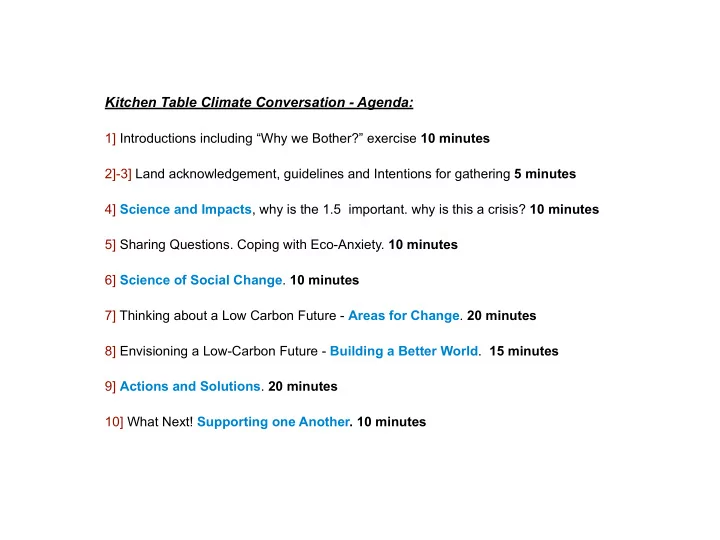
Kitchen Table Climate Conversation - Agenda: 1] Introductions including Why we Bother? exercise 10 minutes 2]-3] Land acknowledgement, guidelines and Intentions for gathering 5 minutes 4] Science and Impacts , why is the 1.5 important. why is
1] Introductions
Exercise: Why do we bother? People have different motives and values which lead them to act on climate change. Read through these statements and check those which resonate with you. Take a moment to reflect on your choices then write a short statement of your own and share with the group along with your name.
- 1. All living things are equal and have a right to life - we have to stop our destruction of other creatures’ lives and habitats.
- 2. Nature is amazing. It fills me with love and awe. I want to respect and protect that.
- 3. According to my faith, we have a responsibility to care for the natural world.
- 4. I am worried about the future for my children and grandchildren. I want to protect the world for future generations.
- 5. Everyone on the planet should have a fair share of natural resources – land, water, oil and minerals.
- 6. I want to see justice for communities that are suffering the effects of climate change through no fault of their own.
- 7. We’ve exploited the world for 200 years – it’s payback time.
- 8. I can see green business opportunities.
- 9. I couldn’t sleep at night if I didn’t act.
2
Land Acknowledgment: We are gathered on the ancestral lands and waters of Indigenous Peoples, who have left their footprints on Mother Earth before us. We respectfully acknowledge those who have walked on the Earth, those who walk on the Earth now, and future generations who have yet to walk upon the Earth. May we gain strength and wisdom that all may continue to serve as stewards of the Earth. Intentions for this gathering: To increase understanding of the climate emergency and to help people confidently take action personally and in their community. To encourage advocacy for strong climate agendas at every level of government. Guidelines Review
2] 3]
3
Fossil Fuel Use Starts
Emissions are rising steeply and primarily human-caused
See current data at: National Oceanic & Atmospheric Administration Earth System Research Laboratory https://www.esrl.noaa.gov/gmd/ccgg/trends/weekly.html
4
4]
A global temperature increase of 1.5°C is bad but 2°C is worse!
5
What happens if the world warms up by 2°C? About 2.5 mins.
What happens if temperatures rise above 1°5C or More?
Climate change scenarios About 3 mins. 6
image from: https:// www.paragkhanna.com/ home/2016/3/9/the-world-4- degrees-warmer
Where are the Worst Impacts?
7 “I really believe in my heart of hearts—after a lifetime of thinking and talking about these issues—that we will never survive the climate crisis without ending white supremacy. Here’s why: You can’t have climate change without sacrifice zones, and you can’t have sacrifice zones without disposable people, and you can't have disposable people without racism.” - Hop Hopkins, “Racism is Killing the Planet,” June 8, 2020, sierraclub.org
Map from Council of Canadian Academies, 2019. Canada’s Top Climate Change Risks, Ottawa (ON): The Expert Panel on Climate Change Risks and Adaptation Potential, Council of Canadian Academies. https://cca-reports.ca/wp-content/ uploads/2019/07/Report-Canada-top-climate-change-risks.pdf
Canada
- temperatures heating
2x global rate
Ontario
- vector-borne disease
- more extreme heat
- flooding
- forest fires
- extreme weather
- water-quality affected
Impacts of Global Warming in Canada & Ontario
8
Figure: Climate Change Health Equity Program - California Department of Public Health v12-2018 adapted from Centres for Disease Control and Prevention report chapter about Climate and Health by J. Patz
9
Impacts of Global Warming On Health
Coping with Feelings around Crisis 5]
Sharing Questions: What are your feelings about the impacts of the climate crisis i.e. concerns, fears and hopes? What do you do to cope with your feelings? Part 1. Start with quiet time of 1-2 min for personal reflection. Take note of your main feeling.
- Type into chat or read out to the group.
Part 2. Take a moment to think about what you do to cope with your feelings.
- Share some insights with the group - 1-2 points each.
10
You can find many links on this research by Erica Chenoweth, here is one: https:// www.ericachenoweth.com/research/wcrw.
Together we Can Make it Happen! 6]
11
When 25% of an on-line community actively promotes a change (posting, re- tweeting, liking etc.), the community adopts the change. Video about 1.5min.
How Many People Does it Take!
12
The 5 S’s - What We Need to be Successful Advocates
Social – Collective Action in Groups
Simple – Nudges (meatless burgers, default carbon travel offsets)
Supportive – risk reduction, resilience, health improvement, innovation and new jobs.
Stories of Success Signals of Progress
Stick figure source: here 13
How to Transform Apocalypse Fatigue into Action on Global Warming
- espen stoknes Video about 15 mins
Hannah Ritchie and Max Roser (2020) - "CO₂ and Greenhouse Gas Emissions". Published
- nline at
OurWorldInData.org. Retrieved from: 'https://
- urworldindata.org/co2-
and-other-greenhouse- gas-emissions' [Online Resource]
Our National Emissions: Why Canada Needs to Act
14
7]
Graph & Statistics from: https://www-cdn.oxfam.org/s3fs-public/file_attachments/mb-extreme-carbon-inequality-021215-en.pdf
Climate Justice: Who’s Responsible? Who Feels the Most Impacts?
15
The poorest are most threatened by the climate emergency and the least able to cope.
- Wealthiest 10% responsible
for about 1/2 of emissions
- Select group of billionaires
benefit from status quo
- Much of their wealth is tied to
the fossil fuel industry
- Tackling economic inequality
is essential to fight climate change & end extreme poverty
“We have to recognize that many of the drivers of environmental harm are the same drivers that create systemic inequity and injustice. Data – both statistics and
- ther information provided by communities
– can reveal the deep connections between these issues and illuminate systemic solutions that can address harm to people and the planet.”
Climate Justice = Racial Justice
What are the responsibilities of environmental organizations in building a racially-just society?
POSTED BY EMMAY MAH ON JUNE 30, 2020 Emmay Mah, Executive Director, Toronto Environmental Alliance
16
Greenhouse gas emissions by economic sector, Canada, 1990 to 2017, Government of Canada
Where do Canadian emissions come from? What can we do?
17
- The report, Oil, Gas and the Climate warns that:
- existing oil and gas fields and mines will take us over 1.5°C of warming and nearly to 2°C.
- Despite this, much expansion is planned for between 2020-2024. US & Canada would account for 85%.
See: https://www.ciel.org/news/oil-gas-and-the-climate-an-analysis-of-oil-and-gas- industry-plans-for-expansion-and-compatibility-with-global-emission-limits/
18
Carbon Crunch
Action Must Happen Now!
19 https://www.nature.com/ articles/d41586-019-03595-0
http://www.auditor.on.ca/en/content/annualreports/arreports/en19/v2_300en19.pdf Pg. 133, Climate Change Ontario's Plan to Reduce Greenhouse Gases
Where do Ontario’s Emissions come from? Where should we be taking action?
20
Since current Provincial government took office:
- 758 renewable and clean industry projects cancelled.
- Major natural gas infrastructure expansion planned.
- Emissions from our electricity sector set to double by 2023 to 8MT and reach to 11MT by 2030.
http://www.auditor.on.ca/en/content/annualreports/arreports/en19/v2_300en19.pdf Pg.148, Climate Change Ontario's Plan to Reduce Greenhouse Gases
What happened when Ontario backtracked on climate action?
21
- Electric vehicle uptake fallen since incentives removed.
- Rules that prevent sprawl which destroys natural spaces & increases need for cars weakened.
Where do Local Emissions come from? Where should we be taking action?
Local Emissions Sources - Areas for Action: Perhaps try to find out whether your town or region has a climate plan or an assessment of where local GHGs come from. At a community level, energy retrofits, including public and multi-unit buildings, planning denser communities (avoiding sprawl), and building better public transit are important.
22
Where do Individual Emissions come from? Where can we take action?
23
Link to Dianne Saxe’s Report: Reducing my Footprint
7]B]
Kairos report: Reducing your Carbon Footprint
Government Community Individual Industry/Business
7]C] Quadrant Exercise
24
Use chat or consider screen-sharing an editable doc and writing people’s ideas on in real-time for the next 2 sections.
8] Let’s Write the Story Together of What A Better World Could Look Like….
25
Graph from https://climateactiontracker.org/countries/canada/ 26
We are in a climate emergency and need more action! 9]
27
Hope in Collective Change & Proposed Solutions
COVID-19 Shows us Emergency Level Action that protects everyone is Possible!
Just Recovery Principles Art throughout by Corrina Keeling
See justrecoveryforall.ca for the full principles & actions to take!
9]B]
Watch 350Canada's Recover, Respond, Rebuild video 3 mins
Demand a Just, Green Recovery from COVID-19!
Compiled and endorsed by a collective
- f organizations who want to ensure
greener, healthier, just and care-based futures as we recover from COVID-19.
Support the campaigns, or endorse the principles! Have fun with the art kit!
#JustRecoveryforAll #BuildBackBetter
“At its core, a Just Recovery to build back better after the pandemic means reorienting our society to tackle the climate crisis, rising inequality, and systemic racism.” See the webcast here: https://justrecoveryforall.ca/anti-racism/ Also See: Just Recovery Rally 28
29
Take a look at drawdown.org for solutions in a range of sectors. The screenshot above is from their website. Also see The Drawdown Review Climate Solutions for a New Decade
More Hope in Collective Change & Proposed Solutions
#Greennewdeal
The Pact for a Green New Deal is source of this video. 2 mins
#Drawdown
“With the recent Black Lives Matter uprisings fighting for racial justice all over the world, the Green New Deal is an essential idea for the modern environmental movement because it shows that you can not have climate action without a racial justice analysis.” Our Changing Climate - Patreon - Video (9 mins): Why we need a Green New Deal right now
The Pact for a Green New Deal is in the works.
Also, M.P Peter Julian introduced a motion for it in parliament, M-1 which represents many of the ideas. Now there is a Bill-C232, introduced by Leah Gazan, calling for an Emergency Climate Action Framework. Contact your MP and give your support.
#JustRecoveryforAll initiatives, like The Leap's From Pandemic to Prosperity are
- underway. See more here: Just Recovery
Yellow Pages. The Federal Ministers responsible for Green Recovery Planning are Catherine McKenna, Steven Guilbeault, Jonathan Wilkinson. Find a letter after the map and toolkit on this page: https://350.org/jr-teachins/
Anti-Racism - Collective Change and Protection for People and Planet
Click the bottom right corner of the graphic to see the pledge on Instagram
"Intersectional environmentalism is an inclusive version of environmentalism that advocates for both the protection of people and the
- planet. It identifies the ways in
which injustices happening to marginalized communities and the earth are interconnected. It brings injustices done to the most vulnerable communities, and the earth, to the forefront and does not minimize or silence social inequality.” Why Every Environmentalist Should Be Anti-Racist
BY LEAH THOMAS June 8, 2020, www.vogue.com
30
Potential Points for Action 1) Make the climate emergency declaration meaningful. Pg. 32 2) Stop spending public money to subsidize fossil fuels. Pg. 33 3) Accelerate the shift to renewables and clean industry. Zero Carbon economy. Pg. 34 4) Create a Just Transition for workers and their communities. Good low-carbon work for all. Pg. 35 5) Ensure accessible, affordable green transportation choices for all. Public Infrastructure and Services for All. Pg. 36 6) Conserve wilderness & adopt regenerative practises in collaboration with Indigenous communities. Pg. 37 7) Enforce environmental protections for waste and toxins. Pg. 38 8) Create a plan that is SMART. Pg. 39 9) Honour & Uphold the rights of Indigenous People. Pg. 40
Climate Justice text on the following pages is quoted or paraphrased from: Green New Deal a) M-1 motion and b) https://act.greennewdealcanada.ca/what-we-heard/ Climate Justice Demands c) https://s27coalition.com and d) https://www.fridaysforfutureto.org/about A Just Recovery e) https://350.org/just-recovery/ and justrecoveryforall.ca Other Selected Background References for Political Action section Greenpeace UK Emergency Report. Environmental Platform Expectations, Environmental Defence. Climate Action Network - Getting Real about Canada's Climate Plan.
31
9]C] Exploring Actions and Solutions
Lot’s of Details! Pick a point to explore the change we could ask and work for. To "Supporting one Another" section, Pg. 41
1) Make the climate emergency declaration
- meaningful. Set and commit to targets and
actions that correspond to this declaration and have the best chance to keep warming below 1.5°C.
- Reach net-zero emissions well before 2050.
Climate Action Network suggests that Canada needs to double its 2030 targets to 60% below 2005 levels and increase international climate financing to do its fair share (C$4 billion between 2020 and 2025 as committed to under the UNFCCC).
- Climate justice is integral to the wide-
sweeping changes needed to address the climate emergency. Mend the cracks and inequities in society, centre those currently marginalized and strengthen social infrastructure to help everyone transition and protect us all.
Back to Points
32
This wheel, from the Science Advisory Group to UN Climate Action Summit 2019, provides a source of strong messaging that each of us can use in communicating our demand for action from politicians and decision-makers.
The report, as well as the organizations and institutions the information was taken from, can be accessed here: https:// public.wmo.int/en/resources/united_in_science
To make the difference we need, we need to think globally. BUILD SOLIDARITY AND EQUITY ACROSS COMMUNITIES, GENERATIONS, AND BORDERS. In a globalized world, what happens to one of us matters to all of us. - from Canada’s Just Recovery Principles
33
2) Stop spending public money to subsidize fossil fuel energy sources and infrastructure immediately. Divest of any fossil fuel energy holdings. Align oil and gas industry plans with net-zero goals.
- Reject new and ongoing fossil fuel extraction and
transportation projects. End the use of coal and diesel.
- Commit to and invest in 100% renewable electricity by 2030.
- Ban fracking. Reduce oil and gas methane emissions.
- Mandate an account of climate-related risk by financial
companies (i.e. pensions, investors).
- Work globally to end the use of coal and ensure
decarbonization (i.e. tariffs, revised trade agreements, international financing).
The graph above is from the “Oil, Gas and the Climate” report, shows that even existing developed reserves will cause us to exceed carbon budgets. See: https://www.ciel.org/ news/oil-gas-and-the-climate-an-analysis-of-oil-and-gas-industry-plans-for-expansion- and-compatibility-with-global-emission-limits/
Back to Points
- Oil corporations have a lot of power and they
lobby government continually. Their executives control an extreme amount of
- wealth. On top of that, the industry is highly
subsidized BY TAXPAYERS. In fact, without these TAXPAYER DOLLARS, and factoring in costs like cleaning up tailings ponds, analysts have found THAT MUCH OF THE INDUSTRY IS A NET DRAIN ON OUR ECONOMY! Instead of looking out for oil and gas corporations, it’s time to turn to assisting the workers who need more resilient jobs and to everyone’s health and wellbeing for the long- term. “never [help] corporations that don’t commit to tackling the climate crisis.” from A Just Recovery: https://350.org/just-recovery/
34
3) Significantly accelerate the shift to renewables and clean industry while ensuring a fair and safe transition for all. Redirect fossil fuel subsidies and ramp up investment in renewable energy installations and
- companies. Increase incentives to solar, wind, geothermal/heat pumps and energy saving building retrofits.
Use a spectrum of tactics. Some Ideas:
- feed-in tariffs and installation cost tax rebates
- a carbon fee and dividend system to account for the social cost of carbon
- low-risk loans and other financing for clean industry
- redress from companies responsible for emissions (legal strategy)
- corporate/wealth tax reform
- effective industry out-put based pricing systems
- Have cross-canada building codes require net-zero builds by 2030.
- All buildings retrofit to carbon neutral by 2030.
- According to a May 2019 IRENA report, renewables can be cost competitive with fossil fuels. Hydroelectric power is cheapest on the whole,
averaging $.05/kWh - hydroelectric from Quebec cheapest for Ontario
Graph above shows results from the 2018 IRENA report, Citation: IRENA (2018), Renewable Power Generation Costs in 2017, International Renewable Energy Agency, Abu Dhabi.
Back to Points
- Along with building code regulations, ensure
affordable and adequate housing, including high-density, retrofitted, green public housing (i.e. with rent control).
- When considering market mechanisms, it is
important to challenge elements of our economic system that threaten people and the planet and that perpetuate inequality. This includes colonialism, corporate mandates that prioritize the bottom line and growth-based assessments of societal health. See New Zealand’s Wellbeing Budget for inspiration!
- BUILD RESILIENCE TO PREVENT FUTURE
CRISES We cannot recover from the current crisis by entrenching systems that will cause the next crisis. - from Canada’s Just Recovery Principles
35
4) Ensure Canada’s long-term prosperity by aggressively creating training programs to help skilled workers in construction, manufacturing and transportation secure long-term employment in clean tech, rather than in CO2 emitting fossil-fuel dependent industries. Be sure to centre those who are structurally oppressed by existing systems and consider whole affected communities, leaving no one behind.
- Support Canada’s Green New Deal, a job creation plan in good, low-carbon jobs focused on a just transition.
- Strengthen and safeguard all workers’ rights, including those in existing low-carbon fields like care-workers.
- right to unionize, family-supportive wages, enough family & medical leave & pensions.
- Promote local initiatives such as community-based energy systems & sustainable infrastructure.
- Extend mandate of the Task Force on Just Transition to all fossil fuel dependent industries and address
shortcomings of original plan (e.g. all members of and workers in affected communities considered and ensure current inequities are not duplicated).
https://youtu.be/-YKUimZ1l-c about 2.3mins Back to Points
- “We have more than enough to lift everybody into decent work,
rest, leisure, and safety….” https://s27coalition.com & https:// www.fridaysforfutureto.org/about
- PRIORITIZE THE NEEDS OF WORKERS AND COMMUNITIES
Support must be distributed in a manner consistent with Indigenous sovereignty, a climate resilient economy, and worker rights, including safe and fair labor standards and a right to
- unionize. - from Canada’s Just Recovery Principles
- Take a look at ironandearth.org for a worker-centred just transition
plan and organization.
5) Ensure green transportation choices are accessible and affordable for Canadians including reliable low-carbon public transportation, electric vehicles, electrical grid systems, and safe, active options like walking and cycling.
- Focus on building compact, complete communities. This increases safe, healthy ways to get around.
- Connect all areas of Canada with electric light rail and buses.
- Make public transit free, or move decidedly in this direction. Start with low income.
- Mandate that all new cars be electric 2030. All internal combustion engines replaced by electric by 2040.
- Create Canada-wide plan for net-zero transport that goes beyond buying individual vehicles.
A strong society that protects everyone and sets us up to best address threats like COVID-19 and the climate crisis includes access to a full range of affordable public services for all. Beyond transit this means healthcare, dental care, pharmacare, education, childcare, settlement services, legal aid, pensions and more!
- STRENGTHEN THE SOCIAL SAFETY NET AND PROVIDE RELIEF DIRECTLY TO PEOPLE Focus relief
efforts on people—particularly those who are structurally oppressed by existing systems. - from Canada’s Just Recovery Principles. See M-1 motion, https://act.greennewdealcanada.ca/what-we-heard/, https://s27coalition.com & https:// www.fridaysforfutureto.org/about
36
Back to Points
37
6) Conserve and develop wilderness and green spaces to protect and increase our most effective CO2 reduction sinks as well as address the biodiversity crisis. Work in partnership with Indigenous peoples, recognizing and upholding Indigenous laws, customs, traditions and values. Encourage agricultural best practices in line with keeping global temperatures below 1.5°C i.e. maintaining carbon absorbing soils.
- Recent reports show that 30-70% of our natural spaces (land, freshwater & ocean) need to be conserved using
high quality protection methods.
- Work collectively, centring Indigenous land stewardship that has gone on for millennia, to maintain and protect
forests, waterways, habitats and species at risk. Re-wilding/regenerative work.
- Mandate the right to a healthy environment for everyone, including future generations (safe air, clean water,
healthy soil, healthy food).
- 80% of remaining untouched natural spaces are on Indigenous
- territories. Upholding Indigenous self-determination is important for
many reasons!
- We depend on and are part of the ecosystems around us. Living
mindfully with both human and non-human forms of life, care-taking and respecting people, animals and all aspects of the natural world is part of a just relationship with all things.
- Food justice is also a key part of responsible land use and communities
based on sustainability and care.
- PEOPLE’S HEALTH AND WELLBEING FIRST, NO EXCEPTIONS!
Health is a human right and is interdependent with the health and well- being of ecological systems. -from Canada’s Just Recovery Principles
Back to Points
7) Enforce environmental protections for waste and toxin management.
- Legally mandate & enforce the responsibility of companies for full product lifecycle. This includes any
associated social and environmental costs i.e. clean-up.
- Ban single-use plastics & create policies that ensure companies use sustainable, non-polluting products.
- Ban food waste going to landfill by 2025.
- Strengthen laws & bans for toxic substances & mandate safe alternatives on a rapid timetable, including
neonicotinoid pesticides.
Our ecosystems, biodiversity, the health of
- ur land and water, animals and plants, our
food production, water quality and ultimately life itself, ARE DEPENDENT ON HOW WE HUMANS care for and safeguard our environment. For a Toronto group working to protect land and water, including High Park from pesticides, see The Indigenous Land Stewardship Circle.
The diagram shows the interrelation between climate action and
- ther Sustainable Development Goals. From a report by the
International Council for Science. https://council.science/ publications/a-guide-to-sdg-interactions-from-science-to- implementation/
38
Back to Points
8) Create plans that are SMART - Specific, Measurable, Accountable, Relevant and Timebound - including
- ngoing meaningful public consultation i.e. a working group composed of scientists, First Nations, citizens
and city representatives.
- Climate should be the central lens for government decision-making, spending & regulating.
- Create a cross-party climate cabinet.
- Establish an independent, expert panel, a citizens’ assembly, to assess progress and make recommendations. This
panel should include First Nations, Metis and other groups that have been under-represented in decision-making processes.
- Legislate long-term targets. Legislate short-term targets (or carbon budgets) that fall within the current term of
Parliament.
39
This graph above, from https://climateactiontracker.org/countries/canada/ shows that our global commitments are currently not strong enough to prevent catastrophic warming. If you go to their site and look up Canada, our current efforts and commitments are rated as Insufficient, a jump up from Highly Insufficient! Federal actions are still not currently in line with keeping global warming below 2°C, let alone 1.5°C.
Back to Points
40
9) In all undertakings, we must fully commit to and uphold the United Nations Declaration on the Rights of Indigenous People and the Protection of Aboriginal and Treaty Rights (section 35 Canadian Constitution).
- Recognize and uphold indigenous laws, values, customs and traditions.
- Uphold the right to Free Prior and Informed Consent.
- Fulfill the calls for justice in final report of the National Inquiry into Missing & Murdered Indigenous Women.
- Heed the 94 Calls to Action from the Truth and Reconciliation Commission.
- UPHOLD INDIGENOUS RIGHTS AND WORK IN PARTNERSHIP
WITH INDIGENOUS PEOPLES A Just Recovery must uphold Indigenous Rights and include the full and effective participation
- f Indigenous Peoples, in line with the standard of free, prior,
and informed consent. - Canada’s Just Recovery Principles.
- The UN Committee on Eradication of Racial Discrimination
called for a halt to construction of the TransMountain Pipeline Expansion, Site C and the Coastal Gaslink Pipeline on Indigenous lands.
- For updates about the Coastal Gaslink Project being built on
Wet’suwet'en territory even though COVID-19 makes man- camps even more dangerous to the community, see unistoten.camp/category/blog/.
- For another good source of knowledge about ongoing
Indigenous climate action: Indigenous Climate Action Network.
https://youtu.be/D3R5Uy5O_Ds
this film is just over 18 mins long and available as part of the unist’ot’en camp media resources
Back to Points
10] What Next? Supporting one Another
Try a Pledge Program! These pledge programs allow people to pick the actions they can take and to move from personal to more political action.
- climatepledgecollective.com
- The section below took its cue from the second part of Le Pact.
41 Practise Citizen Engagement:
- Talk to friends, families, co-workers, share solutions & encourage them to take action too.
- Sign petitions, write letters, demonstrate and participate in the growing non-violent civil disobedience movement to support climate
justice and help speed the ecological transition on a local, business and government level.
- Join or support local groups like Artists for Climate, Migrant Justice and Indigenous Sovereignty, ClimateFast, Climate Justice TO,
Fridays for Future, Idle No More, Parents for Future (supporters of Fridays for Future), Rising Tide Toronto or Toronto350. For a further list of climate groups see: What can I do About Climate Change.
- Support climate justice, a Just Recovery and a Green New Deal through your local unions, workplaces, schools, places of worship
and community groups. Work with, support and act in solidarity with labour and social justice groups.
- Participate in public comment sessions on climate-related topics. Or, go in person as a deputant or intervenor. e.g. Ontario’s
Environmental Registry, Natural Resources Canada, toronto.ca.
- Submit op-eds & letters to editor, call talk-back lines & tweet in response to climate-related articles & news.
- DOES YOUR COUNTY OR
MUNICIPALITY HAVE A CLIMATE ACTION plan that you can support? if not, can you ask for one?
- Any local climate or environmental
justice groups?
- Upcoming events?
Political Action for Climate
- Call, email, text, send a letter or make an appointment with elected officials, tell them your concerns & what you would like them
to commit to doing.
- During elections raise concerns at all-candidates meetings and with candidates at your door.
- Support and encourage candidates that make climate justice a true priority, and make sure to vote!
- MP Contacts: https://www.ourcommons.ca/Parliamentarians/en/constituencies/FindMP
.
- MPP Contacts: Contact Information Ontario Legislature
To see a good example of how to talk about the climate, see Katherine Hayhoe - youtube series ‘Global Weirding’
42
Talking about the Climate
Talk about the climate!
- Start with questions &
feelings
- Explain the emergency
- Present solutions
- Show the benefits that can
- ccur because of the
necessary changes Do you have any questions or concerns?
- See the video clip of
Katherine Hayhoe speaking
- n ClimateFast’s Earth Day