11/22/19 Audrey Fisch and Susan Chenelle Who we are Audrey A. - - PDF document

11 22 19
SMART_READER_LITE
LIVE PREVIEW

11/22/19 Audrey Fisch and Susan Chenelle Who we are Audrey A. - - PDF document

11/22/19 Audrey Fisch and Susan Chenelle Who we are Audrey A. Fisch is Professor of English and former Coordinator of Secondary English Education at New Jersey City University. Audrey currently serves as Using Informational Text to Spark


slide-1
SLIDE 1

11/22/19 1

Using Informational Text to Spark Inspired Inquiry in Students and Teachers

NCTE 2019 November 22, 2019 #NCTE19 @UsingInfoText

Audrey Fisch and Susan Chenelle

Tweet us @UsingInfoText #NCTE19

Who we are

— Audrey A. Fisch is Professor of English and former

Coordinator of Secondary English Education at New Jersey City University. Audrey currently serves as President of the New Jersey Council of Teachers of English (the New Jersey affiliate of NCTE).

— Susan Chenelle is Supervisor of Curriculum and

Instruction at University Academy Charter High School in Jersey City, New Jersey, and a doctoral candidate at Montclair State University. Susan also serves on the board of NJCTE.

Tweet us @UsingInfoText #NCTE19

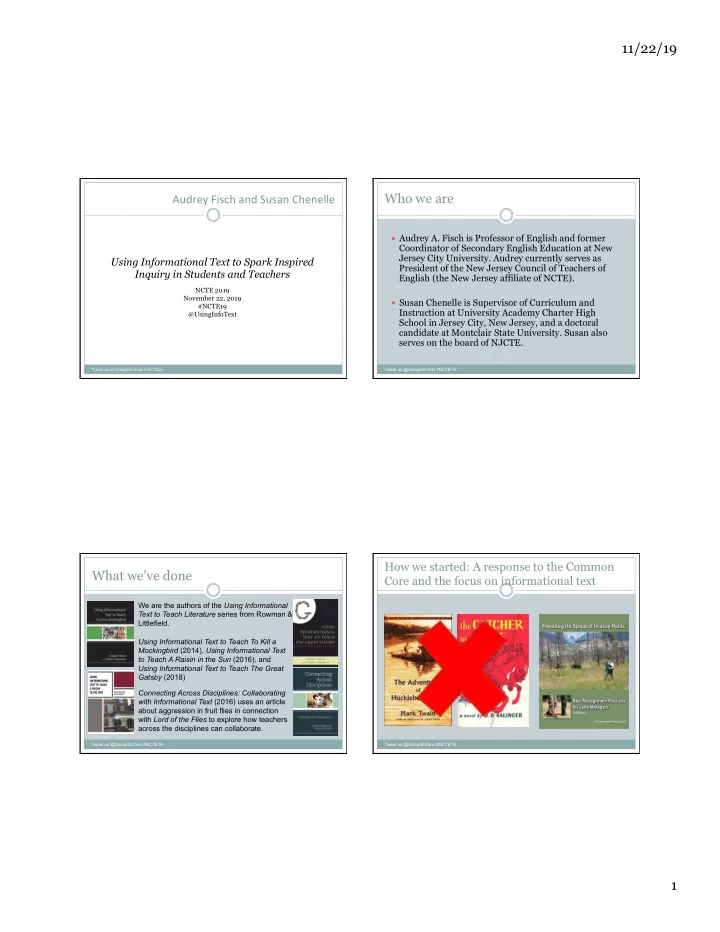
What we’ve done

We are the authors of the Using Informational Text to Teach Literature series from Rowman & Littlefield. Using Informational Text to Teach To Kill a Mockingbird (2014), Using Informational Text to Teach A Raisin in the Sun (2016), and Using Informational Text to Teach The Great Gatsby (2018) Connecting Across Disciplines: Collaborating with Informational Text (2016) uses an article about aggression in fruit flies in connection with Lord of the Flies to explore how teachers across the disciplines can collaborate.

Tweet us @UsingInfoText #NCTE19

How we started: A response to the Common Core and the focus on informational text

Tweet us @UsingInfoText #NCTE19

slide-2
SLIDE 2

11/22/19 2

Sparking inquiry

When you begin planning a unit, where do you start, how do you begin, what do you consider?

Tweet us @UsingInfoText #NCTE19

Flipping our use of literary texts

Instead of starting with the texts, start with essential questions and highlight authentic inquiry:

— Do we all agree about the meaning of consent? à Speak — Why should we care about economic inequality? à The Great Gatsby — Do people have the right to live where they want? à A Raisin in the Sun

Tweet us @UsingInfoText #NCTE19

Today: An example that doesn’t connect with a literary text

We are going to share with you the steps in a years-long inquiry project that evolved at UACHS:

— Step 1: Identify a critical question facing students and/or the community — Step 2: Find some texts to ground the conversation (short or long,

literary or not)

— Step 3: Use visuals/multimedia texts to engage students at the

introductory stage

— Step 4: Think outside the box of your classroom (collaborate!) — Step 5: Let the students take the lead — Step 6: Move from questions to themes and action plans — Step 7: Authentic audiences — Step 8: Reflection

Tweet us @UsingInfoText #NCTE19

Step 1: What’s going on around our school?

Tweet us @UsingInfoText #NCTE19

slide-3
SLIDE 3

11/22/19 3

What’s going on around your schools?

Tweet us @UsingInfoText #NCTE19

Step 2: Find some texts

Tweet us @UsingInfoText #NCTE19

— ”Health Effects of Chromium" Agency for Toxic

Substances and Disease Registry

— NPR’s There

Goes the Neighborhood series

— Ms. Marvel

Some tools for finding informational texts

Tweet us @UsingInfoText #NCTE19

Step 3: Use visuals/multimedia

Tweet us @UsingInfoText #NCTE19

slide-4
SLIDE 4

11/22/19 4

Step 4: Think outside the box of your classroom

We wrote about this experience for New Jersey English Journal ( https://digitalcommons.montclair.edu/nj-english-journal/vol6/iss1/40/)

Co-teaching and co-planning – an interdisciplinary exercise

Tweet us @UsingInfoText #NCTE19

How this co-taught lesson played out

— Susan, Audrey, and the science teacher collaborated on the

scaffolding reading prompts for the science text

— Audrey and Susan collaborated on the scaffolding reading

prompts for the news text and on the writing prompts

— Audrey co-taught the science text with the science teacher;

multiple language arts teachers taught the news article

Tweet us @UsingInfoText #NCTE19

Student feedback and engagement

— 74% indicated that the readings and discussion about

chromium and the NJCU development of the contaminated site helped them connect the content from their science class to the real world.

— One student observed that he/she had previously “learned

about elements but never seen [them] in a real-world setting.”

— Another said, “the lesson was interesting” and wanted “to

know more about what is happening in my community.”

Tweet us @UsingInfoText #NCTE19

Step 5: Let the students take the lead

Tweet us @UsingInfoText #NCTE19

slide-5
SLIDE 5

11/22/19 5

Student-crafted questions

Tweet us @UsingInfoText #NCTE19

— Why are rents increasing? — Is it moral for a landlord to raise rents when people

can’t afford it?

— Will they make sure evicted people have another

place to go?

— Who is buying out the existing property owners? — How will chromium affect people’s health? — Is there a way to renovate without removing or

affecting existing communities?

Step 6: Move from questions to themes and action plans

— Changing culture of the neighborhoods — Exposure to toxic chemicals that may harm

people’s health

— People having to move because they can’t afford

higher rents

— Things in the neighborhood becoming more

expensive

Tweet us @UsingInfoText #NCTE19

Raising awareness

— Presentations to parents — Interviews with community leaders — Presentations in the school — Informational website and flyers

Tweet us @UsingInfoText #NCTE19

The title might be confusing because it's not kids trying to move on the block, it's the higher status adults trying to push the lower class out of their houses. This process is called gentrification.

New Kidz on the Block

slide-6
SLIDE 6

11/22/19 6

Where it all starts

As Gentrification goes on, the population of Black and Spanish people has gone down. Since 2000 in Downtown Jersey City, the percentage of Black residents here has dropped from 46 percent to 41 percent, while the percentage of whites has gone from 21 percent to 26 percent, and Puerto Ricans, from 17 percent to 8 percent. Gentrification has been the reason why the population

  • f Black people and Puerto Ricans has gone down, and

the population of white population has gone up.

Critical research: Analyzing sources

Collected class research in a GoogleSheet:

— Article title — URL — Date of publication — Source/publication — People or groups mentioned in the article — Key quote or info from people or groups — Viewpoint and concerns — Questions after reading the article

Tweet us @UsingInfoText #NCTE19

Step 7: Presenting to authentic audiences

— Presenting research on chromium to chemistry

classes of upperclassmen

— Sharing informational materials (i.e., website, flyers,

posters, slideshows) with parents at report card night

— Distributing flyers in areas being developed

Tweet us @UsingInfoText #NCTE19

3 years later ...

— More development and gentrification — Former freshmen returned to the topic as seniors

for their capstone service learning project

Tweet us @UsingInfoText #NCTE19

slide-7
SLIDE 7

11/22/19 7

Where does gentrification occur ?

Gentrification happens all over the world, but mainly gentrification is taking place in Downtown Jersey City.

BEFORE AFTER Why is this a problem?

  • They are only raising the property values

up enough to push us out.

  • The new buildings being built downtown

by the waterfront are not for us.

  • They are

pushing us out

  • f our own

communities.

slide-8
SLIDE 8

11/22/19 8

What's the problem?

Jersey City residents are basically getting kicked out of their own home by their landlord for a greater profit. Excludes the Jersey City natives

What is the plan?

  • This is too big of a problem for one person
  • We need to work together as a community
  • Start with the youth

What is the plan?

  • Pass out fliers to inform youth about our

presentation

  • Inform people earlier
  • Get them the knowledge they need to profit
  • ff the housing market

Step 8: Reflection and meta-cognition

“I learned a lot about the community and how much people can affect the way the city changes, for the better or good. We spent about half the school year learning about gentrification and how to change the process.” “Most importantly we learned about gentrification. We learned how people are getting kicked out of their homes. The project taught us the reality of everything and about stuff that's really happening in our neighborhood. If we didn’t have this project, I wouldn’t know the stuff I know now about gentrification. I probably wouldn’t even know what was happening in my own neighborhood.” “I have done so much work on presentations in one year, and this has allowed me to get used to speaking to others and groups. We learned a lot of valuable

  • skills. The first one was time management. It was valued because most people

procrastinate and I learned how not to continuing doing that.”

Tweet us @UsingInfoText #NCTE19

slide-9
SLIDE 9

11/22/19 9

Using informational texts can be challenging – some guidelines

  • Find an engaging informational text and media clip that connects your

respective content areas

  • Cut! Use excerpts
  • Front-load key vocabulary words (not too many!) and concepts
  • Use sidebar reading prompts to promote active reading
  • Use multiple-choice questions informally to check for understanding

and practice test-taking skills

  • Use open-ended questions to extend thinking and develop literacy skills

across the disciplines

  • End with a class activity that gives students opportunities to use

content area knowledge for authentic purposes

Tweet us @UsingInfoText #NCTE19

Timing: How to make time for inquiry

  • One or two key texts to start
  • Build skills for questions and later work
  • Ongoing work: 1 day a week; 20% model
  • Cycle back to build skills or make connections as

necessary

Tweet us @UsingInfoText #NCTE19

Literature and inquiry?

— Literature as safer starting point for inquiry

¡ Inequality/white nationalism in Gatsby ¡ Gentrification/housing discrimination in A Raisin in the Sun

— Literature as vehicle for inquiry

¡ Lord of the Flies – How can we create an ideal community?

— Curriculum built around readings that raise

questions about power, social justice, and activism

  • 12th Grade Doc Your Block project: 1984, Dreams of My

Father, The Autobiography of Malcolm X

Tweet us @UsingInfoText #NCTE19

Again – the key steps

Step 1: Identify a critical question facing students and/or the community Step 2: Find some texts to ground the conversation (short or long, literary or not) Step 3: Use visuals/multimedia texts to engage students at the introductory stage Step 4: Think outside the box of your classroom Step 5: Let the students take the lead Step 6: Move from questions to themes and action plans Step 7: Authentic audiences Step 8: Reflection

Tweet us @UsingInfoText #NCTE19

slide-10
SLIDE 10

11/22/19 10

Questions and considerations

— Give up whole-class novels? — Give up whole novels altogether? — More choice, more student-

directed reading?

— Excerpts instead of whole texts for

class purposes?

Tweet us @UsingInfoText #NCTE19

THANK YOU!

Audrey Fisch afisch@njcu.edu Susan Chenelle susanchenelle@gmail.com www.usinginformationaltext.com @usinginfotext Share your stories with us about how you are doing this work! For gentrification project handouts and list of sources for informational text, visit: https://www.usinginformationaltext.com/ professional-development/events

tweet us @usinginfotext