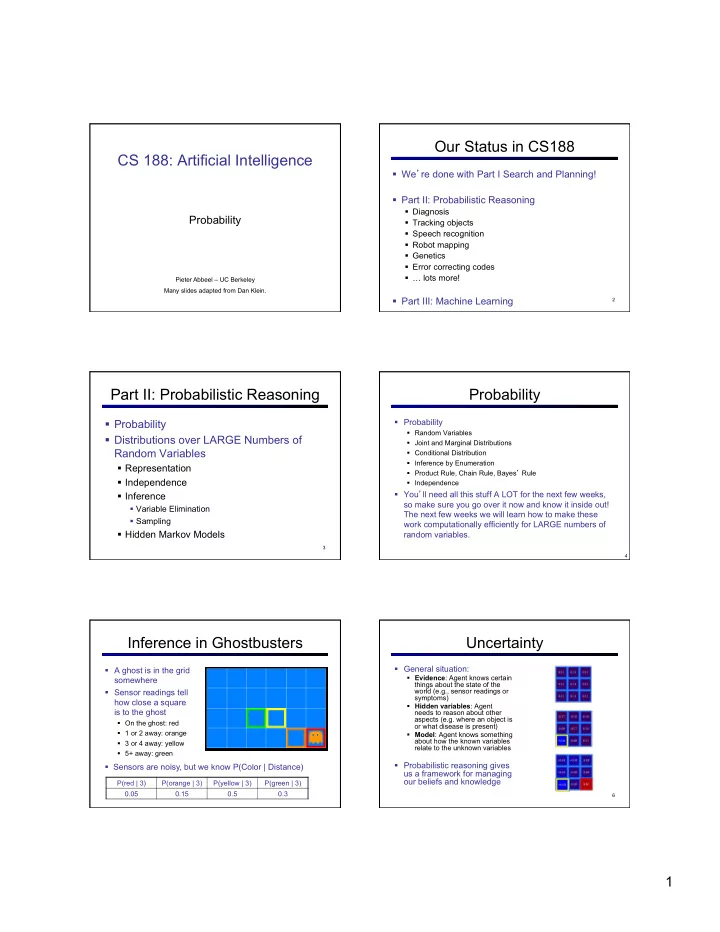

SLIDE 1
1
CS 188: Artificial Intelligence
Probability
Pieter Abbeel – UC Berkeley Many slides adapted from Dan Klein.
1
Our Status in CS188
§ We’re done with Part I Search and Planning! § Part II: Probabilistic Reasoning
§ Diagnosis § Tracking objects § Speech recognition § Robot mapping § Genetics § Error correcting codes § … lots more!
§ Part III: Machine Learning
2
Part II: Probabilistic Reasoning
§ Probability § Distributions over LARGE Numbers of Random Variables
§ Representation § Independence § Inference
§ Variable Elimination § Sampling
§ Hidden Markov Models
3
Probability
§ Probability
§ Random Variables § Joint and Marginal Distributions § Conditional Distribution § Inference by Enumeration § Product Rule, Chain Rule, Bayes’ Rule § Independence
§ You’ll need all this stuff A LOT for the next few weeks, so make sure you go over it now and know it inside out! The next few weeks we will learn how to make these work computationally efficiently for LARGE numbers of random variables.
4
Inference in Ghostbusters
§ A ghost is in the grid somewhere § Sensor readings tell how close a square is to the ghost
§ On the ghost: red § 1 or 2 away: orange § 3 or 4 away: yellow § 5+ away: green P(red | 3) P(orange | 3) P(yellow | 3) P(green | 3) 0.05 0.15 0.5 0.3
§ Sensors are noisy, but we know P(Color | Distance)
Uncertainty
§ General situation:
§ Evidence: Agent knows certain things about the state of the world (e.g., sensor readings or symptoms) § Hidden variables: Agent needs to reason about other aspects (e.g. where an object is
- r what disease is present)
§ Model: Agent knows something about how the known variables relate to the unknown variables
§ Probabilistic reasoning gives us a framework for managing
- ur beliefs and knowledge
6