
CS188 Outline
We’re done with Part I: Search and Planning! Part II: Probabilistic Reasoning
Diagnosis Speech recognition Tracking objects Robot mapping Genetics Error correcting codes … lots more!
Part III: Machine Learning
CS 188: Artificial Intelligence Probability
Instructors: Dan Klein and Pieter Abbeel --- University of California, Berkeley
[These slides were created by Dan Klein and Pieter Abbeel for CS188 Intro to AI at UC Berkeley. All CS188 materials are available at http://ai.berkeley.edu.]
Today
Probability
Random Variables Joint and Marginal Distributions Conditional Distribution Product Rule, Chain Rule, Bayes’ Rule Inference Independence
You’ll need all this stuff A LOT for the next few weeks, so make sure you go
- ver it now!
Inference in Ghostbusters
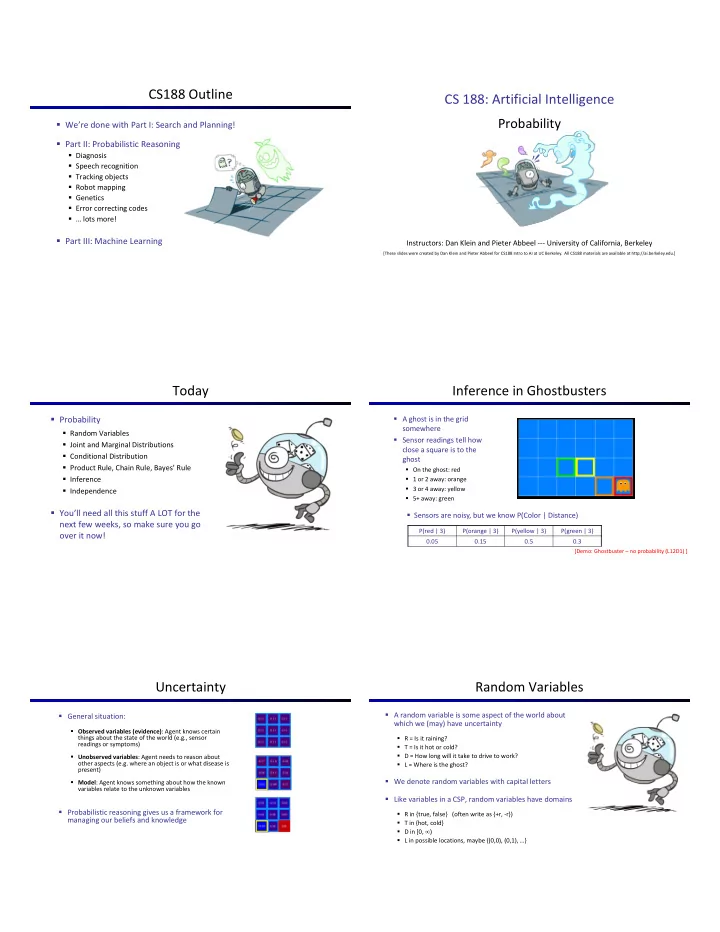
A ghost is in the grid somewhere Sensor readings tell how close a square is to the ghost
On the ghost: red 1 or 2 away: orange 3 or 4 away: yellow 5+ away: green P(red | 3) P(orange | 3) P(yellow | 3) P(green | 3) 0.05 0.15 0.5 0.3
Sensors are noisy, but we know P(Color | Distance)
[Demo: Ghostbuster – no probability (L12D1) ]
Uncertainty
General situation:
Observed variables (evidence): Agent knows certain things about the state of the world (e.g., sensor readings or symptoms) Unobserved variables: Agent needs to reason about
- ther aspects (e.g. where an object is or what disease is
present) Model: Agent knows something about how the known variables relate to the unknown variables
Probabilistic reasoning gives us a framework for managing our beliefs and knowledge
Random Variables
A random variable is some aspect of the world about which we (may) have uncertainty
R = Is it raining? T = Is it hot or cold? D = How long will it take to drive to work? L = Where is the ghost?
We denote random variables with capital letters Like variables in a CSP, random variables have domains
R in {true, false} (often write as {+r, -r}) T in {hot, cold} D in [0, ∞) L in possible locations, maybe {(0,0), (0,1), …}