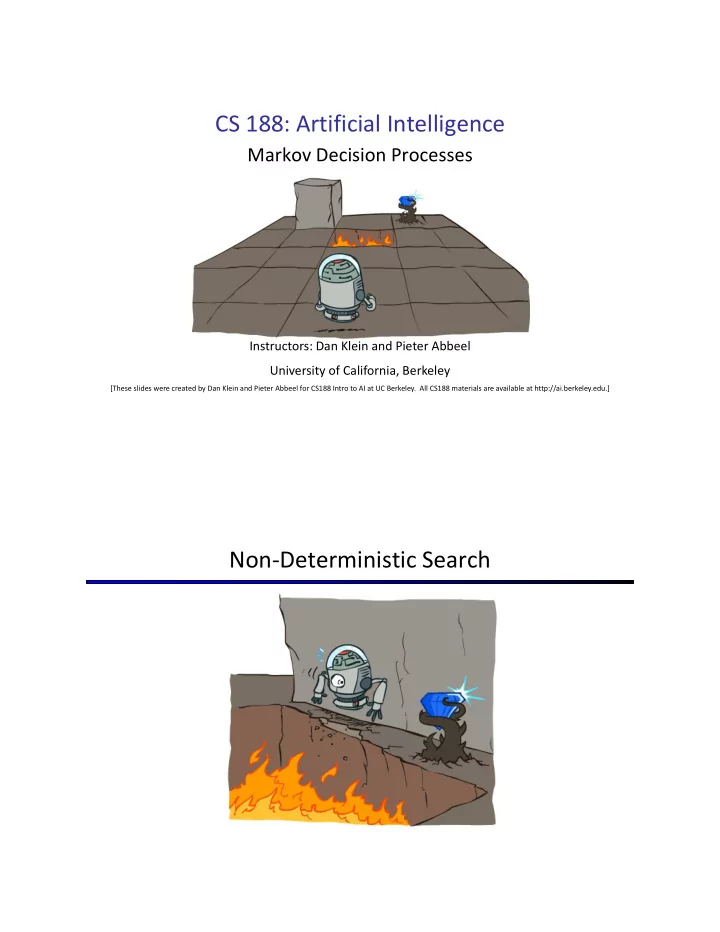
CS 188: Artificial Intelligence Markov Decision Processes - - PDF document

cs 188 artificial intelligence
SMART_READER_LITE
LIVE PREVIEW

CS 188: Artificial Intelligence Markov Decision Processes - - PDF document

CS 188: Artificial Intelligence Markov Decision Processes Instructors: Dan Klein and Pieter Abbeel University of California, Berkeley [These slides were created by Dan Klein and Pieter Abbeel for CS188 Intro to AI at UC Berkeley. All CS188


slide-1
SLIDE 1

CS 188: Artificial Intelligence

Markov Decision Processes

Instructors: Dan Klein and Pieter Abbeel University of California, Berkeley

[These slides were created by Dan Klein and Pieter Abbeel for CS188 Intro to AI at UC Berkeley. All CS188 materials are available at http://ai.berkeley.edu.]

Non-Deterministic Search

slide-2
SLIDE 2

Example: Grid World

  • A maze-like problem
  • The agent lives in a grid
  • Walls block the agent’s path
  • Noisy movement: actions do not always go as planned
  • 80% of the time, the action North takes the agent North

(if there is no wall there)

  • 10% of the time, North takes the agent West; 10% East
  • If there is a wall in the direction the agent would have

been taken, the agent stays put

  • The agent receives rewards each time step
  • Small “living” reward each step (can be negative)
  • Big rewards come at the end (good or bad)
  • Goal: maximize sum of rewards

Grid World Actions

Deterministic Grid World Stochastic Grid World

slide-3
SLIDE 3

Markov Decision Processes

An MDP is defined by:

A set of states s ∈ S A set of actions a ∈ A A transition function T(s, a, s’)

Probability that a from s leads to s’, i.e., P(s’| s, a) Also called the model or the dynamics

A reward function R(s, a, s’)

Sometimes just R(s) or R(s’)

A start state Maybe a terminal state

MDPs are non-deterministic search problems

One way to solve them is with expectimax search We’ll have a new tool soon

[Demo – gridworld manual intro (L8D1)]

Video of Demo Gridworld Manual Intro

slide-4
SLIDE 4

What is Markov about MDPs?

“Markov” generally means that given the present state, the future and the past are independent For Markov decision processes, “Markov” means action

  • utcomes depend only on the current state

This is just like search, where the successor function could only depend on the current state (not the history)

Andrey Markov (1856-1922)

Policies

Optimal policy when R(s, a, s’) = -0.03 for all non-terminals s In deterministic single-agent search problems, we wanted an optimal plan, or sequence of actions, from start to a goal For MDPs, we want an optimal policy π*: S → A

A policy π gives an action for each state An optimal policy is one that maximizes expected utility if followed An explicit policy defines a reflex agent

Expectimax didn’t compute entire policies

It computed the action for a single state only

slide-5
SLIDE 5

Optimal Policies

R(s) = -2.0 R(s) = -0.4 R(s) = -0.03 R(s) = -0.01

Example: Racing

slide-6
SLIDE 6

Example: Racing

  • A robot car wants to travel far, quickly
  • Three states: Cool, Warm, Overheated
  • Two actions: Slow, Fast
  • Going faster gets double reward

Cool Warm Overheated

Fast Fast Slow Slow 0.5 0.5 0.5 0.5 1.0 1.0 +1 +1 +1 +2 +2

  • 10

Racing Search Tree

slide-7
SLIDE 7

MDP Search Trees

Each MDP state projects an expectimax-like search tree

a s s’ s, a (s,a,s’) called a transition T(s,a,s’) = P(s’|s,a) R(s,a,s’) s,a,s’ s is a state (s, a) is a q-state

Utilities of Sequences

slide-8
SLIDE 8

Utilities of Sequences

What preferences should an agent have over reward sequences? More or less? Now or later? [1, 2, 2] [2, 3, 4]

  • r

[0, 0, 1] [1, 0, 0]

  • r

Discounting

It’s reasonable to maximize the sum of rewards It’s also reasonable to prefer rewards now to rewards later One solution: values of rewards decay exponentially

Worth Now Worth Next Step Worth In Two Steps

slide-9
SLIDE 9

Discounting

How to discount?

Each time we descend a level, we multiply in the discount once

Why discount?

Sooner rewards probably do have higher utility than later rewards Also helps our algorithms converge

Example: discount of 0.5

U([1,2,3]) = 1*1 + 0.5*2 + 0.25*3 U([1,2,3]) < U([3,2,1])

Stationary Preferences

Theorem: if we assume stationary preferences: Then: there are only two ways to define utilities

Additive utility: Discounted utility:

slide-10
SLIDE 10

Quiz: Discounting

Given:

Actions: East, West, and Exit (only available in exit states a, e) Transitions: deterministic

Quiz 1: For γ = 1, what is the optimal policy? Quiz 2: For γ = 0.1, what is the optimal policy? Quiz 3: For which γ are West and East equally good when in state d?

Infinite Utilities?!

Problem: What if the game lasts forever? Do we get infinite rewards? Solutions:

Finite horizon: (similar to depth-limited search)

Terminate episodes after a fixed T steps (e.g. life) Gives nonstationary policies (π depends on time left)

Discounting: use 0 < γ < 1

Smaller γ means smaller “horizon” – shorter term focus

Absorbing state: guarantee that for every policy, a terminal state will eventually be reached (like “overheated” for racing)

slide-11
SLIDE 11

Recap: Defining MDPs

Markov decision processes:

Set of states S Start state s0 Set of actions A Transitions P(s’|s,a) (or T(s,a,s’)) Rewards R(s,a,s’) (and discount γ)

MDP quantities so far:

Policy = Choice of action for each state Utility = sum of (discounted) rewards

a s s, a s,a,s’ s’

Solving MDPs

slide-12
SLIDE 12

Optimal Quantities

The value (utility) of a state s: V*(s) = expected utility starting in s and acting optimally The value (utility) of a q-state (s,a): Q*(s,a) = expected utility starting out having taken action a from state s and (thereafter) acting optimally The optimal policy: π*(s) = optimal action from state s

a s s’ s, a

(s,a,s’) is a transition

s,a,s’

s is a state (s, a) is a q-state

[Demo – gridworld values (L8D4)]

Snapshot of Demo – Gridworld V Values

Noise = 0.2 Discount = 0.9 Living reward = 0

slide-13
SLIDE 13

Snapshot of Demo – Gridworld Q Values

Noise = 0.2 Discount = 0.9 Living reward = 0

Values of States

Fundamental operation: compute the (expectimax) value of a state

Expected utility under optimal action Average sum of (discounted) rewards This is just what expectimax computed!

Recursive definition of value:

a s s, a s,a,s’ s’

slide-14
SLIDE 14

Racing Search Tree Racing Search Tree

slide-15
SLIDE 15

Racing Search Tree

We’re doing way too much work with expectimax! Problem: States are repeated

Idea: Only compute needed quantities once

Problem: Tree goes on forever

Idea: Do a depth-limited computation, but with increasing depths until change is small Note: deep parts of the tree eventually don’t matter if γ < 1

Time-Limited Values

Key idea: time-limited values Define Vk(s) to be the optimal value of s if the game ends in k more time steps

Equivalently, it’s what a depth-k expectimax would give from s

[Demo – time-limited values (L8D6)]

slide-16
SLIDE 16

k=0

Noise = 0.2 Discount = 0.9 Living reward = 0

k=1

Noise = 0.2 Discount = 0.9 Living reward = 0

slide-17
SLIDE 17

k=2

Noise = 0.2 Discount = 0.9 Living reward = 0

k=3

Noise = 0.2 Discount = 0.9 Living reward = 0

slide-18
SLIDE 18

k=4

Noise = 0.2 Discount = 0.9 Living reward = 0

k=5

Noise = 0.2 Discount = 0.9 Living reward = 0

slide-19
SLIDE 19

k=6

Noise = 0.2 Discount = 0.9 Living reward = 0

k=7

Noise = 0.2 Discount = 0.9 Living reward = 0

slide-20
SLIDE 20

k=8

Noise = 0.2 Discount = 0.9 Living reward = 0

k=9

Noise = 0.2 Discount = 0.9 Living reward = 0

slide-21
SLIDE 21

k=10

Noise = 0.2 Discount = 0.9 Living reward = 0

k=11

Noise = 0.2 Discount = 0.9 Living reward = 0

slide-22
SLIDE 22

k=12

Noise = 0.2 Discount = 0.9 Living reward = 0

k=100

Noise = 0.2 Discount = 0.9 Living reward = 0

slide-23
SLIDE 23

Computing Time-Limited Values Value Iteration

slide-24
SLIDE 24

Value Iteration

Start with V0(s) = 0: no time steps left means an expected reward sum of zero Given vector of Vk(s) values, do one ply of expectimax from each state: Repeat until convergence Complexity of each iteration: O(S2A) Theorem: will converge to unique optimal values

Basic idea: approximations get refined towards optimal values Policy may converge long before values do

a Vk+1(s) s, a s,a,s’ Vk(s’)

Example: Value Iteration

0 0 0 2 1 0 3.5 2.5 0

Assume no discount!

slide-25
SLIDE 25

Convergence*

  • How do we know the Vk vectors are going to converge?
  • Case 1: If the tree has maximum depth M, then VM holds

the actual untruncated values

  • Case 2: If the discount is less than 1

Sketch: For any state Vk and Vk+1 can be viewed as depth k+1 expectimax results in nearly identical search trees The difference is that on the bottom layer, Vk+1 has actual rewards while Vk has zeros That last layer is at best all RMAX It is at worst RMIN But everything is discounted by γk that far out So Vk and Vk+1 are at most γk max|R| different So as k increases, the values converge

Next Time: Policy-Based Methods