Light-Supervision of Structured Prediction Energy Networks Andrew - - PowerPoint PPT Presentation

light supervision
SMART_READER_LITE
LIVE PREVIEW

Light-Supervision of Structured Prediction Energy Networks Andrew - - PowerPoint PPT Presentation

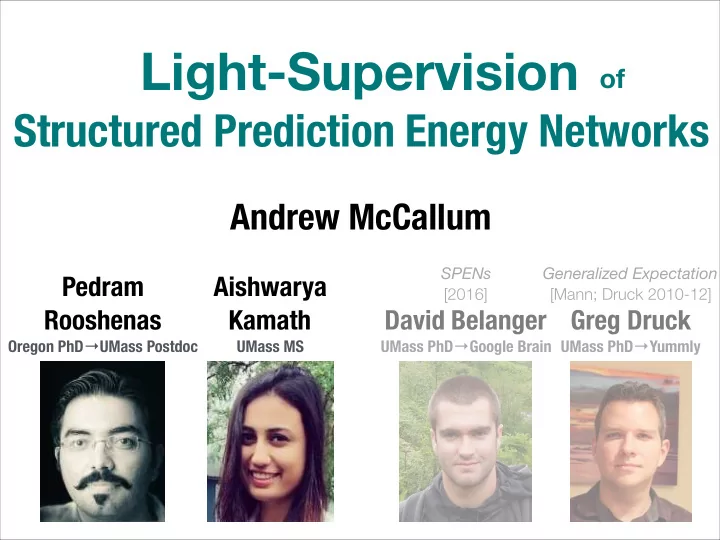
Light-Supervision of Structured Prediction Energy Networks Andrew McCallum SPENs Generalized Expectation Pedram Aishwarya [2016] [Mann; Druck 2010-12] Rooshenas Kamath David Belanger Greg Druck Oregon PhD UMass Postdoc UMass MS


slide-1
SLIDE 1

[2016]

David Belanger

UMass PhD→Google Brain

Andrew McCallum

[Mann; Druck 2010-12]

Greg Druck

UMass PhD→Yummly

Pedram Rooshenas

Oregon PhD→UMass Postdoc

Aishwarya Kamath

UMass MS

Light-Supervision

Structured Prediction Energy Networks

  • f

Generalized Expectation SPENs

slide-2
SLIDE 2

Prior Knowledge as Generalized Expectation

Light-Supervision

Structured Prediction

SPENs

Complex dependencies with …induces extra structural dependencies…

slide-3
SLIDE 3

Generalized Expectation

Chapter 1

slide-4
SLIDE 4

Learning from small labeled data

slide-5
SLIDE 5

Leverage unlabeled data

slide-6
SLIDE 6

Family 1: Expectation Maximization

[Dempster, Laird, Rubin, 1977]

slide-7
SLIDE 7

Family 2: Graph-Based Methods

[Zhu, Ghahramani, 2002] [Szummer, Jaakkola, 2002]

slide-8
SLIDE 8

Family 3: Auxiliary-Task Methods

[Ando and Zhang, 2005]

slide-9
SLIDE 9

Family 4: Boundary in Sparse Region

Transductive SVMs [Joachims, 1999]: Sparsity measured by margin Entropy Regularization [Grandvalet & Bengio, 2005]: minimize label entropy

slide-10
SLIDE 10

Family 4: Boundary in Sparse Region

Transductive SVMs [Joachims, 1999]: Sparsity measured by margin Entropy Regularization [Grandvalet & Bengio, 2005]: minimize label entropy best solution?

100 Label Proportions Student Faculty 50

Family 5: Generalized Expectation Criteria

[Mann, McCallum 2010; Druck, Mann, McCallum 2011, Druck McCallum 2012]

E[p(y)]

Label Prior Expectations

E[p(y|f(x))]

Label | Feature Expectations

slide-11
SLIDE 11

Expectations on Labels | Features


Classifying Baseball versus Hockey Traditional

Human Labeling Effort

(Semi-)Supervised Training via Maximum Likelihood

Generalized Expectation

Brainstorm a few Keywords

Semi-Supervised Training via Generalized Expectation

puck ice stick ball field bat

p(HOCKEY | “puck”) = .9

slide-12
SLIDE 12

Labeling Features

hockey baseball HR Mets

85%

goal Buffalo Leafs puck Lemieux

92%

Toronto Maple Leafs

batting base NHL Bruins Penguins

96%

Accuracy

features labeled . . .

~1000 unlabeled examples

ball Oilers Sox Pens runs

Pittsburgh Penguins

94.5%

Edmonton Oilers

slide-13
SLIDE 13

Accuracy per Human Effort

Labeling features Labeling instances

Labeling time in seconds Test accuracy

slide-14
SLIDE 14

Prior Knowledge

baseball/hockey classification baseball hockey hit puck braves goal runs nhl

resources on the web

  • W. H. Enright. Improving the efficiency of matrix
  • perations in the numerical solution of stiff
  • rdinary differential equations. ACM Trans. Math.

Softw., 4(2), 127-136, June 1978.

  • -- ---
  • ---- --
  • - ---
  • -- ---
  • ---- --
  • - ---
  • -- ---
  • ---- --
  • - ---
  • -- ---
  • ---- --
  • - ---
  • -- ---
  • ---- --
  • - ---
  • -- ---
  • ---- --
  • - ---

data from related tasks

Feature labels from humans many other sources

slide-15
SLIDE 15

Generalized Expectation (GE)

O(θ) = S(E˜

p(x)[Ep(y|x;θ)[g(x, y)]]) + p(θ) input variables

  • utput variables

constraint features returns 1 if x contains “hit” and y is baseball

slide-16
SLIDE 16

Generalized Expectation (GE)

O(θ) = S(E˜

p(x)[Ep(y|x;θ)[g(x, y)]]) + p(θ) model distribution model probability of baseball if x contains “hit” model features assume general CRF [Lafferty et al. 01]

p(y|x; θ) = 1 Zθ,x exp

  • θ>f(x, y)
slide-17
SLIDE 17

Generalized Expectation (GE)

O(θ) = S(E˜

p(x)[Ep(y|x;θ)[g(x, y)]]) + p(θ) empirical distribution (can be defined as) 
 model’s probability that documents that contain “hit” are labeled baseball

slide-18
SLIDE 18

Generalized Expectation (GE)

O(θ) = S(E˜

p(x)[Ep(y|x;θ)[g(x, y)]]) + p(θ) score function larger score if model expectation matches prior knowledge (soft) expectation constraint

slide-19
SLIDE 19

Generalized Expectation (GE)

Objective Function

O(θ) = S(E˜

p(x)[Ep(y|x;θ)[g(x, y)]]) + r(θ) regularization

slide-20
SLIDE 20

GE Score Functions

ˆ g =

target expectations

gθ =

model expectations

Sl2

2(θ) = −

  • ˆ

g − gθ

  • 2

2

squared error:

gθ =

model expectations

ˆ g =

target expectations

} “puck” } “hit”

KL divergence: SKL(θ) = −

X

q

ˆ gq log ˆ gq gθ,q

O(θ) = S(E˜

p(x)[Ep(y|x;θ)[g(x, y)]]) + r(θ)

slide-21
SLIDE 21

Estimating Parameters with GE

violation estimated covariance between model and constraint features

violation term:

vi = −2(ˆ gi − gθi)

  • sq. error:

vi = ˆ gi gθi

KL:

O(θ) = S(E˜

p(x)[Ep(y|x;θ)[g(x, y)]]) + r(θ)

⇥θO(θ) = v⇣ E˜

p(x)[Ep(y|x;θ)[g(x, y)f(x, y)]

Ep(y|x;θ)[g(x, y)]Ep(y|x;θ)[f(x, y)]] ⌘ + ⇥θr(θ)

slide-22
SLIDE 22

Learning About Unconstrained Features

GE unlabeled hit puck

Trained Model puck hit goal run pitcher NHL

model

learned through covariance generalizes beyond prior knowledge

slide-23
SLIDE 23

Generalized Expectation criteria


Easy communication with domain experts

  • Inject domain knowledge into parameter estimation
  • Like “informative prior”...
  • ...but rather than the “language of parameters”


(difficult for humans to understand)

  • ...use the “language of expectations”


(natural for humans)

slide-24
SLIDE 24

Example: Spam Filtering

@

Spam

@

Not Spam

@

Not Spam

@

Spam

“classification” e.g. logistic regression

Observed Predicted

Structured Prediction

Y X

IID

slide-25
SLIDE 25

Start

Not Start

⼈亻

Start

Not Start

C h i n e s e P e

  • p

l e

e.g. “sequence labeling”

羅穆尼頭號對⼿扌 桑托倫在三州勝 選,⽽耍⾦釒瑞契只 贏得喬治亞州的 初選。羅穆尼⾯靣 臨的⼀丁⼤夨挑戰是, 其他共和黨總統 參選⼈亻⺫⽬盯前均表

Structured Prediction

Y X

Chinese Word Segmentation

O(θ) = S(E˜

p(x)[Ep(y|x;θ)[g(x, y)]]) + r(θ)

Linear-chain CRF

v> X

y

X

i

X

j

p(yi1, yi, yj|x; θ)g(x, yj, j)f(x, yi1, yi, i)>

GE Gradient

marginal over three, non-consecutive positions

slide-26
SLIDE 26

Natural Expectations lead to Difficult Training Inference

Anna Popescu (2004), “Interactive Clustering,” Wei Li (Ed.), Learning Handbook, Athos Press, Souroti.

AUTHOR AUTHOR EDITOR EDITOR LOCATION

“AUTHOR field should be contiguous, only appearing once.”

p(yi-1, yi, yj, yk)

The downfall of GE.

slide-27
SLIDE 27

Structured Prediction Energy Networks

Chapter 2

A framework providing easier inference for complex dependencies? Deep Learning + Structured Prediction

slide-28
SLIDE 28

Example: Spam Filtering

@

Spam

@

Not Spam

@

Not Spam

@

Spam

“classification” e.g. logistic regression

Observed Predicted Factor

Structured Prediction

Y X E(Y;X)=횺

Factor Factor Factor

=argminY

slide-29
SLIDE 29

Start

Not Start

⼈亻

Start

Not Start

C h i n e s e P e

  • p

l e

e.g. “sequence labeling”

羅穆尼頭號對⼿扌 桑托倫在三州勝 選,⽽耍⾦釒瑞契只 贏得喬治亞州的 初選。羅穆尼⾯靣 臨的⼀丁⼤夨挑戰是, 其他共和黨總統 參選⼈亻⺫⽬盯前均表

Structured Prediction

Y X

Example: Chinese Word Segmentation

E(Y;X) E(Y,Y)

=argminY

slide-30
SLIDE 30

E(Y,Y)

Start

Not Start

⼈亻

Start

Not Start

C h i n e s e P e

  • p

l e

e.g. “sequence labeling”

羅穆尼頭號對⼿扌 桑托倫在三州勝 選,⽽耍⾦釒瑞契只 贏得喬治亞州的 初選。羅穆尼⾯靣 臨的⼀丁⼤夨挑戰是, 其他共和黨總統 參選⼈亻⺫⽬盯前均表

Structured Prediction

Y X

Example: Chinese Word Segmentation

E(Y;X)

Feature Engineering

slide-31
SLIDE 31

E(Y,Y)

Start

Not Start

⼈亻

Start

Not Start

C h i n e s e P e

  • p

l e

e.g. “sequence labeling”

羅穆尼頭號對⼿扌 桑托倫在三州勝 選,⽽耍⾦釒瑞契只 贏得喬治亞州的 初選。羅穆尼⾯靣 臨的⼀丁⼤夨挑戰是, 其他共和黨總統 參選⼈亻⺫⽬盯前均表

Structured Prediction

Y X

Example: Chinese Word Segmentation

E(Y;X)

Feature Engineering

slide-32
SLIDE 32

E(Y,Y)

Start

Not Start

⼈亻

Start

Not Start

C h i n e s e P e

  • p

l e

e.g. “sequence labeling”

羅穆尼頭號對⼿扌 桑托倫在三州勝 選,⽽耍⾦釒瑞契只 贏得喬治亞州的 初選。羅穆尼⾯靣 臨的⼀丁⼤夨挑戰是, 其他共和黨總統 參選⼈亻⺫⽬盯前均表

Structured Prediction

Y X

Example: Chinese Word Segmentation

E(Y,Z;X)

Feature Engineering Z1

Z2 Z3 Z4

“Hidden Unit Conditional Random Fields” Maaten, Welling, Saul, AISTATS 2011

slide-33
SLIDE 33

Start

Not Start

⼈亻

Start

Not Start

C h i n e s e P e

  • p

l e

e.g. “sequence labeling”

羅穆尼頭號對⼿扌 桑托倫在三州勝 選,⽽耍⾦釒瑞契只 贏得喬治亞州的 初選。羅穆尼⾯靣 臨的⼀丁⼤夨挑戰是, 其他共和黨總統 參選⼈亻⺫⽬盯前均表

Structured Prediction

Y X E(Y,Y)

Example: Chinese Word Segmentation

E(Y,Z;X)

Feature Engineering Z1

Z2 Z3 Z4

slide-34
SLIDE 34

Start

Not Start

⼈亻

Start

Not Start

C h i n e s e P e

  • p

l e

e.g. “sequence labeling”

羅穆尼頭號對⼿扌 桑托倫在三州勝 選,⽽耍⾦釒瑞契只 贏得喬治亞州的 初選。羅穆尼⾯靣 臨的⼀丁⼤夨挑戰是, 其他共和黨總統 參選⼈亻⺫⽬盯前均表

Structured Prediction

Y X E(Y,Y)

Example: Chinese Word Segmentation

E(Y,Z;X)

Feature Engineering Z1

Z2 Z3 Z4

Dependency structure

slide-35
SLIDE 35

Start

Not Start

⼈亻

Start

Not Start

C h i n e s e P e

  • p

l e

e.g. “sequence labeling”

羅穆尼頭號對⼿扌 桑托倫在三州勝 選,⽽耍⾦釒瑞契只 贏得喬治亞州的 初選。羅穆尼⾯靣 臨的⼀丁⼤夨挑戰是, 其他共和黨總統 參選⼈亻⺫⽬盯前均表

Structured Prediction

Y X E(Y,Y)

Example: Chinese Word Segmentation

E(X,Z..,Y)

Feature Engineering Z1

Z2 Z3 Z4

Dependency structure

slide-36
SLIDE 36

barley gold wheat zinc

e.g. “multi-label classification”

Structured Prediction

Y X E(Y,Y)

Example: Multi-label Document Classification

E(X,Y)

Feature Engineering Dependency structure

LONDON, March 3 - The U.K. Exported 535,460 tonnes of wheat and 336,750 tonnes of barley in January, the Home Grown Cereals Authority (HGCA) said, quoting adjusted Customs and Excise

  • figures. Based on the previous January figures issued on February 9,

wheat exports increased by nearly 64,000 tonnes and barley by about 7,000 tonnes. The new figures bring cumulative wheat exports for the period July 1/February 13 to 2.99 mln tonnes, and barley to 2.96 mln compared with 1.25 and 1.89 mln tonnes respectively a year

slide-37
SLIDE 37

road fish tree desk

e.g. “multi-label classification”

Structured Prediction

Y X E(Y,Y)

Example: Multi-label Image Classification

E(X,Y)

Feature Engineering Dependency structure

slide-38
SLIDE 38

Z1 Z2 Z3 Z4

tree tree tree sky

sky sky sky sky

Structured Prediction

Y X E(Y,Y) E(X,Y)

Feature Engineering Dependency structure

sky sky sky sky

tree road road road tree tree tree sky

Example: Scene Understanding

slide-39
SLIDE 39

Z1 Z2 Z3 Z4

tree road road road

Structured Prediction

Y X

Example: Scene Understanding

E(X,Y)

Feature Engineering

tree tree tree sky

sky sky sky sky

E(Y,Y)

Dependency structure•Expressivity of dependencies

  • Parsimony of parameterization
  • Tractability of inference
slide-40
SLIDE 40

Z1 Z2 Z3 Z4

tree tree tree sky

sky sky sky sky

Structured Prediction

Y X E(Y,Y) E(X,Y)

Feature Engineering Dependency structure

sky sky sky sky

tree road road road tree tree tree sky

Example: Scene Understanding

Sampling Inference

slide-41
SLIDE 41

Z1 Z2 Z3 Z4

tree tree tree sky

sky sky sky sky

Structured Prediction

Y X E(Y,Y) E(X,Y)

Feature Engineering Dependency structure

sky sky sky sky

tree road road road tree

road

tree sky

Example: Scene Understanding

Sampling Inference

slide-42
SLIDE 42

Z1 Z2 Z3 Z4

tree tree tree sky

sky sky sky sky

Structured Prediction

Y X E(Y,Y) E(X,Y)

Feature Engineering Dependency structure

sky sky sky sky

tree road road road tree sky tree sky

Example: Scene Understanding

Sampling Inference

slide-43
SLIDE 43

tree road road road

C h i n e s e P e

  • p

l e

Structured Prediction

Y X E(Y,Y)

Example: Scene Understanding

E(X,Y)

Feature Engineering Z1

Z2 Z3 Z4

Dependency structure

tree tree sky

sky sky sky sky

Variational Inference

m(t+1)

i→j (xj) =

X

xi

Φij(xi, xj)Φi(xi) Y

k∈N(i) j

m(t)

k→i(xi)

tree

slide-44
SLIDE 44

Deep Learning Bayesian Network

Sparsely connected Densely connected (learn connectivity) Hand-designed representations Learned, distributed representations Loopy/iterated inference (typically) Feed-forward inference (typically) Cautious about capacity Wild about high capacity “Statistically conscientious” “Wild West” 😄

slide-45
SLIDE 45

Deep Learning

Observed

x

Predicted

y

x2 x1 x3 x4 z11

z1 z2 z11 = σ X

i

w11ixi ! z1 = σ (W1x) z2 = σ (W2z1) y = σ (W3z2) σ(·) = max(·, 0) y = σ (W3σ (W2σ (W1x)))

slide-46
SLIDE 46

Deep Learning

Observed

x

Predicted

y

x2 x1 x3 x4 W1

z1 z2 y = F (x; W)

W2 W3 Training Datan

x(i), y(i)oN

i=1

Loss Training

L = X

i

L ⇣ F(x(i); W), y(i)⌘

e.g. Squared error, Cross-entropy,…

arg min

W L

Wnew = Wold − α ∂L(W) ∂W

Key tools: (1) Back-propagation (2) Stochastic gradient descent Gradient descent

slide-47
SLIDE 47

Deep Learning

Observed

x

Predicted

y

x2 x1 x3 x4 W1

z1 z2 y = F (x; W)

W2 W3

slide-48
SLIDE 48

Deep Learning

Observed

x

Predicted

y

x2 x1 x3 x4 W1

z1 z2

W2 W3

Back-propagation

y = σ (W3σ (W2σ (W1x)))

∂j i h g f ∂x = ∂j ∂i ∂i ∂h ∂h ∂g ∂g ∂f ∂f ∂x

g(f(x))0 = g0(f(x)) · f 0(x) ∂g f ∂x = ∂g ∂f · ∂f ∂x

The “chain rule”

slide-49
SLIDE 49

Deep Learning

Observed

x

Predicted

y

x2 x1 x3 x4 W1

z1 z2

W2 W3

Back-propagation

W

1(x)

W

2 ⚪W 1(x)

W

3 ⚪W 2 ⚪W 1(x)

∂z

2/∂W 2

∂z

1/∂W 1

∂y/∂W

3

∂L/∂y L(y,y(i)) ∂L/∂y ∂L/∂W

2

∂L/∂W

3

∂L/∂W

1

∂L/∂x

Can get gradient of Loss wrt parameters at any depth from (1) local partial derivative functions (2) numeric gradient from above

Differentiable Computation Graph

slide-50
SLIDE 50

Deep Learning

Example: CNNs for Object Classification in Images

Lee, Grosse, Ranganath, Ng. “Convolutional Deep Belief Networks for Scalable Unsupervised Learning of Hierarchical Representations “

Representation Learning

slide-51
SLIDE 51

Motivation for SPENs

Provide an alternative to graphical models.

Linear-Chain MRF

Fast

High-order MRF

Very Slow

2. Use power of deep learning for structure learning

x y

???

1. Black-box interaction with model. 3.

Gradient Descent

Model

Gradients

slide-52
SLIDE 52

中 国 ⼈亻 民

Y∈{0,1} X E(Y,Y) E(X,Z..,Y)

Structured Prediction Energy Networks

[Belanger, McCallum, ICML 2016]

Ψ0[y0, y1] Ψ1[y1, y2] Ψ2[y2, y3]

+ +

slide-53
SLIDE 53

中 国 ⼈亻 民

Y∈{0,1} X E(Y,Y) E(X,Z..,Y)

Structured Prediction Energy Networks

[Belanger, McCallum, ICML 2016]

slide-54
SLIDE 54

Structured Prediction Energy Networks

y x z E(y,z;x) E(y,y)

[Belanger, McCallum, ICML 2016]

slide-55
SLIDE 55

Structured Prediction Energy Networks

y x z E(y,y,z;x)

[Belanger, McCallum, ICML 2016]

slide-56
SLIDE 56

Structured Prediction Energy Networks

y x z E(y,y,z;x)

y ∈ {0, 1}L → ¯ y ∈ [0, 1]L

Relax y, to be continuous

F(x)

Feature Network

E(¯ y; F(x))

Energy network

¯ y∗ = arg min

¯ y∈[0,1]L E(¯

y; F(x))

Soft prediction… x

feature network y energy network

found by gradient descent

[Belanger, McCallum, ICML 2016]

∂E(¯ y; F(x)) ∂¯ y

slide-57
SLIDE 57

SPEN Inference Graph

x initialization network y0 feature network energy network y1 cached features energy network y2

gradient step gradient step

repeat…

Inference Step 1 Inference Step 2 Inference Step 3

E(y0), ∂E/∂y0 E(y1), ∂E/∂y1

slide-58
SLIDE 58

SPEN Inference Graph

x initialization network y0 feature network energy network y1 cached features energy network y2

gradient step gradient step

repeat…

Inference Step 1 Inference Step 2 Inference Step 3

E(y0), ∂E/∂y0 E(y1), ∂E/∂y1

slide-59
SLIDE 59

“A Neural Algorithm for Artistic Style” [Gatys et al. 2015]

Gradient used to Modify Inputs

SPENs use similar idea: Optimize energy using backprop all the way down to the raw pixels.

slide-60
SLIDE 60

Loss-Augmented Inference

Learning Algorithm 1: Structured SVM

X {x(i), y(i)} max

¯ y

h ∆(y(i), ¯ y) − ⇣ E(¯ y; x(i)) − E(y(i); x(i)) ⌘i

+

sum Penalty true Penalty must be differentiable worst violation Model’s energy difference training data search requires

arg min

¯ y

⇣ −∆(y(i), ¯ y) + E(¯ y; x(i)) ⌘

Stochastic Gradient

Training Loss=L =

∂L ∂W

W W

W

(Taskar et al., 2004; Tsochantaridis et al., 2004)

predicted true predicted

Belanger, McCallum, ICML 2016

slide-61
SLIDE 61

Learning Algorithm 2: End-to-end “backprop through inference”

sum training data Training Loss=L =

∂L ∂W

Direct application of: Justin Domke, AISTATS, 2012.

"Generic Methods for Optimization-Based Modeling”

= ∂L ∂¯ y∗ ∂¯ y∗ ∂W =

T

X

t=1

αt ∂L ∂¯ y∗ ✓ ∂ ∂W ∂ ∂yEW (x, ¯ y[t−1] ◆

Hessian-Vector product can be approximated using one-dimensional finite differences

min X

i

L ⇣ y(i), FW (x(i)) ⌘ min X

i

L ✓ y(i), arg min

y EW (y; x(i))

Direct Risk Minimization

min X

i

L ⇣ y(i), AlgorithmW (x(i)) ⌘

sum over “time steps” of inference

¯ y∗ = ¯ y[0] +

T

X

t=1

αt ∂ ∂¯ yEW (x, ¯ y[t−1])

Algorithm for inference sum over “time steps” of inference

Belanger, McCallum, ICML 2017

slide-62
SLIDE 62

Learning Algorithm 2 Graph

x initialization network y0 feature network energy network y1 cached features energy network y2

gradient step gradient step

E(y0), ∂E/∂y0 E(y1), ∂E/∂y1

∂L/∂y

Hessian-vector product Hessian-vector product

L(y,y(i))

Domke, 2012. Generic Methods for Optimization Based Modeling

slide-63
SLIDE 63

Light Supervision training of Structured Prediction Energy Networks

Chapter 3

  • 1. .
  • 2. Learn model with arbitrary dependencies.
  • 3. Efficient inference by gradient descent.

(Turing complete!) (SPEN)

Human writes arbitrary prior knowledge

slide-64
SLIDE 64

Human writes arbitrary prior knowledge…

“AUTHOR field should be contiguous, only appearing once.”

Anna Popescu (2004), “Interactive Clustering,” Wei Li (Ed.), Learning Handbook, Athos Press, Souroti.

AUTHOR AUTHOR EDITOR EDITOR LOCATION

score = 0 score -= 1 foreach AUTHOR non-contiguous score -= 1 if has both JOURNAL & BOOKTITLE score -= 1 foreach “using” not in TITLE score -= 1 foreach [A-Z]\. not AUTHOR|EDITOR score -= 1 if PUBLISHER before JOURNAL ...

…as a scoring function V(x=citation, y=labeling)

(like rule-based AI before ML was popular)

slide-65
SLIDE 65

Why use ML if we get a ruled-based scoring function?

  • Doesn’t generalize
  • examines just a few features
  • SPENs will learn correlated features, labels.
  • No inference procedure just scores for given (x,y)
  • stochastic optimization is slow
  • SPENs provide gradient-descent inference
slide-66
SLIDE 66

Learning Algorithm 3:

“ranking successive gradient steps”

Training Loss= Rooshenas, McCallum,… forthcoming

slide-67
SLIDE 67

Preliminary Experiments

(…much more work and comparisons in future…)

slide-68
SLIDE 68

Weak-Sup SPEN: simple test

Multi-label Document Classification

x = Medical bag-of-words

[amount, cystourethrogram, diagnosed, episode, evaluate, exam, fever, grade, growth, hematuria, infection, interval, kidney, left, lower, occurred, patient, pole, previously, purpose, reflux, renal, scar, scarring, small, study, tract, urinary, vesicoureteral, voiding, year]

y = multiple ICM-9-CD codes

[593-70, 599-00]

Keyword descriptions of ICM-9-CD codes. (Not gathering any labeled correlation knowledge.) 593-70: vesicoureteral, reflux, unspecified, nephropathy V79-99: viral, chlamydial, infection, conditions, unspecified 753-00: renal, agenesis, dysgenesis

x = Human background knowledge Scoring function gives +1 for each label:keyword cooccurrence.

Sparsity constraint Label, Keyword matches
slide-69
SLIDE 69

Does the SPEN generalize

  • ver the human scoring function?

Human Scoring Function, Exhaustive Search SPEN N≦1 N≦2 N≦3 N≦4 N≦5 N≦6 15.5 18.3 19.6 20.5 21.1 20.3 22.6 ICM-9-CD code data set, evaluate F1 of label set

(~10x faster)

slide-70
SLIDE 70

Weak-Sup SPEN: better test

Citation Field Extraction

x = Citation Token Sequence

Anna Popescu (2004), “Interactive Clustering,” Wei Li (Ed.), Learning Handbook, 
 Athos Press, Souroti.

y = Seq. of Labels ∈ |14|

AUTHOR AUTHOR YEAR TITLE TITLE EDITOR, EDITOR EDITOR BOOKTITLE, BOOKTITLE PUBLISHER PUBLISHER LOCATION

Human-written scoring function. 50 lines of code. Written in ~1 hour. score -= 1 foreach AUTHOR non-contiguous score -= 1 if has both JOURNAL & BOOKTITLE score -= 1 foreach “using” not in TITLE …

x = Human background knowledge

~4000 unlabeled examples, 0 labeled. Scoring function advice:

  • Penalties only, so 0 = best.
  • Can use varying magnitudes, -1, -5, -10.
  • Debug with some stochastic optimization.
slide-71
SLIDE 71

Citation Field Extraction Accuracy

Token accuracy

GE [Mann & McCallum ’10] 37% ? N/A V search 10 34% 14

  • 1.86

V search 100 39% 170

  • 0.98

V search 1000 42% 1240

  • 0.62

SPEN 52% 0.0008 ~ -20

  • Ave. V()

score Method (no labeled data)

Wright, A. K. Simple imperative polymorphism. Lisp and Symbolic Computation 8, 4 (Dec. 1995), 343-356.

AUTHOR TITLE AUTHOR AUTHOR AUTHOR AUTHOR NOTE NOTE NOTE NOTE NOTE NOTE DATE DATE PUB PUB

Example text V search 100 output

AUTHOR TITLE TITLE TITLE TITLE TITLE TITLE TITLE TITLE TITLE DATE DATE DATE PAGES PAGES

SPEN output

TITLE PUB PAGES

Time

sec/citation

slide-72
SLIDE 72

Related Work

  • Deep Value Networks…


[Gygli, Norouzi, Angelova 2017 ICML]

  • Matching magnitude (rather than just ranking).
  • Hurts accuracy? 5% vs SPEN’s 52%
  • Constraint-Driven Learning


[Chang, Ratinov, Roth 2007 ACL]

  • Supervised training ➡ Pseudo-label data w/ constraints ↩
  • Snorkel: Rapid Training Data Creation with Weak Supervision


[Ratner, Bach, Ehrenberg, Fries, Wu, Ré 2017 VLDB]

  • Rules ➡ Pseudo-labeled data ➡ Supervised (self) training
  • Label-Free Supervision of NNs w/ … Domain Knowledge 


[Stewart, Ermon 2017 AAAI]

  • Constraints ➡ Loss function ➡ Train feed-forward NN.
slide-73
SLIDE 73

GE Related Work

Measurements Generalized Expectation Distribution Matching Posterior Regularization Coupled Semi- Supervised Learning Constraint Driven Learning Distribution Matching variational approximation; Jensen’s inequality variational approximation MAP approximation MAP approximation log E[pN(b|φ)] ≈ log pN(b|E[φ])

Quadrianto et al. (2009) Carlson et al. (2010) Graça, Ganchev, Taskar (2007) Carlson et al. (2010) Liang, Jordan, Klein (2009) Mann, Druck, McCallum (2007)

slide-74
SLIDE 74

Summary

  • Generalized Expectation
  • Learning from unlabeled data + “labeled features”
  • Hard to do inference
  • Structured Prediction Energy Networks
  • Representation learning for output variables
  • Test-time inference by gradient descent
  • New SPEN training method: Ranking
  • Experiments
  • Multi-label Classification: ICM-9
  • Sequence labeling: Citation field extraction
  • Next
  • Training on corpus-wide expectations.
  • Interactive tools for score function development.
slide-75
SLIDE 75