Kinematics in Two permission of the owners. NJCTL maintains its - - PDF document

kinematics in two
SMART_READER_LITE
LIVE PREVIEW

Kinematics in Two permission of the owners. NJCTL maintains its - - PDF document

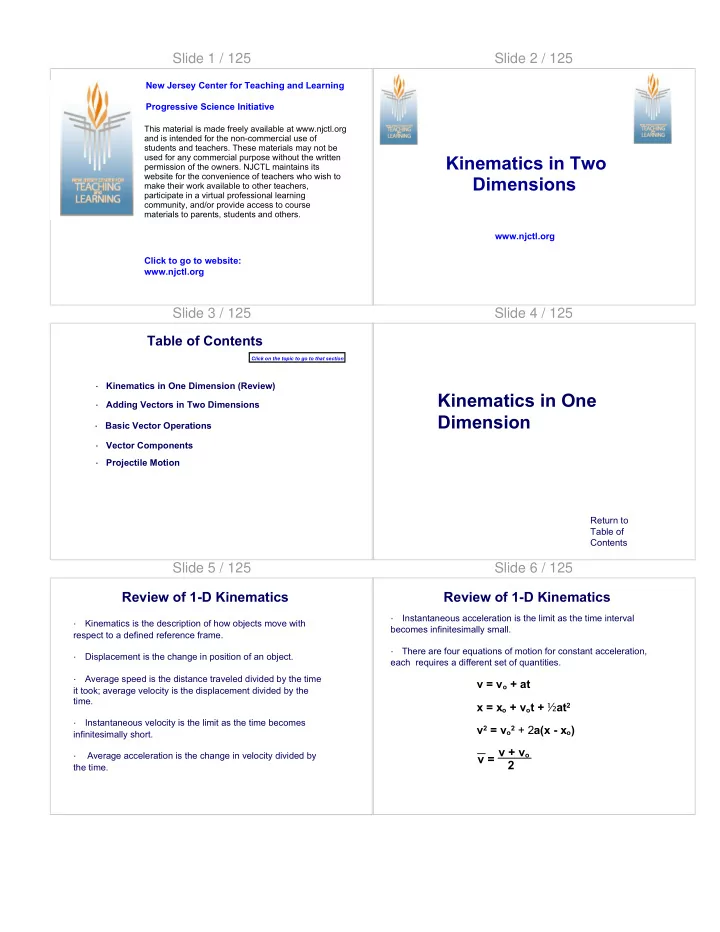
Slide 1 / 125 Slide 2 / 125 New Jersey Center for Teaching and Learning Progressive Science Initiative This material is made freely available at www.njctl.org and is intended for the non-commercial use of students and teachers. These materials


slide-1
SLIDE 1

Slide 1 / 125

This material is made freely available at www.njctl.org and is intended for the non-commercial use of students and teachers. These materials may not be used for any commercial purpose without the written permission of the owners. NJCTL maintains its website for the convenience of teachers who wish to make their work available to other teachers, participate in a virtual professional learning community, and/or provide access to course materials to parents, students and others.

Click to go to website: www.njctl.org New Jersey Center for Teaching and Learning Progressive Science Initiative

Slide 2 / 125

www.njctl.org

Kinematics in Two Dimensions

Slide 3 / 125

· Kinematics in One Dimension (Review)

Table of Contents

Click on the topic to go to that section

· Adding Vectors in Two Dimensions · Vector Components · Projectile Motion · Basic Vector Operations

Slide 4 / 125

Return to Table of Contents

Kinematics in One Dimension

Slide 5 / 125 Review of 1-D Kinematics

· Kinematics is the description of how objects move with respect to a defined reference frame. · Displacement is the change in position of an object. · Average speed is the distance traveled divided by the time it took; average velocity is the displacement divided by the time. · Instantaneous velocity is the limit as the time becomes infinitesimally short. · Average acceleration is the change in velocity divided by the time.

Slide 6 / 125 Review of 1-D Kinematics

· Instantaneous acceleration is the limit as the time interval becomes infinitesimally small. · There are four equations of motion for constant acceleration, each requires a different set of quantities.

v2 = vo2 + 2a(x - xo) x = xo + vot + ½at2 v = vo + at v = v + vo 2

slide-2
SLIDE 2

Slide 7 / 125

1 A snapshot of three racing cars is shown on the

  • diagram. All three cars start the race at the same

time, at the same place and move along a straight

  • track. As they approach the finish line, which car

has the lowest average speed?

A

Car I

B

Car II

C

Car III

D

All three cars have the same average speed

http:/ / njc.tl/ 3m Answer

Slide 8 / 125

2 A car and a delivery truck both start from rest and accelerate at the same rate. However, the car accelerates for twice the amount of time as the

  • truck. What is the final speed of the car compared

to the truck?

A

Half as much

B Twice as much C Four times as much D One quarter as much

Answer

Slide 9 / 125

3 A car and a delivery truck both start from rest and accelerate at the same rate. However, the car accelerates for twice the amount of time as the

  • truck. What is the traveled distance of the car

compared to the truck?

A

Half as much

B

The same

C

Twice as much

D

Four times as much

Answer

Slide 10 / 125

4 A modern car can develop an acceleration four times greater than an antique car like “Lanchester 1800”. If they accelerate over the same distance, what would be the velocity of the modern car compared to the antique car?

A

Half as much

B

The same

C

Twice as much

D

Four times as much

Answer

Slide 11 / 125

In physics there is another approach in addition to algebraic which is called graphical analysis. The formula v = v0 + at can be interpreted by the graph. We just need to recall our memory from math classes where we already saw a similar formula y = mx + b. From these two formulas we can make some analogies: v # y (dependent variable of x), v0 # b (intersection with vertical axis), t # x (independent variable), a # m (slope of the graph- the ratio between rise and run Δy/Δx).

Graphing Motion at Constant Acceleration

Slide 12 / 125

Motion at Constant Acceleration

Below we can find the geometric explanation to the acceleration a =Δv/Δt. If slope is equal to: m = Δy/Δx Then consider a graph with velocity on the y-axis and time on the x-axis. What is the slope for the graph on the right?

slide-3
SLIDE 3

Slide 13 / 125

Motion at Constant Acceleration

(slope) y =Δy/Δx (slope of velocity vs. time) a =Δv/Δt The graph on the right has a slope of Δv/Δt, which is equal to

  • acceleration. Therefore, the slope of a velocity vs. time graph is

equal to acceleration.

Slide 14 / 125

5 The velocity as a function of time is presented by the graph. What is the acceleration?

http:/ / njc.tl/ 3n

Answer

Slide 15 / 125

6 The velocity as a function of time is presented by the graph. Find the acceleration.

http:/ / njc.tl/ 3o

Answer

Slide 16 / 125

The acceleration graph as a function of time can be used to find the velocity of a moving object. When the acceleration is constant it can be shown on the graph as a straight horizontal line.

Motion at Constant Acceleration

Slide 17 / 125

In order to find the change in velocity for a certain limit of time we need to calculate the area under the acceleration versus time graph.

Motion at Constant Acceleration

The change in velocity during first 12 seconds is equivalent to the shadowed area (4x12 = 48). The change in velocity during first 12 seconds is 48 m/s.

Slide 18 / 125

7 Which of the following statements is true?

A The object slows down B The object moves with a constant velocity C The object stays at rest D The object is in free fall

http:/ / njc.tl/ 3q

Answer

slide-4
SLIDE 4

Slide 19 / 125

8 The following graph shows acceleration as a function of time of a moving object. What is the change in velocity during first 10 seconds?

http:/ / njc.tl/ 3r

Answer

Slide 20 / 125

Analyzing Position vs Time Graphs

Recall earlier in this unit that slope was used to describe motion. The slope in a position vs. time graph is Δx/Δt, which is equal to velocity. Therefore, slope is equal to velocity on a position vs. time graph.

x (m) t (s)

Δx Δt v = Δx/Δt

http:/ / njc.tl/ 2t

Slide 21 / 125

Analyzing Position vs Time Graphs

A positive slope is a positive velocity, a negative slope is a negative velocity, and a slope of zero means zero velocity.

x (m) t (s) x (m) t (s) x (m) t (s)

positive slope v > 0 negative slope v < 0 zero slope v = 0

A positive velocity means moving in the positive direction, a negative velocity means moving in the negative direction, and zero velocity means not moving at all.

http:/ / njc.tl/ 2t

Slide 22 / 125

9 The graph represents the relationship between velocity and time for an object moving in a straight line. What is the traveled distance of the

  • bject at 9 s?

A

10 m

B

24 m

C

36 m

D

48 m

http:/ / njc.tl/ 3s

Answer

Slide 23 / 125

10 Which of the following is true?

A

The object increases its velocity

B

The object decreases its velocity

C

The object’s velocity stays unchanged

D

The object stays at rest

http:/ / njc.tl/ 3t

Answer

Slide 24 / 125

11 What is the velocity of the object?

A

2 m/s

B

4 m/s

C

6 m/s

D

8 m/s

http:/ / njc.tl/ 3v

Answer

slide-5
SLIDE 5

Slide 25 / 125 Free Fall

All unsupported objects fall towards the earth with the same acceleration. We call this acceleration the "acceleration due to gravity" and it is denoted by g. g = 9.8 m/s2 Keep in mind, ALL objects accelerate towards the earth at the same rate. g is a constant!

Slide 26 / 125

It speeds up (negative acceleration) g = -9.8 m/s2 It stops momentarily. v = 0 g = -9.8 m/s2 An object is thrown upward with initial velocity, v

  • It slows down.

(negative acceleration) g = -9.8 m/s2 What happens when it goes up? What happens when it goes down? What happens at the top? It returns with its

  • riginal velocity.

What happens when it lands?

Slide 27 / 125

It speeds up. (negative acceleration) g = -9.8 m/s2 It stops momentarily. v = 0 g = -9.8 m/s2 An object is thrown upward with initial velocity, v

  • It slows down.

(negative acceleration) g = -9.8 m/s2 It returns with its

  • riginal velocity.

Slide 28 / 125

a v0 On the way up: a v1 v1 a v2 v2 a a

v

a a

v0

On the way down: v1 v1

v2 v2 v v t = 0 s t = 1 s t = 2 s t = 3 s t = 0 s t = 1 s t = 2 s t = 3 s

Slide 29 / 125

v (m/s) t (s)

An object is thrown upward with initial velocity, v

  • It stops momentarily.

v = 0 g = -9.8 m/s2 It returns with its

  • riginal velocity but in the
  • pposite direction.

For any object thrown straight up into the air, what does the velocity vs time graph look like?

Slide 30 / 125

12 A ball is thrown straight up from point A it reaches a maximum height at point B and falls back to point C. Which of the following is true about the direction of the ball’s velocity and acceleration between A and B? A B C D

E

http:/ / njc.tl/ 42

Answer

slide-6
SLIDE 6

Slide 31 / 125

13 A ball is thrown straight up from point A it reaches a maximum height at point B and falls back to point C. Which of the following is true about the direction the ball’s velocity and acceleration between B and C? A B C D E

http:/ / njc.tl/ 43

Answer

Slide 32 / 125

14 A package is dropped from an air balloon two

  • times. In the first trial the distance between the

balloon and the surface is H and in the second trial 4H. Compare the time it takes for the package to reach the surface in the second trial to that in the first trial? A The time in the second trial is four times greater B The time in the second trial is two times greater C The time in the second trial is four times less D The time in the second trial is two times less

http:/ / njc.tl/ 45

Answer

Slide 33 / 125

15 An archer practicing with an arrow bow shoots an arrow straight up two times. The first time the initial speed is v0 and second time he increases the initial sped to 4v0. How would you compare the maximum height in the second trial to that in the first trial? A Two times greater B Four times greater C Eight times greater D Sixteen times greater

http:/ / njc.tl/ 47

Answer

Slide 34 / 125

Vectors and Scalars

Scalar - a quantity that has only a magnitude (number or value) Vector - a quantity that has both a magnitude and a direction

Quantity Vector Scalar Time Distance Displacement Speed

Which of the following are vectors? Scalars?

Answer

Slide 35 / 125

16 A runner runs halfway around a circular path of radius 10 m. What is the displacement of the runner ? A 0 m B 10 m C 20 m D 31.4 m

http:/ / njc.tl/ 4k

Answer

Slide 36 / 125

17 A runner runs halfway around a circular path of radius 10 m. What is the total traveled distance of the jogger? A 0 m B 10 m C 20 m D 31.4 m

http:/ / njc.tl/ 4l

Answer

slide-7
SLIDE 7

Slide 37 / 125

Return to Table of Contents

Adding Vectors in Two Dimensions

Slide 38 / 125 Adding Vectors

Last year, we learned how to add vectors along a single axis. The example we used was for adding two displacements.

Slide 39 / 125 Adding Vectors

Last year, we learned how to add vectors along a single axis. The example we used was for adding two displacements.

  • 1. Draw the first vector,

beginning at the origin, with its tail at the origin.

Slide 40 / 125 Adding Vectors

Last year, we learned how to add vectors along a single axis. The example we used was for adding two displacements.

  • 1. Draw the first vector,

beginning at the origin, with its tail at the origin.

  • 2. Draw the second vector with

its tail at the tip of the first vector.

Slide 41 / 125 Adding Vectors

Last year, we learned how to add vectors along a single axis. The example we used was for adding two displacements.

  • 1. Draw the first vector,

beginning at the origin, with its tail at the origin.

  • 2. Draw the second vector with

its tail at the tip of the first vector.

  • 3. Draw the Resultant (the

answer) from the tail of the first vector to the tip of the last.

Slide 42 / 125

Adding Vectors

The direction of each vector matters. In this first case, the vector sum of: 5 units to the East plus 2 units to West is 3 units to the East.

slide-8
SLIDE 8

Slide 43 / 125 Adding Vectors

The direction of each vector

  • matters. For instance, if the

second vector had been 2 units to the EAST (not west), we get a different answer. In this second case, the vector sum of: 5 units to the East plus 2 units to EAST is 7 units to the East .

Slide 44 / 125 Adding Vectors in 2-D

But how about if the vectors are along different axes. For instance, let's add vectors

  • f the same magnitude, but

along different axes. What is the vector sum of: 5 units East plus 2 units North

Slide 45 / 125 Adding Vectors

  • 1. Draw the first vector,

beginning at the origin, with its tail at the origin.

Slide 46 / 125 Adding Vectors

  • 1. Draw the first vector,

beginning at the origin, with its tail at the origin.

  • 2. Draw the second vector with

its tail at the tip of the first vector.

Slide 47 / 125 Adding Vectors

  • 1. Draw the first vector,

beginning at the origin, with its tail at the origin.

  • 2. Draw the second vector with

its tail at the tip of the first vector.

  • 3. Draw the Resultant (the

answer) from the tail of the first vector to the tip of the last.

Slide 48 / 125 Adding Vectors

Drawing the Resultant is the same as we did last year. But calculating its magnitude and direction require the use of right triangle mathematics. We know the length of both SIDES of the triangle (a and b), but we need to know the length of the HYPOTENUSE (c).

a b c

slide-9
SLIDE 9

Slide 49 / 125 Magnitude of a Resultant

The magnitude of the resultant is equal to the length of the vector. We get the magnitude of the resultant from the Pythagorean Theorem: c2 = a2 + b2

  • r in this case:

R2 = 52 + 22 R2 = 25 + 4 R2 = 29 R = √(29) = 5.4 units

a = 5 units b = 2 units c = ?

Slide 50 / 125

18 What is the magnitude of the Resultant of two vectors A and B, if A = 8.0 units north and B = 4.5 units east?

Answer

http:/ / njc.tl/ 4p

Slide 51 / 125

19 What is the magnitude of the Resultant of two vectors A and B, if A = 24.0 units east and B = 15.0 units south?

http:/ / njc.tl/ 4q

Answer

Slide 52 / 125 Adding Vectors

In physics, we say the direction of a vector is equal to the angle θ between a chosen axis and the resultant. In Kinematics, we will primarily use the x-axis to measure θ. However, if we were to change the axis we used and apply the proper mathematical techniques, we should get the same result!

θ

Slide 53 / 125 Adding Vectors

To find the value of the angle θ, we need to use what we already know: the length of the two sides

  • pposite and adjacent to the

angle. (remember SOH CAH TOA)

θ

Slide 54 / 125 Adding Vectors

tan(θ) = opp / adj tan(θ) = (2 units) / (5 units) tan(θ) = 2/5 tan(θ) = 0.40 To find the value of θ, we must take the inverse tangent: θ = tan-1(0.40) = 22 0

θ

slide-10
SLIDE 10

Slide 55 / 125 Adding Vectors

θ

The Resultant is 5.4 units in the direction of 22 0 North of East magnitude direction

Slide 56 / 125

20 What is the direction of the Resultant of the two vectors A and B if: A = 8.0 units north and B = 4.5 units east if East is 0

  • and North is 90o?

Answer

http:/ / njc.tl/ 4r

Slide 57 / 125

21 What is the direction (from East) of the Resultant of the two vectors A a nd B if: A = 24.0 units east and B = 15.0 units south?

Answer

http:/ / njc.tl/ 4s

Slide 58 / 125

22 Find the magnitude and direction of the resultant of two vectors A and B if: A = 400 units north B = 250 units east Magnitude = ?

http:/ / njc.tl/ 4t

Answer

Slide 59 / 125

23 Find the magnitude and direction of the resultant of two vectors A and B if: A = 400 units north B = 250 units east Direction = ?

http:/ / njc.tl/ 4t

Answer

Slide 60 / 125

24 A student walks a distance

  • f 300 m East, then walks

400 m North. What is the magnitude of the net displacement? A 300 m B 400 m C 500 m D 700 m

http:/ / njc.tl/ 4u Answer

slide-11
SLIDE 11

Slide 61 / 125

25 A student walks a distance

  • f 300 m East, then walks

400 m North. What is the total traveled distance? A 300 m B 400 m C 500 m D 700 m

http:/ / njc.tl/ 4v Answer

Slide 62 / 125

26 Two displacement vectors have magnitudes of 5.0 m and 7.0 m, respectively. When these two vectors are added, the magnitude of the sum A is 2.0 m B could be as small as 2.0 m, or as large as 12 m C is 12 m D is larger than 12 m

http:/ / njc.tl/ 4w Answer

Slide 63 / 125

27 The resultant of two vectors is the largest when the angle between them is A 0° B 45° C 90° D 180°

http:/ / njc.tl/ 4x Answer

Slide 64 / 125

28 The resultant of two vectors is the smallest when the angle between them is A 0° B 45° C 90° D 180°

http:/ / njc.tl/ 4y Answer

Slide 65 / 125

Return to Table of Contents

Basic Vector Operations

Slide 66 / 125

Adding Vectors

Adding Vectors in the opposite order gives the same resultant. V1 + V2 = V2 + V1

V1 V1 V2 V2

slide-12
SLIDE 12

Slide 67 / 125 Adding Vectors

Even if the vectors are not at right angles, they can be added graphically by using the "tail to tip" method. The resultant is drawn from the tail of the first vector to the tip

  • f the last vector.

V1 V2 V3

+ + =

V1 V2 V3 VR

Slide 68 / 125 Adding Vectors

...and the order does not matter.

V1 V3 V2 V3 V1 V2

+ + =

VR V3 V1 V2 VR

Try it.

Slide 69 / 125 Subtracting Vectors

In order to subtract a vector, we add the negative of that

  • vector. The negative of a vector is defined as that vector in

the opposite direction.

V1

  • =

V2 VR V1

+

  • V2

V1

  • V2

=

Slide 70 / 125 Multiplication of Vectors by Scalars

A vector V can be multiplied by a scalar c. The result is a vector cV which has the same direction as V. However, if c is negative, it changes the direction of the vector.

V 2V

  • ½V

Slide 71 / 125

29 Which of the following operations will not change a vector? A Translate it parallel to itself B Rotate it C Multiply it by a constant factor D Add a constant vector to it

http:/ / njc.tl/ 4z Answer

Slide 72 / 125

Return to Table of Contents

Vector Components

slide-13
SLIDE 13

Slide 73 / 125 Adding Vectors by Components

Any vector can be described as the sum as two other vectors called components. These components are chosen perpendicular to each other and can be found using trigonometric functions.

x y

V

Vx Vy

θ

Slide 74 / 125

Adding Vectors by Components

In order to remember the right triangle properties and to better identify the functions, it is often convenient to show these components in different arrangements (notice v

y below).

x y

V

Vx Vy

θ

Slide 75 / 125

30 If a ball is thrown with a velocity of 25 m/s at an angle of 37° above the horizontal, what is the vertical component of the velocity? A 12 m/s B 15 m/s C 20 m/s D 25 m/s

http:/ / njc.tl/ 51 Answer

Slide 76 / 125

31 If a ball is thrown with a velocity of 25 m/s at an angle of 37° above the horizontal, what is the horizontal component of the velocity? A 12 m/s B 15 m/s C 20 m/s D 25 m/s

http:/ / njc.tl/ 51 Answer

Slide 77 / 125

32 If you walk 6.0 km in a straight line in a direction north of east and you end up 2.0 km north and several kilometers

  • east. How many degrees north of east have you walked?

A 19° B 45° C 60° D 71°

http:/ / njc.tl/ 52 Answer

Slide 78 / 125 Adding Vectors by Components

Using the tip-to-tail method, we can sketch the resultant of any two vectors. x y V1 V2 V But we cannot find the magnitude of 'v', the resultant, since v 1 and v 2 are two-dimensional vectors

slide-14
SLIDE 14

Slide 79 / 125 Adding Vectors by Components

We now know how to break v

1 and v 2 into components...

x y

V1

V1x V1y

V2

V2y V2x

Slide 80 / 125 Adding Vectors by Components

And since the x and y components are one dimensional, they can be added as such.

x y

V1x V1y

V2y V2x Vx = v1x + v2x Vy = v

1y + v 2y

Slide 81 / 125 Adding Vectors by Components

V1 V2

  • 1. Draw a diagram and add the

vectors graphically.

Slide 82 / 125 Adding Vectors by Components

x y

V1 V2

  • 1. Draw a diagram and add the

vectors graphically.

  • 2. Choose x and y axes.

Slide 83 / 125 Adding Vectors by Components

x y

V1

V1x V1y

V2

V2y V2x

  • 1. Draw a diagram and add the

vectors graphically.

  • 2. Choose x and y axes.
  • 3. Resolve each vector into x

and y components.

Slide 84 / 125 Adding Vectors by Components

x y

V1

V1x V1y

V2

V2y V2x

  • 1. Draw a diagram and add the

vectors graphically.

  • 2. Choose x and y axes.
  • 3. Resolve each vector into x

and y components.

  • 4. Calculate each component.

v1x = v1 cos(θ1) v2x = v2 cos(θ2) v1y = v1 sin(θ1) v2y = v2 sin(θ2)

slide-15
SLIDE 15

Slide 85 / 125 Adding Vectors by Components

x y

V1

V1x V1y

V2

V2y V2x Vx Vy

  • 1. Draw a diagram and add the

vectors graphically.

  • 2. Choose x and y axes.
  • 3. Resolve each vector into x

and y components.

  • 4. Calculate each component.
  • 5. Add the components in each

direction.

Slide 86 / 125 Adding Vectors by Components

x y

V1

V1x V1y

V2

V2y V2x

V

Vx Vy

  • 1. Draw a diagram and add the

vectors graphically.

  • 2. Choose x and y axes.
  • 3. Resolve each vector into x

and y components.

  • 4. Calculate each component.
  • 5. Add the components in each

direction.

  • 6. Find the length and direction of

the resultant vector.

Slide 87 / 125

Example: Graphically determine the resultant of the following three vector displacements:

  • 1. 24m, 30º north of east
  • 2. 28m, 37º east of north
  • 3. 20m, 50º west of south

Slide 88 / 125

Example: Graphically determine the resultant of the following three vector displacements:

  • 1. 24m, 30º north of east
  • 2. 28m, 37º east of north
  • 3. 20m, 50º west of south

30O 37O 50O 24m 28m 20m

First, draw the vectors.

Slide 89 / 125

Example: Graphically determine the resultant of the following three vector displacements:

  • 1. 24m, 30º north of east
  • 2. 28m, 37º east of north
  • 3. 20m, 50º west of south

30O 37O 50O 24m 28m 20m

Next, find the x and y components of each.

Slide 90 / 125

Example: Graphically determine the resultant of the following three vector displacements:

  • 1. 24m, 30º north of east
  • 2. 28m, 37º east of north
  • 3. 20m, 50º west of south

30O 37O 50O 24m 28m 20m

Next, find the x and y components of each.

slide-16
SLIDE 16

Slide 91 / 125

Example: Graphically determine the resultant of the following three vector displacements:

  • 1. 24m, 30º north of east
  • 2. 28m, 37º east of north
  • 3. 20m, 50º west of south

30O 37O 50O 24m 28m 20m

Next, find the x and y components of each. Note: these are both negative because south and west are negative directions.

Slide 92 / 125

Now we can put the components in a chart and solve for the resultant vector. x (m) y (m) d1 20.8 12.0 d2 16.9 22.4 d3

  • 15.3
  • 12.9

Ʃ 22.4 21.5 To find the magnitude of the resultant, use the Pythagorean theorem. To find the direction of the resultant, use inverse tangent.

Slide 93 / 125

33 Graphically determine the magnitude and direction of the resultant of the following three vector displacements:

  • 1. 15 m, 30º north of east
  • 2. 20 m, 37º north of east
  • 3. 25 m, 45
  • north of east

Magnitude = ?

http:/ / njc.tl/ 58

Answer

Slide 94 / 125

34 Graphically determine the magnitude and direction of the resultant of the following three vector displacements:

  • 1. 15 m, 30º north of east
  • 2. 20 m, 37º north of east
  • 3. 25 m, 45
  • north of east

Direction = ?

http:/ / njc.tl/ 58

Answer

Slide 95 / 125

35 Which of the following is an accurate statement? A A vector cannot have a magnitude of zero if one of its components is not zero. B The magnitude of a vector can be equal to less than the magnitude of one of its components. C If the magnitude of vector A is less than the magnitude of vector B, then the x-component of A must be less than the x-component of B. D The magnitude of a vector can be either positive or negative.

http:/ / njc.tl/ 59 Answer

Slide 96 / 125

Return to Table of Contents

Projectile Motion

slide-17
SLIDE 17

Slide 97 / 125 Projectile Motion: 1st Type

A projectile is an object moving in two dimensions under the influence of Earth's gravity. Its path is a parabola.

Vertical fall Projectile Motion

vx vy v a = g

Slide 98 / 125 Projectile Motion: 1st Type

Projectile motion can be understood by analyzing the vertical and horizontal motion separately. The speed in the x-direction is constant. The speed in the y-direction is changing.

Vertical fall Projectile Motion

vx vy v a = g

Slide 99 / 125

A mountain lion leaps horizontally from a 7.5 m high rock with a speed of 4.5 m/s. How far from the base of the rock will he land?

Slide 100 / 125

A mountain lion leaps horizontally from a 7.5 m high rock with a speed of 4.5 m/s. How far from the base of the rock will he land? First, determine the time it will take for the lion to reach the ground.

Slide 101 / 125

A mountain lion leaps horizontally from a 7.5 m high rock with a speed of 4.5 m/s. How far from the base of the rock will he land? Then, determine how far from the base he will land.

Slide 102 / 125

36 A cannon ball is shot from a cannon at a height of 15 m with a

velocity of 20 m/s. How far away will the cannon ball land?

Answer

slide-18
SLIDE 18

Slide 103 / 125

37 A marble rolls off a table from a height of 0.8 m with a velocity

  • f 3 m/s. Then another marble rolls off the same table with a

velocity of 4 m/s. Which values are the same for both marbles? Justify your answer qualitatively, with no equations or calculations. A The final speeds of the marbles. B The time each takes to reach the ground. C The distance from the base of the table where each lands. Answer

Slide 104 / 125

vx vy v vx vy v vx = v vx vy v vy vx v

Projectile Motion: 2nd Type

If an object is launched at an angle with the horizontal, the analysis is similar except that the initial velocity has a vertical component.

Slide 105 / 125

vx vy v vx vy v vx = v vx vy v vy vx v

Projectile motion can be described by two kinematics equations: horizontal component: vertical component:

Slide 106 / 125

vx vy v vx vy v vx = v vx vy v vy vx v

Flying time: Horizontal range: Maximum Height:

Slide 107 / 125

38 Ignoring air resistance, the horizontal component of a projectile's velocity A is zero B remains constant C continuously increases D continuously decreases

http:/ / njc.tl/ 5a Answer

Slide 108 / 125

39 A ball is thrown with a velocity of 20 m/s at an angle of 60° above the horizontal. What is the horizontal component of its instantaneous velocity at the exact top of its trajectory? A 10 m/s B 17 m/s C 20 m/s D zero

http:/ / njc.tl/ 5b Answer

slide-19
SLIDE 19

Slide 109 / 125

40 Ignoring air resistance, the magnitude of the horizontal component of a projectile's acceleration A is zero B remains a non-zero constant C continuously increases D continuously decreases

http:/ / njc.tl/ 5c Answer

Slide 110 / 125

41 At what angle should a water-gun be aimed in order for the water to land with the greatest horizontal range? A 0° B 30° C 45° D 60°

http:/ / njc.tl/ 5d Answer

Slide 111 / 125

42 (Mulitple Answer) An Olympic athlete throws a javelin at six different angles above the horizontal, each with the same speed: 20°, 30°, 40°, 60°, 70° and 80°. Which two throws cause the javelin to land the same distance away? Be prepared to justify your answer. A 30° and 80° B 20° and 70° C 30° and 70° D 30° and 60°

Answer

Slide 112 / 125

43 You are throwing a ball for the second time. If the ball leaves your hand with twice the velocity it had on your first throw, its horizontal range R (compared to your first serve) would be A 1.4 R B R/2 C 2R D 4R

http:/ / njc.tl/ 5f

Answer

Slide 113 / 125

44 When a football in a field goal attempt reaches its maximum height, how does its speed compare to its initial speed? (Justify your answer.) A It is zero B It is less than its initial speed C It is equal to its initial speed D It is greater than its initial speed

http:/ / njc.tl/ 5h

Answer

Slide 114 / 125

45 A stone is thrown horizontally from the top of a tower at the same instant a ball is dropped vertically. Which object is traveling faster when it hits the level ground below? (Justify your answer.) A It is impossible to tell from the information given B the stone C the ball D Neither, since both are traveling at the same speed

http:/ / njc.tl/ 5i

Answer

slide-20
SLIDE 20

Slide 115 / 125

46 A plane flying horizontally at a speed of 50.0 m/s and at an elevation of 160 m drops a package. Two seconds later it drops a second package. How far apart will the two packages land on the ground? A 100 m B 170 m C 180 m D 210 m

http:/ / njc.tl/ 5j

Answer

Slide 116 / 125

47 An arrow is fired at an angle of θ above the horizontal with a speed of v. Explain how you can calculate the horizontal range and maximum height. (List the steps you would take and the equations you would use so that another student could solve this problem but do not solve the problem.)

Answer

Slide 117 / 125

48 A projectile is fired with an initial speed of 30 m/s at an angle of 30o above the horizontal. Determine the total time in the air.

Answer

Slide 118 / 125

49 A projectile is fired with an initial speed of 30 m/s at an angle of 30o above the horizontal. Determine the maximum height reached by the projectile. Answer

Slide 119 / 125

50 A projectile is fired with an initial speed of 30 m/s at an angle of 30o above the horizontal. Determine the maximum horizontal distance covered by the projectile.

Answer

Slide 120 / 125

51 A projectile is fired with an initial speed of 30 m/s at an angle of 30o above the horizontal. Determine the velocity of the projectile 2s after firing.

Answer

slide-21
SLIDE 21

Slide 121 / 125

vy vx v vx vy v vx vy v vx = v vx vy v

Projectile Motion: 3rd Type

If an object is launched at an angle with the horizontal and from an initial height,the analysis is similar except when finding the total time in the air. You will need to use the quadratic formula.

vx vy v

Slide 122 / 125

52 A projectile is fired from the edge of a cliff 200 m high with an initial speed of 30 m/s at an angle of 45o above the horizontal. Determine the total time in the air. Answer

Slide 123 / 125

53 A projectile is fired from the edge of a cliff 200 m high with an initial speed of 30 m/s at an angle of 45o above the horizontal. Determine the maximum horizontal range. Answer

Slide 124 / 125

54 A projectile is fired from the edge of a cliff 200 m high with an initial speed of 30 m/s at an angle of 45o above the horizontal. Determine the magnitude of the velocity just before impact. Answer

Slide 125 / 125

55 A projectile is fired from the edge of a cliff 200 m high with an initial speed of 30 m/s at an angle of 45o above the horizontal. Determine the angle the velocity makes with the horizontal just before impact. Answer