Kickstart your Application! Webinar No. 4: Task Descriptions, Cost - - PowerPoint PPT Presentation

kickstart your application
SMART_READER_LITE
LIVE PREVIEW

Kickstart your Application! Webinar No. 4: Task Descriptions, Cost - - PowerPoint PPT Presentation

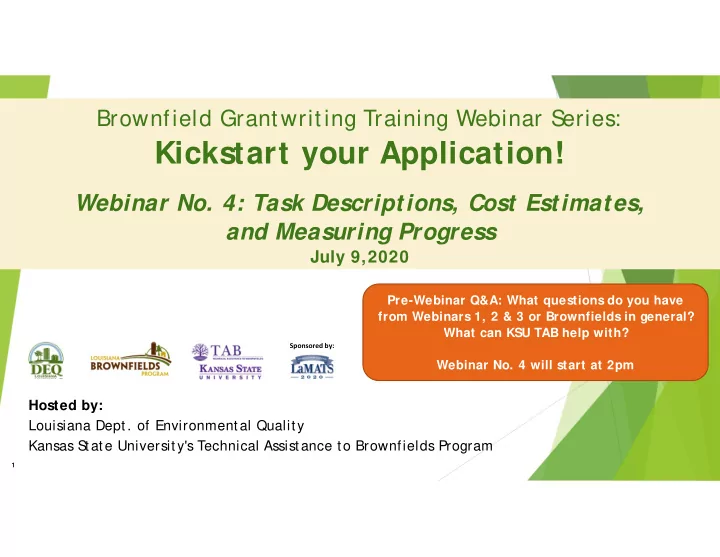
Brownfield Grantwriting Training Webinar S eries: Kickstart your Application! Webinar No. 4: Task Descriptions, Cost Estimates, and Measuring Progress July 9,2020 Pre-Webinar Q&A: What questions do you have from Webinars 1, 2 & 3 or


slide-1
SLIDE 1

1

Brownfield Grantwriting Training Webinar S eries:

Kickstart your Application!

Webinar No. 4: Task Descriptions, Cost Estimates, and Measuring Progress

July 9,2020

Hosted by: Louisiana Dept. of Environmental Quality Kansas S tate University's Technical Assistance to Brownfields Program

Sponsored by:

Pre-Webinar Q&A: What questions do you have from Webinars 1, 2 & 3 or Brownfields in general? What can KSU TAB help with? Webinar No. 4 will start at 2pm

slide-2
SLIDE 2

2

Webinar Logistics

 All participants will be muted during

  • presentation. However, please mute yourself and

minimize distractions and background noise.

 S

ubmit questions via chat to “ Everyone.”

 A recording of the webinar along with slides will

be available after the webinar on the KS U TAB website.

slide-3
SLIDE 3

3

3

If you are using a phone for audio – make sure your Computer Audio is turned off.

slide-4
SLIDE 4

4

Introductions

 Rebecca Otte

S tatewide Brownfield and VRP Program Coordinator Louisiana Dept. of Environmental Quality

 Amanda Alewine, S

enior Planner managing the Brownfields Program for the City of Oklahoma City

slide-5
SLIDE 5

Poll Question – What grant are you planning to apply for?

Assessment – Community Wide (S ingle Entity)

Assessment – S ite S pecific

Assessment – Coalition

Multipurpose Grant

Cleanup Grant

Not sure yet

5

slide-6
SLIDE 6

6

Webinar No. 1: Check all the Boxes: Narrative S ummary S heet & Threshold Criteria Webinar No. 2: Proj ect Area Description & Plans For Revitalization Webinar No. 3: Community Need & Community Engagement

Webinar No. 4: Task Descriptions, Cost Estimates & Measuring Progress

Webinar No. 5: Programmatic Capability & Past Performance Webinar No. 6: Updates to the new Request for Applications

Brownfield Grantwriting Training Webinar S eries: Kickstart your Application!

6

slide-7
SLIDE 7

7

Today’s Webinar

 PART 3: TASK DESCRIPTIONS, COST ESTIMATES AND MEASURING

PROGRESS

 3.a. Description of Tasks/Activities and Outputs

 3.a.i. Proj ect Implementation  3.a.ii. Anticipated Proj ect S

chedule

 3.a.iii. Task/ Activity Lead(s)  3.a.iv. Output(s)

 3.b. Cost Estimates  3.c. Measuring Environmental Results

slide-8
SLIDE 8

8

Today’s Webinar

 Helpful Tip 1 before we get started – Follow the Outline  3.a. Description of Tasks/Activities and Outputs (25 Points)

 3.a.i. Proj ect Implementation (10 points)  3.a.ii. Anticipated Proj ect S

chedule (5 points)

 3.a.iii. Task/ Activity Lead(s) (5 points)  3.a.iv. Output(s) (5 points)

slide-9
SLIDE 9

9

PART 3: TASK DESCRIPTIONS, COST ESTIMATES AND MEASURING PROGRESS

  • a. Description of Tasks/ Activities and Outputs

3.a

3.a.i. Proj ect Implementation (10 points)

slide-10
SLIDE 10

10

3.a

Task/ Activity: i. Proj ect Implementation

  • Discussion of EP

A-funded activities for the priority site(s):

  • Discussion of EP

A-funded activities for the non-priority site(s), if applicable:

  • Non-EP

A grant resources needed to carry out task/ activity, if applicable:

  • ii. Anticipated Proj ect S

chedule

  • iii. Task/ Activity Lead(s)
  • iv. Output(s):

Tip: If EP A provides an example table, use that table!

  • 3. a. Description of Tasks/Activities and Outputs
slide-11
SLIDE 11

11

  • 3. PART 3: TASK DESCRIPTIONS, COST ESTIMATES AND

MEASURING PROGRESS

  • a. Description of Tasks/ Activities and Outputs
  • i. Proj ect Implementation

3.a.i

Task 1: Activity Activity Activity Task 2: Activity Activity Etc.

slide-12
SLIDE 12

12

Today’s Webinar

 Helpful Tip - Tasks must match the budget

slide-13
SLIDE 13

13 13

Ranking Criteria Evaluation Criteria Provide a list and description of the tasks/ activities required to implement the proposed proj ect.

  • i. Proj ect Implementation

Discuss the EP A-funded activities that will take place to address the priority brownfield site(s) in the target area(s); The degree to which the tasks/ activities are eligible, specific, and appropriate to the goals of the proposed proj ect, and the degree to which the response demonstrates a sound plan to address the priority site(s) and the applicant’s readiness to achieve the proj ect goals in an efficient manner.

Writing approach:

3.a.i

slide-14
SLIDE 14

14 14

Ranking Criteria Evaluation Criteria and if applicable, the anticipated activities to occur beyond the priority site(s), in or outside the target area(s). When applicable, the degree to which tasks/ activities for the remaining funds are specific and appropriate, and the degree to which the response demonstrates a sound plan. If applicable, identify tasks and/ or activities that are necessary to carry out the grant that will be contributed by sources other than the EP A grant; such as in-kind resources or funding contributed by your organization. When applicable, the extent to which other resources (e.g. in-kind resources) will bridge the gap between the EP A grant and activities necessary to bring the grant to successful completion. (For example, the applicant does not charge the EP A grant for salary dollars and therefore contributes its

  • wn resources to carry out programmatic oversight

activities or grant administration. Do not duplicate sources listed in 1.c.i. Resources Needed for S ite Reuse.) (Note, a response may not earn full points if the applicant duplicates sources that are listed in 1.c.i. Resources Needed for S ite Reuse.)

Writing approach:

3.a.i

slide-15
SLIDE 15

15 15

Ranking Criteria Evaluation Criteria The degree to which the Assessment Coalition applicant proposes to assess a minimum of 5 sites and at least one in each coalition member’s j urisdiction. (Note, proj ects that plan to assess a minimum of 5 sites with at least one site in each coalition members’ j urisdiction will be reviewed more favorably.)

Writing approach:

3.a.i

slide-16
SLIDE 16

Typical Eligible Tasks

 Cooperative Agreement Oversight  Exchange Program Information with EP

A & Other Grantees (e.g. Attend Conferences and Workshops)

 Community Engagement  Brownfields Planning  Conduct Environmental Assessments  Cleanup Planning

16

3.a.i

Personnel & Fringe Costs to conduct/ oversee these activities are eligible grant expenses

slide-17
SLIDE 17

Typical Eligible Activities

 Cooperative Agreement Oversight  S

ubmitting Quarterly Reports to EP A including DBE reporting and Federal Financial Reports

 Updating ACRES  Procuring an Environmental Consultant  Grant Drawdowns/ Financial Tracking  Ensure Quality Management Plan is up-to-date

17

3.a.i

slide-18
SLIDE 18

Typical Eligible Activities

18

3.a.i

 Exchange Program Information with EP

A & Other Grantees

 Participate in Annual EP

A Regional Meetings in Dallas

 Participate in National Brownfields Conference (every 18-

24 months)

 Participate in EP

A Grantee Calls

slide-19
SLIDE 19

Typical Eligible Activities

19

3.a.i

 Community Engagement  Community Meetings  Website / S

  • cial Media

 S

peaking at Events

 Hosting a Festival Booth  Coordinating Zoom Calls  Coordinating Coalition meetings (if applicable)  S

ite Progress Updates Adapting to Coronavirus

slide-20
SLIDE 20

Typical Eligible Activities

20

3.a.i

 Brownfields Planning  Enhancing your existing Brownfields inventory  Reuse planning  Land use assessment  Development of an area-wide plan  Conducting market feasibility studies  Evaluating infrastructure needs  And more!

slide-21
SLIDE 21

Typical Eligible Activities

21

3.a.i

 Conduct Environmental Assessments  Phase I and Phase II environmental site assessments  Procuring an Environmental Consultant to conduct investigations  S

ite selection

 S

ecuring site access

 S

ubmitting Property Eligibility Determination Request to EP A

 Developing Quality Assurance Proj ect Plans  S

ubmitting Assessment Reports to EP A

 Keeping EP

A Informed of Progress

 S

ite Progress Updates to the Community

slide-22
SLIDE 22

Typical Eligible Activities

22

3.a.i

 Cleanup Planning

 Cleanup Plan  Analysis of Brownfield Cleanup Alternatives

Each Program is Unique!

slide-23
SLIDE 23

Not Typical but still Eligible Activities

Local Governments may use up to 10%

  • f grants funds for:

 Health Monitoring Activities  Monitoring and enforcement of any institutional control

used to prevent human exposure to any hazardous substance from a brownfield site

23

3.a.i

slide-24
SLIDE 24

24

Ineligible Uses of Funds

  • Land Acquisition
  • Building Demolition that is not necessary to assess contamination at the

site

  • Remediation (under Assessment grants)
  • Marketing brownfield properties for redevelopment
  • Area-wide zoning and/ or design guideline development that is unrelated

to advancing cleanup and reuse of brownfields in the project area

  • Area-wide master planning, community visioning, or comprehensive

planning (including updating/ writing such plans) that are unrelated to advancing cleanup and reuse of brownfields in the project area

3.a.i

slide-25
SLIDE 25

25

Ineligible Uses of Funds

3.a.i

  • S

urvey design, distribution or collection

  • S

ite-specific reuse planning for a site ineligible for brownfields funding

  • NPL sites (S

uperfund S ites)

  • Federal facilities
  • S

ites under CERCLA orders/ consent decrees

  • Etc.
  • Proj ects that duplicate grants awarded under other EP

A Brownfields Grant programs or other Federal Program (e.g. No Double Dipping)

slide-26
SLIDE 26

Example

26

3.a.i

Task 1: Community Outreach i. Host quarterly meetings in the target area to inform the community about Brownfields and site progress and gather their input on the environmental work and planned reuses. Regularly post on social media (including our partners’ outlets) to keep the community informed and solicit feedback. Conduct semi-annual Coalition meetings.

  • In-kind contributions include donation of meeting space by XYZ

Nonprofit.

  • ii. Anticipated Proj ect S

chedule

  • iii. Task/ Activity Lead(s)
  • iv. Output(s):
slide-27
SLIDE 27

27

Next S teps: 3.a.i

Develop a bullet list (or table) of your Planned Activities

  • What applies to Priority S

ites / your Target Area(s)?

  • What applies outside your Target Area?
  • In-kind resources necessary to complete the scope of work

Group activities into 3-4 Tasks

3.a.i

slide-28
SLIDE 28

28

Pause for Questions / S tretch Break

3.a.i

slide-29
SLIDE 29

29

  • 3. PART 3: TASK DESCRIPTIONS, COST

ESTIMATES AND MEASURING PROGRESS

  • a. Description of Tasks/ Activities and Outputs
  • ii. Anticipated Proj ect S

chedule

3.a.ii

slide-30
SLIDE 30

30

Writing approach:

30

Ranking Criteria Evaluation Criteria

  • ii. Anticipated Project Schedule (5 points)

Discuss the anticipated schedule and timing for the EP A-funded activities outlined above in 3.a.i. Program Implementation The extent to which the proj ect schedule milestones are achievable and during the 3-year period of performance. the likelihood that the activities will be completed within the 3-year period of performance.

3.a.ii

slide-31
SLIDE 31

Examples

Cooperative Agreement Oversight/ Exchange Program Information with EPA & Other Grantees:

S elect a contractor within 3 months of award

S ubmit reports to EP A quarterly

Update ACRES as proj ects progress (at least monthly)

Participate in EP A calls & conferences as scheduled

Update our Quality Management Plan annually Community Outreach:

Conduct Quarterly Community Outreach Events throughout the 3-year grant period

S end out a monthly Brownfield Newsletter

Hold initial grant Coalition meeting within 2 months of award & qtrly thereafter Environmental Assessments:

Conduct 3 Phase Is and 2 Phase II within Y ear 1; Conduct an additional 3 Phase Is and 3 Phase IIs by the end of the proj ect period.

31

3.a.ii

slide-32
SLIDE 32

Example

32

3.a.ii

Task 1: Community Outreach i. Host meetings in the target area to inform the community about Brownfields and site progress and gather their input on the environmental work and planned reuses. Regularly post on social media (including our partners’ outlets) to keep the community informed and solicit feedback. Conduct semi-annual Coalition meetings.

  • In-kind contributions include donation of meeting space by XYZ

Nonprofit.

  • ii. Quarterly Outreach meetings in Target Area throughout proj ect period;

Weekly social media posts while proj ects are underway; S emi-annual Coalition meetings

  • iii. Task/ Activity Lead(s)
  • iv. Output(s):
slide-33
SLIDE 33

Examples

33

3.a.ii

slide-34
SLIDE 34

34

  • 3. PART 3: TASK DESCRIPTIONS, COST

ESTIMATES AND MEASURING PROGRESS

  • a. Description of Tasks/ Activities and Outputs
  • iii. Task/ Activity Lead(s)

3.a.iii

slide-35
SLIDE 35

35

Writing approach:

35

Ranking Criteria Evaluation Criteria

  • iii. Task/Activity Lead

For each task/activity, identify the lead entity(ies) overseeing the various activities (i.e.

  • the applicant,
  • qualified environmental professional, or
  • other identified entity).

The extent to which the entity overseeing each task/ activity is appropriate and the degree to which the applicant demonstrates an ability to direct grant activities. When applicable, the degree to which the local health agency is involved in health monitoring activities.

3.a.iii

slide-36
SLIDE 36

Task/ Activity Lead

36

  • City of Who Dats (applicant)
  • City of Who Dats (applicant) – Brownfield Coordinator
  • Coalition Partner A
  • Community Partner M
  • Qualified Environmental Professional
  • Environmental Consultant with the City of Who Dats

Oversight Tip: Okay to have the same Lead on Multiple Tasks

3.a.iii

slide-37
SLIDE 37

Example

37

Task 1: Community Outreach i. Host quarterly meetings in the target area to inform the community about Brownfields and site progress and gather their input on the environmental work and planned reuses. Regularly post on social media (including our partners’ outlets) to keep the community informed and solicit feedback. Conduct semi-annual Coalition meetings.

  • In-kind contributions include donation of meeting space by XYZ

Nonprofit.

  • ii. Quarterly Outreach meetings; Weekly social media posts while proj ects

are underway; S emi-annual Coalition meetings

  • iii. City of Who Dats (applicant) – Brownfield Coordinator
  • iv. Output(s):

3.a.iii

slide-38
SLIDE 38

Example

38

3.a.iii

slide-39
SLIDE 39

39

  • 3. PART 3: TASK DESCRIPTIONS, COST

ESTIMATES AND MEASURING PROGRESS

  • a. Description of Tasks/ Activities and Outputs
  • iv. Output(s)

3.a.iv

slide-40
SLIDE 40

40

Writing approach:

40

Ranking Criteria Evaluation Criteria

  • iv. Outputs

Identify, The quality of the specific outputs and quantify as appropriate, and the extent to which the outputs correlate with the proposed proj ect, the anticipated outputs/ deliverables for each activity/ task. and the likelihood that the outputs will be achieved within the 3-year period of performance. Outputs may include, but are not limited to:

  • Quarterly Reports
  • S

ite Inventories

  • Phase I and Phase II Environmental S

ite Assessment Reports

  • S

ite Cleanup Plans

  • An Area-Wide Plan
  • Community Meetings

(Refer to S ection I.D. for an explanation of outputs.)

3.a.iv

slide-41
SLIDE 41

Example

41

3.a.iv

slide-42
SLIDE 42

Example

42

Task 1: Community Outreach i. Host quarterly meetings in the target area to inform the community about Brownfields and site progress and gather their input on the environmental work and planned reuses. Regularly post on social media (including our partners’ outlets) to keep the community informed and solicit feedback. Conduct semi-annual Coalition meetings.

  • In-kind contributions include donation of meeting space by XYZ

Nonprofit.

  • ii. Quarterly Outreach meetings; Weekly social media posts while proj ects

are underway; S emi-annual Coalition meetings

  • iii. City of Who Dats (applicant) – Brownfield Coordinator
  • iv. Output(s): Agendas from Quarterly Community meetings and semi-annual

Coalition meetings; S ummaries of meetings and S

  • cial Media Posts in qtrly

reports to EP A

3.a.iv

slide-43
SLIDE 43

43

Next S teps: 3.a.ii-i.v

Note an Anticipated Proj ect S chedule for each task/ activity 

Combine activity timelines as necessary for space

Note a Task Lead for each task

Note Outputs for activities noted

3.a

slide-44
SLIDE 44

44

Task/ Activity Schedule Task Lead Output

Task 1: Cooperative Agreement Oversight

Procure a QEP oversee the grant Within 3 months of award City of Who Dats (applicant) – Brownfield Coordinator QEP selection noted in Qtrly Report to EP A S ubmit Quarterly Reports to EP A including DBE reporting and Federal Financial Reports Per grant cooperative agreement requirements City of Who Dats (applicant) – Brownfield Coordinator Reports submitted to EP A per grant requirements Update ACRES As sites progress through assessment and reuse process City of Who Dats (applicant) – Brownfield Coordinator ACRES records updated Drawdown on grant funds and track financials As expenses are incurred/ throughout the 3-yeard grant period City of Who Dats – Fiscal Dept. Grant drawdowns Rebecca’s Way Of Organizing For Planning Purposes – Not to Put in the Proposal

3.a

slide-45
SLIDE 45

Example FY2019

45

3.a.i

3.a.i. Project implementation (10 points) City staff are now engaged in community outreach and negotiation of site access agreements and can initiate proj ect activities upon issuance

  • f a Cooperative Agreement. The City follows competitive procurement

procedures adopted by City Council to hire environmental consultants to perform assessment work.

3.a

slide-46
SLIDE 46

Example FY2019

46

3.a.ii 3.a

slide-47
SLIDE 47

Example FY2020

47

3.a

slide-48
SLIDE 48

Example

48

3.a

Task/Activity: Programmatic Support ($10,500)

  • i. Proj ect Implementation: City staff are now engaged in community outreach

and negotiation of site access agreements and can initiate proj ect activities upon issuance of a Cooperative Agreement. The City follows competitive procurement procedures adopted by City Council to hire environmental consultants to perform assessment work.

  • ii. Anticipated Proj ect S

chedule: Cooperative Agreement Negotiated–Aug – S ept Advertise RFP for environmental Consulting and select contractor – S ept – Oct Complete Generic Quality Assurance Proj ect Plan for EP A approval - Nov

  • iii. Task/ Activity Lead(s): City S

taff

  • iv. Output(s): 12 Quarterly Reports, 3 Training Events
slide-49
SLIDE 49

49

Pause for Questions / S tretch Break

3.a

slide-50
SLIDE 50

50

PART 3: TASK DESCRIPTIONS, COST ESTIMATES AND MEASURING PROGRESS

  • b. Cost Estimates

3.b

Do not need to separate out Hazardous vs. Petroleum Don’ t ask for more than you need

slide-51
SLIDE 51

51

 Administrative Costs

 S

  • metimes called Indirect Rate
  • r Operational Costs

 Rent  Utilities  S

hared Clerical Personnel

 Etc.

 Programmatic Costs  Personnel time to complete Quarterly

Reports / Enter information into ACRES

 Conducting / Overseeing ES

As paid for by the grant

 Grant-Related Travel, training,

equipment supplies

 Conducting Grant-S

pecific Outreach

 Maintaining Brownfields Proj ect

Website/ S

  • cial Media

 Other Costs Directly Related to the

Grant

Up to 5%

  • f Grant Funding

No Cap

Administrative vs. Programmatic Costs

Is it worth it?

3.b

slide-52
SLIDE 52

Budget Table

Budget Categories Project Tasks Total Task 1: CA Oversight Task 2: ESAs Task 3: Task 4: Direct Costs Personnel $ $ $ $ $ Fringe Benefits1 $ $ $ $ $ Travel $ $ $ $ $ Equipment $ $ $ $ $ S upplies $ $ $ $ $ Contractual $ $ $ $ $ Other (include subawards) (specify type)______ $ $ $ $ $ Total Direct Costs $ $ $ $ $ Indirect Costs2 $ $ $ $ $ Total Budget (Total Direct Costs + Indirect Costs) $ $ $ $ $

1 City of Who Dats’ Fringe Benefits Rate is 50%of Personnel Costs 2 City of Who Dats’ Indirect Cost Rate is 50%

  • f Personnel + Fringe Benefits

52

3.b

Tip: Y

  • u can move

money out of a category easier than moving it in

slide-53
SLIDE 53

S pecial Considerations for Multipurpose

  • r Cleanup Grant Budgets

53

3.b

slide-54
SLIDE 54

54

Writing approach:

54

Ranking Criteria Evaluation Criteria

Describe how cost estimates for each task were developed (per budget category), 3.b.i. Development of Cost Estimates The degree of clarity on how each cost was developed and and, where appropriate, present costs per unit. the extent to which costs per unit are presented in detail. Replace the task number heading in the sample table with the actual title of the task. 3.b.ii. Application of Cost Estimates The extent to which each proposed cost is reasonable and realistic to implement the proj ect and clearly correlates with the proposed tasks and activities. Only include costs to be covered by EP A grant funds in this table. 3.b.iii. Funds Allocated Toward Environmental S ite Assessments The degree to which grant funds are allocated for tasks directly associated with Phase I and Phase II environmental site assessments. Leveraged resources should not be included in the budget table. (Note, proj ects that allocate at least 50%

  • f the funds for

tasks directly associated with Phase I and Phase II environmental site assessments will be reviewed more favorably.)

3.b

slide-55
SLIDE 55

Examples of Costs per Unit

 Task 1: Personnel to Oversee Grant - Personnel Costs: 20 hours at

average rate of $50/ hr = $1,000

55

3.b

Task 1: Personnel to Oversee Grant: Personnel: 20 Hours $50 Per hour $1,000 Fringe (50%of Personnel): $500

slide-56
SLIDE 56

Examples of Costs per Unit

Task 2: Environmental S ite Assessments – Personnel Costs: 20 hours at average rate of $50/ hr = $1,000; Contractual Costs: 6 Phase I site assessments at average cost of $3,500 based on past experience with similar proj ects in Louisiana = $17,500; 3 Phase II site assessment at average cost of $30,000 per Phase II = $90,000

56

3.b

Task 2: Environmental S ite Assessments: Personnel: 5 Hours per Phase I ES A 6 Phase I ES As $50 Per hour $1500 Personnel: 10 Hours per Phase II ES A 3 Phase II ES As $50 Per hour $1500 Fringe (50%of Personnel): $1500 Contractual: 6 Phase I ES As $3,500 Average cost per Phase I $21,000 3 Phase II ES As $30,000 Average cost per Phase II $90,000

slide-57
SLIDE 57

57

EXAMPLE

Task 1- Programmatic Support Staff time for programmatic support is estimated at 180 hours to be paid from the assessment grant; additional salary costs will be covered from the City’s General Fund. Supplies for each grant is estimated at $500 over 3 years for computer-related hardware, paper, ink, pens and other miscellaneous office supplies. A portion of the funds will be used to offset costs for travel and education/training for staff to attend the National Brownfields Conference or other brownfields venues.

Budget Categories Proj ect Tasks ($) Programmatic Support Total Personnel $6,000 Fringe Benefits $1,500 Travel $2,000 Equipment S upplies $1,000 Contractual Other Total Direct Costs $10,500

Amanda’s Example

3.b

slide-58
SLIDE 58

58

FY20 EXAMPLE Task 2-Phase I & II Environmental Site Assessments The cost assumes about 25 Phase Is will be completed along with 5 Phase IIs. This budget assumes an average per site cost of $3k - $4k for the Phase Is and $30k - $40k for Phase IIs. Most of the funds (estimated at $165,000 collectively) is expected to be spent on Phase II ES As.

Budget Categories Proj ect Tasks ($) Programmatic Support Phase I & II ES A’s Total Personnel $6,000 Fringe Benefits $1,500 Travel $2,000 Equipment S upplies $1,000 Contractual $268,288 Other Total Direct Costs $10,500 $268,288

Amanda’s Example

3.b

slide-59
SLIDE 59

Amanda’s Example

59

EXAMPLE Task 3- Focused Use-based Cleanup Planning: After Phase II reports are completed, staff and the consultant will develop a use-based cleanup plan for an estimated 3 sites. These are estimated to cost between $1,500 and $2,000 each. Preparation of cleanup plans will be consistent with submittal requirements of ODEQ and/ or OCC.

Budget Categories Proj ect Tasks ($) Programmatic Support Phase I & II ES A’s Cleanup/ Reuse Planning Total Personnel $6,000 $4,000 Fringe Benefits $1,500 $1,000 Travel $2,000 Equipment S upplies $1,000 Contractual $268,288 $5,300 Other Total Direct Costs $10,500 $268,288 $10,800 3.b

slide-60
SLIDE 60

60

EXAMPLE Task 4- Community Involvement: Staff time is estimated at 180 hours; additional salary

costs will be covered from the City’s General Fund. Contracts are expected to support community meetings and we have included $500 for rental space or other items as needed.

Budget Categories Proj ect Tasks ($) Programmatic Support Phase I & II ES A’s Cleanup/ Reuse Planning Community Involvement Total Personnel $6,000 $4,000 $6,000 Fringe Benefits $1,500 $1,000 $1,500 Travel $2,000 Equipment S upplies $1,000 Contractual $268,288 $5,300 $2,912 Other $500 Total Direct Costs $10,500 $268,288 $10,300 $10,915

Amanda’s Example

3.b

slide-61
SLIDE 61

61

EXAMPLE Make Sure your Numbers Add Up

Budget Categories Proj ect Tasks ($) Programmatic Support Phase I & II ES A’s Cleanup/ Reuse Planning Community Involvement Total Personnel $6,000 $4,000 $6,000 $16,000 Fringe Benefits $1,500 $1,000 $1,500 $4,000 Travel $2,000 $2,000 Equipment S upplies $1,000 $1,000 Contractual $268,288 $5,300 $2,912 $276,500 Other $500 $500 Total Direct Costs $10,500 $268,288 $10,300 $10,915 $300,000

Amanda’s Example

3.b

slide-62
SLIDE 62

62

Next S teps: 3.b

Draft your Budget Table in Excel 

Only costs to be billed to Grant

Develop Draft Cost Estimates

  • Personnel Time
  • # of hour x Hourly rate =
  • Calculate Fringe & Indirect using Rates (Normally %
  • f Personnel)
  • Travel
  • Annual Region 6 Brownfields Meeting in Dallas
  • National Brownfield Conference – every 18-24 months (estimate 2

per 3-year period)

  • Contractual
  • Outreach
  • Environmental S

ite Assessments:

  • # of Phase I ES

As x Cost of Phase I ES A =

  • # of Phase II ES

As x Cost of Phase II ES A =

  • QEP
  • S

upplies – Include a description

3.b

slide-63
SLIDE 63

63

Pause for Questions / S tretch Break

3.b

slide-64
SLIDE 64

64

  • 3. PART 3: TASK DESCRIPTIONS, COST

ESTIMATES AND MEASURING PROGRESS

  • c. Measuring Environmental Results

3.c

slide-65
SLIDE 65

65

Writing approach:

65

Ranking Criteria Evaluation Criteria Discuss how you plan to track, The extent to which the plan and mechanism to track, measure and measure and evaluate your progress evaluate proj ect progress in achieving these proj ect outputs, in achieving expected outputs,

  • verall proj ect results,
  • utcomes, and

and eventual proj ect outcomes results to ensure the grant funds are expended in a timely and efficient manner. are reasonable, appropriate, and (Definitions of outputs and outcomes are provided in S ection I.D.) correlate with information previously presented in the application. The extent to which proj ect goals will be achieved in an efficient manner.

3.c

slide-66
SLIDE 66

What’s your Plan for Tracking Progress?

 S

preadsheets to track proj ect progression and key deliverables

 KS

U TAB Brownfield Inventory Tool

 Report to EP

A in Quarterly Reports

  • Outreach Events

 Number of People  Type of Event  S

ummary

 Outcomes

 Regularly updating ACRES

, including after the grant has closed out

  • Leveraged Resources and Jobs Created

 Financial Tracking S

  • ftware

 Internal/ Coalition/ Community Check in Meetings to evaluate Progress

  • n a Monthly/ Quarterly/ S

emi-Annual Basis

66

3.c

slide-67
SLIDE 67

67

Example

The City of Oklahoma City

The City of Oklahoma City enters environmental site assessments into ACRES and a GIS Brownfields database to track progress. Brownfields staff routinely attends community meetings which will be tracked and noted in quarterly

  • reports. The City will track j obs created and document the reuse of sites as

they progress. The assessment grants will minimize exposures to contaminants by identifying what sites have contamination and assisting with cleanup planning to remediate/ mitigate the sites and prepare them for reuse. Expected outcomes are listed in the chart.

3.c

slide-68
SLIDE 68

68

Next S teps: 3.c

Develop a plan to Measure Results 

How are you going to track your proj ects?

KSU TAB BiT

S preadsheets

MS Access

Proj ect White Board

Quarterly Reports

ACRES

Regular Check ins to Evaluate Progress

Financial Tracking

3.c

slide-69
SLIDE 69

69

Final Pause for Questions

3.c

slide-70
SLIDE 70

Additional Tips

 Who should write the application?  Is your proposal specific to your

Community?

70

slide-71
SLIDE 71

71

Next S teps: 3.a

Develop a bullet list (or table) of your Planned Activities

  • What applies to Priority S

ites / your Target Area(s)?

  • What applies outside your Target Area?
  • In-kind resources necessary to complete the scope of work

Group activities into 3-4 Tasks

Note an Anticipated Proj ect S chedule for each task/ activity

  • Combine activity timelines as necessary for space

Note a Task Lead for each task

Note Outputs for activities noted

3.a

slide-72
SLIDE 72

72

Next S teps: 3.b

Draft your Budget Table in Excel 

Only costs to be billed to Grant

Develop Draft Cost Estimates

  • Personnel Time
  • # of hour x Hourly rate =
  • Calculate Fringe & Indirect using Rates (Normally %
  • f Personnel)
  • Travel
  • Annual Region 6 Brownfields Meeting in Dallas
  • National Brownfield Conference – every 18-24 months (estimate 2

per 3-year period)

  • Contractual
  • Outreach
  • Environmental S

ite Assessments:

  • # of Phase I ES

As x Cost of Phase I ES A =

  • # of Phase II ES

As x Cost of Phase II ES A =

  • QEP
  • S

upplies – Include a description

3.b

slide-73
SLIDE 73

73

Next S teps: 3.c

Develop a plan to Measure Results 

How are you going to track your proj ects?

KSU TAB BiT

S preadsheets

MS Access

Proj ect White Board

Quarterly Reports

ACRES

Regular Check ins to Evaluate Progress

Financial Tracking

3.c

slide-74
SLIDE 74

74

Previous Webinars Posted!

 Webinar No. 1: Check all the Boxes  Webinar No. 2: Proj ect Area Description and Plans for Revitalization  Webinar No. 3: Community Need and Community Engagement

(coming soon if not posted already)

www.ksutab.org/ resources S earch for: 2020 LDEQ

slide-75
SLIDE 75

75

Upcoming Webinars Thursdays at 2pm (Central)

 July 30: Programmatic Capability & Past Performance  August: Updates to the new RF

A

slide-76
SLIDE 76

76

Contacts

S cott Nightingale, KS U TAB S ervices Coordinator for EP A Region 6 scottnight@ ksu.edu / (785) 207-6021 Jennifer Clancey, KS U TAB S ervices Coordinator for EP A Region 7 j mclancey@ ksu.edu / (319) 270-3394 Rebecca Otte, Louisiana Brownfields & VRP Coordinator Rebecca.Otte@ la.gov / (504) 736-7069

slide-77
SLIDE 77

77

This proj ect has been funded wholly or in part by the United S tates Environmental Protection Agency under assistance agreement TR-83684001 to Kansas S tate University. The contents of this document do not necessarily reflect the views and policies of the Environmental Protection Agency, nor does the EP A endorse trade names or recommend the use of commercial products mentioned in this document.