
SLIDE 1
Constraint satisfaction
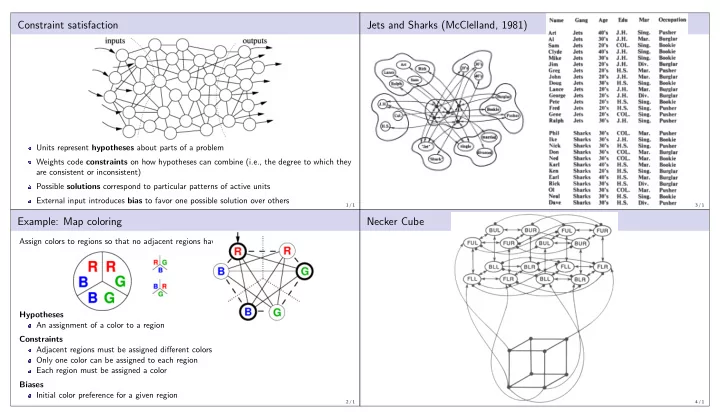
Units represent hypotheses about parts of a problem Weights code constraints on how hypotheses can combine (i.e., the degree to which they are consistent or inconsistent) Possible solutions correspond to particular patterns of active units External input introduces bias to favor one possible solution over others
1 / 1
Example: Map coloring
Assign colors to regions so that no adjacent regions have the same color. Hypotheses An assignment of a color to a region Constraints Adjacent regions must be assigned different colors Only one color can be assigned to each region Each region must be assigned a color Biases Initial color preference for a given region
2 / 1
Jets and Sharks (McClelland, 1981)
3 / 1
Necker Cube
4 / 1