Keys to Successful New Congressional and Legislative Maps for the - - PDF document

keys to successful
SMART_READER_LITE
LIVE PREVIEW

Keys to Successful New Congressional and Legislative Maps for the - - PDF document

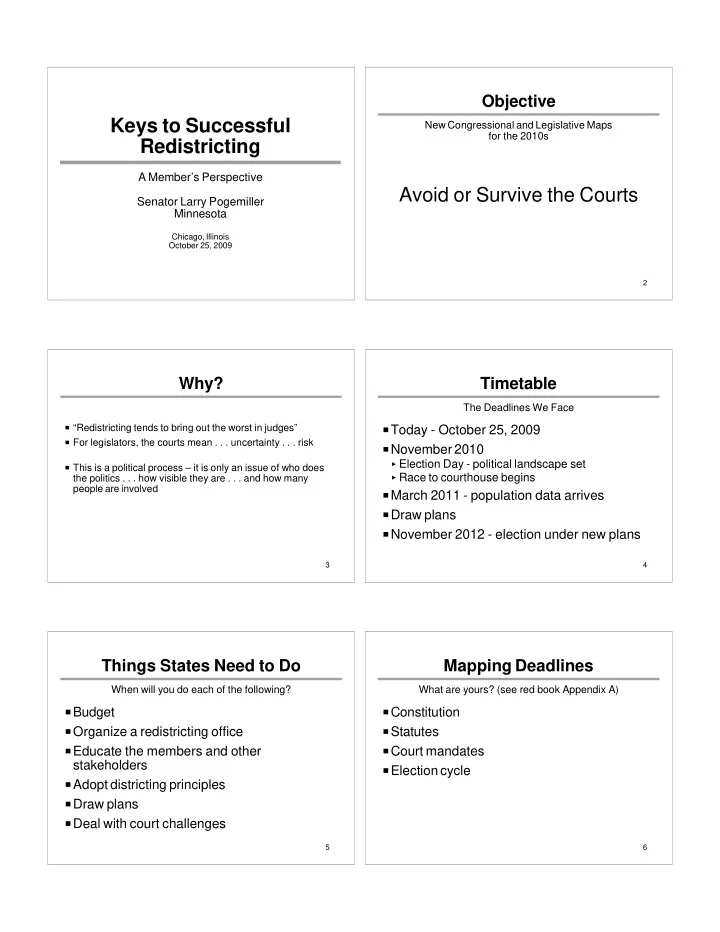
Objective Keys to Successful New Congressional and Legislative Maps for the 2010s Redistricting A Members Perspective Avoid or Survive the Courts Senator Larry Pogemiller Minnesota Chicago, Illinois October 25, 2009 2 Why? Timetable


slide-1
SLIDE 1

Keys to Successful Redistricting

A Member’s Perspective Senator Larry Pogemiller Minnesota

Chicago, Illinois October 25, 2009

Objective

New Congressional and Legislative Maps for the 2010s

Avoid or Survive the Courts

2

Why?

P “Redistricting tends to bring out the worst in judges” P For legislators, the courts mean . . . uncertainty . . . risk P This is a political process – it is only an issue of who does the politics . . . how visible they are . . . and how many people are involved

3

Timetable

The Deadlines We Face

PToday - October 25, 2009 PNovember 2010

< Election Day - political landscape set < Race to courthouse begins

PMarch 2011 - population data arrives PDraw plans PNovember 2012 - election under new plans

4

Things States Need to Do

When will you do each of the following?

PBudget POrganize a redistricting office PEducate the members and other stakeholders PAdopt districting principles PDraw plans PDeal with court challenges

5

Mapping Deadlines

What are yours? (see red book Appendix A)

PConstitution PStatutes PCourt mandates PElection cycle

6

slide-2
SLIDE 2

Organization

Who will draw the plans?

PCommittees in each house? PJoint committee? PCommission?

< Authority in each state - red book Appendix B < Commission options - red book Appendices C & D

7

Educating the Stakeholders

Goals

PDevelop a “common” reality based on facts PDevelop realistic expectations

< Moving people through the 5-step grieving process

– Sadness – Anger – Denial – Fear – Acceptance

< Not everyone can have a perfect district (this is a zero-sum game)

8

Knowing the Stakeholders

PIncumbents

< Majority < Minority

P“Members in waiting” PGovernor PCitizen groups PPolitical parties PAverage citizens PPress

9

Population Shifts Since 2000

PRural to urban? PCentral city to inner-ring suburbs? PGentrification of central city? PInner-ring suburbs to outer-ring suburbs? PSuburban to ex-urban? PRacial and language minority populations?

10

Federal Requirements

PEqual population

< 10% not a safe harbor - Larios v. Cox

PFair opportunity for racial and language minorities – Voting Rights Act

< Majority of voting age population - Bartlett v. Strickland

11

Strategic Considerations

Who will draw the plans?

PThere will be a map

< Yours, or the Court’s?

PIs your partner willing to negotiate? PIs the offer so bad for you

< You’d rather be governed by a court order than negotiate an agreement? < You’d risk the uncertainty of a plan drawn by a court?

12

slide-3
SLIDE 3

Strategic Considerations

Realities

PFor less than $1,000 anyone can draw a plan

< Individual members < Lobbying groups < Governor < Newspapers

PAutomated redistricting by “good government” groups – “take the politics out”

13

Strategic Considerations

Objectives

PTreat people honestly PShare as much information as possible

< Holding your cards to the vest will not work

PMaintain a calming influence

< Be positive < Joyfull . . . but serious

PMinimize unnecessary stress PTry principled negotiations

< Read Getting to Yes by Roger Fischer of Harvard

14

Adopting Districting Principles

Goals

PCreate an atmosphere of fairness PGet stakeholders to buy in

15

State Requirements—What are Yours?

“Traditional Districting Principles” Shaw v. Reno (1993) Red Book, Chapter 5 P Contiguity? P Compactness? P Nest house districts within senate districts? P Preserve political subdivisions? P Preserve communities of interest? P Protect incumbents?

< Preserve cores of prior districts? < Avoid contests between incumbents?

P Politically competitive?

16

Should You Adopt Any More?

State Districting Principles Red Book, Table 8 & Appendix E

PDisadvantages

< May restrict the drafters’ freedom < Ignoring principles may hurt plan in court

PAdvantages

< Members and stakeholders learn the rules of the game < Members accept the rules < Adhering to principles will help defend plan in court

17

Drawing Plans

Learning from the Members

PIf a district must grow, where? PIf a district must shrink, where? PWhose seats are safe, whose are marginal? PWho will be retiring? PWhere would new candidates do best? PWhat are “political” objectives of critical stakeholders? PMaintain confidentiality

18

slide-4
SLIDE 4

Drawing Plans

PFirst drafts of a plan

< Draw minority districts first < Work in regions < Merge regions into a statewide plan < The final district effect—last one drawn is ugly

PResolve conflicts between members PHold public hearings on plans PWork with the other body PGet the governor’s signature

19

Survival Techniques

PDon’t play games

< This is serious business < It is intensely personal

PExercise – to manage stress and develop thick skin PBe self-deprecative – remember the humor

  • f human frailties

PMaintain perspective

20

Benediction

PHighest form of policy making PFoundation of representative democracy PTreat it with respect and humility PRemember, this is personal

< 5-10% will hate you – lifelong enemies < 90-95% will be ingrates

PAvoid cynicism PRemember a loved one – you want them to be proud of you and democracy

21

Savor the Honor

(Even if it May Not Seem Like it at the Time)

P What did one civil war veteran say?

22

As the man said after having been tarred, feathered, and ridden out of town on a rail – “If it hadn’t been for the honor of the thing, I’d rather have walked.” Abraham Lincoln

23