Everglades excerpts of a talk by Fritz Davis 2004 John Kunkel - - PDF document

everglades
SMART_READER_LITE
LIVE PREVIEW

Everglades excerpts of a talk by Fritz Davis 2004 John Kunkel - - PDF document

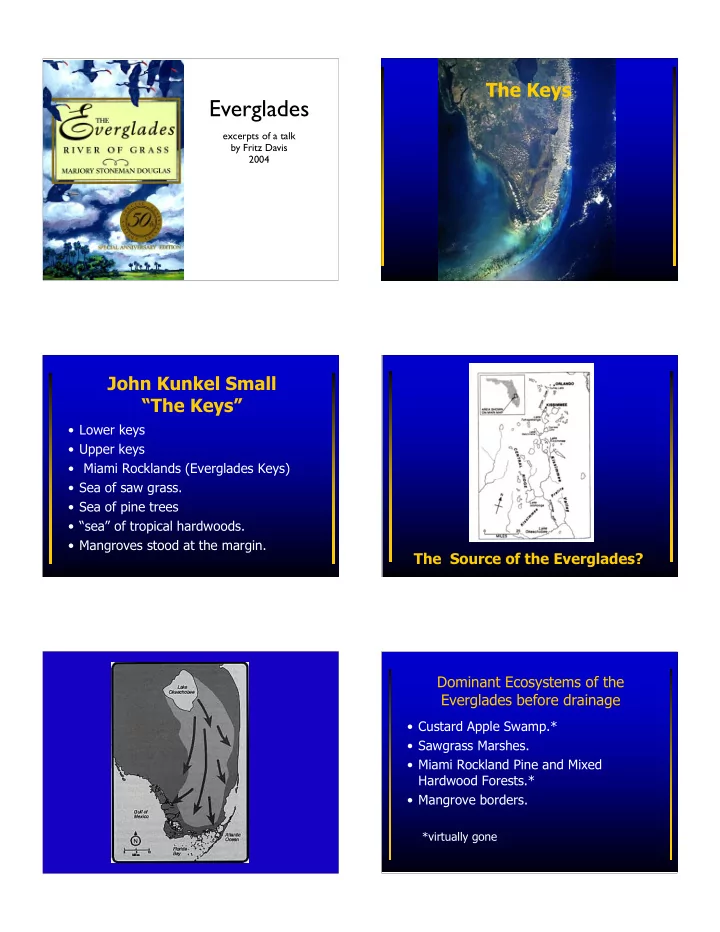
The Keys Everglades excerpts of a talk by Fritz Davis 2004 John Kunkel Small The Keys Lower keys Upper keys Miami Rocklands (Everglades Keys) Sea of saw grass. Sea of pine trees sea of tropical


slide-1
SLIDE 1

Everglades

excerpts of a talk by Fritz Davis 2004

The Keys

John Kunkel Small “The Keys”

  • Lower keys
  • Upper keys
  • Miami Rocklands (Everglades Keys)
  • Sea of saw grass.
  • Sea of pine trees
  • “sea” of tropical hardwoods.
  • Mangroves stood at the margin.

The Source of the Everglades? Dominant Ecosystems of the Everglades before drainage

  • Custard Apple Swamp.*
  • Sawgrass Marshes.
  • Miami Rockland Pine and Mixed

Hardwood Forests.*

  • Mangrove borders.

*virtually gone

slide-2
SLIDE 2

Custard Apple Swamp

  • Reminded explorers of cathedrals.

– Gourd vines, giant ferns, and beautiful epiphytes.

  • Uninhabitable for Europeans.
  • Indians promoted the growth of the

custard apple swamp.

Custard Apple Swamp Custard Apple Swamp After Clearing Sawgrass

  • Another virtually impenetrable barrier
  • Travel slowed to as little as a mile and

a half per day.

  • Healthful place?
slide-3
SLIDE 3

Sawgrass Cladium jamaicense Sawgrass Detail The River of Grass Pine Forest

covered 90% of the Miami rocklands.

  • The transverse glades.
  • Banana Holes
  • Logged (low quality pine).
  • Hardwood hammocks.

Pinewoods Red Mangrove (Rhizophera mangle)

  • Dense stands.
  • Unique prop root system = exotic and

challenging landscape.

  • “Walk” by sending out roots.
  • Only plume hunters visited.

– Breeding sites for marine animals and wading birds.

slide-4
SLIDE 4

Red Mangroves Red Mangroves Reclamation of the Everglades

  • For Progressives: a worthy challenge.
  • “Reclamation:”

– “Reclaim:” sounds worthy – Actual meaning: drainage and conversion to farmland.

Buckingham Smith

  • 1847: First drainage reconnaissance of

the Everglades: $300,000 to $500,000.

– Florida’s first senator J.D. Westcott: “health hazard from dying fish and vegetation.”

  • Swamp Lands Act of 1850
  • Internal Improvement Fund (IIF)

– “reclamation.”

1881

  • Governor William D. Bloxham arranged

to sell Hamilton Disston 4 million acres

  • f Florida land for $1 million.
  • Disston could claim half of the land he

drained and “reclaimed.”

– Dug a canal from the Caloosahatchee River to Lake Okeechobee.

Canals

  • Richard J. Bolles (December 23, 1908).
  • $1 million for 500,000 acres of

Everglades land.

  • Trustees agreed to spend $1.50 of

each $2.00 per acre on 5 canals.

slide-5
SLIDE 5

Bureau of Irrigation and Drainage Investigations Engineering (Wright) Report

  • 8 canals from Lake Okeechobee

through the Everglades

  • Reclaim roughly 1,850,000 acres (one

dollar per acre).

Planned Canals Land Rush

  • Three companies sold

– 4,000 10-acre farm – $20 to $200 per acre.

Florida Fruit Lands Company

  • 8,000 farms - 10 acres
  • 3,620 - 20 acres
  • 40 - 250 acres
  • 20 - 160 acres
  • 8 - 320 acres
  • 2 - 640 acres.
  • 10,000 10-acre farms, sight unseen.

Easy Living?

“Take a tent, a bag of beans, and a hoe; clear a few row in the saw grass, plant the seed, and in 8 weeks you will have an income.”

– Custard apple and elder: machetes. – Pull up the smaller brush and to cut the larger roots

  • One week to clear an acre.

More Problems

  • Muck dried and formed dust storms.
  • Land was not as fertile as the farmers

imagined Cattle died.

– Lack of trace metals in the soils.

slide-6
SLIDE 6

Cold Weather

1914

  • Frost every two weeks between

November and April

  • Damaged fragile truck crops.

Flood Control?

  • 1913 – 1927: 13 major control

structures (>$1.8 million).

  • 1926 Hurricane passed over Lake.

– Dike burst and the town of Moore Haven suffered severe flooding.

Moore Haven Areas of Damage Army of Corps of Engineers

  • 4 recommendations regarding Lake

Okeechobee.

– Increase the depth of the Caloosahatchee River – Expand the St. Lucie Canal (the existing control structure). – Dredge the channel of Taylor Creek to control flooding in Okeechobee. – Build a much larger levee along the south shore

  • f the Lake.

Hoover Levee

slide-7
SLIDE 7

Hoover Dike Dredge Unintended Consequences

  • wildfires
  • soil loss
  • saltwater intrusion into freshwater

wells

Everglades Agro Area

1950s EAA supported

  • Winter vegetables
  • sugar cane
  • cattle

After 1961: sugar

– Cuban tension / government subsidies.

Sugar Cane

Central and Southern Florida Flood Control District

  • Established by Congress after 1947 floods.
  • Army Corps of Engineers: 1600 miles of

canals, levees, and spillways

– agricultural area – 3 water conservation areas – 2 national parks – Straightened the Kissimee River

  • Guaranteed an overland water supply for

southern Miami-Dade County.

slide-8
SLIDE 8

Everglades National Park

  • Also in 1947.
  • Harry Truman dedicated 1.3 million

acres.

  • Ended 4 decades of squabbling at the

local, state, and federal levels.

South Florida Water Management District

  • Controls

– quantity, – quality, – distribution, – timing

  • of water release into the Everglades.

Everglades Today The Comprehensive Everglades Restoration Plan

  • Re-establish a more natural flow of

water throughout South Florida.

– Including The Everglades

  • Ensure reliable water supplies and

provide flood control.

$8 Billion and 50 Years

  • More than 240 miles of canals and levees will

be removed.

– Most of the Miami Canal and the levee that separates the Big Cypress National Preserve from the Everglades National Park.

  • 20 miles of Tamiami Trail (Route 41) will be

rebuilt on a bridge to allow a freer flow of water into the Everglades National Park.

  • Water will be captured and stored in new

reservoirs, man-made wetlands and underground wells.

Everglades Restoration

slide-9
SLIDE 9