Groundwater Surface Water interactions on Satinleaf Tree Island, - - PowerPoint PPT Presentation

groundwater surface water interactions on satinleaf tree
SMART_READER_LITE
LIVE PREVIEW

Groundwater Surface Water interactions on Satinleaf Tree Island, - - PowerPoint PPT Presentation

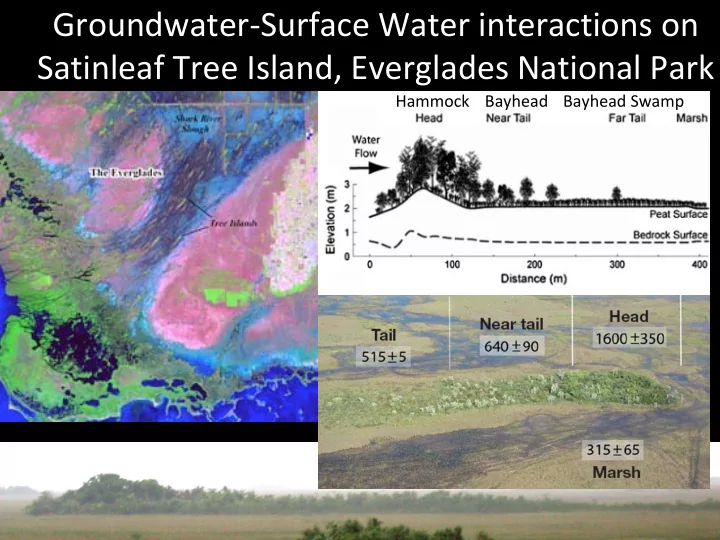
Groundwater Surface Water interactions on Satinleaf Tree Island, Everglades National Park Pamela L. Sullivan and Ren M. Price Hammock Bayhead Bayhead Swamp Florida International University Department of Earth and the Environment


slide-1
SLIDE 1

Groundwater‐Surface Water interactions on Satinleaf Tree Island, Everglades National Park

Pamela L. Sullivan and René M. Price Florida International University Department of Earth and the Environment Southeastern Environmental Research Center Hammock Bayhead Bayhead Swamp

slide-2
SLIDE 2

1.Groundwater‐Surface Water interactions

TI Groundwater TI Groundwater Regional Groundwater SW SW SW Precipitation Precipitation Transpiration Evaporation Regional Groundwater

slide-3
SLIDE 3

Objectives

  • 1. To determine if evapotranspiration and

seasonal surface water levels govern the hydrodynamics of tree islands

  • 2. To determine if nutrient availability in

tree islands varies with seasonal hydro‐ dynamics and variable evapotranspiration rates as compared to the adjacent slough

slide-4
SLIDE 4
  • 3. Bimonthly Sampling Methods

Sampling Locations

Hobo Water Level Loggers Recorded Temperature and Water Level PT‐30min rate of collection (April‐ November 2009)

d Hammock Bayhead Bayhead Swamp

Groundwater and Surface Water were collected (October 2008‐November 2009) Samples were analyzed for major ions, nutrients and isotopes (δD and δ18O)

Groundwater well are 85cm and finished in the peat

slide-5
SLIDE 5

4.0 Groundwater & Surface Water Levels

SW Recharge GW at all locations on the island GW discharge from Hammock to SW

slide-6
SLIDE 6

Dry Season April‐ July Wet Season July‐November

SW Recharging GW

GW Flow Toward BH

SW Recharging GW GW Discharge SW

GW Flow Down Steam

slide-7
SLIDE 7

4.1 Diurnal Groundwater Signal

Diurnal Signal detected in all wells on the tree islands Diurnal signal only detected in Hammock after SW reaches 1.45 m Diurnal drawdown not detected after SW reaches 1.60 m

slide-8
SLIDE 8

4.2 Groundwater‐Surface Water Temperature

GW Temp in BH and BHS very similar Lowest GW temp in Hammock

slide-9
SLIDE 9

4.3 Groundwater‐Surface Chemistry

slide-10
SLIDE 10

4.3 Groundwater‐Surface Chemistry

slide-11
SLIDE 11
  • 5. Sipper Method

Sept 2009

10 sippers creates N‐S and E‐W Transects across the Island Sippers were 85 cm in length

slide-12
SLIDE 12
  • 6. Sipper Results West to East
slide-13
SLIDE 13
  • 6. Sipper Results North to South
slide-14
SLIDE 14

7.0 Conclusions

  • 1. BH and BHS GW levels and Temp suggest

that SW is recharging GW year round

  • 2. GW level and Temp Suggest GW discharge
  • ccurred from hammock to SW from July

through Nov

slide-15
SLIDE 15

Dry Season April‐ July Wet Season July‐November

SW Recharging GW

GW Flow Toward BH

SW Recharging GW GW Discharge SW

GW Flow Down Steam

7.0 Conclusions

slide-16
SLIDE 16

7.0 Conclusions

  • 1. GW Chemistry Suggests similar GW‐SW

interactions occurring on BH and BHS, where by ions are being concentrated in the GW

  • 2. Lower ionic strength of GW in the Hammock

maybe attributed to inputs of rainfall, regional groundwater or surface water

slide-17
SLIDE 17

Acknowledgments

I would like to thank the Everglades Foundation and the Christina Mendez foundation for the fellowships that were used fund this project The field support of David Lagomasino, Danielle Ogurcak, Pablo Ruiz, Nate Colbert, Lawrence Lopez, and Mike Ross were immensely appreciated! THANK YOU