Key Biodiversity Areas and Important Bird and Biodiversity Areas: a - - PowerPoint PPT Presentation

key biodiversity areas and important bird
SMART_READER_LITE
LIVE PREVIEW

Key Biodiversity Areas and Important Bird and Biodiversity Areas: a - - PowerPoint PPT Presentation

Key Biodiversity Areas and Important Bird and Biodiversity Areas: a support tool to implement Aichi Targets 11 and 12 Wouter Langhout CBD Regional Workshop, Minsk, Belarus Important Bird and Biodiversity Areas (IBAs) The IBA Programme

slide-1
SLIDE 1

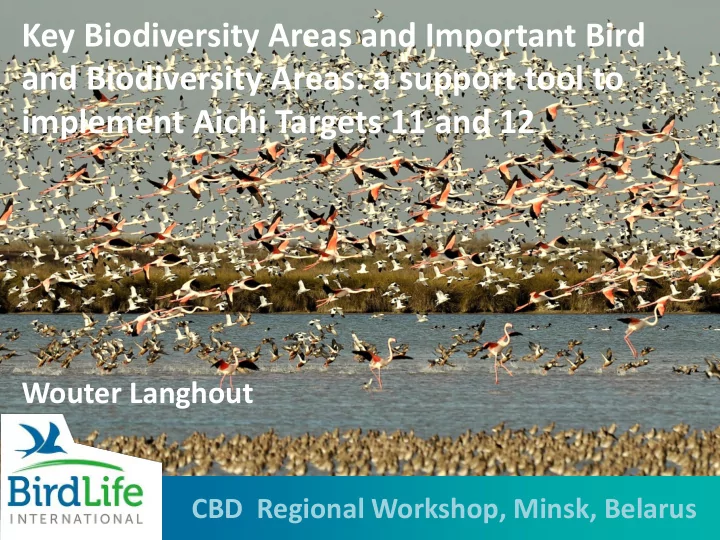
Key Biodiversity Areas and Important Bird and Biodiversity Areas: a support tool to implement Aichi Targets 11 and 12

Wouter Langhout

CBD Regional Workshop, Minsk, Belarus

slide-2
SLIDE 2

Important Bird and Biodiversity Areas (IBAs)

– The IBA Programme started in Europe in the late 1970s – IBA global criteria are based on:

  • Threatened species, Restricted-range species,

Biome-restricted assemblages, Congregations

– In Europe, also regional and sub- regional (EU level) criteria – The IBA network captures a large proportion of species in other taxonomic groups

slide-3
SLIDE 3

Global science and local expertise

  • Data for IBA identification is collected locally and analyzed at

the national and regional levels

  • IBAs are identified using the global or regional IBA criteria in

a fully participative way, using expert knowledge

  • Site information is up-dated using monitoring and other

published and unpublished data

  • BirdLife Partners find it difficult to raise funds for monitoring

and up-dating, both of which are key for the continued provision of high-quality information

slide-4
SLIDE 4

Over 12,000 IBAs have been identified globally

Terrestrial IBAs cover c. 7% of land surface

slide-5
SLIDE 5

Marine IBAs: the marine e-atlas

3000 sites in 150 countries and on high seas – 6.5% of the oceans

slide-6
SLIDE 6

AZE SITES:

587 SITES 920 SPECIES

slide-7
SLIDE 7

Key Biodiversity Areas (KBAs)

  • KBAs are sites contributing significantly to the global

persistence of biodiversity

  • The new global KBA Standard was approved in April 2016 and

now provides the framework for KBA identification and revision

  • The KBA Standard has 11 criteria grouped under five

categories: Threatened Biodiversity, Geographically Restricted Biodiversity, Ecological Integrity, Biological processes and Irreplaceability through quantitative analysis

  • A global KBA Partnership will be launched at the IUCN WCC in

Hawaii “to implement a programme to develop and maintain an up-to-date, fully documented list of sites identified against the KBA Standard, and to communicate, promote and position this information to enable the achievement of the KBA vision.”

  • Regional and national KBA criteria may be developed and used

(e.g. regional IBA criteria)

slide-8
SLIDE 8

IBAs and AZE sites as Key Biodiversity Areas

  • ALL IBAs are KBAs

for birds at the global or regional level

  • ALL AZE sites are

also KBAs

  • In selected regions it

was found that the majority of KBAs identified to date are IBAs

  • IBAs will need to be

re-assessed against the global KBA criteria within the next 8-12 years

slide-9
SLIDE 9

KBAs including IBAs and AZE sites need better protection

Terrestrial IBA protection:

By area: 39% covered by national PA networks By number: 28% of IBAs completely covered by PAs 49% of IBAs are wholly unprotected

slide-10
SLIDE 10

Approximately 60% of AZE sites identified so far are protected today. We need 100% or c. 230 more sites protected by 2020 to meet the CBD Aichi Targets.

slide-11
SLIDE 11

Progress towards Target 11

Temporal trends in mean percentage area IBAs (green) and AZEs (violet) covered by PAs.

slide-12
SLIDE 12

IBAs are a basis for PA gap analysis

slide-13
SLIDE 13

Protected IBAs are in better shape

Extinction risk of birds is lower in better protected IBAs (Butchart et al. PLOS One 2012).

Annual % change in Red List index Coverage by Protected Areas

But as PA network grows, proportion of PAs covering IBAs is falling.

slide-14
SLIDE 14

IBA identification & SPA designation in EU

Nearly 47 million hectares of IBAs are now protected within the Natura 2000 network of protected Areas

slide-15
SLIDE 15

IBAs have many other applications…

… for Target 11, Target 12 and other Aichi Targets

slide-16
SLIDE 16

Informing EBSA description

Over 600 IBAs have so far been included within EBSAs

slide-17
SLIDE 17

Supporting Ramsar site designation

Important Bird Areas and potential Ramsar Sites in Europe

slide-18
SLIDE 18

Safeguards and mainstreaming biodiversity

slide-19
SLIDE 19

Promoting local engagement with conservation

Local Conservation Groups or IBA Caretakers are at

  • ver 2,700 IBAs around the world
slide-20
SLIDE 20

Thank you…

slide-21
SLIDE 21 International Iguana Foundation IUCN Iguana Specialist Group World Pheasant Association International Iguana Foundation World Pheasant Association