Karoo Trajectories of Change in the Anthropocene Joh Henschel, - - PowerPoint PPT Presentation

karoo trajectories of change in the anthropocene
SMART_READER_LITE
LIVE PREVIEW

Karoo Trajectories of Change in the Anthropocene Joh Henschel, - - PowerPoint PPT Presentation

Karoo Trajectories of Change in the Anthropocene Joh Henschel, Cherryl Walker and Timm Hoffman South African Environmental Observation Network Stellenbosch University University of Cape Town African Journal of Range and Forage Science Karoo

slide-1
SLIDE 1

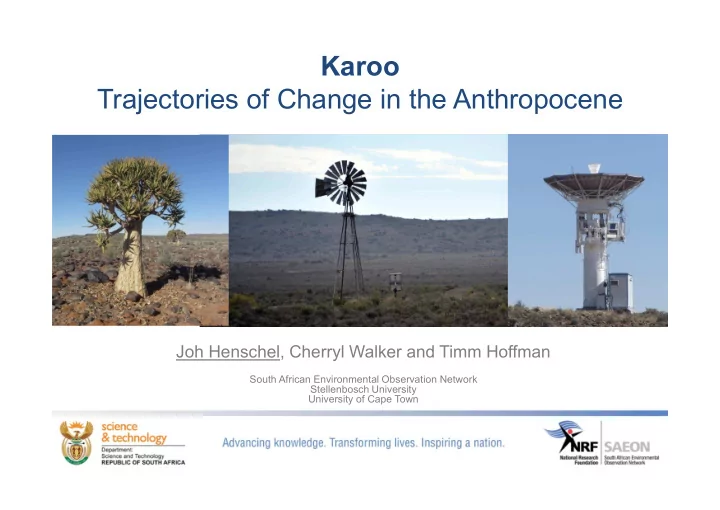
Karoo Trajectories of Change in the Anthropocene

Joh Henschel, Cherryl Walker and Timm Hoffman

South African Environmental Observation Network Stellenbosch University University of Cape Town

slide-2
SLIDE 2

Karoo Special Issue African Journal

  • f Range and

Forage Science

slide-3
SLIDE 3

Social-Ecological Systems

complex interaction of social and ecological dynamics in the environment on which life depends (humans are part of nature)

slide-4
SLIDE 4

Social-Ecological Research Multi- Inter- Trans- Disciplinary

  • Difficult for Scientists due to Incompatibilities

– uni-disciplinary training – literature – jargon – data systems – viewpoints of a problem – methodologies/epistemologies

  • Social sciences e.g.

– livelihoods, household dynamics, social inequality, political economy, power

  • Ecology e.g.

– ecosystem dynamics, land use effects, climate, substrates, abundance and distribution of species

slide-5
SLIDE 5

Karoo Special Issue

inter-disciplinary collaboration of editors articles from multiple disciplines (inter-, trans-)

11 Associate Editors

  • Casper Crous
  • Sue Milton
  • Nicoli Nattrass
  • Chrizette Neethling
  • Tim O’Connor
  • André Pelser
  • Igshaan Samuels
  • Ute Schmiedel
  • Helga van der Merwe
  • Gretel van Rooyen
  • Noel van Rooyen

Guest Editors

  • Joh Henschel
  • Cherryl Walker
  • Timm Hoffman

Editor in Chief

  • Pieter Swanepoel
slide-6
SLIDE 6

Karoo Special Issue social and ecological contents

SECTIONS

  • Climate in the Anthropocene
  • Gharo across History
  • Long-term Trends and Processes
  • Dynamics of Current Developments
  • Farming Impacts
  • Ecosystem Processes and Rehabilitation
slide-7
SLIDE 7

Succulent Karoo & Nama Karoo

Mean Annual Precipitation

slide-8
SLIDE 8

Succulent Karoo Nama Karoo Bioregions 6 3 Biodiversity high low Endemism high low Vegetation succulents dominate non-succulent shrubs, partly grassy Atmospheric moisture fog, dew, rain rain Rainfall season winter bioregions differ mid/late summer Variability of rain relatively low high Variability of temperature relatively low high Conservation areas many few Communal farming more fewer Commercial farming fewer more Urban/rural population 70% rural 75% urban

Two Karoos

slide-9
SLIDE 9

KSI in Context

Previous Karoo Overviews

  • 1999

2006

slide-10
SLIDE 10

KSI context (ctd)

Previous Special Issues

  • 1999 Special Issue, Plant Ecology: “Namaqualand, South Africa – an
  • verview of a unique winter-rainfall desert ecosystem” (edited by

Cowling, Esler and Rundel);

  • 2007 Special Issue, Journal of Arid Environments: “Sustainable land

use in Namaqualand” (edited by Hoffman, Allsopp and Rohde);

  • 2010 BIOTA book set: “Biodiversity in southern Africa” (edited by

Jürgens, Schmiedel and Hoffman)

  • 2016 book: “Hydraulic fracturing in the Karoo – critical legal and

environmental perspectives” (edited by Glazewski and Esterhuyse);

  • 2019 Special Issue: “Karoo Futures? Astronomy in place and space”

(edited by Walker et al 2019);

  • Numerous single scientific papers, also social sciences, e.g.,

“Marginalisation and demographic change in the semi-arid Karoo, South Africa” (Nel & Hill 2008)

slide-11
SLIDE 11

KSI context (ctd)

Comprehensive Specialist Reports and Reviews for Strategic Environmental Assessments (CSIR)

  • 2015: Wind and solar photovoltaic energy

(eds. van der Westhuizen, Cape-Ducluzeau, Lochner);

  • 2016: Shale Gas Development in the Central Karoo: A Scientific

Assessment of the Opportunities and Risks

(eds. Scholes, Lochner, Schreiner, Snyman-Van der Walt, de Jager),

especially:

– “Impacts on social fabric” (Atkinson et al.) – “Biodiversity and ecological impacts” (Holness et al.);

  • 2017: South African Radio Astronomy Square Kilometre Array,

SKA Phase 1 (ed. Cape)

slide-12
SLIDE 12

Address lack of biodiversity data for the Karoo through: 1) integrating and upgrading existing data located in museums and herbaria 2) conducting detailed surveys for 11 representative taxonomic groups in selected study sites (30 Square Kilometre Observatories) These data will also be useful for monitoring long-term effects of shale gas extraction.

KSI context (ctd)

  • ngoing project
slide-13
SLIDE 13

KSI context (ctd)

>100 years agricultural surveys and experiments (analyses initiated, not yet synthesised)

  • Grootfontein Agricultural Development

Institute (DAFF) and provincial departments

Historic datasets, some currently being resurveyed

slide-14
SLIDE 14

Research leading towards the KSI

founded on a generation of a dozen leading scientists

Ecologists

  • Sue Milton
  • Richard Dean
  • Richard Cowling
  • Karen Esler
  • Graham Kerley
  • Timm Hoffman
  • Guy Midgley
  • Gretel van Rooyen
  • William Bond

Social Scientists

  • Doreen Atkinson
  • Trevor Hill
  • Etienne Nel
slide-15
SLIDE 15

KSI Celebration of Achievements by Sue Milton and Richard Dean

  • Most prolific Karoo scientists

– together >300 papers (each 200, many jointly), most on Karoo – collaboration with numerous scientists, attracted to Karoo – Inspired and trained numerous postgraduate students

  • Founders of Tierberg LTER

(aka TKRC) in 1987, made it ‘window’ to Karoo ecology

  • Pioneered transdisciplinary

research encompassing conservation and periurban socio-economic dynamics

  • Catalysts of social-ecological

research approaches and intergenerational equity practices in the Karoo

slide-16
SLIDE 16

Karoo Special Issue: Contents (24 papers)

Editorial: Introduction Lead Article: Drivers and trajectories of social and ecological change in the Karoo, South Africa Climate in the Anthropocene

  • Will the Karoo see fundamental shifts in vegetation due to climate and land use change this century?

Gharo across History

  • Before the Anthropocene: human pasts in Karoo landscapes
  • An overview of themes in the agrarian and environmental history of the Karoo since c.1800
  • Long-term changes in land use, land cover and vegetation in the Karoo drylands of South Africa: Implications for degradation monitoring

Long-term trends and processes

  • Reflections, applications and future directions of Long-Term Ecological Research at Tierberg
  • Plant diversity and species-specific responses to seasonal rainfall patterns in the Namaqualand Hardeveld – 17 years of plot-based annual monitoring
  • Long-term vegetation change (> 20 years) in the plains habitat on the Goegap Nature Reserve, Succulent Karoo, South Africa

Dynamics of Current Developments

  • Efficiency, vulnerability and land use change in the Karoo Region of South Africa, 2012-2014
  • By their own bootstraps: Municipal commonage farmers as an emerging agrarian class in the Karoo
  • Population change in the Karoo
  • Linear structures in the Karoo

Farming impacts

  • Interactions of grazing and rainfall on vegetation at Grootfontein in the eastern Karoo
  • Long-term impacts of livestock grazing in the Succulent Karoo: A 20-year study of vegetation change under different grazing regimes in Namaqualand
  • Trampling tolerance of Karoo plants ‘using sheep as proxies for trekking springbok’
  • Web spider abundance is affected by sheep farming in the Karoo
  • Estimating mammal diversity in the shale gas footprint
  • Spatio-temporal patterns of perceived conflict between small-livestock farmers and three predators in the Karoo

Ecosystem Processes and Rehabilitation

  • Biological soil crusts of the Succulent Karoo
  • The composition of soil seedbank and its role in ecosystem dynamics and rehabilitation potential in the arid Tankwa Karoo Region, South Africa
  • Improving the success of rehabilitation through experimentation on a coastal mineral sands mine in Namaqualand, South Africa
  • Response of arthropod communities to plant-community rehabilitation efforts after strip mining on the semi-arid west coast of South Africa

Editorial: Synthesis & Gaps

slide-17
SLIDE 17

Drivers of Change

  • Type

– Global Change – Land Use Change – Human wellbeing

  • Context

– History – Social, Economic, Policy/Governance – Ecosystems

slide-18
SLIDE 18

History of changes in Karoo

Start of period Cause of change Social change Rangeland change 2 M year ago Humanoids ? San hunter-gatherers 2 k years ago Khoekhoen pastoralists Dominated over San Domestic grazing started 1740 Dutch settlers in Karoo San & Khoekhoen societies unravel Grazing intensified 1850

  • church towns
  • fences, boreholes
  • market-oriented

farming

  • farms and towns

control social fabric

  • heavy overgrazing
  • species extinctions
  • landscape

fragmentation 1930 23 million sheep

  • growing prosperity

land degradation 1970 farm consolidation

  • growing inequality

reduced grazing 1994

  • democracy
  • Karoo partitioned
  • intensified

marginalisation land use diversification

slide-19
SLIDE 19

Climate change - global driver

↑ temperatures ↑ evapotranspiration ↑ carbon ∆ precipitation ∆ droughts

Average minimum and maximum daily temperatures

Years in that month Temperature at Tierberg-LTER

slide-20
SLIDE 20

Land use changes - local drivers

slide-21
SLIDE 21

Land use changes - external drivers

www.farmersweekly.co.za www.karoospace.co.za

slide-22
SLIDE 22

Human wellbeing - social driver

slide-23
SLIDE 23

Change brings New Opportunities

www.resilience.org e.g. Honey from solar power generators

slide-24
SLIDE 24

Challenge: Effective management

  • f social-ecological change
  • Safe boundaries for environmental change to

avoid irreversibly failure of ecosystems

 environmental sustainability

  • Governance, eradicate poverty and inequality,

adapt to changes, societal self-empowerment

 environmental sustainability

slide-25
SLIDE 25

Can a Karoo-Gardenroute LTSER Platform address these challenges?

  • Human ecosystem complex (steep rainfall gradient; contrasting

biomes; transformed ecosystems; ecosystem services; global significance; socio-economical uses & impacts including agriculture, forestry & recreation; development and global change impacts & threats; impact of local policies/infrastructure or lack thereof; etc)

  • Broad encompassing research agenda & design (social-ecological

conditions, power relations and decision-making)

  • Field Sites and Remote Sensing
  • Past, current or future research projects, data sources and research

infrastructure

  • Transformative policy feed forward & citizen science
  • Institutional capacity, arrangements, coordination and commitments
slide-26
SLIDE 26

Thank you