
SLIDE 1 March / April 2018
“This Time Is Different” 14 Profile: Manny Rouvelas 18 In the LOOP 22
Ofgshore Energy Report 26
CEO & CFO, CAPITAL PRODUCT PARTNERS L.P.
46
KALOGIRATOS KALOGIRATOS
GERASIMOS “ Jerry”
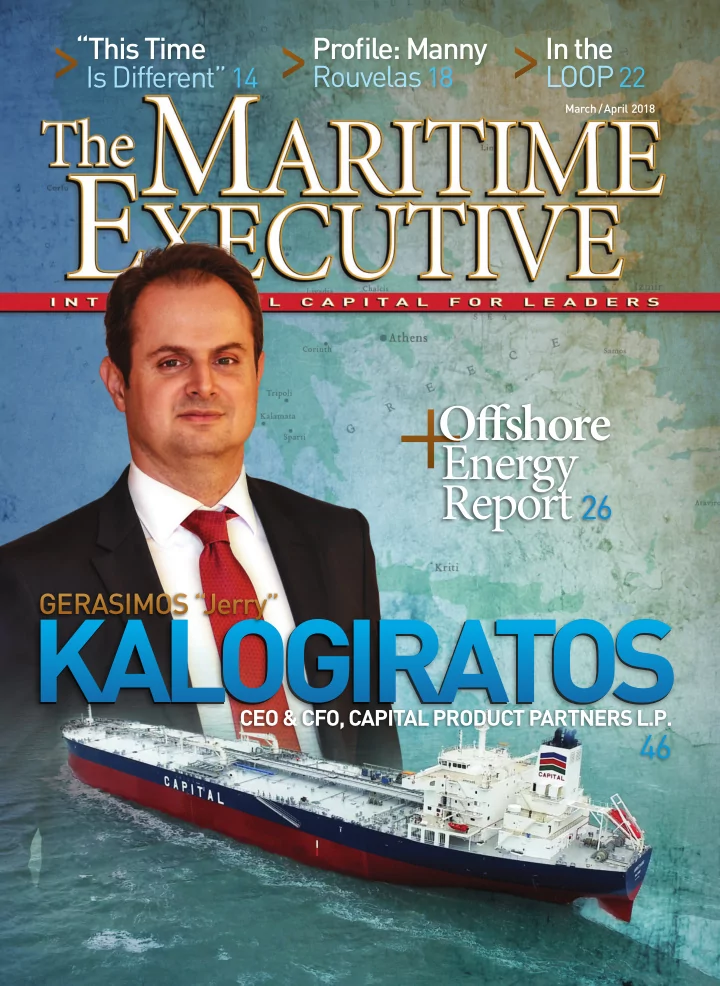
KALOGIRATOS KALOGIRATOS CEO & CFO, CAPITAL PRODUCT PARTNERS - - PDF document
This Time Profile: Manny In the Is Different 14 Rouvelas 18 LOOP 22 March / April 2018 Ofgshore Energy Report 26 GERASIMOS Jerry KALOGIRATOS KALOGIRATOS CEO & CFO, CAPITAL PRODUCT PARTNERS L.P. 46 U.S. PERSPECTIVE NIXON
“This Time Is Different” 14 Profile: Manny Rouvelas 18 In the LOOP 22
Ofgshore Energy Report 26
CEO & CFO, CAPITAL PRODUCT PARTNERS L.P.
46
GERASIMOS “ Jerry”
Emanuel “Manny” Rouvelas has been on the front lines of the maritime industry in Washington, D.C. for almost 50 years. He started as the U.S. Senate’s primary maritime stafger in 1969, where he helped write major pieces of legislation still in force today. He began his own maritime law fjrm in 1973, and this summer his K&L Gates Public Policy Group will celebrate its 45th anniversary, making it one of the largest and longest-last- ing law fjrm policy groups in Washington.
VER FIVE DECADES, he has received the American maritime industry’s highest honors, including the Admiral of the Ocean Sea Award in 2013, the
the maritime industry. Legal Times recognized him as “one of the greatest Washington Lawyers of the past 30 years,” a “legal visionary,” who “helped turn the nation’s capital’s legal and lobbying community into an international powerhouse.” He has received many other awards within and outside the industry.
We sat down with Manny in his corner offjce at K&L GatesHow did you start?
I got my fjrst job in Washington in 1969 as maritime counsel to the Senate Commerce Committee’s Maritime Subcom-Tiose are big names!
Add two more: Daniel Inouye and Fritz Hollings. Senator Inouye was a member of the Commerce Committee and, of course, always very interested in the maritime world because he represented Hawaii. He was extraordinary. He served in the Senate longer than nearly anyone and rose to be Senate President Pro Tempore, third in line to the presidency. Over the years he chaired both the Senate Commerce Committee and the Senate Appropriations Committee. He won both the Congressional Medal of Honor and the Presidential Medal of Freedom. Senator Ernest (Fritz) Hollings, who later became Chair- man of the Commerce Committee, was the quickest wit in the Senate and is still alive and well. So I learned the maritime business from Senate giants and legends.How did Congress treat the maritime industry back then?
Well, we enacted a lot more legislation in those days. I served as maritime counsel for four years, and during that time I was the principal Senate stafger for more than 30 pieces of meaningful shipping legislation. Tiat would include laws like the Merchant Marine Act of 1970. It’s one of the pieces of legislation that still hangs on my offjce wall because I cut my maritime teeth on it. So does the Ports and Waterways Safety Act of 1972. You could write a book about that act, and in fact someone did – When the Senate Worked for Us by Michael Pertschuk, Chief Counsel and Stafg Director of the Commerce Committee. And I have a personal fondness for the Boating Safety Act of 1971 because we were seeing terrible numbers of boating accidents in those days and it put in place a framework that saved lives. I could go on and on about the other 28 pieces of legislation.And then you started your own fjrm, which remains in existence today, 45 years later.
Yes, our Public Policy Group at K&L Gates, started at Preston Gates in 1973, will be 45 years old on June 1. We’ve been around longer than other policy groups, and maritime remains a core practice. We started small – just me – in 1973, but we are now large, enduring and global.“Well, we enacted a lot more legislation in those days. I served as maritime counsel for four years, and during that time I was the principal Senate staffer for more than 30 pieces of meaningful shipping legislation.”
What has made the maritime industry interesting to you over the years?
Well, it was among the fjrst industries to be global. My maritime practice has brought me to 45 countries over the years because of its international nature. Concepts like goingYour practice has always been focused on issues where government and the maritime industry
decades in Washington?
For lobbying and government relations, whether in the mar- itime industry or not, Washington is in a league all its own. Nothing in the world matches it. Tie size and importance of the U.S. Government, its trillion-dollar budgets, complexity of institutions and separation of powers, the active engagement and competition of thousands of companies, industries, nonprofjts, foreign governments and embassies, and tens of thousands of lobbyists all make Washington the 24/7/365 Super Bowl of lobbying and government relations. So being a lawyer/lobbyist in Washington is defjnitely playing in the “Big Leagues” of your sport.You have focused on the maritime industry, but
Anything give you optimism?
Oh sure. Tiere are always lots of good reasons to be optimistic when it comes to business, science, technology, economic progress and more. For the maritime industry, one thing that gives me op- timism is having Elaine Chao as our Secretary of Transpor-Any favorite memories?
Too many to count or relate, but here’s one: Long ago my client, George P. Livanos, an American citizen who became the world’s largest tanker owner, took me to Posidonia for the big maritime industry show in Greece. George had started a new business related to oily water separators, and he was trying to draw attention to it. Somehow he convinced John Wayne – yup, that John Wayne! – to invest in the company, and then George brought John Wayne to Posidonia to draw attention to the product. We all hung around together for two“ For the maritime industry, one thing that gives me optimism is having Elaine Chao as our Secretary of Transportation. She entered the job more knowledgeable about the industry than any Secretary in the department’s 50-plus year history.”
U.S. PERSPECTIVE