K M Multiple Dirac cones and spontaneous QAH state in transition - - PowerPoint PPT Presentation

k m
SMART_READER_LITE
LIVE PREVIEW

K M Multiple Dirac cones and spontaneous QAH state in transition - - PowerPoint PPT Presentation

K M Multiple Dirac cones and spontaneous QAH state in transition metal trichalcogenides Yusuke Sugita collaborators Takashi Miyake ( AIST ) Yukitoshi Motome ( U.Tokyo ) 1 2017/10/24 @ NQS 2017 Outline Introduction - van der Waals


slide-1
SLIDE 1

@ NQS 2017 2017/10/24

K M Γ

1
✓collaborators Takashi Miyake (AIST) Yukitoshi Motome (U.Tokyo)

Yusuke Sugita

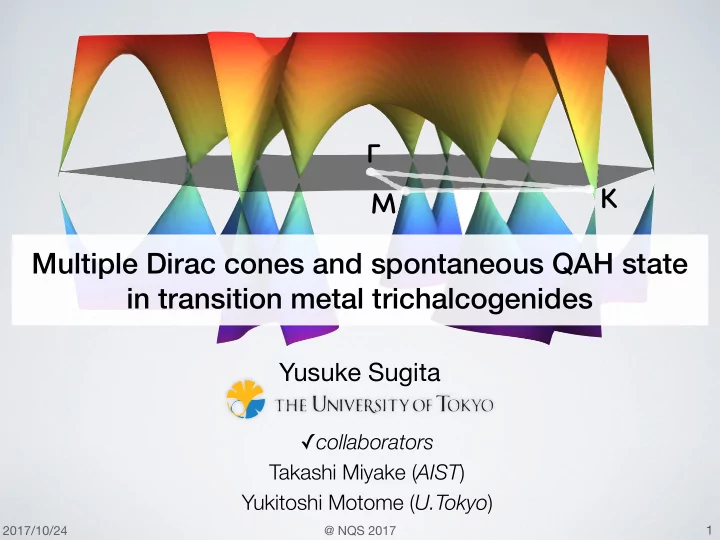
Multiple Dirac cones and spontaneous QAH state in transition metal trichalcogenides

slide-2
SLIDE 2

2017/10/24 @ NQS 2017

Outline

2

Introduction

  • van der Waals materials with heavy elements
  • motivation: towards the realization of topological matters in 2D systems

Materials and methods

  • transition metal trichalcogenides (TMTs), MBX3
  • ab initio calculations, Wannier analysis, and Hartree-Fock approx.

Results

  • multiple Dirac cones in monolayer TMTs
  • effects of correlations & SOC: a QAH state with a high Chern number
  • effects of layer stacking: bulk case

Summary & Perspectives

Y.S., T. Miyake, and Y. Motome, arXiv:1704.00318 & 1707.00921

slide-3
SLIDE 3

2017/10/24 @ NQS 2017

Graphene

3

✓purely-2D honeycomb layer ✓Dirac semimetal

almost ideal Dirac cones: weak electron correlations and weak SOC anomalous transport, e.g., anomalous QH effect & Klein tunneling

https://www.nobelprize.org/nobel_prizes/physics/laureates/2010/

slide-4
SLIDE 4

2017/10/24 @ NQS 2017

Post-graphene

4

larger spin-orbit coupling: larger electron correlations: candidates of purely-2D magnets?

✓candidates of QSH insulators: honeycomb sheets of Si, Ge, Sn,… ✓spin-valley physics: transition metal dichalcogenides

C.-C. Liu et al., PRB (2011)

  • D. Xiao et al., PRL (2012)

transition metal trichalcogenides transition metal trihalides

  • N. Sivadas et al., PRB (2015)
  • J. Kohler, Ency. of Inorg. and Bio. Chem. (2014)
slide-5
SLIDE 5

2017/10/24 @ NQS 2017

Discovery of purely-2D ferromagnets

5

transition metal trichalcogenides CrGeTe3

  • C. Gong et al., Nature (2017)

transition metal trihalides CrI3

  • B. Huang et al., Nature (2017)

magneto-optic Kerr measurements

slide-6
SLIDE 6

2017/10/24 @ NQS 2017

Transition metal trichalcogenides (TMTs)

6

MBX3 (M=transition metal; B=P , Si, Ge; X=S, Se, Te) honeycomb network of edge-sharing MX6 octahedra

3-R structure C2/m structure Top view of monolayer

B2 dimer

MnPS3, FePS3, NiPS3,etc. MnPSe3, FePSe3, CrSiTe3, CrGeTe3, etc.

slide-7
SLIDE 7

2017/10/24 @ NQS 2017

Diversity of magnetism in 3d TMTs

7

FePS3 MnPS3

  • E. Ressouche et al., PRB (2010)
  • D. Lancon et al., PRB (2016)

NiPS3

  • A. R. Wildes et al., PRB (2012)

K.-z. Du et al., ACS Nano (2016)

various magnetic ordering (Neel AFM, zigzag AFM, FM, etc.) wide range of band gaps difference of magnetic anisotropy

slide-8
SLIDE 8

2017/10/24 @ NQS 2017

Motivation

8

What happens in 4d & 5d transition metal trichalcogenides where the SOC and electron correlations compete?

Magnetic 3d TMTs will play an important role in the post-graphene era. 4d & 5d TMTs have been less studied theoretically though the synthesis was reported.

ab initio study of 4d & 5d TMTs!

  • W. Klingen et al., Z. Anorg. Allg. Chem. (1973)

Our DFT predictions

multiple Dirac cones appear in a family of TMTs interplay between electron correlations and SOC may turn the multiple-Dirac semimetal into a QAH state with a high Chern number interesting behaviors of Dirac cones depending on the layer stacking

slide-9
SLIDE 9

2017/10/24 @ NQS 2017

Setup

9

ab initio setup

  • using OpenMX code
  • in the monolayer case, 10 Ang. vacuum slabs are inserted between monolayers
  • structures are fully optimized in the calculation without SOC
  • monolayer case: GGA (XC: PBE) & # of k grids = 30 × 30 × 1
  • bulk case: LDA (XC: PW) & # of k grids = 8 × 8 × 8

Target materials

  • group 10 & 12 transition metals can take a divalent oxidation state
  • bulk MPX3 (M=Ni, Pd, Zn, Cd, Hg) have been synthesized
  • W. Klingen et al., Z. Anorg. Allg. Chem. (1973)
  • N. N. Greenwood and A. Earnshaw, Chemistry of the Elements (1997)
  • T. Ozaki et al., http://www.openmx-square.org

we systematically study group 10 MPX3 (M=Ni, Pd, Pt & X=S, Se) !!

slide-10
SLIDE 10

2017/10/24 @ NQS 2017

Band structure w/o SOC

10

crossing points!

Γ M K

crystal field splitting by S6 octahedra Brillouin zone eg orbitals t2g orbitals

PdPS3

Y.S., T. Miyake, and Y. Motome, arXiv:1704.00318

slide-11
SLIDE 11

2017/10/24 @ NQS 2017

Multiple Dirac cones

11

multi-species Dirac cones (2 at K, K’, 6 on Γ-K, K’)

Y.S., T. Miyake, and Y. Motome, arXiv:1704.00318

slide-12
SLIDE 12

2017/10/24 @ NQS 2017

Multiple Dirac cones

12

multi-species Dirac cones (2 at K, K’, 6 on Γ-K, K’)

Y.S., T. Miyake, and Y. Motome, arXiv:1704.00318

  • cf. graphene: only 2 at K, K’
slide-13
SLIDE 13

2017/10/24 @ NQS 2017

Origin of multiple Dirac cones

13

transfer integrals constraint from crystalline and orbital symmetry

all d-p-d hoppings are almost prohibited… some d-p-p-d hoppings are allowed!! 3rd neighbor hopping is the most dominant !!

constructed MLWFs

Y.S., T. Miyake, and Y. Motome, arXiv:1704.00318

eg orbitals & p-orbital tails

unit: meV

slide-14
SLIDE 14

2017/10/24 @ NQS 2017

Origin of multiple Dirac cones

14

honeycomb-superstructure hopping paths & “folded” Dirac cones !!

Γ K K/2

Y.S., T. Miyake, and Y. Motome, arXiv:1704.00318

transfer integrals constructed MLWFs

eg orbitals & p-orbital tails

unit: meV

3rd neighbor hopping is the most dominant !!

slide-15
SLIDE 15

2017/10/24 @ NQS 2017

Correlation & SOC effects: mean-field analysis

15

Y.S., T. Miyake, and Y. Motome, arXiv:1704.00318

  • 1. multiorbital Hubbard model

= (hoppings within 5th neighbor sites) +(an effective SOC for eg orbitals) +(Coulomb interaction)

  • 2. applying Hartree-Fock approx. including 4-sublattice orders

constructing an effective model ground-state phase diagram

half filling: 2 electrons in eg orbitals (case of group 10 TMTs) 3/4 filling: 3 electrons in eg orbitals

(ex. substituting Ag or Cd for Pd)

trivial insulator… non-trivial Chern insulator!

slide-16
SLIDE 16

2017/10/24 @ NQS 2017

Correlation & SOC effects: QAH state

16

Y.S., T. Miyake, and Y. Motome, arXiv:1704.00318

band structures & Berry curvature of ferromag. insulator (U=1.5)

Chern insulator with C=4 at 3/4 filling

Berry curvature of the HOMO band (C=6) Chern number

sharp peaks locate at Dirac nodes

high Chern number originates in multiple Dirac cones!!

slide-17
SLIDE 17

2017/10/24 @ NQS 2017

Bulk case

17

DFT band structures (PdPS3) kz = 0 kz = π

quasi-2D metallic band structures remnant 8 Dirac nodes are hidden near the Fermi level !

Y.S., T. Miyake, and Y. Motome, arXiv:1707.00921

reported bulk structures of PdPS3

monoclinic structure C2/m

  • W. Klingen et al., Z. Anorg. Allg. Chem (1973)
slide-18
SLIDE 18

2017/10/24 @ NQS 2017

Summary & Perspectives

18

Summary Perspectives

monolayer

multiple-Dirac semimetal QAH state with high Chern num. quasi-2D metal with remnant Dirac nodes

bulk

pursuing novel phenomena due to the multiple Dirac-node (valley) structure

  • electronic transport - phase transition by electron correlations

application to other eg-orbital systems with the honeycomb structure

arXiv:1704.00318 arXiv:1707.00921