K 4 -based and C 6 -based planar bricks Nishad Kothari - - PowerPoint PPT Presentation

k 4 based and c 6 based planar bricks
SMART_READER_LITE
LIVE PREVIEW

K 4 -based and C 6 -based planar bricks Nishad Kothari - - PowerPoint PPT Presentation

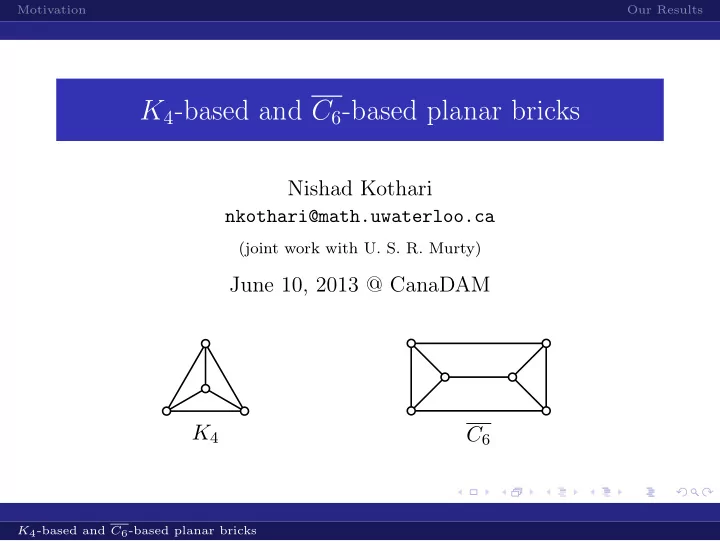
Motivation Our Results K 4 -based and C 6 -based planar bricks Nishad Kothari nkothari@math.uwaterloo.ca (joint work with U. S. R. Murty) June 10, 2013 @ CanaDAM K 4 C 6 K 4 -based and C 6 -based planar bricks Motivation Our Results Matching


slide-1
SLIDE 1

Motivation Our Results

K4-based and C6-based planar bricks

Nishad Kothari

nkothari@math.uwaterloo.ca

(joint work with U. S. R. Murty)

June 10, 2013 @ CanaDAM K4 C6

K4-based and C6-based planar bricks
slide-2
SLIDE 2

Motivation Our Results

Matching Covered Graphs

K4-based and C6-based planar bricks

slide-3
SLIDE 3

Motivation Our Results

Matching Covered Graphs

Petersen

K4-based and C6-based planar bricks

slide-4
SLIDE 4

Motivation Our Results

Matching Covered Graphs

Petersen Definition (Matching Covered Graph) A connected graph with at least two vertices is matching covered if each of its edges lies in some perfect matching.

K4-based and C6-based planar bricks

slide-5
SLIDE 5

Motivation Our Results

Matching Covered Graphs

Petersen Definition (Matching Covered Graph) A connected graph with at least two vertices is matching covered if each of its edges lies in some perfect matching. For example, any 2-connected cubic graph is matching covered.

K4-based and C6-based planar bricks

slide-6
SLIDE 6

Motivation Our Results

A classification of nonbipartite matching covered graphs

K4-based and C6-based planar bricks

slide-7
SLIDE 7

Motivation Our Results

A classification of nonbipartite matching covered graphs

K4-based C6-based

K4-based and C6-based planar bricks

slide-8
SLIDE 8

Motivation Our Results

Building a matching covered graph

K4-based and C6-based planar bricks

slide-9
SLIDE 9

Motivation Our Results

Building a matching covered graph

G

K4-based and C6-based planar bricks

slide-10
SLIDE 10

Motivation Our Results

Building a matching covered graph

G G1

slide-11
SLIDE 11

Motivation Our Results

Building a matching covered graph

G

slide-12
SLIDE 12

Motivation Our Results

Building a matching covered graph

G

slide-13
SLIDE 13

Motivation Our Results

Building a matching covered graph

G

slide-14
SLIDE 14

Motivation Our Results

Building a matching covered graph

G G2

slide-15
SLIDE 15

Motivation Our Results

Building a matching covered graph

G G2

K4-based and C6-based planar bricks

slide-16
SLIDE 16

Motivation Our Results

Ear decomposition

Definition (Single and double ears) A single ear of a graph is a path of odd length whose each internal vertex (if any) has degree two in the graph.

K4-based and C6-based planar bricks

slide-17
SLIDE 17

Motivation Our Results

Ear decomposition

Definition (Single and double ears) A single ear of a graph is a path of odd length whose each internal vertex (if any) has degree two in the graph. A pair of vertex-disjoint single ears is called a double ear.

slide-18
SLIDE 18

Motivation Our Results

Ear decomposition

Definition (Single and double ears) A single ear of a graph is a path of odd length whose each internal vertex (if any) has degree two in the graph. A pair of vertex-disjoint single ears is called a double ear.

slide-19
SLIDE 19

Motivation Our Results

Ear decomposition

Definition (Single and double ears) A single ear of a graph is a path of odd length whose each internal vertex (if any) has degree two in the graph. A pair of vertex-disjoint single ears is called a double ear.

slide-20
SLIDE 20

Motivation Our Results

Ear decomposition

Definition (Single and double ears) A single ear of a graph is a path of odd length whose each internal vertex (if any) has degree two in the graph. A pair of vertex-disjoint single ears is called a double ear.

slide-21
SLIDE 21

Motivation Our Results

Ear decomposition

Definition (Single and double ears) A single ear of a graph is a path of odd length whose each internal vertex (if any) has degree two in the graph. A pair of vertex-disjoint single ears is called a double ear.

K4-based and C6-based planar bricks

slide-22
SLIDE 22

Motivation Our Results

Ear decomposition

Definition (Ear decomposition) An ear decomposition of a matching covered graph G is a sequence G1 ⊂ G2 ⊂ ... ⊂ Gr of matching covered subgraphs of G such that:

K4-based and C6-based planar bricks

slide-23
SLIDE 23

Motivation Our Results

Ear decomposition

Definition (Ear decomposition) An ear decomposition of a matching covered graph G is a sequence G1 ⊂ G2 ⊂ ... ⊂ Gr of matching covered subgraphs of G such that:

1 for each i such that 1 ≤ i ≤ r − 1, Gi+1 is the union of Gi

and exactly one single ear or double ear of Gi+1, and

K4-based and C6-based planar bricks

slide-24
SLIDE 24

Motivation Our Results

Ear decomposition

Definition (Ear decomposition) An ear decomposition of a matching covered graph G is a sequence G1 ⊂ G2 ⊂ ... ⊂ Gr of matching covered subgraphs of G such that:

1 for each i such that 1 ≤ i ≤ r − 1, Gi+1 is the union of Gi

and exactly one single ear or double ear of Gi+1, and

2 Gr := G.

K4-based and C6-based planar bricks

slide-25
SLIDE 25

Motivation Our Results

Ear decomposition theorem

Theorem (Lovász) Every nonbipartite matching covered graph G has an ear decomposition G1 ⊂ G2 ⊂ ... ⊂ Gr such that G1 is either:

K4-based and C6-based planar bricks

slide-26
SLIDE 26

Motivation Our Results

Ear decomposition theorem

Theorem (Lovász) Every nonbipartite matching covered graph G has an ear decomposition G1 ⊂ G2 ⊂ ... ⊂ Gr such that G1 is either:

1 a bi-subdivision of K4

K4-based and C6-based planar bricks

slide-27
SLIDE 27

Motivation Our Results

Ear decomposition theorem

Theorem (Lovász) Every nonbipartite matching covered graph G has an ear decomposition G1 ⊂ G2 ⊂ ... ⊂ Gr such that G1 is either:

1 a bi-subdivision of K4 (we say G is K4-based), or

K4-based and C6-based planar bricks

slide-28
SLIDE 28

Motivation Our Results

Ear decomposition theorem

Theorem (Lovász) Every nonbipartite matching covered graph G has an ear decomposition G1 ⊂ G2 ⊂ ... ⊂ Gr such that G1 is either:

1 a bi-subdivision of K4 (we say G is K4-based), or 2 a bi-subdivision of C6

K4-based and C6-based planar bricks

slide-29
SLIDE 29

Motivation Our Results

Ear decomposition theorem

Theorem (Lovász) Every nonbipartite matching covered graph G has an ear decomposition G1 ⊂ G2 ⊂ ... ⊂ Gr such that G1 is either:

1 a bi-subdivision of K4 (we say G is K4-based), or 2 a bi-subdivision of C6 (we say G is C6-based).

K4-based and C6-based planar bricks

slide-30
SLIDE 30

Motivation Our Results

K4-based C6-based

slide-31
SLIDE 31

Motivation Our Results

K4-based C6-based

slide-32
SLIDE 32

Motivation Our Results

K4-based C6-based

slide-33
SLIDE 33

Motivation Our Results

K4-based C6-based

slide-34
SLIDE 34

Motivation Our Results

K4-based C6-based

slide-35
SLIDE 35

Motivation Our Results

K4-based C6-based

K6

K4-based and C6-based planar bricks

slide-36
SLIDE 36

Motivation Our Results

Bricks

Definition (Brick) A 3-connected bicritical graph is called a brick. (These are special nonbipartite matching covered graphs.)

K4-based and C6-based planar bricks

slide-37
SLIDE 37

Motivation Our Results

Bricks

Definition (Brick) A 3-connected bicritical graph is called a brick. (These are special nonbipartite matching covered graphs.)

K4-based and C6-based planar bricks

slide-38
SLIDE 38

Motivation Our Results

Bricks

Definition (Brick) A 3-connected bicritical graph is called a brick. (These are special nonbipartite matching covered graphs.) Corollary Every brick is either K4-based or C6-based (or possibly both).

K4-based and C6-based planar bricks

slide-39
SLIDE 39

Motivation Our Results

A necessary condition for a planar brick to be K4-based

Let G be a plane matching covered graph which is K4-based.

K4-based and C6-based planar bricks

slide-40
SLIDE 40

Motivation Our Results

A necessary condition for a planar brick to be K4-based

Let G be a plane matching covered graph which is K4-based. Then G has an ear decomposition G1 ⊂ G2 ⊂ ... ⊂ Gr such that G1 is a bi-subdivision of K4.

K4-based and C6-based planar bricks

slide-41
SLIDE 41

Motivation Our Results

A necessary condition for a planar brick to be K4-based

Let G be a plane matching covered graph which is K4-based. Then G has an ear decomposition G1 ⊂ G2 ⊂ ... ⊂ Gr such that G1 is a bi-subdivision of K4. Note that K4 has exactly four odd faces, and so does G1.

K4-based and C6-based planar bricks

slide-42
SLIDE 42

Motivation Our Results

A necessary condition for a planar brick to be K4-based

Let G be a plane matching covered graph which is K4-based. Then G has an ear decomposition G1 ⊂ G2 ⊂ ... ⊂ Gr such that G1 is a bi-subdivision of K4. Note that K4 has exactly four odd faces, and so does G1. We conclude that G has at least four odd faces.

K4-based and C6-based planar bricks

slide-43
SLIDE 43

Motivation Our Results

A necessary condition for a planar brick to be K4-based

Let G be a plane matching covered graph which is K4-based. Then G has an ear decomposition G1 ⊂ G2 ⊂ ... ⊂ Gr such that G1 is a bi-subdivision of K4. Note that K4 has exactly four odd faces, and so does G1. We conclude that G has at least four odd faces.

K4-based and C6-based planar bricks

slide-44
SLIDE 44

Motivation Our Results

A necessary condition for a planar brick to be K4-based

Let G be a plane matching covered graph which is K4-based. Then G has an ear decomposition G1 ⊂ G2 ⊂ ... ⊂ Gr such that G1 is a bi-subdivision of K4. Note that K4 has exactly four odd faces, and so does G1. We conclude that G has at least four odd faces. Proposition A K4-based planar brick must have at least four odd faces.

K4-based and C6-based planar bricks

slide-45
SLIDE 45

Motivation Our Results

K4-based planar bricks

K4-based and C6-based planar bricks

slide-46
SLIDE 46

Motivation Our Results

K4-based planar bricks

Theorem (K. and Murty) Let G be a planar brick. If G has at least four odd faces then G is K4-based.

K4-based and C6-based planar bricks

slide-47
SLIDE 47

Motivation Our Results

K4-based planar bricks

Theorem (K. and Murty) Let G be a planar brick. If G has at least four odd faces then G is K4-based. In other words, the K4-free planar bricks are precisely those which have exactly two odd faces.

K4-based and C6-based planar bricks

slide-48
SLIDE 48

Motivation Our Results

Two infinite families of C6-free planar bricks

K4-based and C6-based planar bricks

slide-49
SLIDE 49

Motivation Our Results

Two infinite families of C6-free planar bricks

An odd wheel

K4-based and C6-based planar bricks

slide-50
SLIDE 50

Motivation Our Results

Two infinite families of C6-free planar bricks

An odd wheel An odd staircase

slide-51
SLIDE 51

Motivation Our Results

Two infinite families of C6-free planar bricks

An odd wheel An odd staircase

slide-52
SLIDE 52

Motivation Our Results

Two infinite families of C6-free planar bricks

An odd wheel An odd staircase

slide-53
SLIDE 53

Motivation Our Results

Two infinite families of C6-free planar bricks

An odd wheel An odd staircase

K4-based and C6-based planar bricks

slide-54
SLIDE 54

Motivation Our Results

C6-based planar bricks

Tricorn

K4-based and C6-based planar bricks

slide-55
SLIDE 55

Motivation Our Results

C6-based planar bricks

Tricorn Theorem (K. and Murty) Let G be a planar brick. If G is not an odd wheel or an odd staircase or the Tricorn, then G is C6-based.

K4-based and C6-based planar bricks

slide-56
SLIDE 56

Motivation Our Results

C6-based planar bricks

Tricorn Theorem (K. and Murty) Let G be a planar brick. If G is not an odd wheel or an odd staircase or the Tricorn, then G is C6-based. In other words, the C6-free planar bricks are precisely the odd wheels, the odd staircases and the Tricorn.

K4-based and C6-based planar bricks

slide-57
SLIDE 57

Motivation Our Results

Why tricorn?

Tricorn

K4-based and C6-based planar bricks

slide-58
SLIDE 58

Motivation Our Results

Why tricorn?

Tricorn Tricorn

K4-based and C6-based planar bricks