Joint searches of gravitational waves (GW) and high-energy - - PowerPoint PPT Presentation

joint searches of gravitational waves gw and high energy
SMART_READER_LITE
LIVE PREVIEW

Joint searches of gravitational waves (GW) and high-energy - - PowerPoint PPT Presentation

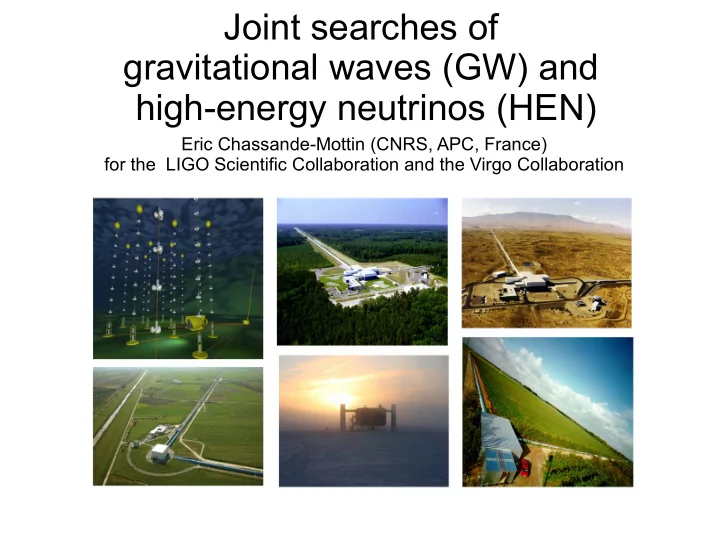
Joint searches of gravitational waves (GW) and high-energy neutrinos (HEN) Eric Chassande-Mottin (CNRS, APC, France) for the LIGO Scientific Collaboration and the Virgo Collaboration Gravitational waves and High Energy Neutrinos GW and HEN


slide-1
SLIDE 1

Joint searches of gravitational waves (GW) and high-energy neutrinos (HEN)

Eric Chassande-Mottin (CNRS, APC, France) for the LIGO Scientific Collaboration and the Virgo Collaboration
slide-2
SLIDE 2

Gravitational waves and High Energy Neutrinos

GW and HEN as cosmic messengers

  • no absorption/diffusion: travel “cosmological” distances

as opposed to photons (dust, gaz, MW or IR background)

  • no deflection by magnetic fields: trace back

(as opposed to charged cosmic rays)

  • weakly interacting: escape from dense objects
slide-3
SLIDE 3

Potential GW+HEN sources

Requirements

  • Massive, compact, relativistic

(→ GW)

  • Sudden <1s (→ LIGO/Virgo)
  • Baryons (→ neutrino)
  • Close/frequent enough
  • Galactic

– Soft γ repeater – Micro quasar

  • Extra-galactic

– Long GRBs – Short GRBs – Low-lumin. GRBs

slide-4
SLIDE 4

GW+HEN sources (1) : GRBs

  • accel. electrons produce

gamma rays by synchrotron

  • accel. protons interact and

produce pions, which decay in high-energy neutrinos HEN

Fireball model: colliding relativistic shells GW high-energy radiation γ+ν

supernovae hypernovae binary mergers short long caveat: Fermi observations puts the “internal shock model” in

  • troubles. Basic scenario under

reconsideration

slide-5
SLIDE 5

GW+HEN sources (2) : “failed” GRBs

  • Why GRB jets are relativistic? (compactness pb)

non-relativistic: optical depth due to absorption γγ → e- e+

>> 1

  • includ. relativistic effects, optical depth is x Γ -2
  • 2

α (Lorentz fact.)

  • ptically thin if Γ = O(100), required to see flash of γ-rays
  • Baryon (heavy) pollution → mildly relativistic jet Γ = O(1)
  • ptically thick, photon don't escape! No GRB. (“failed”)

more baryons means more neutrinos

  • Events hidden from conventional telescopes

accessible only to GW+HEN observation unknown rate, could be large

Ref: Ando & Beacom, PRL 2005

slide-6
SLIDE 6

GW+HEN sources (3): connection between SN and GRB?

missing link between SN and GRB?

slide-7
SLIDE 7

Common data sets with HEN telescopes

time time

2007 2007 2009 2009 2015 2015 2020? 2020?

LIGO Virgo S5/VSR1 aLIGO adVirgo eLIGO Virgo+ S6/VSR2 Einstein telescope & LISA ANTARES 5 strings ANTARES 12 strings Km3net ? IceCube 22 strings IceCube 59 strings Ice Ray ?

Data exchange agreement being finalized

IceCube

(south pole)

ANTARES

(mediterranean sea)

slide-8
SLIDE 8

Feasibility: basic ingredients

Sky coverage

  • ANTARES and IceCube sky complementary
  • Each have ~30 % common sky with GW det.

Resolution of source localization

  • ANTARES has sub-degree error box
  • IceCube has ~ degree error box
  • GW network has few degree error box

ANTARES & GW det. IceCube & GW det.

slide-9
SLIDE 9

Exploring possible data analysis strategies

  • Y. Aso et al. APS'08 arXiv:0711:0107v2

Pradier arXiv:0807.2567v1

  • GW and HEN = same search style

few small signal buried in background noise

  • rationale for a coincidence search :

independent detectors : prob. of accidental coincidence (backgrounds) is very low if coinc. observed, high confidence in detection

  • first studies initiated within LIGO/Virgo and

Icecube and independently within ANTARES detect an excess of time/spatial coincidence reduce false alarm rate, dig deeper into background

Investigate the use of X pipeline currently used for burst searches in coincidence with GRB from coherent analysis

  • f LIGO and Virgo data
slide-10
SLIDE 10

Coincidence time window

  • Time delay between GW and HEN
  • Source/model dependent
  • Case study: long GRBs (Bartos et al.)

GW emission is prompt Neutrinos emission simultaneous to γ GRB duration as indicator for time window: <~ 150 sec (from 4th BATSE catalog)

  • GRB may be preceded by precursor

final window is [-350, +200] sec

  • Reconsider this window in light of

Fermi observations (low statistic for now)

~ 150 sec

time jet

HEN GW

150 sec 200 sec

slide-11
SLIDE 11

Conclusions

  • Working group joining GW and HE neutrinos (IceCube and

ANTARES) just formed

  • In the process of signing data exchange agreement
  • Individuate scenarios for potential joint sources
  • Propose procedure for the time/spatial coincidence of GW

and HEN events

  • Pathfinder effort for advanced detectors