
SLIDE 1
Jeff Scott| FRASER SURREY DOCKS LP A Presentation to the Port Community Liaison Committee
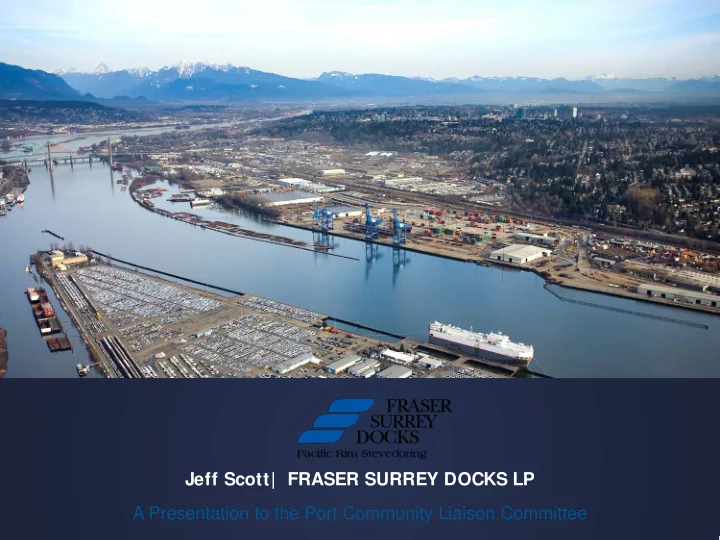
Jeff Scott| FRASER SURREY DOCKS LP A Presentation to the Port - - PowerPoint PPT Presentation
Jeff Scott| FRASER SURREY DOCKS LP A Presentation to the Port Community Liaison Committee The History of Fraser Surrey Docks 2007 Macquarie Group 1991 purchased FSD 1973 Acquired by First 2 gantry cranes arrived. 1961 HongKong 1999 FSD
Jeff Scott| FRASER SURREY DOCKS LP A Presentation to the Port Community Liaison Committee
The History of Fraser Surrey Docks
1920 Terminal began
1926 Handled first grain vessel into British Columbia 1961 Acquired by Johnston Terminals and named Fraser Surrey Docks 1970 Pacific Direct Shipping Line began regular service and Shed 1 was built 1973 First 2 gantry cranes arrived. FSD handled the very first container vessel. Pacific Rim Stevedoring created as a joint venture with Nootka Shipping 1971 Grain Elevator was dismantled and shed 2 was erected 2011 We diversified the business further into Agriculture 2007 Macquarie Group purchased FSD 2004 2 new high-speed Panamax Gantry cranes arrived IDC became operational handling over 100,000 feet of rail traffic per week 1999 3rd container crane added 1998 Container yard expanded. Terminal size increase to 135 acres 1991 Acquired by HongKong Consortium. Expansion of the facility began
Macquarie’s Global Ports Investments
Halifax
72-acre container terminalVancouver
183-acre break bulk and container terminal Oil terminals and storage facilities in Northern FrancePisto
Liquid bulk handling and storage facilities in US and CanadaI MT Terminals
80-acre break bulk and container terminalPenn Terminals
NYK Ports Terminals in Los Angeles, Montreal, Houston, and New Orleans plus 25 stevedoringTanQuid
German’s largest independent oil and chemical tank provider Largest container terminal in PolandGdansk
Mixed cargo terminal in China, along Yangtze RiverNanjing LTT
Terminals in Kaohsiung, Osaka, Tokyo, Seattle and Long Beach portsHanjin Terminals Busan
Busan New Port, located within Busan Port, the largest port in Korea & a regional shipping hubThrough its global portfolio, Macquarie has strong experience in terminal management and extensive relationships with shipping customers.
A true Multi-Purpose Terminal
4
FSD Capabilities
FSD I nfrastructure:
200 Acre terminal including 300,000 square foot of weather sensitive cargo storage 7 Berths (3 for Containers, 2 for Steel and Project Cargo, 1 for Agri, and 1 Dolphin Berth) 4 Dock gantry cranes (3 currently operational) – 80MT lifting capacity Large fleet of onsite dock equipment for any job, including Reachstackers, Lift-trucks, Bombcarts, Tractor-trailers, Gantry Cranes and Top Picks Experienced and highly capable labour force, available 24/7
FSD Truck and Rail Access:
2 Dedicated congestion free truck gates, allowing quicker turn times of Breakbulk, Project Cargo and Container Traffic. With 50,000 feet of rail, FSD has the most efficient rail solution in the Vancouver Gateway Direct rail access on berth face for cargo going to and from railcars Our intermodal rail yard has direct access to the Port of Vancouver Holding Tracks which link the terminal to the major railways (CN, CP , and BNSF) Our own switch crews and 2 locomotive on dock, operated by FSD
Containers
with the container spreader
productivity
9,000 feet of working track
FRASER SURREY DOCKS
Agri-bulk
MTPA
Quick Fact: FSD supports local farmers by sending our extra agriculture products to them at no cost.
Fraser Grain Terminal
FRASER SURREY DOCKS 8
(Bekeart property) with expansion to 6m mtpa.
(Estimate $30 million).
Anticipated schedule:
the first and only Dry Bulk Agri Facility on the West Coast of Canada to service a unit train without breaking the train.
and still provide the following Terminal capacity:
Steel
FRASER SURREY DOCKS
year
the total Breakbulk volumes at FSD
handling terminal in the Vancouver Gateway
cargo types
who are motivated to increase productivity while handling cargo safely
between containers and breakbulk
General/Project Cargo
We are a logistics partner with key local, provincial and federal projects:
10
FRASER SURREY DOCKS
Location of Fraser Surrey Docks
major industrial parks & distribution centers used by container trade
Terminal Features Overview
highway
, CN, BNSF , SRY) and close proximity to CN and CP rail yards
Fraser River Industrial Association
commissioned by local chambers and boards of trade in July 2014
sustainability of the Fraser River for Industrial users
Fraser River Industrial Association is an alliance of marine-dependent businesses operating in and around the lower Fraser River.
Our Mandate
The Fraser River Industrial Association seeks to raise the profile of the lower Fraser River as a key component of our local, provincial and national economies and draw attention to opportunities for sustainable growth and expansion of the Gateway. FRIA will identify opportunities for cohesive action on issues of mutual interest. FRIA is a representative voice of businesses that operate along the lower Fraser River and will serve as a forum for the exchange of industry news and information.
Fraser River History
Sto:lo First Nations
Galiano and Valdes first European explorers
Simon Fraser navigates and charts the river in its entirety
First fur trading post established at Fort Langley
Gold found at bottom of Fraser River
Dredging of the Fraser River commences
First salmon cannery built
Construction of CPR - first bridge built over Fraser River
7.85m Record flood in Mission - dyking system constructed
Rockslides at Hell’s Gate during CN Rail construction
Sumas Lake drained to create 10,000 acres of farmland
Massive flood breaks dykes and floods communities
Debris trap installed near Hope to catch 100,000 cubic meters of wood annually 1998 Fraser River named a Canadian Heritage River
A 500 kilo, 3.7 meter sturgeon caught and released in Fraser River
Fraser River Industrial Association is formed
The Lower Fraser River stretches from the mouth
Canyon, at Hope;
1,375 km
The longest river in BC
3,475 m3
Average flow of water per second
20 Million
Tons of sediment discharged into the sea annually
300,000
People live in the flood plain of the lower Fraser River
2.9 Million 2/3 Of British Columbians live in
the Fraser Basin
10% 80%
Economic activity along the river accounts for 80% of the provincial and 10% of the national gross domestic product
25%
Drains 25% of the province The longest river in BC
In 2016, the lower Fraser River port, shipping and related activities supported:
55,500 jobs $3.4 billion in wages
$5.6 billion in GDP
Port jobs pay well. The average annual compensation per person related to port activity is $68,000 – 54% greater than the average Canadian wage. PORT OF VANCOUVER
port
to the Pacific
billion in goods annually
cargo in 2017
54%
access to existing infrastructure
industrial settings ready to support growth and expansion
alleviate congestion and provide access from sand heads to Mission
Pacific, and can facilitate Canada’s increasing trade and support BC’s Economy
How can the Fraser River help?
16
development of communities
communities
Rivers are Important to our Overall Existence
Major Rivers of the World
the 206 countries in the world (67%) are located on Rivers
Rivers of the World
Major Rivers in the United States
are not built on water: Carson City, Nevada; Helena, Montana; and Raleigh, North Carolina
Major Rivers in Canada
lives along the Great Lakes and
Windsor, Ontario and Quebec City
River Basin is home to
million people, two- thirds of all British Columbians
Fraser River
Saskatchewan River Ottawa River
River
is 8.08m (26ft 6in)
225.6m and beam 23.8m
Management Corporation
established in 1998
from Montreal to Lake Erie
Comparison between the Fraser River and the St. Lawrence Seaway
Lower Fraser River
Cargo (million tonnes) 30.8 mt 47.8 mt Direct Jobs (FTE’s) 41,860 63,041 Wages ($ Billions) $2.77 bil $2.88 bil
Fraser River Pilots Interfor Fortis BC Catalyst Paper Seaspan Ferries SRY Railink WWL Annacis FSD Fraser Richmond VAFFC Fraser Wharves Council of Marine Carriers
FRIA Strategic Priorities
1. STAKEHOLDER ENGAGEMENT
FRIA is committed to creating and preserving a collaborative engagement process that builds understanding, support and alignment with critical stakeholders, communities, governments, First Nations and commercial enterprises who have an interest in the Lower Fraser River.
2. INDUSTRIAL LAND
FRIA supports the more efficient use of industrial lands around the Lower Fraser River and will advocate for the sustainable expansion of these lands through regional growth initiatives.
3. CHANNEL IMPROVEMENT INITIATIVE
FRIA supports regulatory changes to protect and optimize the use of the Lower Fraser River, including navigation safety enhancement, dredging, dike protection, debris reduction and protection of the environment.
4. LAND TRANSPORTATION ACCESS & CONGESTION
FRIA promotes fluidity and efficient access to commercial and industrial lands. Industry along the Lower Fraser River believes that the implementation of effective transportation strategies can only be achieved through a joint Lower Mainland Transportation Committee with representation from Industry, First Nations, government, stakeholders and community.
FRIA Strategic Priorities
5. MARINE & PUBLIC SAFETY
FRIA is committed to safe commercial activity along the Lower Fraser River. Industry along the Lower Fraser River will build a robust safety culture beyond the regulations amongst commercial vessel operators, across all fleets, through the implementation of consistent safety practices by all service providers and clients.
6. STEWARDSHIP
FRIA recognizes and respects the unique ecosystems and biodiversity of the Lower Fraser River and supports the implementation of programs, policies and procedures that protect people, wildlife and habitats.
7. PORT COMPETIVENESS
FRIA advocates for fee levels and structures that encourage investment and ensure the
8. STREAMLINED REGULATORY PROCESS
FRIA advocates for a streamlined and coordinated regulatory framework that will promote efficient permitting for industrial activities in and along the Lower Fraser River. Industry along the Lower Fraser River will work with all regulators and levels of government to ensure expansion and enhancement projects follow a rigid and stringent set of guidelines .