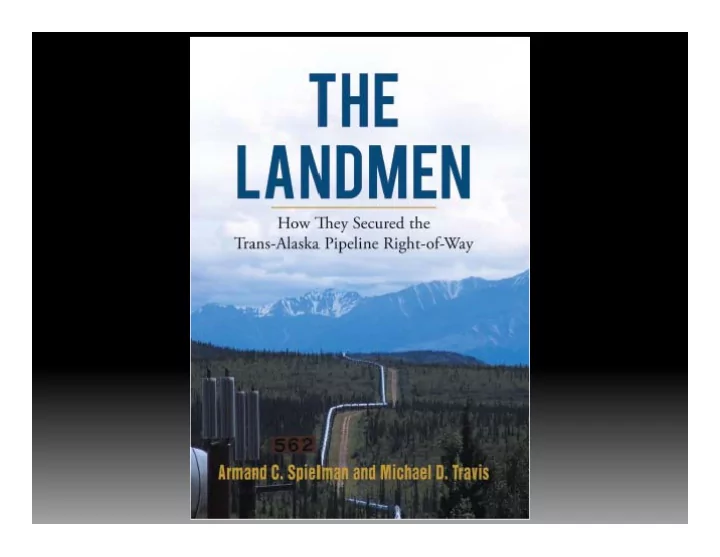
SLIDE 1
SLIDE 2
SLIDE 3
Armand Spielman Alyeska Pipeline Service Company
Jay Sullivan Land Field Services
SLIDE 4
SLIDE 5
SLIDE 6
The Story Starts . . .
March, 1969, Armand receives a phone
call to immediately report to his supervisor.
Accepts the Landman position with
TAPS .
Goes to Washington D.C. to develop
the federal ROW request.
SLIDE 7
Federal Application
June, 1969 – Harry Brelsford and Armand
deliver a truck-load of plat rolls to BLM.
SLIDE 8
Two Maj or Hurdles
The 1958 Alaska S
tatehood Act authorized Alaska to select 103.5 million acres.
Federal Native Land Issues.
None of this was done!
SLIDE 9 S ecretary of the Interior
Ex-Alaska Governor: Walter Hickel Assistant S ecretary: Russell Train
SLIDE 10 March,1969 to July,1970 The Big Push
TAPS punches a 56-mile haul road from Livengood to the Yukon River.
Using ice roads and bridges, TAPS slide equipment north and establish ten construction camps between the Yukon and Prudhoe Bay.
S ept 12, 1969 – First pipe delivered.
Everyone thought the pipeline was eminent!
SLIDE 11
National Environmental Policy Act of January 1,1970
Invoked when federal money or a maj or federal
decision was required.
CE EA EIS Established the Council of Environmental
Quality– Russell Train.
SLIDE 12
Original Federal ROW Plan
Hickel to use the 1920 Mineral Leasing
Act.
The Problem: Mineral Lease Act could only
authorize 50-foot wide ROW.
The pipeline and haul road needed up to
300-foot widths.
SLIDE 13 1970 Law Warfare
February 4 – Bettles and Allakaket sue TAPS
for breach of contract.
March 9 – Five villages and Ten Athabaskans sue
TAPS for damages for lack of employment. Result of breakdown of negotiations with TCC.
March 26 – Wilderness S
sue S ecretary of Interior for improper use of the 1920 Mineral Leasing Act.
SLIDE 14
Law Warfare Continued
April 1 – Federal Judge Hart issues an
inj unction against the DOI for issuing ROW within a 19.8 mile stretch claimed by S tevens Village.
April 3 – Governor Keith Miller responded
by announcing he will authorize the haul road ROW by using the 1866 Lode Act. TAPS had mixed feelings.
SLIDE 15
Governor Miller’s Haul Road ROW Plan
Use the 1866 Lode Act. Confirmed by AG. S
tate would finance the haul road. Oil producers would reimburse Alaska at 7.5% interest.
The Problem: Lode Act could only authorize
ROW for the haul road. Producers were afraid of no return on their investment if the pipeline was not built. Backed out of plan in June 30, 1970.
Miller’s humiliating July radio broadcast
would cost him re-election.
SLIDE 16 Law Warfare Continued
April 5 –Three villages sue the Governor
and Transportation Commissioner to prevent them from granting the haul road ROW under the Lode Act.
April 6: The Knockout Punch – WS
, FOE, and EDF amend their lawsuit accusing the DOI for violating NEP
and DOI start the EIS process.
SLIDE 17
TAPS On-the-Job Training
End of April, 1970 – John Knodell and Quinn
O’ Connell call Armand. Need to hire interior natives.
Jay S
ullivan develops a land surveying program to train ten men from Beaver.
TAPS
then hires DNH to hydroseed the Livengood to Yukon River haul road during the summer of 1970.
SLIDE 18 Name Change
August 14, 1970 –TAPS
consortium formed the Alyeska Pipeline S ervice Company.
Headquartered in Bellevue, Washington with
- ffices in Fairbanks, Anchorage, and
Houston.
Armand secures a long-term lease at 1835
S
treet, Anchorage.
SLIDE 19
Three S taging Areas
Prudhoe Bay – encumbered an existing ARCO- Humble Oil lease. 160 acres next to ocean. S tored 168 miles of pipe.
SLIDE 20
Fairbanks – Leased the Bentley Trust Land. 200 acres. Built a railroad spur. S tored 289 miles of pipe.
SLIDE 21 Valdez – Leased 300 acres from the old town
tored 343 miles of pipe.
SLIDE 22 Alaska Native Claims S ettlement Act December 18, 1971
Granted 44 million Acres to Alaska Natives. Knodell and O’ Connell inserted language ensuring
the selections could not include potential TAPS
haul road ROW.
Established 13 native regional corporations and
allowed villages to form profit companies.
The U.S
. would pay $462 million over 11 years to the regional corporations plus a 2% mineral royalty until it generated another $500 million.
SLIDE 23 TAPS Environmental Impact S tatement
The very first EIS
in the nation.
No prior policy regulating scope, so everything was
studied.
The Draft EIS
contained 256 pages.
Agency and Public comment covered 12,000 pages. DOI issued the Final EIS
ix Volumes.
Preferred Alternative – Prudhoe to Valdez pipeline.
Not through Canada.
Alyeska reimbursed DOI $12.25 million for developing
the EIS . Alyeska spent at least another $9 million in support costs. ($83 million in 2018 dollars).
The Federal Government still needed to amend the
Minerals Act or develop a new Act to authorize the ROW.
SLIDE 24
1970 - 1974 Proj ect Delay Devastated Alaska’s Economy
High bankruptcy rate. High unemployment rate. A 1969 Prudhoe Bay lease sale generated
$900 million ($3.8 billion in 2018 dollars) for Alaska. The S tate managed to spend it within two years.
By 1973, the S
tate was broke.
SLIDE 25 Valdez Land S candal
William “ King Fish” Arnold March 1971: Armand discovers someone is
- ffering $20,000 options to control a small
piece of land next to the Dayville Homestead for two weeks. Then a lawsuit is filed against the US FS to prevent the federal land from transferring to Alaska followed by an application to the Army Corps of Engineers to build a dock in front of the future VMT . King Fish wants Alyeska to pay top dollar for the homestead and trade and manufacturing claim. S ettlement: $2 million plus conditions.
SLIDE 26
SLIDE 27 Land Field S ervices Gold Claims
Harry wanted to prevent a flood of scams when
the sale price hit the streets.
Jay comes up with the idea of filing gold claims
along the proposed Alyeska ROW from Glennallen to Valdez.
On December 29, 1971, Jay filed 148 claims
straddling the pipeline route.
January 28, 1972, ADN displays purchase price
- n the front page. All hell breaks loose!
SLIDE 28 Middle Fork Koyukuk River
- 1969 and 1970, miners hastily
staked claims along the proposed pipeline route.
) and BLM spent years gathering data to prove these claims were not sustainable.
gravel resources.
SLIDE 29
Perfect S torm
July 17, 1973 – S
enator Gravel Amendment to the Mineral Leasing Act. 49-49 S enate split. VP S piro Agnew voted to break the tie.
August 1973 – Muammar Gaddhafi naturalized
the Libyan oil fields and doubled the price of crude.
Upset over US
support of Israel during the S ix Day War, newly formed OPEC increases oil prices by 70% .
October 19, Nixon pushes an emergency $2.2
billion relief package for Israel.
SLIDE 30
Perfect S torm Continued
OPEC responded with a total oil embargo. Congress overwhelmingly passes the Trans-
Alaska Pipeline Act to grant federal ROW.
Nixon signs it into law on November 16,
1973.
SLIDE 31 “ Unique” ROW Permit
Granted TAPS
construction material priority under the Defense Production Act of 1950. First private proj ect to receive this protection.
Affirmative Action goals – especially Native hire
quotas.
Established j oint S
tate/ Federal oversight office.
Established oil-spill contingency fund – applies
land and sea: even in California waters.
Prohibition of tankers discharging ballast water
in Valdez Arm. Land ROW permit regulating
SLIDE 32 Right-of Way Permits
January 23, 1974 – DOI issued federal ROW
grant – 54-feet for buried pipe and 64-feet for above-ground sections.
March/ April, 1974 – BLM coordinate transfer
- f the haul road ROW to Alaska.
April –ADNR issued the S
tate Certificate of Public Convenience and Necessity.
May 2, 1974 – BLM transferred road ROW to
Alaska.
May 3, 1974 –ADNR leased the S
tate pipeline and haul road ROW to Alyeska.
SLIDE 33 S
- cial-Economic Impacts to Alaska
Outsiders starting showing up in early
1974.
Construction started May 1974. Fairbanks
and Valdez boomed!
Fairbanks shot from 18,000 in May 1974 to
88,000 in June 1975.
Valdez went from 1,350 to 6,500 in one
year.
Crime, overcrowding, and high housing
chools double-shifted. Utilities stretched beyond capacity.
SLIDE 34 ROW From:
Federal Government:
376 miles
State Government:
344 miles
Native-Owned Land:
51 miles
Private Land Owners:
29 miles
SLIDE 35 Amazing!
Of 149 parcels of private ownership,
- nly eight parcels required
condemnation! A tribute to the hard and persistent work of Alyeska and Land Field S ervices.
SLIDE 36 Armand’s Job Responsibilities
Mediated a Teamster strike in Valdez. Removed fortified road blocks. Developed an Alaska Native j ob training
program
S
topped Land S windles.
Convinced Miners to lower their weapons. Deactivated explosives.
“ Because people trust us, Armand.”