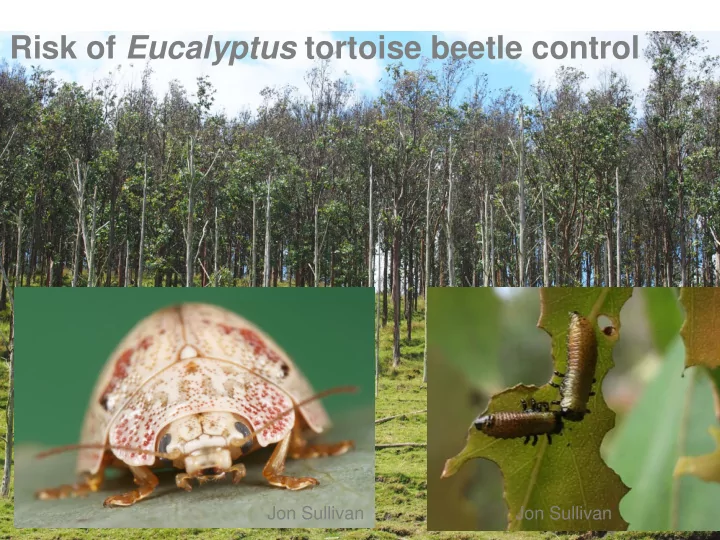
Risk of Eucalyptus tortoise beetle control Jon Sullivan Jon - - PowerPoint PPT Presentation
Risk of Eucalyptus tortoise beetle control Jon Sullivan Jon Sullivan Biology of the pest in NZ Egg parasitoids Enoggera nassaui and Neopolycystus insectifurax provide good Adults and larvae strip all control of 2 nd generation eggs in NZ:
Biology of the pest in NZ
- Adults and larvae strip all
flush, young leaves from hosts
- Each female can lay ~
2000 eggs
- At least two generations
per annum results in rapid population expansion
- First generation needs
biological control to
- ptimise tree growth
Egg parasitoids Enoggera nassaui and Neopolycystus insectifurax provide good control of 2nd generation eggs in NZ: Egg survival 4% Egg survival 95%
Refer Appendix Two
Biological control research in country of
- rigin
- Paropsis charybdis is one of many
eucalyptus leaf beetles native to Australia
- Field work collaboration with Dr Geoff
Allen at the University of Tasmania
- Earlier research evaluated all the
parasitoids of P. charybdis
- Eadya (initially named paropsidis) most
promising to be host specific
- Molecular research confirmed host
range, and number of species.
- Since 2000 reared thousands of leaf
feeding caterpillars and 2700 Gonipterus larvae (weevils) reared – no Eadya
Results in Sharanowski et al. 2018
Eadya daenerys – larval parasitoid (Braconidae)
- Parasitoid that attacks larvae in
spring (first generation)
- Lays one egg directly into the
larva of any size
- Eats it from the inside out,
pushes out after 3 weeks
- Spins cocoon in soil
- Overwinters until emerges as an
adult following Nov-Dec
- Eadya only reared from 4
Paropsis and Paropsisterna beetles in Australia
Approx 10mm long
Photo: Anthony Rice Described in Ridenbaugh et al 2018
Scion assessed the risk this parasitoid might pose to other non-target beetles in NZ
- Pest paropsines are Chrysomelidae:
Chrysomelinae beetles
- New Zealand has no native paropsini beetles,
- nly invaded pests
- But NZ has other Chrysomelinae
- Most risk if medium sized (>5mm), with
leaf feeding larvae, active during early summer
- Prioritise beneficial species in either
subfamily Chrysomelinae or Galerucinae (weed agents)
- Utilised both traditional and a model
(PRONTI) to draw up the best host testing list
Phylogenetic relationships between target and non-targets
Chrysomelidae
Chrysomelinae Chrysomelini Paropsis charybdis Trachymela sloanei Dicranosterna semipunctata Phyllocharitini Allocharis tarsalis Chalcolampra speculifera Gonioctenini Chrysolina abchasica Gonioctena
- livacea
Galerucinae Galerucini Lochmaea suturalis Alticini Agasicles hygrophila Cassidinae Cassidini Cassida rubiginosa Criocerinae Neolema
- globlini
Exotic pests Largest endemic chrysomelines Beneficial weed BioControl Agents
- Eadya target is Paropsis charybdis the
largest of the invasive pest paropsines in NZ
- Phylogenetically closest relatives exotic
pests in NZ, subfamily Chrysomelinae: – tested 2 largest out of Paropsisterna spp., Trachymela spp. (paropsines), Dicranosterna, Peltoschema
- Endemic species in subfamily
Chrysomelinae - tested 1 we located –
- Allocharis. Also searched unsuccessfully
for Chalcolampra, & Caccomolpus.
Undertook host testing (Appendix 5)
Dicranosterna Trachymela Allocharis Paropsis
- Beneficial weed biocontrol agents in
subfamily Chrysomelinae – tested 2: Gonioctena olivacea on Scotch broom, and Chrysolina abchasica on Tutsan.
- Beneficial weed biocontrol agents in
sister subfamily Galerucinae – tested 2: Agasicles hygrophila on Alligator Weed, and Lochmaea suturalis on Heather
- Beneficial weed biocontrol agents in
unrelated subfamilies – tested 2: Neolema ogloblini on Tradescantia (Criocerinae), Cassida rubiginosa on Californian thistles (Cassidinae).
…host testing continued
Chrysolina Gonioctena Neolema Cassida Agasicles Lochmaea
Host testing methods in containment
- No-choice physiological assays – 24 hours one
female to 8 larvae on foliage, rearing and dissecting any dead larvae
- Close-up behavioural observations in petri dishes
Results of No-choice physiological host range :
- Viable parasitism – Paropsines only:
- Paropsis charybdis target pest 34+% (n=120)
- Trachymela sloanei 12.5% (n = 5 reps)
- Non-viable parasitism found only in
Chrysomelines, after larval dissections
- Dicranosterna semipunctata 1.6% (n= 16)
- Allocharis nr tarsalis 7.5% (n= 10)
- Chrysolina abchasica 1.8% (n=14)
- Gonioctena olivaceae 5.2 % (n=12)
- All other species in Galerucinae, Cassidinae and
Criocerinae, 0% parasitism (n=11 -16)
Paropsines Chrysomelines
Conclusion from physiological tests
- Non-target larval rearing survival in the laboratory ranged from 40%
(Chrysolina) to 90% (Allocharis). Generally was good.
- Target P. charybdis rearing survival dropped from 95% in the
absence of parasitism, to 9% after stinging by Eadya.
- Physiological host tests are considered worst case scenario, over-
estimating likely field host range, as long as appropriate life stages are presented, and parasitoids remain active and viable through-out the tests.
- Our tests ran for 24 hours, thereby allowing for nocturnal or diurnal
activity by the parasitoid, and long enough for deprivation effects to become extreme.
- Only paropsines tested, were complete physiological hosts
Body size comparisons among beetles
Predicted minimum host size
- 1/5 of the Eadya larvae emerging from T. sloanei became a minute
but viable adult, confirming minimum host size of about 35 mg
- Suggests the non-target beetles will be too small to be physiological
hosts, therefore unable to form populations, even if had been hosts.
Hosts Non- Hosts
Paropsines
Chrysomelines
Behavioural observations
- Often host testing of parasitoids only reports on results of
physiological host range
- But behavioural observations can assist with interpretation of any
uncertain data
- Therefore we report here the additional data on behaviour of
individual female parasitoids in two-choice, and no-choice sequential petri dish assays
- Non-parametric statistics (comparisons of medians)
- Attack rate (number stings per minute)
when given a CHOICE significantly less than against P. charybdis
Number of ovipositor-insertions per minute
- Attack rate (number stings per minute spent on the plant) when in a
NO Choice test (n=12-16 reps^)
^Only in 8 reps with Trachymela sloanei was there no sig difference in attack
Conclusion on risk to non-targets
- No non-target beetles feed on any NZ Myrtaceae
- Eadya parasitoids show little interest in non-target except
Trachymela and Paropsis that both feed on Eucalyptus leaves
- All beetles on Eucalyptus leaves in NZ are pests
- Some physiological effects (mortality) on sub-alpine native
beetle Allocharis attack from no-choice 24 hour assay, but larvae ignored in two-choice petri dish tests
- Cannot rule out that Eadya will reach sub-alpine areas,
but without presence of Eucalyptus or paropsine hosts, believe they will move on, not stay and unlikely to search non-Myrtaceous plant species.
Minimal Risk to Non-targets
Larger native beetle species have been collected from alpine peaks such as: Mt Arthur, Gordons Knob, Mt Cook village, Mt Earnslaw, Ben Lomond, Mt Dick, Arthur’s Pass, Old Man Range ( )
CLIMEX Composite Match Index for Eadya Tasmania
- cf. NZ
- minimal overlap
Introducing Eadya will significantly increase P. charybdis larval mortality
- This is what a sustainable eucalyptus
forest industry needs
> 90% survival ~ 9% survival
So benefits outweigh risks of introducing this parasitoid, Eadya daenerys
- Biocontrol is environmentally sustainable method of pest control
- Previous biocontrol agents have controlled the second generation of
the pest Eucalyptus tortoise beetle
- Eadya daenerys will reduce larval survival in first generation
- It is specific in Australia to some Paropsis and Paropsisterna
beetles (known as “paropsines”)
- Eadya daenerys could prevent $7.2 million in yield losses per year
from damage to susceptible Symphyomyrtus species
- Sustainable control will reduce spraying, better for environment
- Economic benefits outweigh any potential risks to air, soil, water,
testing reveals a very low risk to any non-target beetles
Acknowledgements
- Sustainable Farming Fund (MPI)
- Scion SSIF (core funding)
- NZ Farm Forestry Association: Dean Satchell
- Speciality Wood Products Partnership
- Southwood Exports Ltd: Graeme Manley
- Oji Fibre Solutions: Adam Mills, David Fox, Richard Sherratt
- Scion Forest Protection staff: incl. summer students, co-funded by University
- f Waikato
- Uni of Tasmania: Geoff Allen, Bek Smart, Vin Patel, Steve Quarrell, Karina
Potter
- Helen Nahrung and Owen Seeman
- TasForests, iFarm, PF Olsens for access to sites
- Forest Owners Association
- Landcare Research: Rich Leschen, Hugh Gourlay, Chris Winks, Paul
Peterson
- AgResearch: Mike Cripps
www.scionresearch.com
Scion is the trading name of the New Zealand Forest Research Institute Limited
Prosperity from trees Mai i te ngahere oranga