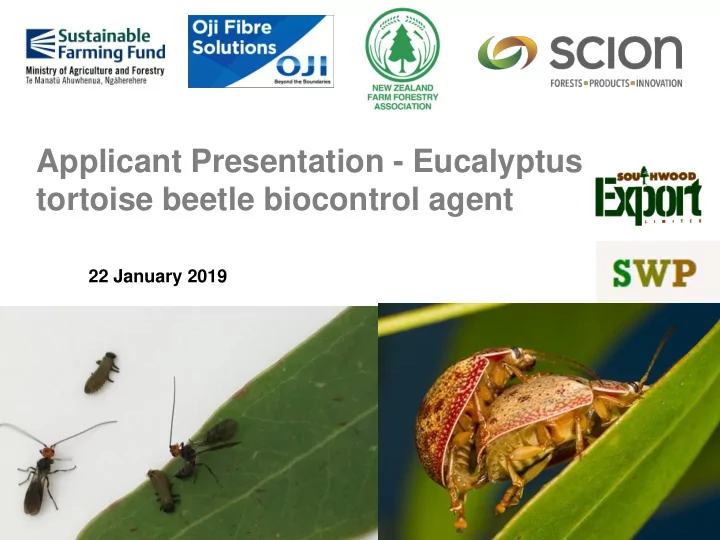
Applicant Presentation - Eucalyptus tortoise beetle biocontrol agent - - PowerPoint PPT Presentation

applicant presentation eucalyptus tortoise beetle
SMART_READER_LITE
LIVE PREVIEW

Applicant Presentation - Eucalyptus tortoise beetle biocontrol agent - - PowerPoint PPT Presentation

Applicant Presentation - Eucalyptus tortoise beetle biocontrol agent 22 January 2019 What is the benefit to NZ of introducing this parasitoid? Biocontrol is environmentally sustainable method of pest control Previous biocontrol


slide-1
SLIDE 1

Applicant Presentation - Eucalyptus tortoise beetle biocontrol agent

22 January 2019

slide-2
SLIDE 2

What is the benefit to NZ of introducing this parasitoid?

  • Biocontrol is environmentally sustainable method of pest control
  • Previous biocontrol agents have controlled the second generation of

the pest Eucalyptus tortoise beetle

  • Eadya daenerys will reduce larval survival in first generation
  • Host specific in Australia to some Paropsis and Paropsisterna

beetles (known as “paropsines”)

  • Eadya daenerys could prevent $7.2 million in losses per year from

damage to numerous susceptible Symphyomyrtus species

  • Sustainable control will reduce spray inputs, better for environment
  • Economic benefits outweigh any potential risks to the environment,

testing reveals a very low risk to any non-target beetles

slide-3
SLIDE 3

Scion is the applicant on behalf of Eucalyptus growers in New Zealand

  • Benefit to New Zealand
  • Grant Wilcock (VP Sales and Marketing Paper, Oji Fibre

Solutions NZ Ltd) – What is so special about eucalypt fibre?

  • Toni Withers (Senior Entomologist, Forest Protection, Scion) –

Cost to NZ if Paropsis charybdis is not controlled

  • Robert Radics (Value Chain Optimisation, Scion) – How we

valued eucalypts to show benefits?

  • Risk to the environment
  • Toni Withers– What did the host testing tell us about risk of this

new organism?

  • Carl Wardhaugh (Entomologist, Forest Protection, Scion) – Are

there any native beetles closely related to Paropsis charybdis in NZ that could be at risk?

slide-4
SLIDE 4
slide-5
SLIDE 5

Benefits of Eucalyptus to New Zealand

  • As well as superior pulp qualities
  • Eucalyptus grow to become of the hardest and most durable wood

poles in the world, not requiring chemical treatment

  • Power poles, cross-arms, bridges, wharfs, vineyard posts
  • Beautiful grains of timber for flooring, decking and other uses such

as production of Laminated Veneer board (LVL)

  • Winter flowering food resource for bees
  • Shade, shelter
  • Firewood
  • Bird habitat
slide-6
SLIDE 6
  • Eucalyptus a small industry

c.f. radiata pine, but diversified forest estate = resilient to natures challenges and border biosecurity threats

  • Eucalypts complement

replanting land with native species

  • Superior nutrient recycling
  • Symphyomyrtus sub-genus
  • most durable timbers
  • cold climate tolerant
  • est. 15,300 hectares

planted

  • Monocalyptus sub-genus

much slower growing

Both types are being developed by the NZ Dryland Forests Initiative, see Paul Millen’s submission. Aim plant 100,000 ha by 2030

slide-7
SLIDE 7
  • Expensive aerial applications of

insecticides cost between $160 - $340 per ha. per spray

  • Negative effects on the environment
  • Whole industry current cost is $1 - 2

million per annum for spraying

  • Yield loss between $4,800 and $9,700

per hectare per year if don’t spray

  • Repeatedly defoliated trees stop growing

completely

  • Plantations worth $402-503 million are at

risk

  • Costs will increase if industry loses the

proven current chemical control option (alpha cypermethrin)

Risk to industry and environment from insect attack

slide-8
SLIDE 8

Healthy E. nitens (Shining Gum)

Scion estimated Eucalyptus provide additional ecosystem services conservatively estimated at $11 million per year

slide-9
SLIDE 9

Damaged

slide-10
SLIDE 10
slide-11
SLIDE 11

How did we value NZ eucalypts?

METHOD:

  • Forest inventory plantation

data of eucalypts in NZ 2016

  • Add additional 16% for

woodlots less than 40 ha

  • Berrill et al. yield model

applied

  • Net Present Value obtained by

applying values to age class data

  • Weighted stumpage value

applied differentially for solid wood and pulp wood RESULTS:

  • 23,182 ha. all eucalypt

plantations in NZ

  • Plus est. 4,416 ha. in small

lots = 27, 598 ha

  • Trunk volume calculated
  • Younger plantations currently

dominate age classes

  • Used $50/m3 for pulp wood,

and $101/m3 for solid wood

  • Symphyomyrtus species 60-

75% of all plantations = NPV is $402-$503 million for eucalypts susceptible to Paropsis charybdis in NZ

slide-12
SLIDE 12

Benefit of chemical applications

  • Short rotation 15 years
slide-13
SLIDE 13

Benefit of chemical applications to prevent yield loss

  • Long rotation 40 years, $160/ha cost, larger than 40 ha plantations

0.0 1.0 2.0 3.0 4.0 0% 10% 20% 30% 40% 50% 60% 70% 80% 90% 100% Benefit : cost ratio Avoided yield loss (%) Heavy Moderate Low Break even

slide-14
SLIDE 14

Benefit: cost of managing P. charybdis

  • Estimated by region and age

class the resistant: suscep. ratio of plantings

  • Aerial spray applications

range in price due to cost effectiveness of spraying larger plantations

  • Estimate 12,300 ha are in

species resistant to the pest, but 15,300 ha are susceptible species (Symphyomyrtus)

  • Economic modelling shows the

cost of spraying the pest in small wood lots or when damage is only low is unjustifed

slide-15
SLIDE 15

Economic benefit of Paropsis charybdis control by the parasitoid Eadya

  • Effective biocontrol will reduce damage from “heavy” damage down

to “light damage”

  • This reduces yield loss from 20% volume loss to less than 10%

(Elek & Baker 2017)

  • This improvement provides an average Net Present Value of $1,245

per ha over a long rotation

  • For the 15,300 ha of susceptible species in New Zealand the Net

Present Value of this effective biocontrol instead of chemical control is $17.4 - $21.8 million

slide-16
SLIDE 16

Benefit to NZ of introducing the parasitoid Eadya daenerys

  • This parasitoid once established will reduce damage from “heavy” to

“light”

  • Reduce spray applications
  • Good for environmental sustainability
  • Increased cost savings
  • Increase acceptability & “social license to operate” of these

renewable plantations for fibre production

  • Reduced damage severity of susceptible eucalypt species
  • Increase growth rates
  • Shorter rotation times
  • Increased wood volumes/ higher yield
  • Increased profitability
  • Increased confidence to invest in diversified plantings
slide-17
SLIDE 17