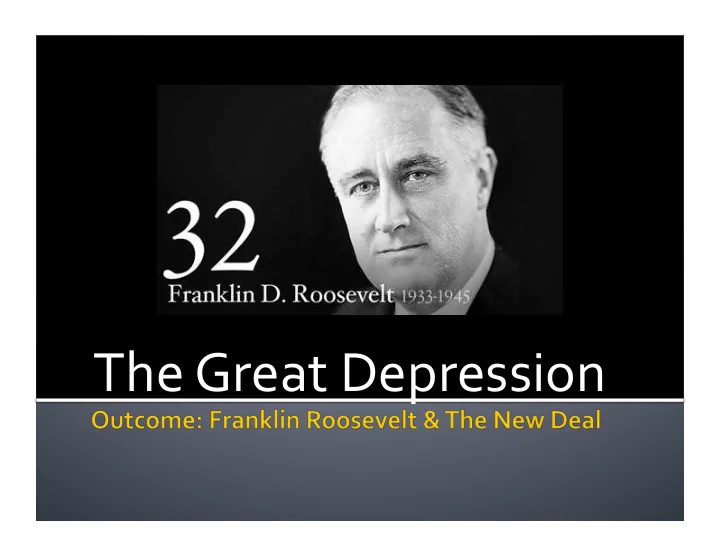
The Great Depression 1. Background a. Youth and Personal Life - - PowerPoint PPT Presentation

the great depression
SMART_READER_LITE
LIVE PREVIEW

The Great Depression 1. Background a. Youth and Personal Life - - PowerPoint PPT Presentation

The Great Depression 1. Background a. Youth and Personal Life i. Born into wealthy New York family ii. Spoiled; only child , doted on iii. Harvard Educated


slide-1
SLIDE 1

The ¡Great ¡Depression ¡

slide-2
SLIDE 2
  • 1. Background ¡
  • a. Youth ¡and ¡Personal ¡Life ¡

i. Born ¡into ¡wealthy ¡New ¡York ¡family ¡ ii. Spoiled; ¡only ¡child, ¡“doted ¡on” ¡

  • iii. Harvard ¡Educated ¡-­‑-­‑-­‑> ¡history ¡& ¡law ¡(athlete) ¡
  • iv. Married ¡Eleanor ¡Roosevelt ¡(influential ¡1st ¡Lady); ¡6 ¡kids ¡

v. 1921 ¡– ¡age ¡39 ¡-­‑-­‑-­‑> ¡stricken ¡w/polio ¡(changed ¡his ¡life) ¡

slide-3
SLIDE 3
slide-4
SLIDE 4
  • b. Long ¡Political ¡Career ¡

i. 1910 ¡– ¡NY ¡Senate; ¡1912 ¡– ¡Asst. ¡Secr. ¡Of ¡U.S. ¡Navy ¡ ii. 1920 ¡– ¡Vice ¡Presidential ¡candidate ¡-­‑-­‑> ¡lost ¡to ¡Harding/Coolidge ¡

  • iii. 1928-­‑1932 ¡-­‑-­‑-­‑> ¡served ¡as ¡Governor ¡of ¡NY ¡
  • iv. 1932 ¡-­‑-­‑-­‑> ¡defeats ¡Herbert ¡Hoover ¡for ¡Presidency ¡
slide-5
SLIDE 5
  • 2. Presidency ¡

a.

Character: ¡-­‑-­‑-­‑> ¡energetic, ¡compassionate, ¡confident, ¡feared ¡no ¡one ¡

b.

Broke ¡Traditions ¡

i. Created ¡a ¡“Brain ¡Trust” ¡of ¡experts ¡to ¡advise ¡him ¡(beyond ¡his ¡cabinet) ¡

ii. Appointed ¡1st ¡woman ¡to ¡his ¡cabinet: ¡Frances ¡Perkins ¡

  • iii. Called ¡Congress ¡into ¡Emergency ¡Special ¡Session ¡
  • iv. Ordered ¡a ¡Nation ¡Bank ¡Holiday ¡(goal: ¡to ¡inspect ¡the ¡banks) ¡

v. Elected ¡President ¡4 ¡times ¡

  • vi. Used ¡media ¡to ¡fullest ¡-­‑-­‑-­‑> ¡“Fireside ¡Chats” ¡
slide-6
SLIDE 6
slide-7
SLIDE 7
  • c. Personal ¡Attitude ¡Toward ¡Depression ¡and ¡The ¡Role ¡of ¡Government ¡

i. Federal ¡Government ¡has ¡a ¡responsibility ¡to ¡help ¡-­‑-­‑-­‑> ¡directly ¡if ¡need ¡be ¡

  • ii. Ignored ¡Traditional ¡Conservative ¡Approach ¡of: ¡
  • 1. Maintaining ¡a ¡balanced ¡budget ¡
  • 2. Cutting ¡taxes ¡& ¡waiting ¡for ¡recovery ¡
slide-8
SLIDE 8
  • iii. Adopts ¡theory ¡of ¡economist ¡John ¡Maynard ¡Keynes ¡who ¡suggested: ¡
  • 1. Increasing ¡government ¡spending; ¡deficit ¡spend ¡if ¡necessary ¡
  • 2. Cutting ¡taxes ¡
  • 3. Creating ¡government ¡job ¡programs ¡
  • 4. If ¡workers ¡have ¡$, ¡they ¡will ¡spend ¡it, ¡priming ¡the ¡economic ¡pump ¡
slide-9
SLIDE 9
slide-10
SLIDE 10

d.

Actions ¡& ¡Policies ¡-­‑-­‑-­‑> ¡New ¡Deal ¡Program ¡(3 ¡part ¡Public ¡Assistance) ¡

i. Relief ¡($, ¡food, ¡shelter; ¡temporary ¡charity) ¡

  • 1. Ex. ¡CCC, ¡FERA, ¡WPA ¡

ii. Recovery ¡(programs ¡aimed ¡at ¡industrial ¡& ¡agricultural ¡recovery, ¡jobs) ¡

  • 1. Ex. ¡AAA, ¡NRIA, ¡PWA ¡
  • iii. Reform ¡(lasting ¡changes; ¡built ¡in ¡safeguards) ¡
  • 1. Ex. ¡FDIC, ¡NLRB, ¡SEC, ¡Social ¡Security ¡
  • e. 1933 ¡– ¡21st ¡Amendment ¡-­‑-­‑-­‑> ¡repealed ¡prohibition ¡
slide-11
SLIDE 11
  • 3. FDR’s ¡Critics ¡
  • a. Some ¡said ¡he ¡was ¡too ¡liberal ¡

i. Conservatives ¡called ¡him ¡a ¡radical ¡socialist ¡ ii. Gave ¡government ¡too ¡much ¡control ¡of ¡the ¡economy ¡(TVA, ¡jobs, ¡etc) ¡

slide-12
SLIDE 12
  • b. Demagogues ¡said ¡he ¡moved ¡too ¡slowly ¡

i. Huey ¡Long ¡(King ¡Fish) ¡“Share ¡the ¡Wealth” ¡

  • 1. Louisiana ¡Senator ¡& ¡Governor ¡
  • 2. Guaranteed ¡every ¡family ¡a ¡$5,000 ¡yearly ¡income ¡
  • 3. Gov’t ¡would ¡tax ¡the ¡rich ¡and ¡seize ¡estates ¡over ¡$50M ¡
  • 4. Assassinated ¡before ¡he ¡could ¡run ¡for ¡president ¡
slide-13
SLIDE 13
slide-14
SLIDE 14
  • ii. Charles ¡Coughlin ¡“Radio ¡Priest” ¡
  • 1. Supported ¡FDR ¡at ¡first ¡and ¡then ¡grew ¡impatient ¡with ¡New ¡Deal ¡
  • 2. Offered ¡an ¡annual ¡living ¡wage; ¡wanted ¡banks ¡nationalized ¡
  • 3. Blamed ¡the ¡Jews ¡-­‑-­‑-­‑> ¡BAD! ¡
slide-15
SLIDE 15
slide-16
SLIDE 16
  • iii. Dr. ¡Francis ¡Townsend ¡-­‑-­‑-­‑> ¡focused ¡on ¡program ¡for ¡the ¡elderly ¡
  • 1. Plan ¡would ¡give ¡people ¡60 ¡and ¡older ¡$200 ¡a ¡month; ¡could ¡not ¡save ¡
  • 2. Ideas ¡led ¡to ¡Social ¡Security ¡
slide-17
SLIDE 17
  • c. Supreme ¡Court ¡said ¡he ¡abused ¡power ¡

i. Declared ¡many ¡“Recovery” ¡programs ¡unconstitutional ¡

ii. Conservative ¡Group ¡(1930-­‑36); ¡FDR ¡called ¡them ¡“The ¡9 ¡Old ¡Men” ¡

  • iii. Court ¡Packing ¡Affair ¡-­‑-­‑> ¡FDR’s ¡attempt ¡to ¡liberalize ¡the ¡Court ¡(1937) ¡
  • iv. FDR ¡loses ¡the ¡battle, ¡but ¡wins ¡the ¡war ¡– ¡retirements ¡occur ¡
slide-18
SLIDE 18
  • 4. FDR’s ¡Long-­‑Term ¡Impact ¡

a.

Deficit ¡Spending ¡became ¡normal ¡procedure ¡at ¡Federal ¡level ¡(debt ¡today?) ¡

b.

Government’s ¡role ¡in ¡regulating ¡the ¡economy ¡remains ¡strong ¡

c.

Reform ¡programs ¡still ¡exist ¡(ex. ¡FDIC, ¡SEC, ¡Social ¡Security) ¡

d.

Federal ¡government ¡remains ¡a ¡big ¡and ¡growing ¡employer ¡

e.

22nd ¡Amendment ¡(1951) ¡-­‑-­‑-­‑> ¡2 ¡term ¡limit ¡for ¡presidency ¡

f.

Democratic ¡party ¡membership ¡increased ¡

slide-19
SLIDE 19
  • 5. World ¡Solutions ¡to ¡the ¡Depression ¡
  • a. Dictators ¡offered ¡prosperity ¡in ¡exchange ¡for ¡power ¡

i. Germany: ¡Hitler ¡-­‑-­‑-­‑> ¡Nazism ¡ ii. Italy: ¡Mussolini ¡-­‑-­‑-­‑> ¡Fascism ¡

  • iii. Soviet ¡Union ¡-­‑-­‑-­‑> ¡Stalin ¡-­‑-­‑-­‑> ¡communism ¡
slide-20
SLIDE 20
  • b. The ¡Stage ¡is ¡Set ¡for ¡World ¡War ¡II ¡