Janus: Observing the Sun-Earth Connection. A Lunar Mission Jay - - PowerPoint PPT Presentation

janus observing the sun earth connection a lunar mission
SMART_READER_LITE
LIVE PREVIEW

Janus: Observing the Sun-Earth Connection. A Lunar Mission Jay - - PowerPoint PPT Presentation

Janus: Observing the Sun-Earth Connection. A Lunar Mission Jay Herman (GSFC), Joseph Davila (GSFC), Clarence Korendyke (NRL) Simultaneous Observations of the Sun and Earth Dont Get Stuck in LEO There is New Science with New Perspectives


slide-1
SLIDE 1

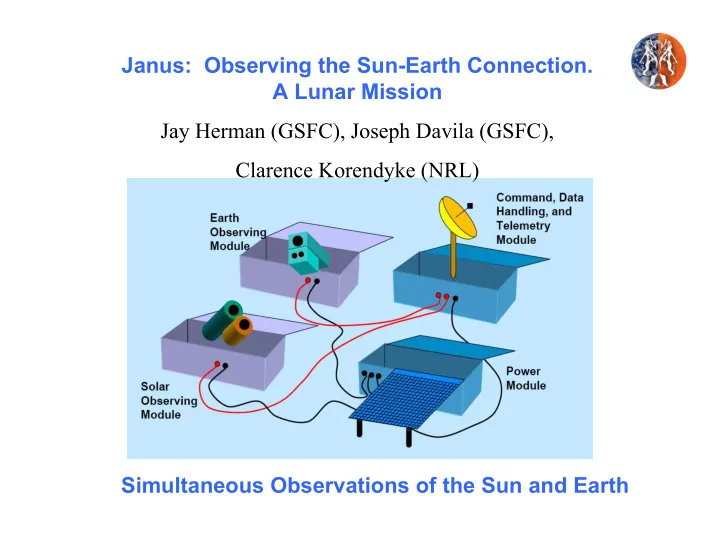
Janus: Observing the Sun-Earth Connection. A Lunar Mission Jay Herman (GSFC), Joseph Davila (GSFC), Clarence Korendyke (NRL) Simultaneous Observations of the Sun and Earth

slide-2
SLIDE 2

Don’t Get Stuck in LEO There is New Science with New Perspectives

It may seem strange to go 384,400 kilometers away from Earth in order to take close-up science images. However, the view is unique.

slide-3
SLIDE 3
  • Understand the processes and interactions that determine

the composition of the Earth’s whole atmosphere including the connections to solar activity.

  • Understand the role of solar plasma dynamics in coronal

heating, solar wind acceleration, flares and transients, and UV irradiance variations.

  • Quantify the sources and transport of environmentally

important atmospheric species (greenhouse gases, aerosols,

  • zone) using high-resolution synoptic mapping of

concentrations.

  • Understand the fundamental physical processes within the

active solar corona which lead to coronal mass ejections/solar flares and contribute to irradiance variability.

  • Provide real-time space weather data for predictive modeling
  • f the space environment and for protecting satellite

communication, astronaut safety, and ground power distribution assets.

Janus: Science Objectives

slide-4
SLIDE 4

JANUS JANUS

JANUS Key Science Capabilities

Earth-Viewing

  • Synoptic Global Maps

– Stratosphere/Troposphere

  • O3 Column
  • O3 Profile
  • SO2 NO2, HCHO, BrO

Column

  • Aerosol optical depth and

absorption

  • H2O, Cloud Height

– Ionosphere/Mesosphere

  • NO, O, O+, He, H2
  • O/N2
  • Connection of observed

motions and composition to solar activity using comprehensive GCM- chemistry models

Solar Viewing

  • Address physical processes driving

soft x-ray and EUV irradiance variations and large scale solar energetic phenomenon (CMEs and flares).

  • Quantify the role of plasma flows to

reveal the fundamental physics of energy and mass transport in the solar corona.

  • Measure soft x-rays as the source for

ionizing radiation that plays a critical role in the Nitrogen Oxide chemistry in the thermosphere and mesosphere.

  • Image the evolving coronal streamer

belt to detect coronal mass ejections that are the primary solar drivers of large, geomagnetic storms and solar energetic particle events.

  • Measure solar wind properties:

– Magnetic field and energetic particles

slide-5
SLIDE 5

Janus Science Objectives

  • Understand the relationship between solar activity and

the structure and dynamics of Earth’s atmosphere from the surface to the thermosphere-ionosphere for a range

  • f seasons, solar radiation and energetic particle inputs.
  • Understand the role of plasma dynamics in coronal heating, solar

wind acceleration, flares and transients, and UV irradiance variations.

  • Understand the role of transport and source distribution using high-

resolution synoptic mapping of environmentally important species, tracking of pollution plumes, and ozone layer dynamics with the input to GCM chemistry models.

  • Provide real-time space weather data for predictive modeling of the

space environment and Earth’s upper atmosphere.

  • Provide solar storm data for the purpose of astronaut safety.
slide-6
SLIDE 6

If you are in a spacecraft between the Earth and the Moon or on the Moon, the exposure can be quite serious, amounting to about 100 rad, a 1000 times more than in low-Earth

  • rbit. A standard chart for judging the severity of radiation doses is (see Physiological

Problems in Space Exploration, ed. James Hardy, 1964)

  • Typical Exposure:

5 rem/yr, or 25 rem in a single emergency exposure: "maximum permissible dose" in terrestrial radiation workers

  • Medium Flare:

25-100 rem: increased probability of leukemia; germ cell damage (likelihood of problems in offspring)

  • Large Flare:

100-250 rem: nausea/vomiting in hours; high incidence of leukemia; shortened life; can die if untreated Extraordinary Events:

  • 250-750 rem: nausea/vomiting after about an hour; shock; death likely within 1 month if

untreated; cancers; cataracts; significant life shortening; sterility

  • 750-2,000 rem: nausea/vomiting within an hour; unconsciousness then temporary return to

consciousness; death within a week

  • >2,000 rem: unconscious in minutes; brief recovery then death

10,000 rem: one instance documented. Death occurred in 38 hours.

Janus: Solar Flares and Astronaut Safety

REM = Roentgen Equivalent Mammal RAD = Radiation Absorbed Dose roentgen = the amount of x- or gamma ray radiation producing 1/3 x 10-9 coulomb of electric charge/cm-3

  • f dry air at standard conditions (or 2.58 x 10- 4 coulombs/kg) ~ 1 RAD for x-rays

The succession of storms in July 1959 would have given an astronaut within an Apollo spacecraft a skin dose of about 150 rads. August 1972: 360 rads ("SPACE RADIATION" by W. Corliss)

slide-7
SLIDE 7

Visible IR Continuous full –globe

  • bservations
slide-8
SLIDE 8

There are other places for NASA to go New Perspectives – Search for Life

slide-9
SLIDE 9

Janus: Earth Viewing Telescope Module

3 spectrometers based on a previous mission design. The larger telescope is for stratosphere and troposphere measurements, while the two smaller telescopes are for airglow and line emissions in the mesosphere. Aperture doors can be closed to protect against dust. For the lunar mission, all aperture sizes are 15 cm.

slide-10
SLIDE 10

Janus observing system block diagram showing both solar and earth observing telescopes. Solar package points independently from the Earth observing telescopes. This drawing is based on a previous mission design. The solar and earth viewing modules are now separate.

Janus: Earth-Sun Observation Package

slide-11
SLIDE 11

Janus: Observing System Block Diagram

slide-12
SLIDE 12

Janus: Mass, Power, and Cost

slide-13
SLIDE 13

Measured Temperatures of the lunar surface and subsurface (20 mm, 50mm, 100mm) during Apollo 12 [Cremers et al., 1971]

Janus: Environment (Temperature)

slide-14
SLIDE 14

"…The [Moon's] surface material is

  • ne of the lousiest

imaginable electrical conductors, so the dust normally on the surface picks up and keeps a charge. And what, dear student, happens to particles carrying like electrical charges?" "They are repelled from each other." "Head of the class. And if a hundred- kilometer circle with a rim a couple of [kilometers] high is charged all over, what happens to the dust lying on it?"

Janus: Environment (Dust)

A particle of extremely jagged lunar dust

slide-15
SLIDE 15

[A] Earth's hydrogen geocorona envelops the earth. Image was obtained with the Apollo-16 Far UV Camera in Lyman α, [B] image of earth from the moon showing the oxygen dayglow in 1304A (UV) emission and nightside tropical arcs produced by recombination of ionospheric O+ with electrons, [C] CME with an embedded prominences as observed the LASCO C2 coronagraph on SOHO, [D] Apollo 11 picture of Earthrise from the Moon in visible light.

Janus: The view from the Moon A B C D Apollo 11 and 16

slide-16
SLIDE 16

Airglow and Aurora at 100 km seen from space

A coronal hole (black area) seen in X-ray

  • bservations. These holes are associated

with high speed streams in the solar

  • wind. The EUV spectrograph on Janus

will directly observe velocities in these structures on the disk and at the limb.

Janus: Earth Airglow and a Solar Coronal Hole

slide-17
SLIDE 17

Solar Flares Duration ~ 3 hours

slide-18
SLIDE 18

Sunset from Space On a Clear Day Seen from a Geostationary Orbit

A similar view would be

  • btained from a lunar

base or lunar Lagrange- Point orbit

slide-19
SLIDE 19

Janus: Tropospheric NO2 columns seen from space Janus will see the time dependence of NO2 everywhere

slide-20
SLIDE 20

2

Goddard Space Flight Center “Use or disclosure of these data is subject to the restriction

  • n the title page of this document”

Tropospheric Pollution: Asian pollution being transported towards America

Follow Pollution Plumes in the Northern Hemisphere 65o 165o When the Northern Hemisphere is illuminated, JANUS will be able track pollution plumes at least once per hour instead of once per day.

How are global air quality and climate being affected by pollution? [Aerosols & Clouds, CO, NO2, and Transport]

slide-21
SLIDE 21

2

Goddard Space Flight Center “Use or disclosure of these data is subject to the restriction on the title page of this document”

Why are we interested in Asian Pollution?

1. For the local effect on Asia and its impact on global climate. 2. The pollution rapidly leaves Asia on the prevailing winds heading towards North America. Asian pollution starts at lower latitudes where it is injected higher (~8km) than from the US and EU (~4km). The transport is faster so that pollutants with lifetimes ~10 days can reach the US within a concentrated plume.

Why is JANUS Needed?

TOMS Aerosol Index

slide-22
SLIDE 22

16

Goddard Space Flight Center “Use or disclosure of these data is subject to the restriction on the title page of this document” Nitrogen Dioxide (NO2) from October 8, 2004 on top of the Earth at Night image. NO2 concentration is clearly evident over major cities (San Diego, Los Angeles, Phoenix, Denver, Houston, Dallas, Chicago, Detroit, Cleveland, Toronto, Birmingham, Washington DC, Philadelphia, and New York)

OMI NO2 image over South America

  • n October 7, 2004. overlaid on the

fires that form every year.

NO2 combined with the smoke aerosols are a major source of surface pollution in the southern hemisphere

OMI NO2 Image over US at 25 km

  • resolution. JANUS will have a 4

km resolution that is much smaller than the size of the cities NO2 is a proxy for emission sources of CO and CO2

Competition Sensitive Restricted Use

slide-23
SLIDE 23
slide-24
SLIDE 24

2

Goddard Space Flight Center “Use or disclosure of these data is subject to the restriction on the title page of this document”

JANUS: A Super-Geostationary Observatory

All of the advantages of Geostationary

  • 1. During any exposure time, sit and stare
  • 2. See between the clouds as they move through a scene
  • 3. Observe Diurnal variation of the surface, oceans, and trace gases

Plus: Observe the entire Earth with one satellite Has a single calibration Track pollution plumes crossing the Oceans Does not interfere with scarce GEO slots

JANUS is a new observational concept and new viewpoint for observing Earth processes in the atmosphere, land, and oceans. The goal is to study dynamical processes over the whole Earth during its mission lifetime in conjunction with existing or new LEO satellites.

Competition Sensitive Restricted Use

slide-25
SLIDE 25

Janus: Summary (Observations)

  • Using the Moon as a platform for scientific observations of the Earth and Sun is

highly attractive for its unique views of the Earth compared to GEO and LEO orbits.

  • The Moon offers exceptional stability compared to satellite platforms.
  • We have designed a unique astronaut deployable package of Sun and Earth observing

spectrometers and a solar coronagraph to investigate the relationship between solar activity and the processes in the Earth’s atmosphere.

  • We know that there is an observed relationship between solar activity and the

photochemical processes in the stratosphere for ozone and coupled chemical species. Observations clearly show a similar relationship for photochemistry at even higher altitudes.

  • What is not well known is if any effects propagate into the troposphere and even

down into the boundary layer.

  • The instrument package will have the capability of observing tropospheric trace gases

(e.g., NO2 and O3) and the amount of cloud cover on a continuous daytime synoptic basis from the Earth’s day-night terminator and for a week each month, nearly the entire Earth’s disk. At the same time, we will observe solar activity and the response of emission lines originating in the Earth’s upper atmosphere.

slide-26
SLIDE 26

Janus: Summary (Challenges)

  • Deployment on the lunar surface also presents challenges to the design,

construction and successful operation of instrumentation that are not present

  • n satellite platforms.
  • Interference of lunar dust with the mechanical and optical portions of

instrumentation.

  • Survival of the instruments through the long and cold lunar night.
  • The need for operating power during the lunar night.
  • We need to refine payload resource requirements, address payload

deployment and safety issues, and study possible solutions to the dust, power, and thermal challenges.

  • Unconventional solutions may also be required to repel dust from critical
  • volumes. The solutions and strategies developed for Janus, will also be

applicable to other scientific remote sensing instrumentation that may be employed on the Moon and eventual deployment of instrumentation on Mars.