Jane Eyre Jane Eyre by Charlotte Bront by Charlotte Bront - - PowerPoint PPT Presentation

jane eyre jane eyre
SMART_READER_LITE
LIVE PREVIEW

Jane Eyre Jane Eyre by Charlotte Bront by Charlotte Bront - - PowerPoint PPT Presentation

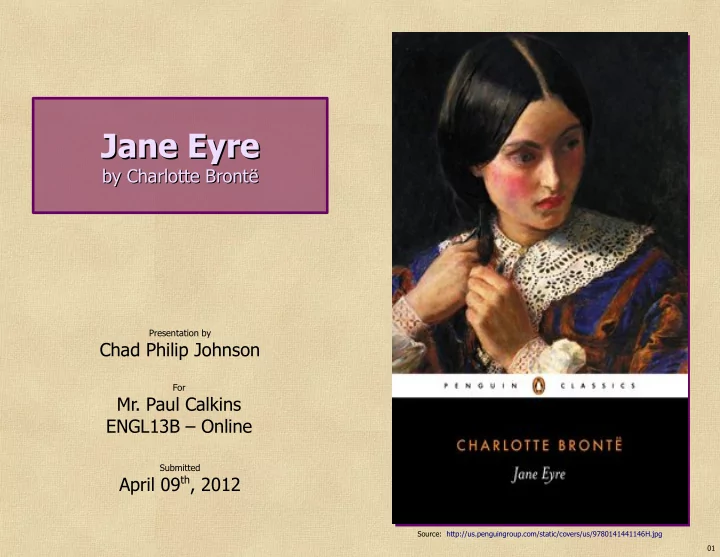
Jane Eyre Jane Eyre by Charlotte Bront by Charlotte Bront Presentation by Chad Philip Johnson For Mr. Paul Calkins ENGL13B Online Submitted April 09 th , 2012 Source:


slide-1
SLIDE 1

Jane Eyre Jane Eyre

by Charlotte Bront by Charlotte Brontë ë

Presentation by

Chad Philip Johnson

For

  • Mr. Paul Calkins

ENGL13B – Online

Submitted

April 09th, 2012

Source: http://us.penguingroup.com/static/covers/us/9780141441146H.jpg 01

slide-2
SLIDE 2

Contents Contents

Introduction / Synopsis ............................................................................. 03 Charlotte Brontë ....................................................................................... 04 Parts I and II: Gateshead Hall and Lowood School ….................................. 06 Part III: Thornfield Hall ............................................................................ 07 Parts IV and V: Moor House and Ferndean ................................................. 08 Cultural Impact …...................................................................................... 09 Legacy ….................................................................................................. 10 Works Cited .............................................................................................. 11

02

slide-3
SLIDE 3

Introduction / Synopsis Introduction / Synopsis

The novel Jane Eyre is a story about a young woman’s personal hardships and eventual triumphs through the perseverance of self. The setting is early 19th century England, before the dawn of the Victorian Age. The titular character tells her story in five intervals, each one belonging to a unique locale. Jane is an

  • rphan being raised by her wealthy but cruel aunt, whose deceased husband

charged that his niece be cared for. After years of mounting enmity, young Jane is precariously sent away to school at the age of ten and must make her way through the world alone. Growing up she attains an education which provides her with both the means to provide service to others and the stalwart composure to meet

  • adversity. As a teacher, she leaves school and finds work as a governess, her

employer being the man with whom she would fall in love. Their relationship is genuine and pure, but the man's history holds unforgiving secrets which force Jane to flee from her new life, leaving her completely destitute and again alone. Shunned by strangers and starving, Jane wanders the outskirts of an unfamiliar village where her life is nearly extinguished. By good graces alone she is taken in and nursed back to health, an experience that also produces a newfound security with her benefactors. Joyous and restored, she has finally found a home, but still has many unanswered questions. Now safe, Jane resolves to venture back into the world to find the man whom she loves.

03

slide-4
SLIDE 4

Charlotte Bront Charlotte Brontë ë

The author, Charlotte Brontë, was born on April 21st, 1816 in Thornton, Yorkshire, England, to her mother Maria Branwell and father Patrick Brontë, an Irish Anglican Clergyman. The third of six children, Charlotte and her sisters Emily, Maria and Elizabeth were sent to the Clergy Daughters' School at Cowan

Source: http://www.famednames.com/wp-content/uploads/2010/11/charlotte-bronte-1.png

in Lancashire. Conditions were very poor and Elizabeth and Maria died of tuberculosis, which caused both Charlotte and Emily to be removed from the school (Fraser 261). She continued her education at Roe Head, Mirfield, from 1831-1832 and then became a teacher from 1835-1838. From 1839-1841 she served as governess to a number of families in Yorkshire (Fraser 261). Charlotte had been writing all the meanwhile and Jane Eyre was published to great success in 1847. Many of her life experiences are projected through this novel, being communicated through the character Jane.

04

slide-5
SLIDE 5

Charlotte Bront Charlotte Brontë ë

Charlotte Brontë's other novels include Shirley (1849), Villette (1853), and The Professor (1857). Like Jane Eyre, these were initially published under the pseudonym Currer Bell, because at the time literature was not considered to be a suitable profession for women. Her younger sisters, Emily—who was with Charlotte at Cowan—and Anne Brontë, are also highly regarded authors, having written Wuthering Heights (1847) and Agnes Grey (1847), respectively. Like their sister, they too published their works under gender neutral names. Before the release of any of these novels, the three sisters self-published a collection of poems together in 1846 titled Poems by Currer, Ellis and Acton Bell (which is reputed to have sold only two copies). In a time when women had no rights and were supposed to be “domestic and pure, selflessly motivated by the desire to serve others rather than fulfill [their] own needs” (Damrosch 1061), the Brontë sisters' success as authors should be regarded as a tribute to their collective uniqueness and talent. Fittingly, Jane Eyre was the first of these novels to be consumed by the masses.

From left to right: Anne, Emily and Charlotte Brontë. Source: http://en.wikipedia.org/wiki/File:Painting_of_Bront%C3%AB_sisters.png Painting by Branwell Brontë (brother). 05

slide-6
SLIDE 6

Jane Eyre: Parts I and II Jane Eyre: Parts I and II

The first book begins with a young Jane Eyre living with her aunt, Mrs. Reed, and cousins in the extravagant Gateshead Hall. An orphan—her father and mother passed away before she knew them—Jane is subsequently left in the care of her uncle's family. With his early passing she loses her only form of protection from the world. Jane's relations treat her contemptuously, denying her kinship and the many privileges afforded by their wealth. After many confrontations and a mounting dislike, Mrs. Reed makes arrangements for Jane's future: to send her away from Gateshead to Lowood

  • school. Lowood is a cruel institution for girls who are orphan or have been given

up by their parents. Its abject conditions serve as a reflection of the personality

  • f the man who runs it: the evangelical Mr. Brockelhurst, a character who

enforces “self-serving piety which urges humility and self denial on others... while complacently exempting [himself]” and is based on the founder of Cowan, the school where Charlotte Brontë's two elder sisters died (Damrosch 1299). Jane continues to struggle daily, until powerful events draw the awareness of the public to the school, resulting in its restructuring and improvement. Eight years then pass and Jane is a teacher at Lowood. Growing restless with her quaint life, she places and advertisement for her services in the paper and is hired as a governess in a distant place called Thornfield Hall.

Gateshead Hall and Lowood School Gateshead Hall and Lowood School

06

slide-7
SLIDE 7

Jane Eyre: Part III Jane Eyre: Part III

In book two an anxious Jane is received at Thornfield Hall, a grand estate, by the quiet Mrs. Fairfax, who maintains its affairs and is the relative of its

  • wner, Edward Rochester. Jane is introduced to her new pupil, Adéle, a girl of

age eight who is the ward of Mr. Rochester. To Jane's relief her new duties and responsibilities are fair and the living arrangement is comfortable. However, she soon finds herself in a situation similar to that which caused her to leave Lowood: life is quaint and her only companions are the residents and servants

  • f Thornfield Hall. She longs for more purpose in her life.
  • Mr. Rochester crashes into the story as the necessary response to Jane's
  • unrest. With this new character—an intelligent, intriguing and charismatic man—

the author adds new dimensions to the story. Jane is stirred to life whenever he is near. Their conversations represent two intellects sparring over myriad subjects, each word overflowing with subtle confirmations of two minds capable and appreciative of great consideration. The realities of class frequently surface: he being a wealthy landowner and she a simple governess. Their relationship blossoms and a wedding is arranged, but these plans are interrupted by a ghost from Edward's past. Distraught, Jane abruptly quits Thornfield Hall by a passing carriage, with nothing to her name and unsure of where life will lead her next.

Thornfield Hall Thornfield Hall

07

slide-8
SLIDE 8

Jane Eyre: Parts IV and V Jane Eyre: Parts IV and V

Book three begins with Jane having traveled as far from Thornfield Hall as twenty shillings would purchase. Dropped off on the side of the road and utterly penniless, she seeks support at a nearby village. Her inquiries for work are denied and she is turned away from every doorstep. Starving and with nowhere to go, Jane wanders into the moors surrounding the village. On a stormy night, before her strength fails, she discovers a place called Moor House and collapses

  • n its doorstep. The residents Diana, Mary and the clergyman St. John Rivers,

nurse Jane back to health and, upon discovering her nature, enthusiastically take her in and give her a place to live. After some time, and through a twist of fate, Jane finds the first place she will call home. This is the first ending to Jane Eyre, resolving the story from parts I, II and IV. Though happy, Jane cannot quell her longing for Edward Rochester and must learn of his fate. Seeking him in a familiar place, she is instead told a harrowing tale, one which casts new doubt over their already distant relationship. She soon discovers that her final destination is Ferndean, a portentous, remote dwelling surrounded by thick wood. Alone and determined, it is in this place where she is to find the answers to her heart's questions. This is the second and final ending to Jane Eyre, which offers closure to the events that occur in parts III and V.

Moor House and Ferndean Moor House and Ferndean

08

slide-9
SLIDE 9

Cultural Impact Cultural Impact

The success of Jane Eyre had an immediate effect on both its audience and

  • critics. Such an honest account of a woman's life challenged established ideals

yet was still embraced by readers. One result of this is that many people have made the story into a symbol for women's rights. As Stevie Davies states in her introduction to the Penguin Classics publication of the novel: “What was

09

the secret of Jane Eyre's magical success and what inspired the backlash against the novel as a dangerous and sexually arousing feminist manifesto...? Jane Eyre spoke with too personal a voice to be ignored.” (XII). The release of the novel also came at a time when Chartism—the working class movement for political reform in Britain—was at its height, and many readers found sympathetic ideas in Charlotte Brontë's story, such as the novel's “murmuring against the comforts of the rich and the privations of the poor” (Davies XV). Revolution in Britain was a very real possibility and Jane Eyre echoed the sentiments of many during this time.

Portrait of Charlotte Brontë by J.H. Thompson Source: http://upload.wikimedia.org/wikipedia/commons/d/d3/CharlotteBrontePortrait.jpg

slide-10
SLIDE 10

Legacy Legacy

The story Jane Eyre garners significant attention to this day. In the 20th and 21st centuries many films, television productions, radio shows and musicals have been based on the novel. Literary “sequels” and retellings have also been released by different authors, such as Thornfield Hall by Emma Tennant. The memory of Charlotte Brontë is honored by the Brontë Society (along with her sisters Anne and Emily), which is one of the oldest literary societies in

  • England. Fans join the Society by purchasing a membership, the proceeds of

which go toward the maintenance of the Brontë Parsonage Museum: the

  • riginal home of the Brontë family.

Source: http://upload.wikimedia.org/wikipedia/commons/e/e4/Bronte_Parsonage_Museum.JPG The Brontë Parsonage Museum, Haworth, West Yorkshire, England Source: http://upload.wikimedia.org/... Source: http://img1.fantasticfiction.co.uk/... Literature Inspired by Jane Eyre The 2011 British Film Jane Eyre 10

slide-11
SLIDE 11

Works Cited Works Cited

Damrosch, D., et al. The Longman Anthology of British Literature. Harlow: Longman, 2010. Brontë, Charlotte. Jane Eyre. 1847. Ed. Stevie Davies. London: Penguin Group, 2006. Fraser, Rebbecca. Charlotte Brontë: A Writer's Life. New York: Pegasus Books LLC, 2008.

11