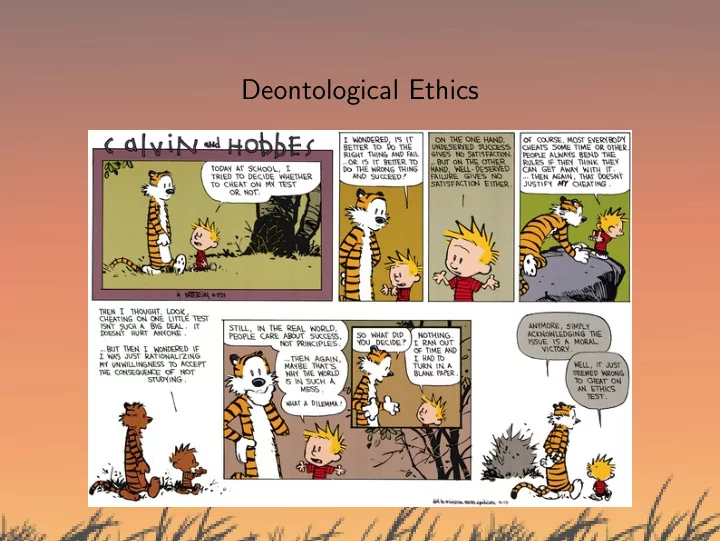
SLIDE 1
Deontological Ethics
SLIDE 2
From Jane Eyre, the end of Chapter XXVII: (Mr. Rochester is the first speaker) “And what a distortion in your judgment, what a perversity in your ideas, is proved by your conduct! Is it better to drive a fellow-creature to despair than to transgress a mere human law, no man being injured by the breach? for you have neither relatives nor acquaintances whom you need fear to offend by living with me?” This was true: and while he spoke my very conscience and reason turned traitors against me, and charged me with crime in resisting him. They spoke almost as loud as Feeling: and that clamoured wildly. ”Oh, comply!” it said. ”Think of his misery; think of his danger look at his state when left alone; remember his headlong nature; consider the recklessness following on despair soothe him; save him; love him; tell him you love him and will be his. Who in the world cares for you ? or who will be injured by what you do?” Still indomitable was the reply “ I care for myself. The more solitary, the more friendless, the more unsustained I am, the more I will respect myself. I will keep the law given by God; sanctioned by man. I will hold to the principles received by me when I was sane, and not mad as I am now. Laws and principles are not for the times when there is no temptation: they are for such moments as this, when body and soul rise in mutiny against their rigour; stringent are they; inviolate they shall be. If at my individual convenience I might break them, what would be their worth? They have a worth so I have always believed; and if I cannot believe it now, it is because I am insane quite insane: with my veins running fire, and my heart beating faster than I can count its throbs. Preconceived opinions, foregone determinations, are all I have at this hour to stand by: there I plant my foot.” I did. Mr. Rochester, reading my countenance, saw I had done so.
SLIDE 3 Deontological Ethics
◮ Deontological ethics says that being good consists in
following the right rules/meeting all your obligations.
◮ Unlike consequentialism, it is highly un-situational. (e.g. if
killing is wrong, it is always wrong even if killing someone will save 1 million lives).
◮ Rules could come from anywhere; for instance, W. D. Ross
thought that it was self-evident that we had the following
- bligations:
- 1. Fidelity
- 2. Reparation
- 3. Gratitude
- 4. Justice
- 5. Harm-Prevention
- 6. Self-Improvement
- 7. Non-Malfeasance
◮ Many people are not satisfied with a mere list of rules, but
instead want a systematic answer to what determines the rules.
SLIDE 4 Deontological Ethics
Kantian ethics rests on two major claims:
- 1. The sole source of moral
goodness is the Will
- 2. A Good Will is one which acts
from universalizable reasons Immanuel Kant (1724-1804)
SLIDE 5
The Will as the source of goodness
◮ In looking to what we should actually ascribe the word
“good”, Kant first rules out abilities/talents, because these can be used for evil.
◮ He also rules out consequences, because those are not
ultimately up to us, and goodness should not be based on luck.
◮ The only thing we always have control over is our will−we
can choose what policies to enact within our own minds.
SLIDE 6
The Will as the source of goodness
◮ The fact that the will is the source of goodness is further
confirmed by the fact that reason is the thing which is most distinctively human.
◮ Reason is very bad at making us happy (just consider how
much happier most animals are), so our end purpose cannot be happiness.
◮ The only thing reason is good for is allowing us to consider
and follow good principles/maxims.
SLIDE 7
The Categorical Imperative
◮ Moral claims are imperatives. ◮ There are two kinds of imperatives: hypothetical and
categorical.
◮ A hypothetical imperative is conditional. It says “if you
want to get X, then you should do Y”
◮ A categorical imperative is unconditional. It says “You
should do Y”
◮ According to Kant, only one imperative could rise to the
level of being a categorical imperative; hence it is the categorical imperative
SLIDE 8
The Categorical Imperative
◮ The Categorical Imperative: Act only on maxims that you
can simultaneously will to become a universal law
◮ This is sometimes put, “don’t make an exception of
yourself.”
◮ To put it another way, suppose that any time you acted it
instantly became the case that everyone else acted in the same way (acted on the same reasons). If you could not coherently still act in that way, or if you would no longer desire to act in that way, then you should not act on that reason.
SLIDE 9
Why think that the Categorical Imperative is true?
Act only on rules that you can simultaneously will to become a universal law
◮ If we act, we are acting on a principle ◮ A principle is something like “one should hurt those who
hurt you” or “one should try to make others happy”
◮ If I think that principle is true, then it would be irrational
for me to think that others should not act on it. That is, if I think it is right to act on the principle “take what you can, give nothing back” then by the very nature of it being a principle, I also think that others should act on it.
◮ If I cannot coherently will everyone to act on a principle,
then I cannot will myself to act on that principle. Principles are not the sorts of things that can apply to one individual.
SLIDE 10
Why think that the Categorical Imperative is true?
Act only on maxims that you can simultaneously will to become a universal law
◮ It is irrational to think that I should act a certain way
while thinking that society should be held to a different standard.
◮ There are no moral principles we must act on other than
the principles that we give ourselves. But there are rational requirements on the principles such that morality is not just whatever we want it to be or think it should be. “the laws to which [one] is subject are only those of his own giving, though at the same time they are universal, and that he is only bound to act in conformity with his own will; a will, however, which is designed by nature to give universal laws” −Kant
SLIDE 11 Applying the Categorical Imperative
Act only on maxims that you can simultaneously will to become a universal law There are primarily two ways Kant thinks we can fail to follow the categorical imperative. (1) We can act on a principle which we cannot consistently conceive of as a universal law. Here he gives two examples:
◮ Suppose one has no desire to live. She wants to act on a
principle that she kill herself because it would be helpful to herself; but the very idea of helping oneself implies not harming oneself, so this is an incoherent desire.
◮ Suppose a man needs to borrow money which he knows he
will not be able to pay back. If he were to desire that everyone who needed money borrow it with no intention of paying it back, then he is in fact imagining a scenario in which no one lends money. He thus cannot consistently desire that everyone borrow money without intending to pay it back, because this is conceiving an inconsistent scenario.
(2) We can act on a principle which we cannot consistently will to be a universal law. Again, he gives two examples:
SLIDE 12
The Other? Categorical Imperative
◮ Kant actually states the categorical imperative 3 different
ways.
◮ The 3rd is very similar to the first, so we won’t worry
about it
◮ The second, however, is “So act that you use humanity,
whether in your own person or in the person of any other, always at the same time as an end, never merely as a means”
◮ The basis for this is that humans are rational creatures,
therefore we have aims/desires.
◮ One should always treat rational creatures as equals, as
fellow moral agents with their own desires and purposes
◮ Kant does not say that we cannot use people as means to
an end, but merely that we must also always treat them as ends in themselves
◮ Kant thinks that this second formula is equivalent to the
first, and goes through his cases again to show that it gives the same results
SLIDE 13
More examples
How should Kant evaluate the following?
◮ Abortion ◮ Partying ◮ Nuclear bombs ◮ Divorce
SLIDE 14
Why follow the Categorical Imperative?
◮ Deontological ethics says that one should act on principles
which she wishes to be universalized; that no one should make an exception of themselves.
◮ The egoist and nihilist specifically want to make special
rules for themselves so that they can get everything they want for themselves.
◮ Kant’s response is based on the nature of what he calls
autonomy.
SLIDE 15
Why follow the Categorical Imperative?
◮ We are autonomous when we are in control of ourselves,
exercising our free will.
◮ Autonomy seems like a desirable thing; if we are not
autonomous, we just kinda do things without those things actually being guided by our rationality and desires.
◮ However, Kant argues, we are only autonomous when we
are following the categorical imperative.
◮ Roughly, to make an exception of ourselves is to be
irrational.
◮ If I think that I should cheat others, but others should not
cheat me, then I am contradicting myself. I am telling myself to do something that I don’t think should be done, which is just to be irrational.
◮ If I am acting irrationally rather than on principles, then I
am not autonomous.
SLIDE 16
Why follow the Categorical Imperative?
◮ To put the point another way, I have to be acting for
reasons in order to be acting rationally (or freely).
◮ Reasons, by their very nature, are things that we think are
true.
◮ If I think it is true that I should A, but I think it is false
that someone else should A, then I think the same thing is both true and false and am being irrational.
◮ Where this ultimately leaves us is that Kant can say that
the egoist and nihilist are irrational and thereby non-autonomous.
◮ Suppose the egoist responds, “thats ok, I like being
irrational because it makes me happy!” What else can Kant say? Has he said enough?
SLIDE 17
Problems for Deontology
◮ Once again, one of the ways we evaluate a normative ethic
is if we think it generally tells us the right thing to do in various cases
◮ Once again, this evidence appears mixed ◮ One noteworthy feature which may be considered bad or
good is that the categorical imperative does not always say what to do. Sometimes there may be one forbidden action, but many permissible actions, and Kant does not say which is the best
◮ There are other problems, such as Kant’s distinction
between acting from duty and acting in accordance with duty, which seems to many to be wrong.
◮ One remaining difficulty deserves to be especially
highlighted: the problem of how broad maxim’s are supposed to be.
SLIDE 18
Problems for Deontology
◮ Whether or not we can or do wish a rule to be
universalized seems to depend a lot on how specific a maxim is.
◮ If we consider the case of borrowing money without
intending to give it back, then if the maxim on which we were acting were “anyone with my DNA sequence should borrow money with no intention to pay it back” then we probably could coherently imagine and will such a scenario.
◮ Kant thinks we should not do this, so he needs maxims to
be broader claims, such as “one should borrow money without intending to pay it back”; a maxim of that sort plausibly could not be universalized.
SLIDE 19
Problems for Deontology
◮ Whether or not we can or do wish a rule to be
universalized seems to depend a lot on how specific a maxim is.
◮ As maxim’s get more general, other moral problems seem
to crop up. For instance, “everyone should lie” could not be coherently willed as a universal law, so instead we should act on the maxim “everyone should tell the truth.” This seems fine, until we consider scenarios in which the Nazi’s are at the door and asking if you are harboring Jews in your house...
◮ Despite these problems, Kant accepts the results. To claim
that we have a different moral obligation regarding truth when we are harboring Jewish people from Nazis is just to not understand what it is for a imperative to be “categorical” rather than hypothetical.
SLIDE 20
Religious Deontological Ethics
◮ A lot of people have thought that we should get our
ethical rules from religious sources (Torrah, Bible, Quran, catechism, etc)
◮ Quite different from Kant, the rules in these systems do
not come from you, but from God (mediated by humans writing them down)
◮ It is difficult to evaluate these views as normative ethics,
because there is sufficient disagreement between them about what exactly we should do (and there are a lot of ethical situations that do not appear to be talked about in these texts)
◮ Instead, I want to mainly focus on religious deontology as
it relates to meta-ethics−why be ethical?
SLIDE 21
Religious Meta-ethics
◮ From very early in human history, humans have said that
they should do good so that they may be blessed by the god(s).
◮ According to this way of thinking, the egoist and nihilist
are foolish because they do not understand that there is a divine law by which they will be punished, in this life or the next.
◮ If the sacred text tells us what God wants, then if we are
being good to please God, we should do what the sacred text says.
◮ However, there is a very famous problem for this
position−the Euthyphro dilemma.
SLIDE 22 Religious Meta-ethics
◮ The Euthyphro dilemma can be stated as a question:
Are things good because God says they are good,
- r does God say they are good because they are
good?
◮ If they are good because God says they are good, then
ethics seems arbitrary−what if tomorrow God decides that murder is good and feeding the poor is bad; do we really want to say that it would then be good to kill people and bad to feed the poor?
◮ If God says they are good because they are good, then
God is merely recognizing goodness−things are right or wrong independently of God. Perhaps God is very skilled at recognizing good and evil, so sacred texts could still be good for telling us the answers on things, but ethics no more depends on God than gravity depends on physicists.
◮ Both options seem bad, so how might the defender of the
religious answer respond?
SLIDE 23
Horn 1: Ethics are Arbitrary
◮ Søren Kierkegaard was a Danish philosopher of the early
19th century who defended the position that right and wrong depend entirely on what God declares to be right and wrong.
◮ His prime example that he used to illustrate this was the
biblical story of Abraham and Isaac.
◮ Recall that in the story, God asks Abraham to sacrifice his
son Isaac. Just before this occurs, God stops him and explains that it was ultimately a test of Abraham’s devotion to God.
SLIDE 24
Horn 1: Ethics are Arbitrary
◮ Should Abraham have been willing to follow God’s order to
kill his son?
◮ Did God have the right to command murder? Should a
religious person today kill someone if God commanded them?
◮ According to Kierkegaard, the only faith worth having is a
faith that can ask us to do otherwise irrational things. If we were not willing to receive ridiculous commands, like killing your son or marching around a wall, then we don’t really have faith. Sure ethics could seem somewhat arbitrary if you could be told murder used to be wrong but now is right, but on the other hand, if you think God is good, why not think that all his judgments are good?
SLIDE 25
Horn 2: God is the Enforcer
◮ Suppose, on the other hand, that God says things are
good because they are good.
◮ This means there is an ethical standard independent of
God to which God himself is subject.
◮ If this is the case, in what way can we still say that God is
relevant to ethics (particularly relevant to the egoist and nihilist)?
◮ One thing that could be said is that God might tell us
what is right and wrong in sacred texts. While this is relevant, it is not relevant to the egoist and nihilist other than informing them that they are factually wrong in their beliefs.
SLIDE 26 Horn 2: God is the Enforcer
◮ What is more relevant is if God acts as a divine law
- enforcer. Many religions believe in some sort of karmic
system where God(s) punish evil and reward good, in this life or the next.
◮ If this is the case, the rational egoist should do good and
avoid evil out of self-interest; if she continues to do evil, she is just really bad at trying to achieve her aims of happiness.
◮ Does this actually motivate people? Should it? ◮ Do we see these punishment and rewards in this life? ◮ Should we like a God that acts like this? ◮ Is God then a grown-up version of Santa Claus?
SLIDE 27
Splitting the Horns: God’s character
◮ Some philosophers have tried to find a third option by
saying that morality depends on God (so it is not a higher standard), but it is not arbitrary or changing because it depends on his unchanging character (not his will).
◮ Good is whatever is like the character of God, and bad is
whatever is unlike the character of God.
◮ Assuming God’s character is not changing or arbitrary,
ethics will not be changing or arbitrary.
SLIDE 28 Splitting the Horns: God’s character
◮ Suppose this is a legitimate 3rd option, so what? If saying
“action A is good,” means the same thing as “action A is in line with God’s character,” why does this matter to the egoist or nihilst?
◮ For one thing, they are now both factually wrong. The
nihilist is wrong because there is in fact a good and a bad; the egoist is most likely wrong because it is unlikely that what is in one’s selfish interest is always in line with God’s character (consider the fact that sometimes lying will be in
- ne’s self-interest, and sometimes telling the truth will be
in one’s self-interest).
◮ One might claim, as some utilitarians claim, that it is
analytically true that “one ought to seek the good,” and this theory is merely spelling out what being good consists in.
◮ This system can still say that God is a law
enforcer−rewarding those who do good and punishing those who do evil.
SLIDE 29
Evaluating Religious Deontological Ethics
This still leaves open a lot of questions:
◮ How could we know what the character of God is like? ◮ Which of the many religious traditions (if any) gives us the
right normative ethics?
◮ What if God’s character seems really bad to us (such as
with the wars and plagues of the old testament)?
◮ Should we like a God that polices the world in this way?