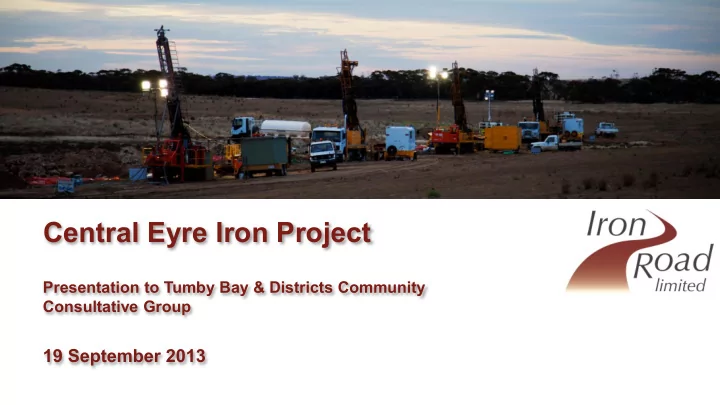
Central Eyre Iron Project Presentation to Tumby Bay & Districts - - PowerPoint PPT Presentation

central eyre iron project
SMART_READER_LITE
LIVE PREVIEW

Central Eyre Iron Project Presentation to Tumby Bay & Districts - - PowerPoint PPT Presentation

Central Eyre Iron Project Central Eyre Iron Project Presentation to Tumby Bay & Districts Community Consultative Group 19 September 2013 Notices Forward-Looking Statements This presentation contains forward looking statements concerning


slide-1
SLIDE 1

Central Eyre Iron Project

Central Eyre Iron Project

Presentation to Tumby Bay & Districts Community Consultative Group

19 September 2013

slide-2
SLIDE 2

Notices

Forward-Looking Statements This presentation contains forward looking statements concerning the projects owned by Iron Road Limited. Statements concerning mining reserves and resources may also be deemed to be forward looking statements in that they involve estimates based on specific assumptions. Forward-looking statements are not statements of historical fact and actual events and results may differ materially from those described in the forward looking statements as a result of a variety of risks, uncertainties and other factors. Forward looking statements are based on management’s beliefs, opinions and estimates as of the dates the forward looking statements are made and no obligation is assumed to update forward looking statements if these beliefs, opinions and estimates should change or to reflect other future developments. Data and amounts shown in this presentation relating to capital costs, operating costs and project timelines are internally generated best estimates only. All such information and data is currently under review as part of Iron Road Limited’s ongoing development and project studies. Accordingly, Iron Road Limited cannot guarantee the accuracy and/or completeness of the figures or data included in the presentation until the project studies are completed. Competent Person’s Statements The information in this report that relates to Exploration Results is based on and accurately reflects information compiled by Mr Larry Ingle, who is a fulltime employee of Iron Road Limited and a Member of the Australasian Institute of Mining and Metallurgy. Mr Ingle has sufficient experience relevant to the style of mineralisation and the type of deposits under consideration and to the activity which he is undertaking to qualify as a Competent Person as defined in the 2004 Edition of the “Australasian Code for Reporting of Exploration Results, Mineral Resources and Ore Reserves. Mr Ingle consents to the inclusion in the report of the matters based on his information in the form and context in which it appears. The information in this report that relates to Mineral Resources is based on and accurately reflects information compiled by Mr Iain Macfarlane and Mr Alex Virisheff, both of Coffey Mining Ltd, who are consultants and advisors to Iron Road Limited and Members of the Australasian Institute of Mining and Metallurgy. Mr Macfarlane and Mr Virisheff have sufficient experience relevant to the style of mineralisation and the type of deposits under consideration and to the activity which they are undertaking to qualify as Competent Persons as defined in the 2004 Edition of the “Australasian Code for Reporting of Exploration Results, Mineral Resources and Ore Reserves”. Mr Macfarlane and Mr Virisheff consent to the inclusion in the report of the matters based on their information in the form and context in which it appears. Exploration Targets It is common practice for a company to comment on and discuss its exploration in terms of target size and type. The information in this presentation relating to exploration targets should not be misunderstood or misconstrued as an estimate of Mineral Resources or Ore Reserves. Hence the terms Resource(s) or Reserve(s) have not been used in this context. Any potential quantity and grade is conceptual in nature, since there has been insufficient work completed to define them beyond exploration targets and that it is uncertain if further exploration will result in the determination of a Mineral Resource.

2

slide-3
SLIDE 3

Introductions

  • Larry Ingle, General Manager
  • Tim Scholz, Principal Advisor- Stakeholder

Engagement

  • Tilly Smart, Community Engagement Advisor
  • Laura Johnston, Regulation and Approvals Manager
  • Aaron Deans, Project Manager (Construction)
  • Steve Green, Environmental Manager
  • Alan Millett, Infrastructure Manager
  • Brad Hunter, Principal Civil/Rail Engineer

3

slide-4
SLIDE 4

Iron Road Limited

  • Listed on the Australian Securities Exchange

in 2008

  • Our vision is to become a trusted and reliable

supplier of premium iron concentrates

  • Two projects, Central Eyre Iron Project and

Gawler Iron Project

  • Adelaide head office

– Approximately 30 Iron Road staff and 40 local consultants – Consultants also working out of other

  • ffices in Adelaide, Melbourne, Perth and

Brisbane

4

slide-5
SLIDE 5

A Brief History of the Project

Deposit studied by the SA Department of Mines in the 1960’s

  • Iron Road acquired exploration licence in 2008
  • Commenced drilling shortly thereafter
  • The deposit has been the subject of two

prefeasibility studies: – 1960’s SA Department of Mines; and – 2011 Iron Road Limited

  • Infrastructure component recently declared a

Major Development by the South Australian government

5

slide-6
SLIDE 6

Central Eyre Iron Project

Large scale iron ore project near Warramboo

  • Second largest resources project in SA

history (after Olympic Dam)

  • Open pit mine
  • Processing plant
  • Waste rock and tailing storage
  • Power upgrade to the Eyre Peninsula

and project

  • Water treatment facilities
  • Offices and accommodation
  • Infrastructure corridor to link the mine

and port

  • Standard gauge railway line
  • Deep water port at Cape Hardy

6

Head Office Local Office

slide-7
SLIDE 7

Study Main Points of Difference

7

Prefeasibility Study Definitive Feasibility Production rate 12.4Mtpa 20Mtpa Concentrate transport Slurry pipeline Standard gauge railway Water Potable water used in process, desalination on the coast Potable water only used for final concentrate wash, desalination on site Port Third party facility Cape Hardy

slide-8
SLIDE 8

Mining

Large scale, conventional open pit mining – drill, blast, load and haul. Cat 797F 360t payload 54 units

8

slide-9
SLIDE 9

Processing Plant

Common process, established technology

  • On-site crushing, grinding

and magnetic separation

  • Ore treatment throughput

+100Mtpa

  • Concentrate production of

20Mtpa @ 67% iron and low impurities

Aerial view of the Karara Iron Project, Western Australia

9

slide-10
SLIDE 10

Mine Footprint

10

Correct at August 2013

slide-11
SLIDE 11

11

Mine Fly Through

slide-12
SLIDE 12

Rail and Utilities

  • Standard gauge rail, approximately 145

kilometres from mine to port

  • Infrastructure corridor for rail, water and

power

  • Potential to link rail into the wider

national network

  • Twin rotary car dumper – 660,000t

stockpile at port

  • Seawater pipeline from port, with

desalination unit on mine site

  • High voltage power upgrade

– to service entire district

12

slide-13
SLIDE 13

Infrastructure and Utilities Corridor

  • Rationale for the Corridor

– Minimise impact, one corridor only

  • Comprises rail, pipeline, power line,

service road, pump station

  • Best route possible avoiding remnant

native vegetation, towns and dwellings

  • Corridor quarantined during construction
  • Automated crossings, culverts for stock,

service road

  • Rail schedule- six return trips per day
  • Power line to site, reinforcement of EP

transmission network

  • Corridor fenced

13

slide-14
SLIDE 14

Why can’t you upgrade the existing rail corridor?

14

  • Design is significantly different to the

Genesee & Wyoming line, so much so, they are incompatible.

  • Construction period of 2 – 3 years will

shutdown the current rail operation.

  • Current rail system highly impacts

residents and towns.

  • Significant remnant vegetation in the

Genesee & Wyoming easement.

slide-15
SLIDE 15

Why doesn’t the company run the corridor through Hambidge conservation park & avoid productive farm land?

15

  • Prohibited under the Wilderness

Protection Act 1992 (SA)

  • Mallee Parks of Central Eyre

Peninsula Management Plan captures Hambidge and Hincks as Wilderness Protection Areas

  • Prohibits the construction of

private infrastructure

  • DEWNR strongly opposes the

construction of public infrastructure

slide-16
SLIDE 16

Corridor Construction

16

slide-17
SLIDE 17

Port Facility

  • Best suited locality on EP
  • Deep water
  • Required capacity
  • No other bulk commodity

port has committed to development

  • Necessary for each

proposal to seek approvals

  • No dredging

17

Correct at Sept 2013

slide-18
SLIDE 18

Port Facility

  • East coast of the Eyre Peninsula offers

sheltered, deep water locations

  • 1.6km modular jetty and wharf structure
  • 30Mtpa capacity at commissioning, 20Mtpa

required for CEIP

  • Handymax, Panamax and Capesize capable
  • Ship loader capacity of 7,300tph
  • Easy and cost effective expandability of wharf
  • First and only Capesize port in South Australia
  • Land parcel sufficient to cater for third party

access and facilities

Cape Hardy visualisation

18

slide-19
SLIDE 19

Port Fly Through

slide-20
SLIDE 20

Employment Opportunities

  • 1000+ during construction
  • 550 during operation

Mine

  • 600 during construction
  • 100 during operation

Port & Rail

  • 1600+ during construction
  • 650 during operation

Total Direct

  • Industry employment multiple of 4

Indirect

20

slide-21
SLIDE 21
  • Environment ↔ natural, social, cultural and economic
  • Comprehensive baseline
  • Listen to community, government and technical experts
  • Undertake impact and benefit assessments
  • Modify design for optimal outcome
  • Positive legacy

Environment

slide-22
SLIDE 22

Environment

Topics raised to date include:

  • Natural – noise, dust, visual, waste, flora, fauna, water
  • Social / Economic – employment, lifestyle, traffic, land values, human services, tourism
  • Cultural – Aboriginal sites of significance, shipwrecks, cemeteries

22

slide-23
SLIDE 23

Approval Processes & Timelines

Mining Act Development Act Environment Protection and Biodiversity Conservation Act

The major development assessment process

Stage 1 – Referral to the Development Assessment Commission Once a proposal has been declared a major development by the Minister, and a formal development application received, it is referred to the Development Assessment Commission (DAC) . The DAC will determine what level of assessment is required and issue formal guidelines. There are three possible levels of assessment:

  • 1. an environmental impact statement
  • 2. a public environmental report
  • 3. a development report.

Stage 2 – Detailed assessment documents released Once the necessary assessment document is completed by the proponent, the document is released for public or agency comment for three to six weeks. The document is made available at the relevant local council and on the listing of major developments proposals. Stage 3 – Responding to public comment After the public comment period, the proponent is required to respond to any public or agency comments. This completed response document is released for public information and is made available at the relevant local council and on the listing of major developments proposals. Stage 4 – Assessing the proposal The Minister will consider the proposal and detail in an assessment report. The completed report is made available at the relevant local council and the listing of major developments proposals. Stage 5 – Decision The Governor will make a decision on the final proposal having regard to the assessment report and other documentation. This will be notified:

in the Government Gazette

by listing on this site under current major developments proposals

to the local media.

It is involved…

23

slide-24
SLIDE 24

Simplified Timeline

Company Study Submit studies Respond If approved, decide to proceed Construct Operate Close Relinquish

Estimated dates 2010 - 2013 Mid 2014 End 2014 2015 2015-2018 2018-??? ~5 years Criteria Compliance

24

slide-25
SLIDE 25

Seek community response

Simplified Process

Company Study Submit studies Respond If approved, decide to proceed Construct Operate Close Relinquish

Assessment Government decision on Project

Government

Decide assessment path (DA) Publish guidelines - infrastructure

Ongoing / Annual Regulation Mine - assess achievement of closure criteria Community

Stakeholder meetings including CCC Ongoing stakeholder engagement – performance, final land uses, opportunities Review Govt published Guidelines Review Study Findings Comment to Government

25

slide-26
SLIDE 26

Bulk Materials

Course tailings – gravel Fine tailings – silt like Product – magnetite concentrate

26

slide-27
SLIDE 27

Bulk Materials

Course tailings – gravel, sand Fine tailings – silt like Product – magnetite concentrate

27

slide-28
SLIDE 28

Dust limits

slide-29
SLIDE 29

Mine

  • Model established
  • Finalising key data inputs
  • Awaiting mine plan – November
slide-30
SLIDE 30

Port - Benchmark

  • Coal example
  • Twice as light as iron concentrate (SG 1.2 v 3.7)
  • Ten times moisture content required to eliminate

dust (DEM 8% v 0.6%)

  • 14 stockpiles

Aspect Coal (Hay Point Area) Iron (Cape Hardy) Comment

Stockpiles 14 1 Much smaller scale Length Short 600m long 1.3km ~1000m Mid-size Density Light (SG 1.17) Heavy (SG 3.68) Much heavier → less potential for dust % moisture to eliminate dust (DEM) 8% 0.6% (product is 8%) Minimal water to keep dust down Reclaimer height Elevated Ground level Lower height → less wind → less potential for dust

30

slide-31
SLIDE 31

Bucket wheel reclaimers

slide-32
SLIDE 32

Benchmark

slide-33
SLIDE 33

Benchmark

slide-34
SLIDE 34

Mitigation options

34

Mine

  • Waste rock locations
  • Road quality and maintenance
  • Mist sprays
  • Enclosed wagon loading and transfer points
  • Stockpile veneering
  • Predictive weather modelling

Corridor – train wagons

  • Veneering

Port

  • Veneering
  • Enclosed wagon unloading and transfer

points

  • Mist sprays
  • Water cannons
  • Wind barriers – earth, vegetation, fencing
  • Predictive weather modelling
slide-35
SLIDE 35

Flora and Fauna

Overview

  • Vegetation largely cleared for agriculture
  • Remnant vegetation in conservation areas, dune crests

and road / rail corridors

  • Full flora and fauna survey at mine and port completed
  • Desktop fauna and 90% field vegetation assessment at

Infrastructure Corridor

  • Numerous agricultural weeds and feral fauna
  • No EPBC listed vegetation communities
  • One EPBC listed vegetation species
  • Considering migratory birds and marine mammals for

Port Impact Mitigation

  • SEB offsets, revegetation of buffers/linkage
  • Construction EMP
  • Management of weeds, particularly WoNs and declared
  • Management of feral fauna

*Remnant vegetation on dune crest

slide-36
SLIDE 36

Vegetation Offsets

Overall Aim

  • Leave the region in a measurably improved

ecological state in terms of an increase in biodiversity values and ecological connectivity. SEB Priorities

  • Protect and improve existing remnant vegetation

(e.g. Heritage Agreements)

  • Implement ongoing monitoring programs
  • Revegetate strategically to improve habitat quality

and connectivity

  • Integrate with existing regional and local

conservation initiatives

Ongoing Active Management Rehabilitation and revegetation programs across project area to improve connectivity Re-vegetation programs at mine site Protect, rehabilitate and expand patches of existing native vegetation in region

36

slide-37
SLIDE 37

Investigations to date-

  • Nine investigation wells drilled
  • Groundwater salinity ranges from 20,000

ppm to 150,000 ppm – 2/3 to 5 times as salty as seawater

  • Water table is at 2-3m depth in low-lying

areas and 10 to 30m below ground surface

  • n the higher ground
  • Bore yields are low, <0.5l/s.

Groundwater

37

slide-38
SLIDE 38

Distance to Fresh Groundwater

38

slide-39
SLIDE 39

Impacts from mining operations-

  • Mine dewatering: will reduce the level of the local saline water table. Drawdown will be greatest close to

the mine and diminish quickly with distance. Preliminary estimates are a maximum radius of about 6km.

  • Potable groundwater. The nearest source of fresh groundwater is the Polda Lens in the Musgrave

Prescribed Wells Area. This lens is 25 kilometres from the mine, not connected and too far away to be impacted by mining.

  • Soil Moisture: Groundwater is saline. Areas where soil moisture is supported by groundwater are low

lying salinized areas where the water table is close to the surface. Soils suitable for cropping are not supported by saline groundwater. Dewatering will not impact on the moisture content of these soils used for cropping.

Groundwater

39

slide-40
SLIDE 40

Further Work

  • Drilling, construction and pumping tests of 10

investigation bores in and around the mine site.

  • Objective is to obtain more information regarding,

groundwater salinity, groundwater yield and aquifer properties.

  • Data will be used to support detailed groundwater

modelling of the mine site.

Groundwater

40

slide-41
SLIDE 41

Community Engagement Update

Port

  • Public Information Sessions at Port Neill and

Tumby Bay March 2013

  • Port Neill Reference Group
  • Tumby Bay and Districts Community Consultative

Group Utilities & Infrastructure Corridor

  • We have met with most impacted landowners
  • Cleve Drop in Session – Friday 20th Sept
  • Ongoing Landowner discussions

Mine

  • Community Project Updates – Warramboo and

Wudinna

  • Community Consultative Committee (CCC)

41

slide-42
SLIDE 42

Keeping the Community Informed

  • Community Information Sessions
  • Dedicated community team
  • Involved in local events
  • Presentations to community groups, councils and

government agencies

  • Regular updates in the Granite
  • Work with the CCC to further

improve project communications

42

slide-43
SLIDE 43

Community Involvement

  • Tumby Bay & Districts Community Consultative Group
  • Proposed Mine at Warramboo- Community Consultative

Committee

  • Port Neill Community Reference Group

Iron Road working with community representative groups

  • Voice of the community
  • Conduit for information
  • Improve decision making
  • Keep informed on Community

expectations

  • Achieve the best outcomes possible

43

slide-44
SLIDE 44

Next Steps Complete supporting studies Community Consultative Committee’s / Reference Groups Government submissions and applications We will continue to keep communities informed and involved

44

slide-45
SLIDE 45

Thank you for your time Questions

Feel free to ask questions now or later in the evening. You may also contact Iron Road or the Tumby Bay & Districts Community Consultative Group Email: community@ironroadlimited.com.au 1800 176 008 (toll free) Alerts- www.ironroadlimited.com.au

45